
Why Are School Buses Yellow? Science, History, and Global Standards Explained
Have you ever looked at morning traffic and wondered, why are school buses yellow instead of red, white, or blue? The answer combines visibility, human vision, safety standards, and history. School buses carry millions of children, so making them easy to recognize is an important safety measure.
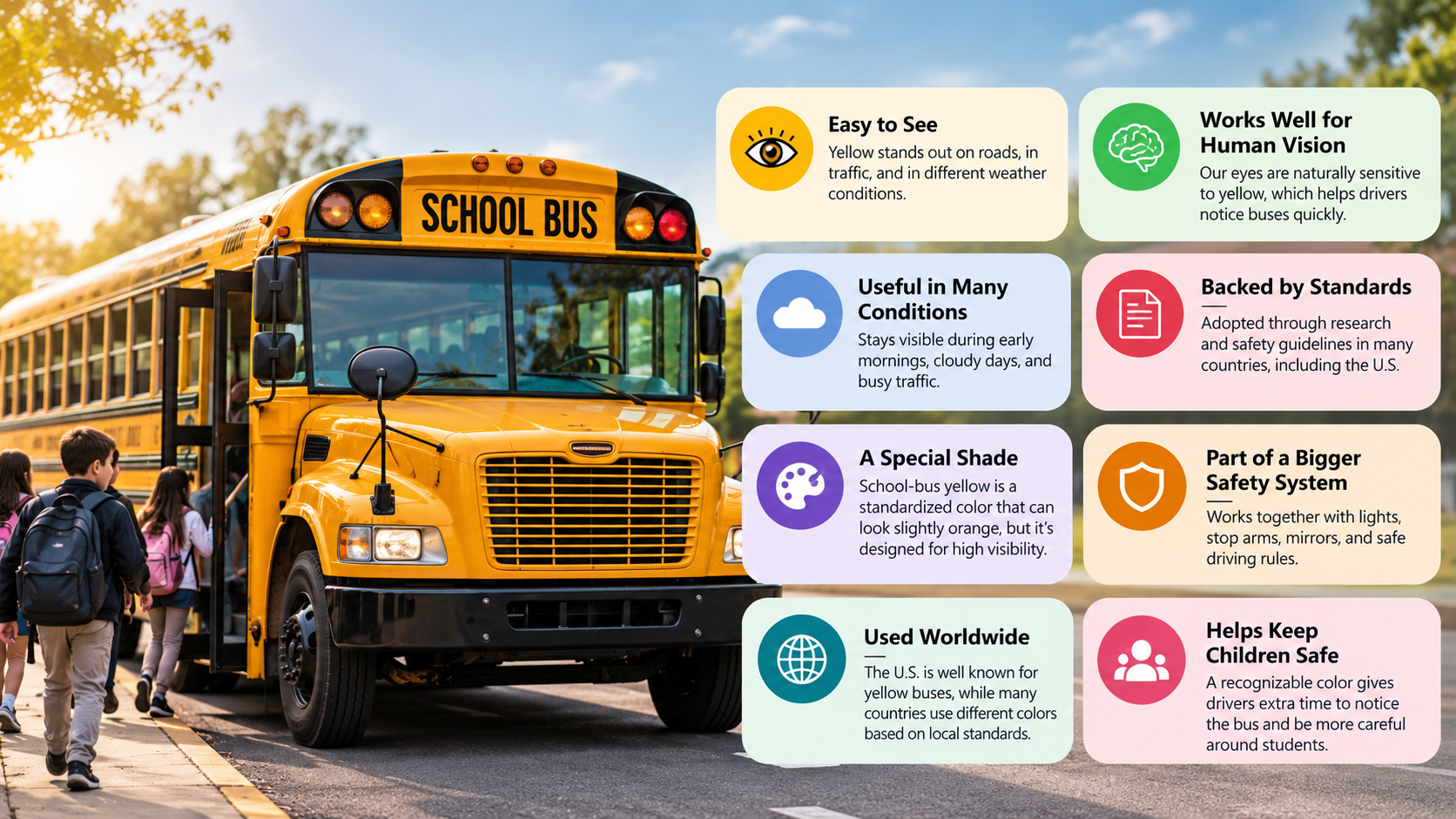
Yellow stands out strongly against many common road backgrounds. Drivers can notice a yellow bus from a distance, including during early mornings, cloudy weather, and busy traffic. Its high visibility is especially useful when children are boarding or leaving the vehicle.
Color selection is therefore more than a design preference. Researchers and transportation officials considered how people perceive colors and how different shades appear in varying conditions. The familiar yellow shade became closely associated with school transportation in the United States and several other countries. The National Highway Traffic Safety Administration also provides information about school-bus safety and precautions around these vehicles.
In this guide, we explain the science behind yellow school buses, their historical development, and related safety standards. We also examine whether school-bus yellow is actually orange, what the color means, and how school buses differ across India, Europe, and Japan.

The Science Behind the Yellow School Bus
The yellow color of school buses is closely linked to visibility and human vision. Bright yellow creates strong contrast against many common backgrounds, including roads, trees, buildings, and cloudy skies. This focus on visibility also connects with discussions about why STEM education is important in schools today and how science can shape practical safety decisions.
Why Visibility Matters for School Buses
Transportation officials considered how quickly drivers could recognize a distinctive vehicle color. A standardized appearance makes school buses easier to identify, especially when they approach stops where children may be present.
However, color represents only one part of school-bus safety. Warning lights, stop arms, reflective markings, mirrors, and safe driving practices also help protect students. These broader considerations connect with 10 things schools need to get right for modern student success, including systems that support students beyond classroom learning.
Understanding these factors explains why yellow became more than a familiar design choice. It developed into a recognizable safety feature that helps distinguish school buses from ordinary vehicles.
The following sections explore the science, history, and international differences behind this distinctive color.
Why yellow color to school bus class 10th answer?
The common Class 10 science explanation focuses on visibility and light scattering. Yellow has a shorter wavelength than red but is highly visible to human vision. Human eyes are particularly sensitive to yellow-green portions of the visible spectrum, which helps bright yellow objects attract attention.
However, the explanation that yellow simply travels through fog better than every other color is an oversimplification. Atmospheric scattering depends on conditions such as particle size, moisture, and distance. Red has a longer wavelength and also performs well in many visibility situations.
The main safety advantage comes from the combination of high contrast, brightness, and human visual sensitivity. A bright yellow bus can stand out against dark roads, vegetation, buildings, and many weather backgrounds. Its distinctive appearance also helps drivers recognize it quickly as a school vehicle.
For a Class 10 answer, you can state that yellow was selected because it is highly noticeable and provides strong visual contrast in traffic.
Rayleigh Scattering and Lateral Vision
Rayleigh scattering explains why shorter wavelengths, such as blue and violet, scatter more strongly in the atmosphere than longer wavelengths. This principle helps explain why distant objects can appear less distinct under certain atmospheric conditions.
Yellow sits between the shorter blue wavelengths and longer red wavelengths. However, its selection for school buses cannot be explained by Rayleigh scattering alone. Human visual sensitivity and contrast are equally important factors.
The human eye responds strongly to yellow-green light because of the sensitivity of the cone cells involved in daytime vision. Bright yellow can therefore attract attention effectively, including when an object appears outside the center of a person’s vision.
This matters for school buses because drivers may notice them from an angle before looking directly at them. A distinctive color also separates the bus from ordinary passenger vehicles.
Poor weather can still reduce visibility, regardless of color. Yellow does not make a bus immune to fog, rain, darkness, or glare. Instead, its bright color works as one part of a broader school-bus safety system that also includes lights, signs, mirrors, and reflective materials.
Is school bus yellow actually orange?
The familiar American school-bus color is not simply the same yellow used on household objects or road signs. It is a specific standardized shade commonly known as National School Bus Glossy Yellow. To the human eye, the color can appear slightly warm or orange compared with a pure, bright yellow.
Authorities selected the shade because it provides strong visibility and contrast. A school bus needs to remain recognizable against many backgrounds, including roads, buildings, trees, and changing weather conditions.
The color also became an important visual identifier. Drivers can recognize a school bus quickly because the distinctive yellow exterior works together with its large size, markings, warning lights, and stop arm.
Therefore, calling a school bus “orange” is not technically accurate in the United States. It is better described as standardized school-bus yellow with a warm appearance.
The exact appearance can vary slightly because of lighting, paint condition, photography, and manufacturing. Sunlight can make the color appear brighter, while shadows can make it look darker or more orange.
The Standard Federal Specification 595a
The standardization of school-bus color is closely connected to the work of Dr. Frank W. Cyr, an education professor who helped establish national school-bus standards in the United States. In 1939, a national conference helped create greater uniformity in school-bus design and color.
The familiar shade became known as National School Bus Glossy Yellow. It was chosen because students could be transported in vehicles that were easier for other road users to identify.
The original reference to Federal Standard 595 in discussions about the color can create confusion. Federal Standard 595 was a broader U.S. government color-reference system, while modern school-bus requirements use specific standards and specifications for the school-bus yellow finish.
The important point is that the color is standardized rather than randomly selected by individual schools. Consistency helps drivers recognize school buses quickly.
This standardization also contributed to the yellow school bus becoming a recognizable part of American transportation. The color has remained strongly associated with school travel for generations.
What does yellow mean on a school bus?
Yellow on a school bus primarily serves as a high-visibility identification color. It helps drivers recognize the vehicle as a school bus and signals that children may be nearby.
The color itself does not automatically create a legal requirement to stop. Instead, school-bus warning systems communicate what drivers should do. In the United States, buses commonly use flashing amber warning lights before stopping and flashing red lights when children are loading or unloading.
When the red warning system activates, drivers may be legally required to stop depending on the road layout and local traffic laws. A deployed stop arm provides another highly visible warning.
The combination of color, warning lights, stop arms, reflective markings, and mirrors creates a broader school-bus safety system. These features help drivers recognize potential child-loading zones and react appropriately. Schools need similarly coordinated systems to support students, which is explored in 10 things schools need to get right for modern student success.
The yellow exterior therefore has an important practical purpose. It makes the bus easy to identify before drivers even see its warning lights.
Amber Warning Lights and Traffic Laws
School buses commonly use amber warning lights to alert drivers that the bus is preparing to stop for students. These lights provide an early warning and give approaching motorists time to slow down.
The exact activation distance and traffic requirements can vary by jurisdiction, so drivers should not treat a universal distance such as 100 or 300 feet as a worldwide rule. Local laws determine when warning lights activate and what other drivers must do.
After the bus stops, red warning lights typically indicate that students are boarding or leaving the vehicle. Many buses also extend a stop arm with flashing lights to make the instruction more obvious.
Drivers should never assume that they can pass simply because the road appears clear. Children may cross the road unexpectedly or remain hidden by the bus itself.
The important distinction is simple: amber lights generally provide a warning that a stop is approaching, while red lights and the stop arm communicate the active student-loading safety procedure.
Why are Europeans obsessed with yellow school buses?
The idea that Europeans are “obsessed” with yellow school buses is better understood as fascination with an American cultural symbol. American school buses have appeared extensively in Hollywood films, television shows, music videos, and children’s entertainment.
For many international viewers, the large yellow bus represents an instantly recognizable image of American school life. European visitors may therefore find real American school buses interesting because they resemble vehicles seen in popular culture.
School transportation looks different across Europe. Many students use public buses, trains, bicycles, walking routes, or other forms of organized transportation. Dedicated school buses exist in some European locations, but their designs and colors vary by country and region.
The American model is particularly distinctive because of its standardized appearance. The combination of bright yellow paint, large bodywork, warning lights, and traditional design makes it visually different from ordinary city buses.
As a result, photographs of American school buses can feel like a direct connection to familiar movie imagery. The fascination is mainly cultural rather than evidence that Europeans universally prefer yellow school buses.
Cinematic Tropes Versus European Public Transit
American school buses have become powerful cinematic symbols. Movies and television programs often use them to establish a school setting immediately. Their recognizable shape and bright yellow exterior make them visually useful on screen.
European school transportation does not follow one single model. Different countries use different combinations of public transportation, dedicated school services, bicycles, walking routes, and private transport.
Urban planning also influences how children travel. Dense cities with extensive public transportation can make regular buses and trains practical for students. Smaller communities may use dedicated school vehicles instead.
This difference helps explain why the traditional American school bus can appear unusual to European visitors. In the United States, the vehicle became closely connected with the daily school experience. In Europe, transportation arrangements often vary more significantly between regions.
Popular culture has strengthened this contrast. International audiences repeatedly see yellow American school buses in fictional stories, even when they rarely encounter the same vehicles in their own countries.
The result is a familiar image that represents American childhood and school culture far beyond the United States.
What color are school buses in India?
In India, school-transport regulations generally require buses to have a yellow exterior. The familiar yellow appearance makes these vehicles easier to identify in India’s busy traffic conditions.
School buses also carry clear markings that identify their purpose. Common requirements include displaying “School Bus” prominently and following additional safety measures for student transportation. Vehicles operating on school duty can have specific identification requirements under applicable local rules.
Indian school-bus safety standards can include features such as speed governors, emergency exits, fire extinguishers, first-aid equipment, and window protection. Requirements can vary according to the applicable central and state regulations.
The yellow color is therefore only one part of the safety framework. Vehicle condition, driver qualifications, speed control, emergency equipment, seating arrangements, and supervision also matter. These factors are part of the wider set of considerations involved in how to choose the right school for your child, where safety and the overall school environment can influence the decision.
Private vehicles used for transporting students may have different identification requirements depending on their classification and local rules. Schools and operators must follow the regulations applicable to their vehicles.
For readers asking why school buses are yellow in India, the simple answer is that the standardized high-visibility color helps distinguish student-transport vehicles from ordinary traffic.
Does Japan have school buses?
Japan does have school buses, but their use differs from the traditional American model. Many Japanese children, especially those living close to school, walk to school. In many communities, children travel together along established routes.
This arrangement reflects Japan’s emphasis on community participation and children’s independence. Walking also provides regular physical activity and reduces the need for large numbers of dedicated school vehicles in densely populated areas.
However, school buses are still used where they are practical or necessary. Rural communities can operate buses or minibuses when schools are far from students’ homes. Private kindergartens and preschools also commonly use smaller shuttle buses.
Japanese kindergarten buses can look very different from American school buses. Some have colorful designs featuring animals, characters, trains, or other child-friendly themes. These designs make the vehicles attractive to young children.
Therefore, Japan does not lack school transportation. Instead, its system reflects local geography, school location, community design, and student travel habits. The American-style large yellow school bus is simply not the universal model. These differences are part of the broader classroom difference based on countries and global school styles.
The contrast shows that school-bus design depends heavily on a country’s transportation system and the needs of its communities.
Frequently Asked Questions
When was the yellow school bus first invented?
The modern yellow school bus became standardized in the United States in 1939, when Dr. Frank Cyr organized a national conference at Columbia University to establish consistent school transportation standards. One major outcome was the adoption of a distinctive yellow-orange color, commonly called National School Bus Chrome, because it provided strong visibility for students, drivers, and other road users. Before this standardization, school vehicles often had different colors and designs, making them less recognizable and consistent. This history helps explain why are school buses yellow today.
Why are school buses not painted red like fire engines?
One important reason why are school buses yellow is that yellow is highly noticeable in traffic, particularly through peripheral vision. Research associated with school-bus visibility found that yellow could be detected more quickly than red from the side. Unlike fire engines, which use red to communicate emergency status, school buses need a color that makes them easily recognizable during ordinary traffic conditions. The distinctive yellow appearance therefore helps drivers identify school buses and recognize that children may be entering or leaving the vehicle.
Do private schools have to use yellow buses?
Whether private schools must use yellow school buses depends on state, local, and transportation regulations. In the United States, school-bus requirements can vary based on the vehicle’s design, intended use, passenger capacity, and applicable laws. Some private schools operate vehicles that meet school-bus standards, while others use passenger vans or commercial coaches under different regulations. Therefore, why are school buses yellow does not automatically mean every vehicle transporting private-school students must be yellow.
Can personal vehicles be painted school bus yellow?
Local motor-vehicle regulations may restrict painting a personal vehicle school-bus yellow, particularly when the vehicle also has equipment associated with official school buses. These rules help authorities distinguish vehicles that carry students because the distinctive color, flashing lights, stop arms, and other markings signal a school bus. If someone converts a retired school bus for private use, registration authorities may require the owner to change its markings or remove certain equipment. This is another practical consideration when understanding why are school buses yellow and why some jurisdictions regulate their appearance.
Conclusion
Understanding why are school buses yellow shows how visibility and safety influence everyday transportation. The distinctive yellow color makes school buses easier to recognize in traffic and helps drivers notice them quickly, especially during busy routes. Learning why are school buses yellow also highlights the importance of standardized safety practices. Although transportation systems differ worldwide, the familiar yellow bus remains strongly associated with student safety, visibility, and responsible driving.