
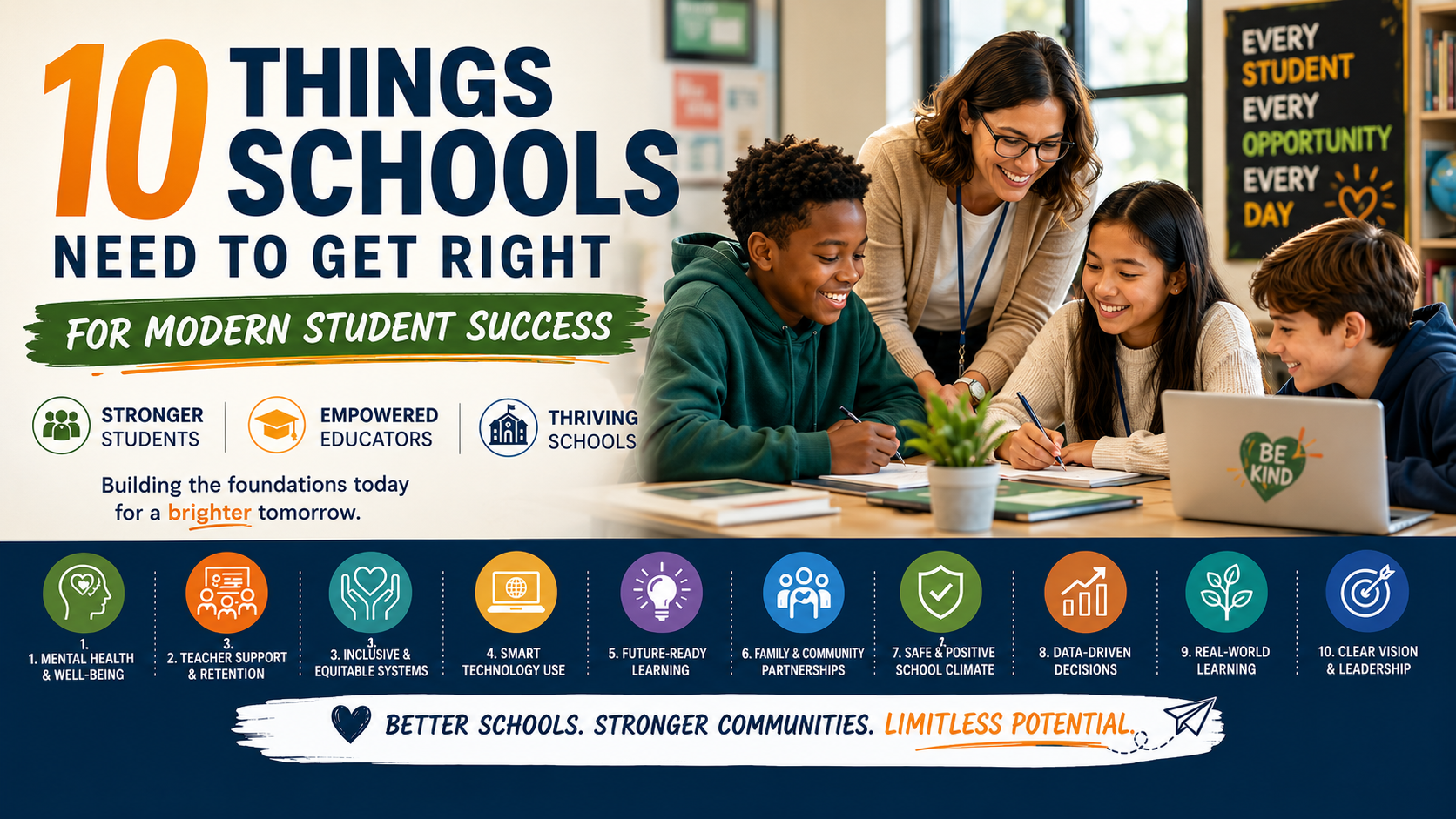
10 Things Schools Need to Get Right for Modern Student Success
Education is changing faster than ever before. To prepare students for a rapidly evolving world, traditional teaching models are no longer enough. Educators must adapt to new cultural shifts, technological breakthroughs, and psychological insights. Understanding the 10 things schools need to get right helps communities build classrooms where children truly thrive. According to the U.S. Department of Education, modern educational institutions must focus heavily on equity, evidence-based practices, and holistic student support to close achievement gaps. When districts prioritize these core foundations, academic performance rises naturally across all demographics.
Modern schools face distinct, unprecedented pressures, from managing digital distractions to addressing mental health crises. Consequently, leadership teams cannot afford to guess which strategies work. They need a proven, actionable roadmap to guide their investments. This comprehensive guide breaks down the essential pillars of modern schooling, offering practical insights into curriculum design, teacher support, and community engagement. By examining these core components deeply, educational leaders can systematically transform their campuses into centers of innovation, safety, and academic excellence that prepare kids for the future.
The Core Foundations: 10 Things Schools Need to Get Right
1. Prioritizing Mental Health and Well-being
Academic achievement is completely impossible if students are anxious, stressed, or emotionally overwhelmed. Therefore, modern education systems must integrate robust mental health resources directly into the daily school routine. This means hiring qualified counselors, creating quiet decompression spaces, and teaching emotional regulation skills. When children feel safe and supported, their capacity to learn expands significantly.
Schools that treat emotional well-being as an afterthought consistently see lower test scores and higher disciplinary rates. Conversely, proactive institutions teach social-emotional learning alongside traditional subjects. This holistic strategy equips children with the resilience required to navigate life’s challenges. By investing in mental health infrastructure, districts create a foundation where academic success can naturally grow and endure for all students.
2. Investing in Teacher Support and Educator Retention
Teachers are the heartbeat of any educational institution. However, burnout rates are reaching historic highs across the globe due to expanding responsibilities and lack of respect. Districts must focus on the essential pillars of campus improvement by offering competitive salaries, meaningful professional development, and realistic workloads. When administrators value educators, classroom instruction improves automatically, reducing costly turnover that disrupts the learning environment.
Furthermore, supportive school leadership protects teachers from administrative bloat and unrealistic societal expectations. Providing mentors for new teachers and establishing clear boundaries for parental communication are practical ways to reduce stress. When teachers feel heard, respected, and properly compensated, they pour more passion into their daily lessons. Ultimately, supporting teachers is the most direct way to support students.
3. Creating Inclusive and Equitable Learning Environments
Every child deserves an equal opportunity to succeed, regardless of their background, socioeconomic status, or learning differences. True equity requires schools to audit their systemic practices continuously rather than just checking boxes. This involves providing specialized assistive technologies, diversifying the curriculum, and eliminating biased disciplinary policies that disproportionately affect minority students. Inclusion ensures that no student feels invisible or left behind.
Achieving this requires a conscious shift from equality, which gives everyone the same thing, to equity, which gives everyone what they need. For example, providing extra tutoring resources to struggling readers or offering advanced tracks for gifted students ensures individual growth. When a campus culture celebrates diversity and actively tears down learning barriers, every student feels a profound sense of belonging.
4. Integrating Technology Intelligently into the Classroom
Technology should enhance learning, not act as a mere gimmick or distraction. Schools frequently make the mistake of buying expensive tablets without training teachers how to use them effectively. Successful districts focus on digital literacy, cybersecurity safety, and blended learning models. They use software to personalize instruction while keeping human connection at the center of the classroom.
Smart technology integration means utilizing tools that encourage creation rather than passive consumption. Students should learn how to code, build digital portfolios, and critically evaluate online information. Moreover, schools must ensure that digital tools do not worsen the digital divide by providing internet access to low-income families. When implemented thoughtfully, technology becomes a powerful equalizer that prepares children for a digital economy.
5. Blending Foundational Skills with Future-Ready Competencies
Rote memorization is no longer valuable in the age of instant internet information and generative artificial intelligence. Instead, classrooms must balance core academic subjects with critical thinking, creativity, and media literacy. Students need to learn how to analyze sources, solve complex problems, and collaborate across diverse teams. These skills prepare them for jobs that do not even exist yet.
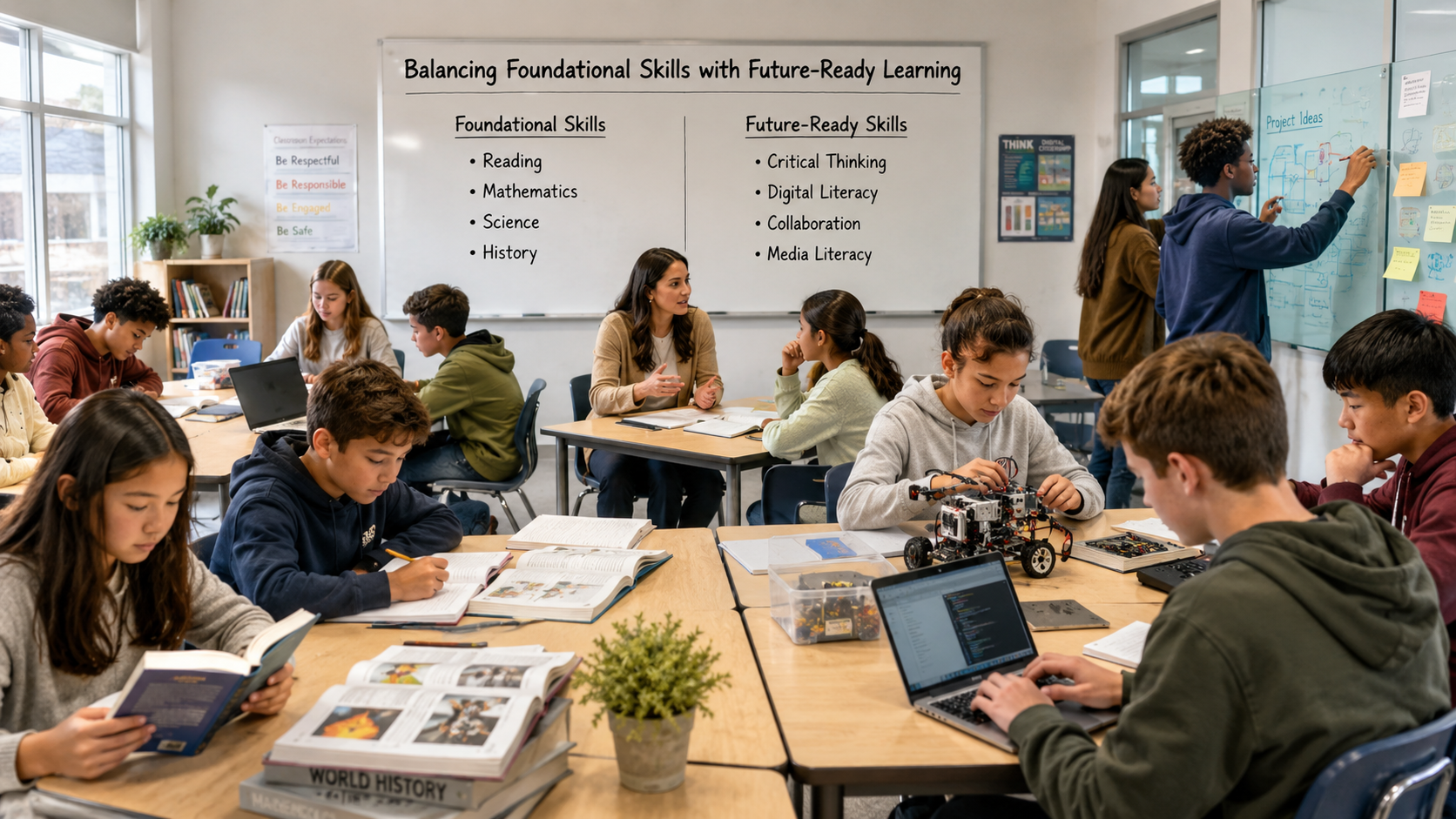

Therefore, the curriculum must evolve from answering questions to asking the right questions. Project-based learning environments allow students to apply historical facts or mathematical principles to real-world scenarios. This pedagogical shift transforms passive listeners into active, self-directed learners who view education as an ongoing journey rather than a series of tests to pass.
6. Strengthening Community and Parental Partnerships
Education does not stop when the final school bell rings at the end of the afternoon. Schools achieve the best outcomes when they build strong bridges with families and local organizations. Transparent communication, regular town halls, and welcoming volunteer programs keep parents engaged. A unified community creates a powerful safety net for struggling students and builds long-term institutional trust.
When schools isolate themselves from the surrounding neighborhood, they miss out on valuable external resources. Partnering with local businesses can secure sponsorships, mentorship programs, and internship opportunities for older students. Likewise, involving parents in decision-making processes creates a shared responsibility for student outcomes. When the community and school speak with one voice, students thrive both academically and socially.
7. Designing Functional, Inspiring Physical Spaces
The physical layout of a classroom heavily dictates how students learn and interact with each other. Dark, rigid rows of heavy desks stifle collaboration and cause physical fatigue over long hours. Conversely, modern classrooms require flexible furniture, natural lighting, and dynamic collaborative zones that can be reconfigured in seconds. Well-designed environments stimulate curiosity and keep student energy levels high.
Ergonomic spaces also reduce behavior problems by giving hyperactive children options to stand or move safely. Furthermore, school design should incorporate outdoor learning spaces, green environments, and quiet zones for independent study. When an architectural environment feels welcoming and professional, students treat their campus with greater respect. Investing in physical infrastructure is a direct investment in the daily mental focus of students.
8. Reforming Assessment Methods and Grading Systems
Traditional high-stakes testing often measures a student’s temporary memory rather than their actual, long-term understanding. To fix this structural flaw, institutions must shift toward formative assessments and portfolio-based grading systems. This modern approach allows students to demonstrate mastery in diverse ways over an extended timeframe. Consequently, it reduces test anxiety and fosters a genuine love for learning.
Reformed grading focuses on growth rather than penalizing initial failure. If a student fails a quiz but masters the concept two weeks later, their grade should reflect that ultimate mastery. This builds a growth mindset, teaching children that failure is simply a stepping stone toward improvement. When grades become tools for learning rather than labels of intelligence, student engagement skyrockets.
9. Providing Robust Career and Technical Education Pathways
Not every student wants or needs to attend a traditional four-year university immediately after graduation. Schools must destigmatize vocational training by offering robust career and technical education (CTE) programs. Partnering with local trades, coding bootcamps, and businesses allows students to graduate with marketable certifications and clear, high-paying career pathways.
Modern CTE programs are not dumping grounds for struggling students; they are highly technical tracks involving robotics, healthcare, and advanced manufacturing. By providing these options, schools cater to different talents and intelligences. Students gain practical, hands-on experience that makes their high school diploma immediately valuable in the local job market, reducing youth unemployment and student debt.
10. Cultivating Strong, Empathetic District Leadership
Principal and administrative leadership sets the definitive tone for the entire campus culture. Toxic, bureaucratic, or disorganized management drives away great teaching talent and demoralizes the student body. Successful schools are led by empathetic, visionary administrators who listen to feedback from teachers, students, and parents. These leaders protect their staff, inspire their students, and drive continuous improvement.
Great leaders do not sit behind a desk all day; they are visible in the hallways, classrooms, and community events. They establish a clear vision, allocate resources efficiently, and handle conflicts with grace. When an administrator builds a culture of trust and shared leadership, teachers feel empowered to innovate. This strong, positive leadership trickles down, creating an exceptional school environment.
Action Plan: Mastering the 10 Things Schools Need to Get Right
Implementing Systematic Educational Reform
To truly modernize an academic ecosystem, administrators cannot simply pick and choose their favorite priorities from the list. They must understand that the 10 things schools need to get right function together as an interdependent puzzle. For example, integrating technology intelligently requires well-supported teachers who have the professional training to use digital platforms effectively. Similarly, designing inspiring physical spaces directly benefits student mental health, showing that structural changes impact emotional outcomes.
Districts should start by conducting a comprehensive audit to see where they currently stand on these ten pillars. By gathering transparent feedback from parents, staff, and students, leadership teams can identify their biggest institutional vulnerabilities. Upgrading a school system requires time, financial investment, and clear communication, but the cultural rewards are profound. When an entire community aligns behind the 10 things schools need to get right, classrooms transform from outdated test centers into dynamic, thriving environments where every child can discover their unique potential.
FAQ SECTION
What is the most critical factor among the 10 things schools need to get right?
While all ten factors are deeply interconnected, prioritizing teacher support and retention is arguably the most critical foundation for long-term success. Without highly motivated, well-trained, and emotionally supported educators, implementing any other strategy becomes utterly impossible. Teachers directly deliver the curriculum, manage complex classroom dynamics, and spot student distress on the front lines every day. Therefore, investing in your teaching staff yields the highest return on investment for student outcomes. When administrators take care of their teachers, the teachers can properly take care of their classrooms. Schools can have the newest technology and the most beautiful buildings, but without excellent, inspired educators, true learning will grind to a halt. Protecting teachers protects the future of education.
How can older campuses update their learning environments on a limited budget?
Updating physical spaces does not require a multi-million-dollar structural renovation project. Schools can make massive, immediate improvements by applying fresh, bright paint and maximizing natural sunlight by clearing heavy window obstructions. Teachers can swap traditional rows for flexible seating arrangements using affordable cushions, area rugs, or modified existing furniture. Creating dedicated collaborative zones using existing tables also fosters better teamwork without extra costs. Simple, creative design choices immediately boost student engagement and improve classroom energy without breaking the district bank. Additionally, involving students in painting murals or organizing clean-up days builds pride in the physical environment. A small budget can yield incredible results when mixed with creativity, collaborative effort, and smart spatial organization.
Why should educational systems shift away from traditional high-stakes testing models?
Traditional high-stakes testing often creates immense, unhealthy anxiety while failing to measure deep conceptual understanding or critical thinking. These rigid exams typically incentivize rote memorization and teaching to the test rather than authentic, lifelong learning. By shifting toward formative assessments, project-based portfolios, and real-world presentations, educators gain a much clearer view of a child’s true capabilities and intellectual growth. This holistic approach accommodates different learning styles, encourages creative problem-solving, and builds practical skills that students will actually use in their future careers. High-stakes tests only capture a snapshot of a student on a specific day under high stress, whereas continuous, diverse assessments reflect true knowledge mastery and promote a healthier psychological relationship with education.
How does strong parental engagement directly impact student academic performance?
When parents actively participate in the educational journey, students achieve significantly higher grades, exhibit better behavior, and attend school more regularly. Parental engagement bridges the gap between home and the classroom, creating a consistent, supportive environment for the child. Schools can cultivate this essential partnership by offering flexible meeting times, transparent digital grade books, and clear, welcoming communication channels. A unified support system ensures that learning challenges or behavioral shifts are identified and addressed quickly by both parties before they snowball into major crises. When a child sees their parents and teachers working together respectfully, they understand that education is valued and important, which deeply motivates them to put forth their best effort every single day.
What role does vocational training play in a modern school curriculum?
Vocational training and career technical education provide essential, high-value pathways for diverse student populations with varying goals. Modern economies require highly skilled technicians, programmers, healthcare workers, and tradespeople who do not necessarily need a traditional university degree. By offering robust CTE courses, schools validate alternative paths to financial stability and professional success, breaking the outdated college-for-all stigma. These programs keep at-risk students engaged by offering hands-on, practical learning experiences that feel relevant to the real world. Ultimately, graduation rates improve significantly when students see a direct, clear connection between their daily coursework and a future career. Vocational training ensures that schools serve all segments of the student population equally well, fueling the local economy with capable workers.
CONCLUSION
Transforming an educational institution requires deliberate, sustained effort across multiple interconnected areas. From protecting teacher well-being to modernizing grading systems, the 10 things schools need to get right serve as a holistic, necessary framework for meaningful growth. True progress happens when school boards, administrators, teachers, and parents work toward these shared goals in unison rather than pulling in opposite directions.
Education should never stand completely still or rely on outdated methods simply out of tradition. As technology develops and workforce demands shift rapidly, our classrooms must evolve in parallel to serve the next generation effectively. By focusing on empathy, equity, and evidence-based strategies, schools can successfully navigate these complex modern changes. Preparing students during their formative years also helps them long after graduation when they are choosing the right college major or entering the workforce. Ultimately, creating a supportive, well-rounded environment allows every single student to fulfill their true potential and graduate ready to change the world.