
What Is Ray Tracing & What Does It Do? Complete Guide
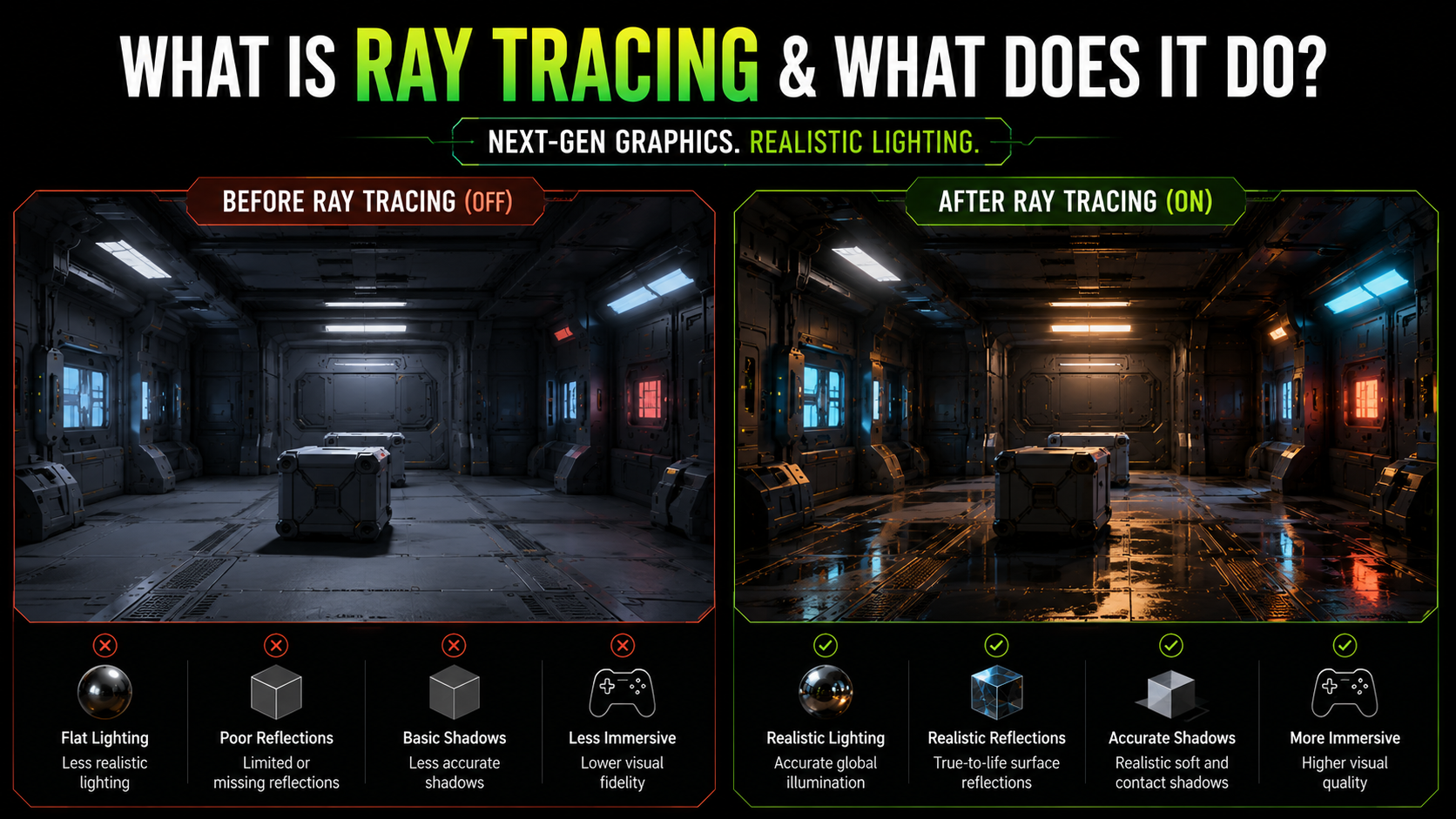
Ray tracing is a rendering technique that simulates how light behaves to create realistic visuals in digital environments. As gaming and simulation technologies advance, understanding ray tracing has become important for anyone interested in modern computer graphics.
The technology models how light rays interact with virtual surfaces. These interactions can include reflections, refractions, shadows, and other lighting effects. The result is more natural and detailed imagery than many traditional rendering methods can produce.
This guide explains what ray tracing is in real life, how RTX works, why ray tracing matters, and what it means in computer graphics. It also explains whether ray tracing is exclusive to NVIDIA. For more technical information, you can visit NVIDIA’s official ray tracing documentation.
Whether you are a gamer, designer, or technology enthusiast, understanding ray tracing can help you appreciate modern graphics technology. You will also learn why hardware acceleration has made real-time ray tracing practical for games and interactive applications.
What is ray tracing in real life?
In the physical world, light constantly interacts with objects and surfaces. When sunlight reaches an object, some light is absorbed, reflected, or transmitted. Transparent materials, such as glass, can also bend light through refraction.
Shadows appear when an object blocks light from reaching another surface. Reflections occur when light bounces from polished or glossy materials. These interactions create many of the visual details we naturally see around us.
Real-world lighting involves countless interactions. Light can bounce between surfaces before eventually reaching our eyes. These interactions create soft shadows, reflections, color variation, and natural-looking illumination.
Computer graphics attempts to recreate these behaviors mathematically. The technology models how light rays interact with virtual surfaces. These interactions can include reflections, refractions, shadows, and other lighting effects. The result is more natural and detailed imagery than many traditional rendering methods can produce, especially when viewed on displays with advanced visual technologies such as OLED and QLED.
The goal is not to reproduce every photon. Instead, rendering systems calculate the light interactions that contribute to the final image. This approach creates realistic visuals without simulating every physical particle of light.
Simulating Nature Through Optics
Simulating natural lighting requires software to calculate how rays travel through a digital environment. A common approach traces rays from the camera into the scene. This avoids tracking every ray emitted by each individual light source.
The method is efficient because it focuses on rays that can contribute to the image. The renderer determines which objects a ray encounters and how their materials affect the resulting light.
These calculations can reproduce effects such as:
- Glossy reflections on wet roads and polished surfaces.
- Refraction through glass and other transparent materials.
- Soft shadows created by larger or partially blocked light sources.
- Indirect lighting caused by light bouncing between surfaces.
These effects make digital environments appear more believable. They are especially noticeable around mirrors, water, glass, metallic objects, and complex lighting.
However, this rendering technique remains computationally demanding. Modern GPUs use specialized hardware and advanced rendering methods to make these calculations practical for games and interactive applications.
Why does ray tracing matter?
This technology matters because it can make digital lighting behave more naturally. Traditional rendering methods often use carefully designed approximations for shadows, reflections, and other lighting effects. These techniques can be effective, but they may not respond naturally to every scene change.
Real-time implementations allow lighting effects to react dynamically. For example, a moving light source can change reflections and shadows across nearby surfaces. Breaking a glass window can also alter how light passes through the environment.
These details can increase visual realism and immersion. They are especially valuable in games with reflective surfaces, dynamic lighting, and detailed environments, making the choice of a gaming monitor an important part of experiencing these visual effects.
The technology also matters outside gaming. Industries such as architecture, automotive design, product visualization, and film use physically based rendering techniques to preview designs and scenes before production.
By simulating light more accurately, designers can evaluate materials, lighting, and visual appearance earlier. This can improve creative decisions and reduce the need for physical prototypes.
Transforming Interactive Entertainment
The move toward real-time rendering represents an important development in interactive entertainment. Developers can create lighting systems that respond more naturally to changes within a game world.
This approach can reduce the need for some manually created lighting tricks. Instead of relying entirely on precomputed shadows or static lighting, developers can use dynamic calculations for selected effects.
This can benefit games with changing environments, moving light sources, and highly reflective materials. Players can see more convincing reflections, shadows, and lighting interactions as they move through a scene.
However, advanced lighting does not automatically make every game better. Its benefits depend on the scene, artistic direction, hardware, and implementation.
Developers often combine these effects with traditional rendering techniques. This hybrid approach helps balance visual quality and performance.
As graphics hardware becomes faster, developers can apply more advanced lighting effects. The technology is therefore becoming an increasingly important part of modern game rendering.
What is ray tracing in computer graphics?
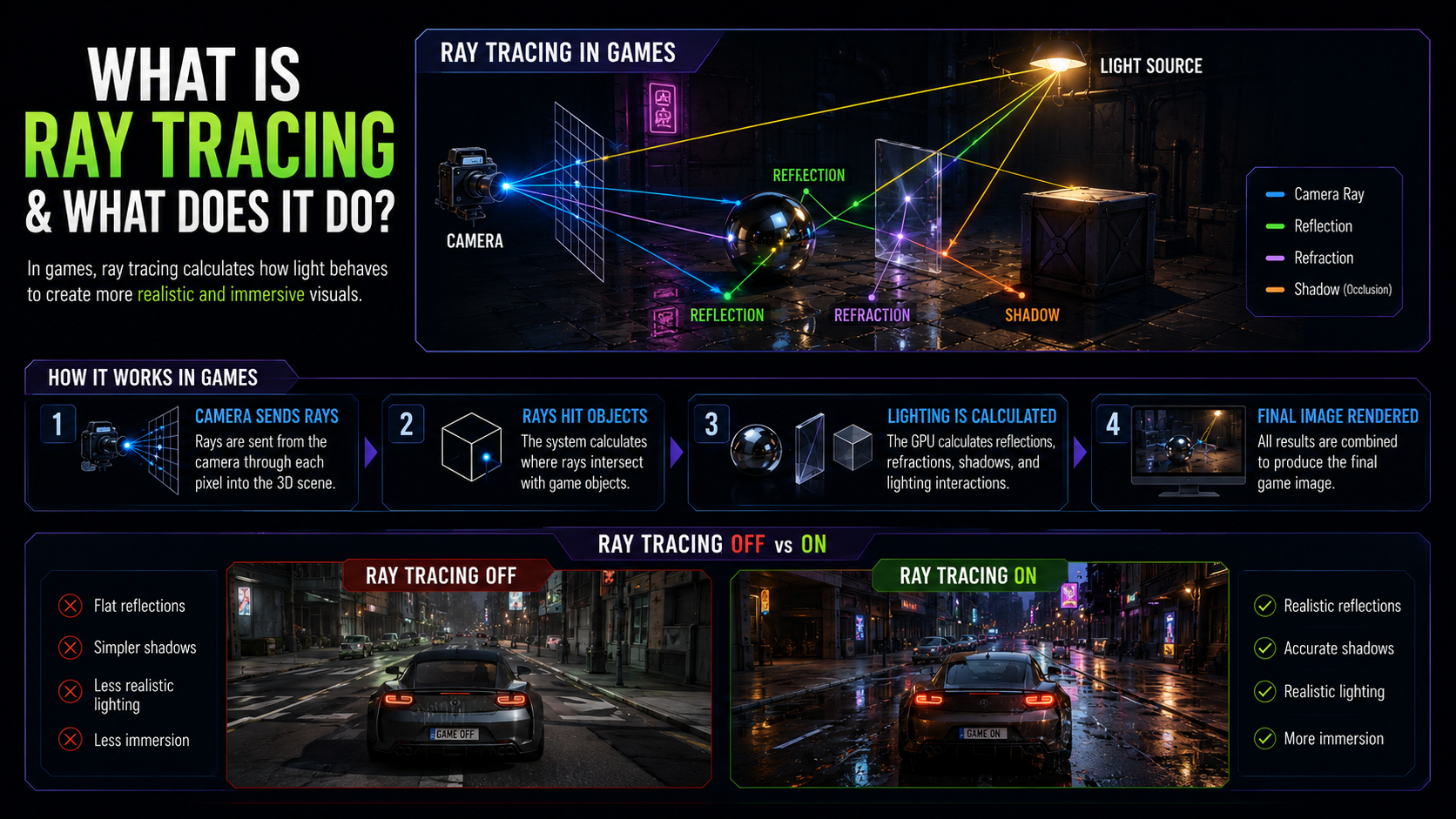
In computer graphics, ray tracing is a rendering method that calculates how simulated rays travel through a 3D scene. The renderer typically starts with the virtual camera and sends rays through image pixels into the scene.
When a ray reaches an object, the renderer determines what happens next. It can calculate surface materials, lighting conditions, reflections, refractions, and the visibility of nearby light sources.
This process produces realistic effects that can be difficult to reproduce with traditional rasterization alone. Reflections can accurately show surrounding objects, transparent materials can bend light, and shadows can respond naturally to light sources.
The method requires substantial computational power because each pixel may involve many calculations. Modern graphics processors have made real-time versions practical for games and other interactive applications.
The technique has also played an important role in film and animation. Offline renderers can spend significantly longer calculating individual frames when performance matters less than image quality.
Evolution From Offline to Real-Time
Ray tracing was historically associated with offline rendering. Film studios could spend considerable time calculating individual frames to achieve highly realistic lighting and materials.
Real-time applications have different requirements. Games need to produce new frames quickly while responding to player input. Waiting several minutes or hours for each frame is not practical.
Advances in GPU architecture have changed this situation. Dedicated hardware can accelerate important calculations, allowing compatible games to use ray-traced effects at interactive frame rates. Understanding the difference between integrated and discrete graphics can also help explain why some systems handle these demanding workloads better than others.
Modern systems can combine this technique with rasterization, upscaling, denoising, and other methods. This hybrid approach reduces the amount of computation required for each frame and gives users more ways to get more out of their GPU without overclocking.
As hardware and software continue to improve, real-time rendering is becoming more accessible. It now appears across high-end PCs, modern consoles, and professional graphics applications.
Is ray tracing nvidia only?
Ray tracing is not an NVIDIA-only technology. It is a rendering technique based on mathematical principles and the physical behavior of light. Different hardware manufacturers can support it through compatible graphics APIs and hardware acceleration.
NVIDIA helped popularize real-time versions in consumer graphics with its RTX platform. However, AMD and Intel also offer graphics hardware with dedicated acceleration capabilities.
Modern graphics APIs provide important cross-platform support. Microsoft DirectX Raytracing (DXR) and the Vulkan API allow developers to implement compatible effects without creating completely separate rendering systems for each GPU manufacturer.
Hardware support and performance can vary between graphics cards. A game may therefore perform differently depending on the GPU, driver, settings, and optimization.
The key point is that the underlying technology is not proprietary to NVIDIA. RTX is NVIDIA’s branding and implementation of related hardware and software technologies.
Industry Standards and Open APIs
Industry standards make advanced lighting more accessible across different graphics platforms. APIs such as DirectX Raytracing provide developers with standardized ways to access compatible capabilities.
This means developers can build rendering systems without creating an entirely different solution for every GPU brand. Hardware manufacturers can then implement the required functionality within their own architectures.
NVIDIA, AMD, and Intel all support modern graphics technologies that can enable these effects. Their implementations differ, particularly in hardware design, efficiency, and performance.
Open graphics standards also encourage competition. Manufacturers can improve rendering performance, efficiency, and image quality without controlling the underlying concept.
For consumers, this means the technology is available across multiple hardware ecosystems. Choosing a graphics card therefore depends on performance, features, price, power efficiency, and game support.
It is best understood as an industry-wide graphics technique. RTX is one major implementation rather than another name for the technology itself.
How does RTX work?
RTX refers to NVIDIA’s platform for accelerating real-time ray tracing and related graphics technologies. Traditional graphics hardware was not designed specifically for the complex calculations required by these workloads. Dedicated hardware helped address this limitation.
NVIDIA introduced RT Cores to accelerate important operations. These specialized components can handle calculations such as ray-triangle intersections. This allows the GPU to process demanding workloads more efficiently.
During rendering, the graphics system sends rays into a virtual scene. The RT hardware helps determine where those rays intersect with objects. Other GPU components then use that information to calculate lighting, reflections, shadows, and material responses.
This division of work improves efficiency compared with relying entirely on general-purpose shader cores. It helps modern graphics cards deliver advanced lighting while maintaining playable performance.
RTX is therefore more than ray tracing alone. It combines hardware acceleration with other technologies designed to improve image quality and overall performance.
The Power of Tensor Cores
RTX graphics cards also include Tensor Cores, which accelerate certain artificial intelligence and machine-learning workloads. These cores support technologies such as Deep Learning Super Sampling (DLSS).
DLSS can render a game internally at a lower resolution. An AI-based reconstruction process then creates a higher-resolution output image. This can improve performance while maintaining strong image quality.
Advanced lighting can place a heavy workload on a graphics card. Technologies such as DLSS can help offset some of that performance cost.
The combination of dedicated RT hardware and AI-based rendering makes real-time effects more practical. Players can use demanding visual features without always accepting the full performance penalty of native high-resolution rendering.
Frequently Asked Questions
Does ray tracing reduce your gaming frame rate?
Yes, ray tracing significantly reduces frame rates because calculating millions of light paths requires immense processing power. However, modern technologies like AI-powered upscaling help recover lost performance by rendering games at lower base resolutions before sharpening the final image for your display screen.
Can older graphics cards support ray tracing?
Most older graphics cards lack the specialized hardware needed to run real-time ray tracing efficiently. While some legacy GPUs can technically run ray-traced software through slow software emulation, the resulting frame rates are usually far too low to provide an enjoyable gaming experience.
What is path tracing compared to ray tracing?
Path tracing is a more advanced subset of ray tracing that simulates multiple bounces of light across an entire scene. While standard ray tracing often calculates specific direct effects like reflections or shadows, path tracing simulates global illumination entirely, resulting in unmatched visual realism.
Do video game consoles support ray tracing?
Current-generation home consoles like the PlayStation 5 and Xbox Series X feature custom AMD graphics hardware with built-in ray-tracing acceleration. While they handle ray-traced reflections and shadows effectively, developers often lower certain settings or resolutions to maintain steady, smooth gameplay performance.
Conclusion
Understanding what ray tracing is and what it does shows how far computer graphics have advanced. The technology uses simulated light paths to create more realistic reflections, shadows, refractions, and lighting interactions.
Ray tracing can make digital environments feel more natural and immersive. Its applications also extend beyond gaming into film, architecture, automotive visualization, and other professional fields.
RTX hardware has helped make real-time ray tracing practical for consumer devices. However, ray tracing is not exclusive to NVIDIA. AMD and Intel also support the technology through modern graphics hardware and industry-standard APIs.
Performance remains an important consideration. Ray tracing can reduce frame rates, especially when multiple demanding effects are enabled. Technologies such as AI-based upscaling can help balance image quality and performance.
As GPUs become more capable, ray tracing will likely become increasingly common. Its continued development can bring more realistic lighting to games and digital experiences.
If you have compatible hardware, trying ray-traced effects in supported games is one of the best ways to see the difference. Realistic lighting can significantly change how a digital world looks and feels.