
What Is Multimodal AI? The Complete Guide for 2026
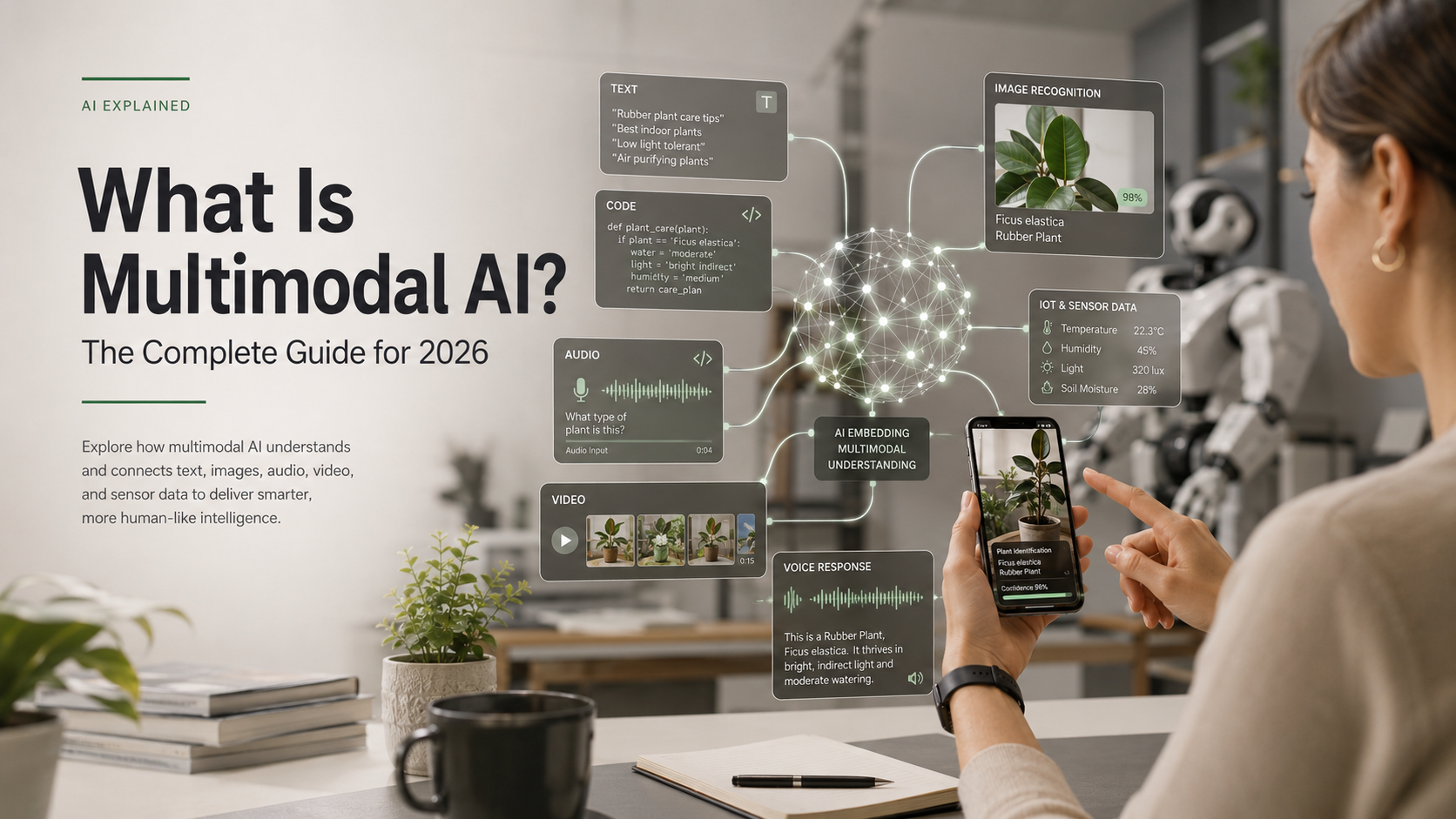
For many years, artificial intelligence systems worked within separate data environments. Multimodal AI represents a major advancement in this field by allowing machines to understand and combine different types of information, including text, images, audio, video, and sensor data. Traditional AI models could analyze text, recognize images, or process audio, but they usually handled only one type of information at a time. These unimodal AI systems performed specific tasks well but struggled with situations requiring multiple sources of information.
Multimodal AI changes this approach by enabling machine learning models to process and connect different data types within a unified framework. Research from organizations such as Google DeepMind demonstrates how combining visual and language information can create more capable AI systems. You can learn more about related AI research through Google DeepMind Research.
This advancement makes technology more natural and easier to use. Instead of describing a problem manually, users can provide an image, ask a spoken question, and receive an intelligent response based on multiple inputs.
For example, a user can point a smartphone camera at a damaged appliance and ask for repair guidance. A multimodal AI system can analyze the image, understand the voice request, and provide step-by-step instructions.
This ability closely matches how humans interact with the world. People naturally combine sight, hearing, language, and environmental awareness when making decisions.
In this guide, we will explore how multimodal AI works, the technologies behind it, enterprise applications, major benefits, challenges, and the future impact of these advanced AI systems.
Understanding the Shift From Unimodal AI to Cross-Modal Systems
Traditional artificial intelligence systems are mainly unimodal models. Each system is designed to process a specific type of input. A natural language model handles written content, a computer vision model analyzes images, and speech recognition systems convert audio into text.
These specialized models can deliver strong results within their individual areas. However, they often lack broader context because they cannot naturally connect information from different sources.
For example, an image recognition system may identify a red traffic light. A language model may understand the word “stop.” An audio model may detect a vehicle horn. A unimodal system treats these signals separately.
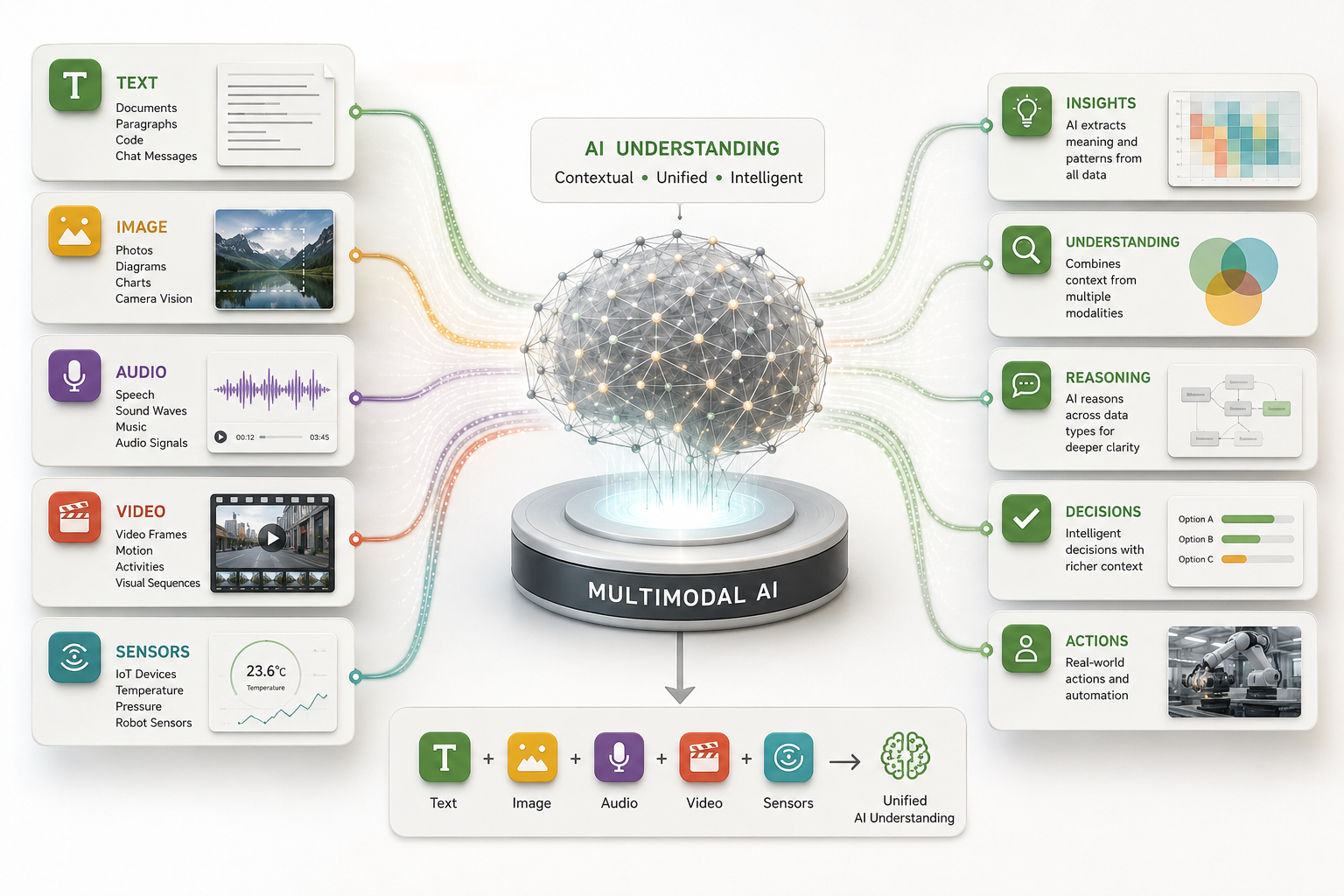
Multimodal AI models solve this limitation by combining multiple information streams. They create connections between different data formats and build a more complete understanding of a situation.
A simplified comparison:
Unimodal AI  → Handles ONE format (Text OR Image OR Audio)

Multimodal AI → Combines MULTIPLE formats
(Text + Image + Audio + Video)
Cross-modal architectures transform different inputs into shared mathematical representations. These representations allow AI systems to understand relationships between unrelated data types.
For example, the system can connect an image of a red traffic light with the word “stop” and the sound of a car horn. Together, these signals create a stronger understanding of the environment.
This ability makes multimodal AI valuable for complex tasks. It improves reasoning, search capabilities, automation, and human-computer interaction.
Core Data Modalities Used in Modern Multimodal AI Systems
Modern multimodal AI systems process several types of information at the same time. Each data type provides unique context that helps the model create better responses.
The main AI modalities include:
- Text data: Documents, websites, code, messages, reports, and user instructions.
- Visual data: Images, diagrams, maps, photographs, and video content.
- Audio data: Speech, conversations, environmental sounds, and music.
- Sensory data: IoT signals, temperature readings, depth information, and machine-generated measurements.
Text remains one of the most important inputs because it provides detailed instructions and descriptions. However, combining text with other formats allows AI systems to understand situations more accurately.
Visual information gives models the ability to recognize objects, environments, and patterns. Audio data adds another layer by helping systems understand spoken language and surrounding sounds.
Sensory inputs are especially important in industries such as robotics, manufacturing, and autonomous vehicles. These systems depend on continuous environmental information to make real-time decisions.
By combining these different modalities, multimodal AI creates a richer understanding than any single data source could provide alone.
How Multimodal AI Processing Works Behind the Scenes
Building a system that understands multiple data types requires advanced AI architectures. Instead of processing each input separately and combining results afterward, modern multimodal models learn relationships between different data sources during training.
The process begins by converting different inputs into numerical representations. Images, audio files, and text passages are transformed into mathematical patterns called embeddings.
These embeddings allow AI systems to compare information across different formats. For example, an image of a dog and the text phrase “golden retriever” can become closely connected inside the model’s shared representation space.
Developers commonly use two main approaches for combining data:
Early Fusion Architecture
Early fusion combines different data inputs at the beginning of the processing pipeline.
The model merges raw features or early-level representations before deeper analysis occurs. This approach helps the system discover relationships between different data types from the start.
For example, an AI model analyzing a medical scan may combine image information with patient notes during the initial processing stage.
Late Fusion Architecture
Late fusion processes each data type separately before combining the final results.
Different AI networks analyze text, images, or audio independently. The system then merges their outputs near the final decision stage.
This method allows specialized models to maintain their individual strengths while still creating a combined prediction.
Both approaches are used in modern multimodal AI development. The best choice depends on the application, available data, and performance requirements.
The Role of Shared Vector Embeddings in Multimodal AI
Shared vector embeddings are one of the most important technologies behind multimodal AI models. They allow different types of information to exist inside the same mathematical space. This means text, images, audio, and other inputs can be compared and connected more effectively.
During training, AI systems convert different data types into high-dimensional numerical vectors. These vectors represent the meaning, patterns, and relationships within the original information.
When two concepts are closely related, their vector representations move closer together. For example, an image of a golden retriever, the spoken word “dog,” and the text phrase “loyal canine” can appear near each other in the same embedding space.
This alignment helps AI systems perform advanced tasks such as:
- Multimodal search: Finding images through text descriptions or finding information through visual input.
- Cross-language understanding: Connecting concepts across different languages and formats.
- AI reasoning: Understanding relationships between objects, words, sounds, and environments.
A simplified example:
Image: "Dog"      ──┐
                    │
Audio: "Woof"    ───┼── Shared Embedding Space → Unified Context
                    │
Text: "Canine"   ───┘
Because these representations share a common space, multimodal AI systems can understand meaning rather than simply matching keywords.
This capability improves how users interact with technology. People can communicate naturally using combinations of text, images, and voice instead of relying on a single input method.
Practical Enterprise Applications of Multimodal AI Across Industries
Businesses across different industries are adopting multimodal AI technology to improve automation, decision-making, and customer experiences. These systems are valuable because most real-world business processes involve multiple forms of information.
Unlike traditional AI tools that analyze isolated datasets, multimodal systems can combine different sources at the same time. This creates more accurate insights and reduces the need for manual data processing.
From healthcare and retail to transportation and customer service, organizations are using multimodal AI to solve complex problems.
Healthcare and Medical Diagnostics
Healthcare professionals often evaluate multiple sources before making decisions. Doctors review medical images, patient histories, laboratory results, and clinical notes together.
Multimodal AI systems can analyze these different inputs simultaneously. For example, an AI model can examine MRI images while reviewing medical records and test results.
This combined analysis can help identify patterns faster. It may support healthcare professionals by highlighting important details and reducing the chance of missing critical information.
E-Commerce and Visual Search
Retail businesses use multimodal AI to create smarter shopping experiences. Customers can upload an image and add a written request at the same time.
For example, a shopper can upload a photo of a jacket and ask, “Find similar styles in blue under $50.”
The AI system analyzes the visual design, understands the text request, and searches for matching products.
This creates a more natural shopping experience compared with traditional keyword-based search.
Autonomous Vehicles and Robotics
Autonomous vehicles depend on multiple data sources to understand their surroundings. Cameras alone cannot provide complete environmental awareness in every condition.
Self-driving systems combine:
- Camera images and video streams
- LiDAR spatial information
- Radar signals
- Sensor measurements
- Environmental data
By combining these inputs, AI systems can detect obstacles, understand road conditions, and make faster decisions.
Multimodal processing is also essential for advanced robotics. Robots use vision, sound, and sensor information to interact safely with humans and their surroundings.
| Industry | Primary Multimodal Data Inputs |
|---|---|
| Healthcare | Medical imaging, doctor notes, and electronic health records |
| Retail and E-Commerce | Product images, descriptions, and customer searches |
| Automotive | Camera video, LiDAR maps, and radar signals |
| Customer Support | Voice conversations, chat records, and screenshots |
Key Advantages of Multimodal AI Over Traditional AI Systems
The biggest advantage of multimodal AI is its ability to understand information from multiple sources. Traditional AI systems often depend on a single input type, which limits their ability to interpret complex situations.
By combining different data formats, multimodal models create richer context and provide more accurate results.
Richer Contextual Understanding
Multimodal AI can connect visual, audio, and text information together. This allows systems to understand situations more similarly to human perception.
For example, an AI assistant can analyze a screenshot, understand a written question, and provide a relevant solution.
This reduces confusion because the model has access to more complete information.
More Natural User Interaction
Users no longer need to communicate through only typed commands. Multimodal systems support multiple interaction methods, including:
- Voice instructions
- Image uploads
- Video input
- Text prompts
- Sensor-based information
This makes digital tools easier to use for a wider range of people.
Improved Accuracy for Complex Tasks
Combining multiple data sources allows AI systems to verify information across different inputs.
For example, a medical AI model can compare image findings with written patient information. This additional context can improve decision support.
Better Accessibility Features
Multimodal AI also improves accessibility. These systems can describe images for visually impaired users, convert speech into text summaries, and translate spoken conversations into different formats.
This creates technology experiences that are more inclusive and adaptable.
Main Challenges of Implementing Multimodal AI Systems
Although multimodal AI provides major benefits, building and deploying these systems creates several technical challenges. Organizations must solve issues related to data quality, computing power, and real-time performance.
Data Alignment and Dataset Quality
Training multimodal models requires large amounts of carefully matched data. Images, text, audio, and other inputs must be correctly connected during the training process.
Poor-quality data can reduce model performance. For example, incorrect image labels or inaccurate text descriptions may teach the system the wrong relationships.
Creating reliable datasets requires significant engineering effort. Teams must collect, clean, organize, and evaluate millions of data examples.
High Computational Requirements
Multimodal AI models require substantial computing resources. Processing high-resolution images, video streams, audio signals, and text together requires powerful hardware.
Organizations often rely on advanced cloud infrastructure, GPUs, or specialized AI processors to run these systems efficiently.
The challenge is finding the right balance between model performance, speed, and operational cost.
Smaller and optimized models are becoming increasingly important. Techniques such as model compression and efficient AI architecture design help bring multimodal capabilities to more devices.
Frequently Asked Questions About Multimodal AI
What is the main difference between unimodal AI and multimodal AI?
Unimodal AI systems are designed to process one type of data input. For example, a language model may only understand text, while a computer vision system focuses on images. These models can perform specific tasks effectively but have limited awareness outside their trained data format.
Multimodal AI systems can process and connect multiple data types, including text, images, audio, video, and sensor information. This allows them to understand relationships between different inputs and create more complete responses.
For example, a unimodal image model may identify a damaged machine part from a photo. A multimodal AI system can analyze the image, read a maintenance report, understand a technician’s voice description, and suggest possible solutions.
This broader understanding makes multimodal AI more flexible for complex tasks. It supports applications such as healthcare analysis, customer service automation, robotics, and advanced search systems.
By combining multiple information sources, multimodal models can better understand real-world situations where humans naturally use several senses together.
Why is multimodal AI important for modern enterprise businesses?
Modern businesses manage large amounts of information across different formats. Customer messages may include text, screenshots, voice recordings, and documents. Healthcare organizations work with medical images, reports, and patient records. Retail companies combine product photos with descriptions and customer searches.
Traditional AI systems often require separate tools for each type of information. This creates disconnected workflows and limits automation opportunities.
Multimodal AI helps enterprises combine these data sources into a single intelligent system. It allows organizations to analyze information faster and create more responsive digital experiences.
Common business benefits include:
- Faster customer support through text, voice, and image understanding.
- Improved search experiences using visual and language inputs.
- Better decision-making through combined data analysis.
- Reduced manual work in complex workflows.
As businesses continue generating more diverse data, multimodal AI provides a practical way to manage and understand information more effectively.
What hardware is required to run multimodal AI models efficiently?
Multimodal AI models require significant computing resources because they process multiple data types at the same time. These systems often rely on powerful hardware, including Graphics Processing Units (GPUs) and Tensor Processing Units (TPUs).
Large AI models must handle complex calculations involving images, video frames, audio signals, and text data. High memory capacity and fast processing speeds are important for maintaining performance.
Enterprise organizations commonly use:
- Cloud-based AI infrastructure.
- Dedicated GPU servers.
- AI accelerator hardware.
- Edge computing devices.
The required hardware depends on the model size and application. A large enterprise AI platform processing video streams requires much more power than a lightweight mobile AI feature.
New optimization methods are helping reduce hardware requirements. Techniques such as quantization, model compression, and efficient architecture design allow smaller devices to run advanced AI capabilities.
Can multimodal AI run on mobile and edge devices?
Yes, modern multimodal AI systems can operate on mobile devices and edge platforms. Advances in AI optimization have made it possible to run smaller models directly on smartphones, tablets, and embedded devices.
Mobile hardware now includes specialized AI processors called Neural Processing Units (NPUs). These components are designed to handle machine learning tasks efficiently.
On-device multimodal AI enables features such as:
- Real-time camera translation.
- Voice-based assistants.
- Image enhancement tools.
- Offline object recognition.
- Smart accessibility features.
Running AI locally also offers privacy advantages. Sensitive information can sometimes be processed directly on the device instead of being uploaded to external servers.
However, large and complex multimodal models may still require cloud computing because they need greater processing power.
The future will likely involve a combination of cloud-based and edge-based AI systems working together.
How do developers connect text and image data during AI training?
Developers use advanced machine learning techniques to connect different data types during multimodal AI training. One of the most common methods is contrastive learning, which helps AI models understand relationships between matching and unrelated data. As a result, the system learns how different formats can represent the same concept.
During training, the model receives paired examples, such as an image along with its corresponding text description. Then, it analyzes these examples and adjusts its internal representations to bring related inputs closer together inside a shared vector space.
For example:
- An image of a bicycle is paired with the text “a person riding a bicycle.”
- The model learns that both inputs represent the same idea.
- At the same time, unrelated examples are moved farther apart in the embedding space.
Over time, this process allows the AI system to build a deeper understanding of how images, text, and other data formats are connected. Therefore, multimodal AI models can recognize meaning instead of simply matching keywords.
Furthermore, this capability enables advanced features such as image-based search, visual question answering, and AI responses that combine multiple input types. Shared representations are one of the key reasons modern multimodal AI models can perform complex reasoning tasks across different data formats.
What are the biggest limitations of multimodal AI?
Although multimodal AI has advanced quickly, several challenges remain. Building reliable systems requires solving problems related to data quality, computing costs, accuracy, and safety.
Common limitations include:
- High computational requirements: Processing multiple data streams requires significant hardware resources.
- Complex training data: Models need large datasets with accurate connections between different formats.
- Latency issues: Real-time applications may require faster processing speeds.
- Input quality problems: Poor audio, unclear images, or incorrect data can affect results.
Multimodal systems can also produce incorrect responses when they misunderstand relationships between inputs. Developers must include testing, monitoring, and safety controls to improve reliability.
As AI research continues, improvements in hardware, training methods, and model efficiency are expected to reduce many of these limitations.
Conclusion: The Future of Multimodal AI Technology
Multimodal AI is transforming the future of artificial intelligence by allowing systems to understand and combine text, images, audio, video, and sensor data. Unlike traditional AI models, these advanced systems can process multiple information sources together; therefore, they can deliver more accurate and context-aware results. Additionally, this ability enables AI solutions to better understand complex real-world situations.
Moreover, across industries such as healthcare, e-commerce, robotics, and automation, multimodal AI is helping organizations create smarter solutions and improve user experiences. For example, these systems can analyze different data formats simultaneously, which allows businesses to make faster and more informed decisions.
Furthermore, multimodal AI can work alongside other advanced AI approaches, such as retrieval augmented generation (RAG), to improve information retrieval and generate more reliable responses. However, challenges such as high computing costs, data complexity, and model reliability still exist. Nevertheless, continuous improvements in AI hardware, model optimization, and training methods are gradually making these technologies more accessible and practical for wider adoption.