
Open-Source AI: The Complete Guide to Models, Benefits, and Tools
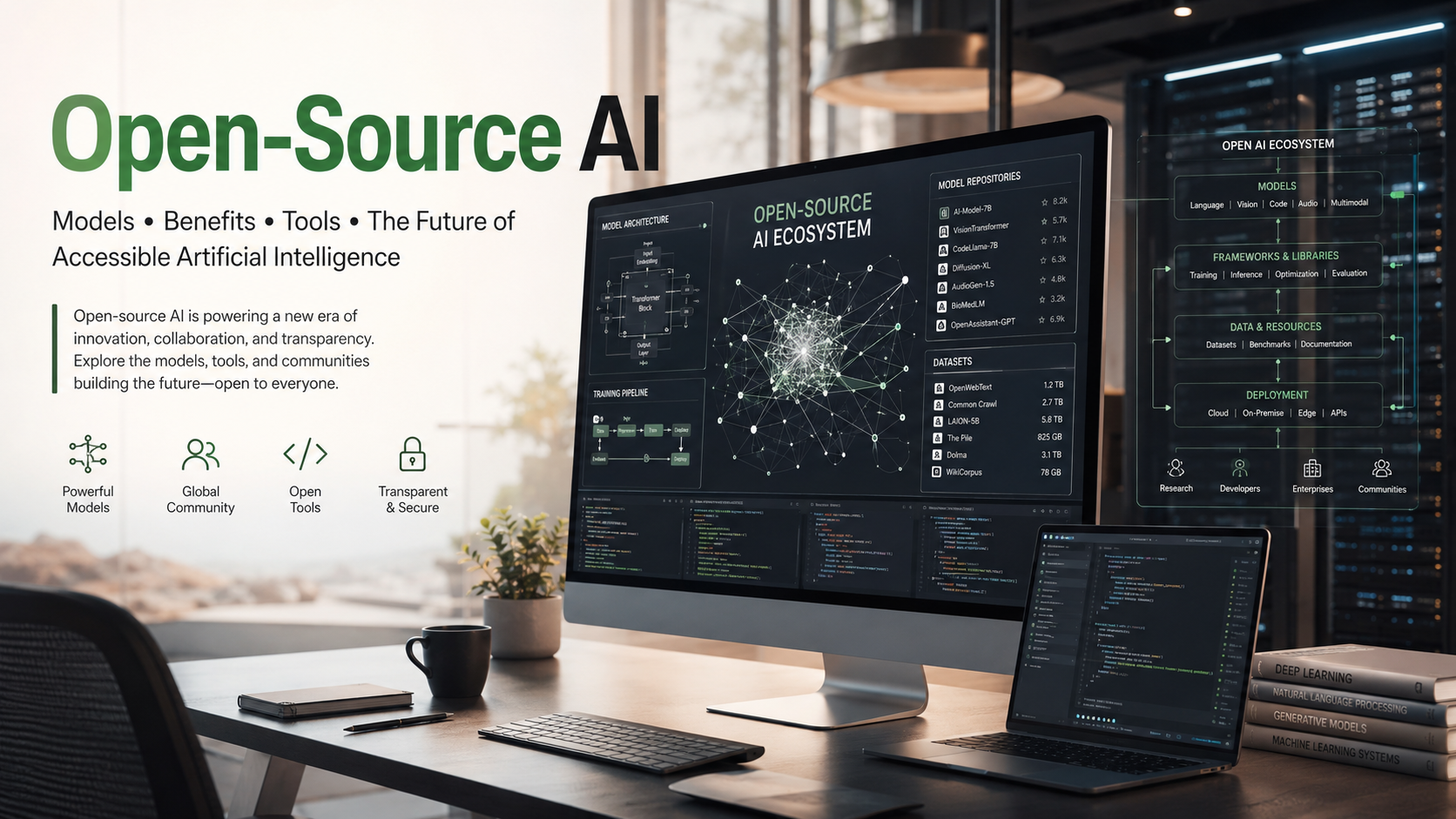
The rapid growth of open-source AI is changing how developers, businesses, and researchers create intelligent systems. By making model architectures, software frameworks, and trained model weights publicly available, open AI projects have expanded access to advanced machine learning technology.
Platforms such as Hugging Face have helped developers discover, test, and deploy powerful machine learning models. These resources were once available mainly to large technology companies with extensive research budgets.
This shift is important because it speeds up innovation and lowers development costs. It also improves transparency by allowing researchers and developers to examine how artificial intelligence systems operate.
Whether you want to build enterprise applications, customize language models, or explore new AI capabilities, open technologies provide greater flexibility. Developers can modify models, run them on private infrastructure, and adapt them for specific business needs.
In this guide, we will explore how open-source AI models work, their major advantages, popular tools, and important security considerations.
Understanding Open-Source AI and Its Growing Impact
Open-source artificial intelligence refers to AI software, model weights, and development frameworks released under licenses that allow users to access, modify, and distribute the technology.
Unlike proprietary AI systems, which often operate as closed platforms, open models provide greater visibility into their internal structure. Developers can inspect available components and adjust systems according to their requirements.
This approach creates a more collaborative AI ecosystem. Researchers, engineers, and independent developers around the world can contribute improvements, identify problems, and optimize performance.
Open-source AI also helps organizations reduce dependence on external providers. Companies can deploy models on their own servers, private clouds, or local machines.
The technology is becoming increasingly important across industries because it supports customization, privacy, and independent development. Businesses can create specialized AI solutions without relying entirely on third-party platforms.
The Open-Source AI Technology Stack
A complete open AI ecosystem usually contains several connected layers:
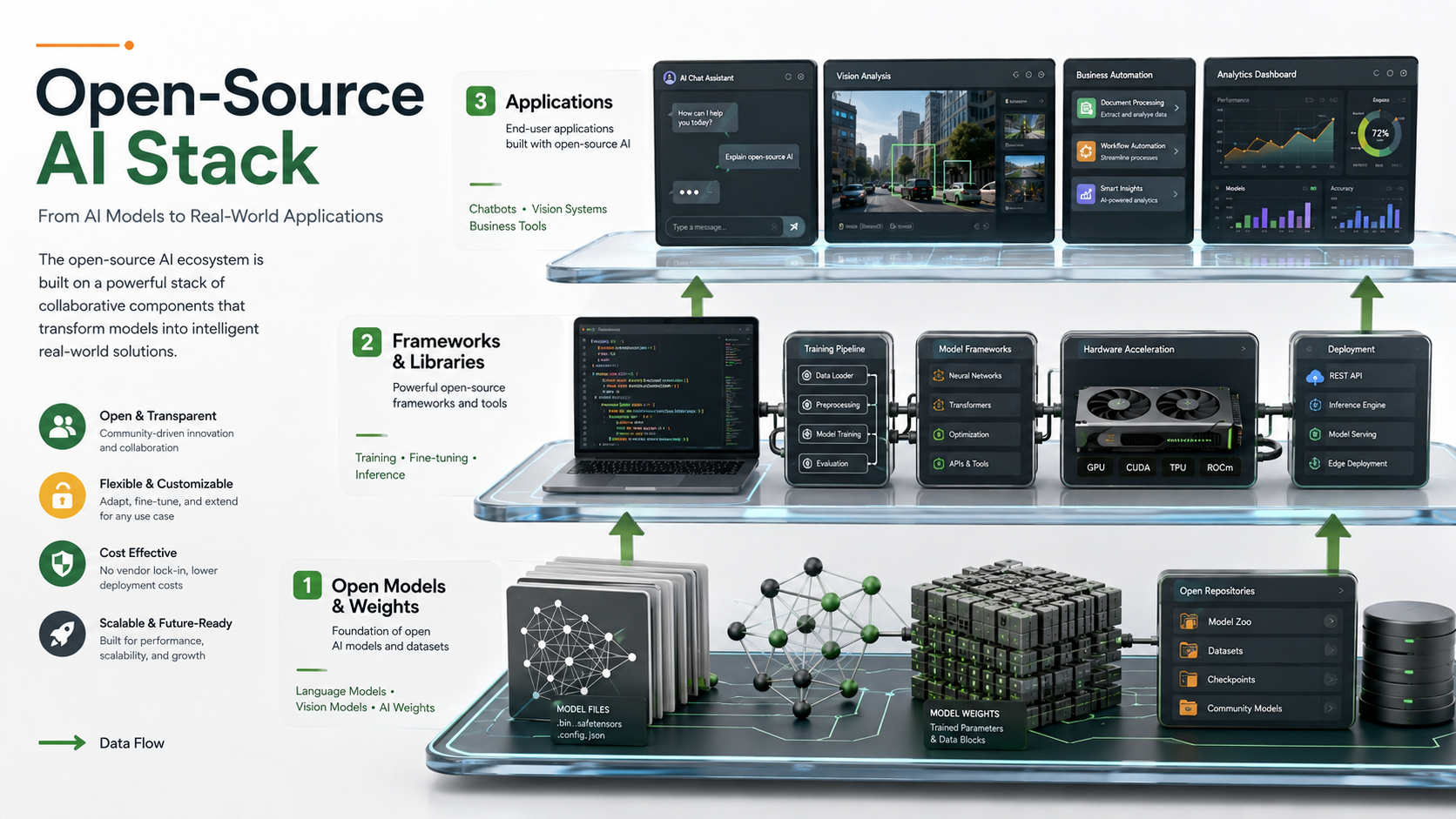
Each layer plays a different role. Applications provide user-facing experiences. Frameworks help developers train and run models. Open weights allow teams to customize existing AI systems.
This layered structure encourages faster experimentation. Developers can combine different tools and models to create solutions for specific use cases.
Key Characteristics of Open Artificial Intelligence Models
Open artificial intelligence models provide several features that make them valuable for developers and organizations. Their main advantage is accessibility. Users can download models, examine their components, and adapt them for different applications.
Unlike closed AI platforms, open models provide more control over deployment. Organizations can choose where their systems run and how their data is processed.
The most important characteristics include:
- Accessible weights: Developers can download trained model parameters and run them on their own infrastructure.
- Customizability: Teams can fine-tune models with specialized datasets for specific industries or workflows.
- Community auditing: Researchers can review systems, identify weaknesses, and improve reliability.
- Flexible deployment: Organizations can operate models across private servers, cloud environments, or local devices.
These features make open-source AI especially useful for companies that need control over their technology stack.
For example, a healthcare company may customize a language model for internal research while keeping sensitive information within its own systems.
Similarly, developers can optimize smaller models for devices with limited computing resources. This flexibility continues to expand the practical uses of open artificial intelligence.
Why Open-Source AI Matters for Businesses and Developers
Open-source AI has become a strategic technology choice for many organizations. It provides advantages that extend beyond simple cost reduction.
Companies increasingly need AI systems that are secure, customizable, and independent. Open models help meet these requirements by giving teams direct control over their applications.
The growing availability of open tools has also reduced barriers for smaller companies. Startups and individual developers can now experiment with advanced AI capabilities without requiring massive research budgets.
Key business advantages include:
- Better control over sensitive data
- Lower long-term technology costs
- Greater customization opportunities
- Reduced dependence on individual vendors
As AI adoption increases, organizations are looking for solutions that provide both performance and flexibility. Open-source AI helps create that balance by combining advanced capabilities with greater ownership.
The next sections explore these benefits in more detail, along with the platforms and frameworks powering this ecosystem.
Core Advantages of Deploying Open-Source AI Systems
Choosing open-source AI instead of relying only on proprietary AI services can provide important strategic benefits for modern organizations. Businesses gain more control over their technology, data, and infrastructure decisions.
Open models allow companies to build customized solutions without depending completely on external providers. This flexibility is valuable for industries that require strict privacy controls, specialized workflows, or long-term technology independence.
The main advantages include improved data protection, predictable costs, and greater customization. Organizations can also avoid being tied to a single vendor’s pricing structure, policies, or platform limitations.
However, successful deployment requires proper planning. Companies must evaluate hardware requirements, licensing rules, security practices, and ongoing maintenance needs.
When implemented correctly, open AI systems can provide a strong foundation for innovation. They allow businesses to create tailored applications while maintaining greater ownership of their digital infrastructure.
| Advantage | Primary Business Impact |
|---|---|
| Data Privacy | Keeps sensitive information within internal systems. |
| Cost Optimization | Reduces dependency on recurring API usage fees. |
| Vendor Freedom | Prevents long-term dependence on specific providers. |
| Customization | Enables specialized AI workflows and applications. |
Complete Data Ownership and Privacy Benefits
Data privacy is one of the strongest reasons businesses adopt open-source AI solutions. Many organizations handle sensitive information that cannot be shared with external services.
When companies use third-party AI platforms, user prompts and business data may travel through external servers. This can create concerns about compliance, security, and data ownership.
Self-hosted open models provide an alternative approach. Organizations can run AI systems on private servers or controlled cloud environments.
This setup keeps confidential information within company-managed infrastructure. It reduces exposure to external processing systems and provides greater control over data handling.
Industries such as healthcare, finance, and legal services often require strict privacy standards. Open AI solutions can help these organizations maintain stronger control over sensitive information.
However, privacy advantages depend on proper security practices. Companies must still manage access controls, software updates, monitoring, and infrastructure protection.
Open-source AI does not automatically guarantee security. It provides the flexibility needed to build a secure environment when combined with responsible management.
Significant Cost Savings at Scale
AI costs can increase quickly when organizations process large volumes of requests through commercial APIs. While pay-per-use services may work for smaller projects, expenses can become challenging as usage grows.
Self-hosted open models provide another option. Companies can invest in their own infrastructure and optimize computing resources according to their specific requirements.
For example, businesses can run batch processing tasks locally, optimize model performance, and select hardware that matches their workload.
Open-source AI also reduces ongoing dependency on subscription-based services. Instead of paying continuously for every request, organizations can manage their own computing environment.
The financial benefits are especially noticeable for companies with high-volume AI applications. Customer support systems, document processing platforms, and internal automation tools often require thousands or millions of AI interactions.
Although initial setup costs may include hardware and technical expertise, long-term savings can be significant.
Careful planning helps organizations balance infrastructure investments with operational efficiency.
Avoiding Proprietary Vendor Lock-In
Depending entirely on one AI provider can create long-term challenges. Companies may face changing prices, updated service policies, or limitations imposed by external platforms.
Open-source AI reduces these risks by giving organizations more control over their technology choices. Teams can move models between different environments and adjust their systems when business needs change.
This flexibility creates greater operational independence. Businesses are not forced to rebuild their entire AI infrastructure if a provider changes its terms or discontinues a service.
Open models also encourage competition within the AI ecosystem. Developers can compare different architectures and select the solutions that best match their goals.
For technology teams, this freedom is valuable. It allows experimentation with different models, frameworks, and deployment strategies.
Vendor independence does not mean avoiding all external services. Many organizations combine open models with cloud platforms and commercial tools.
The key benefit is maintaining the ability to make independent decisions about AI infrastructure.
Leading Platforms and Open AI Frameworks
The modern artificial intelligence ecosystem depends on powerful platforms, libraries, and community resources. These tools simplify model development, training, testing, and deployment.
Open-source AI platforms have created a global environment where researchers and developers can share models and improve existing technologies.
These resources make advanced AI development more accessible. Small teams can now experiment with technologies that previously required large research departments.
Important parts of the ecosystem include model repositories, machine learning frameworks, and local deployment tools.
Together, these platforms support everything from academic research to enterprise production systems.
Community Hubs and Model Libraries
Community-driven platforms play a major role in expanding access to artificial intelligence. Hugging Face has become one of the most widely used resources for discovering and sharing AI models.
The platform provides access to thousands of models, datasets, and development tools. Developers can compare performance, review documentation, and test different solutions before deployment.
Model libraries reduce development time because teams do not need to build every system from scratch. Instead, they can start with existing models and customize them for specific purposes.
These communities also encourage collaboration. Researchers share improvements, publish benchmarks, and create better tools for everyone.
For businesses, model repositories provide a practical starting point. Teams can evaluate available options before choosing a solution for production use.
The growth of these platforms has played a major role in making open-source AI more accessible worldwide.
Powerful Training and Deployment Frameworks
Behind every successful AI model is a strong development framework. These tools provide the foundation for training, testing, and running machine learning systems.
Popular open AI frameworks include:
- PyTorch: A flexible framework widely used for research, experimentation, and advanced model development.
- TensorFlow: A powerful platform designed for large-scale machine learning applications and enterprise deployments.
- vLLM: A high-performance engine focused on efficient large language model inference.
- Ollama: A simple tool that helps users run local AI models on personal computers.
| Framework | Creator / Origin | Best Suited For |
| PyTorch | Meta / Linux Foundation | Research and model development |
| TensorFlow | Enterprise applications and edge systems | |
| vLLM | UC Berkeley | High-throughput AI inference |
These frameworks help developers create reliable AI applications. They support different workloads, from experimental research to large production environments.
Choosing the right framework depends on factors such as performance needs, hardware availability, and deployment goals.
Overcoming Challenges in Open AI Deployments
Although open-source AI offers many benefits, organizations must address several challenges before large-scale adoption.
Running advanced models requires technical expertise, computing resources, and careful management. Businesses need suitable infrastructure and experienced teams to maintain reliable systems.
Security and licensing also require attention. Open availability does not always mean unrestricted usage.
Companies must review each model’s license, understand limitations, and create proper governance processes.
A successful open AI strategy requires balancing innovation with responsible management.
Organizations that prepare properly can benefit from the flexibility of open models while reducing potential risks.
Hardware Infrastructure Requirements
Running modern AI models locally requires significant computing power. Large language models often need advanced graphics processing units (GPUs) to operate efficiently.
High-performance hardware can be expensive, especially for smaller organizations. However, new optimization techniques have made AI deployment more accessible.
Methods such as quantization reduce model size and improve efficiency. These techniques allow smaller teams to run compressed models using fewer resources.
Many organizations now use smaller open models that provide strong performance with lower hardware requirements.
Cloud infrastructure is another option. Companies can combine open models with flexible computing services when local hardware is unavailable.
The best approach depends on workload size, budget, and performance requirements.
Careful hardware planning helps organizations achieve reliable AI performance without unnecessary costs.
Licensing and Intellectual Property Considerations
Open-source AI licensing requires careful review. Not every model uses the same rules or provides identical commercial permissions.
Some licenses allow broad commercial use, modification, and redistribution. Others may include restrictions related to user numbers, industries, or specific applications.
Businesses should examine licensing agreements before integrating open models into important products or services.
Legal and compliance teams should verify whether a model’s terms match the organization’s intended use.
Understanding licensing prevents future conflicts and protects intellectual property rights.
Responsible adoption requires more than technical evaluation. Companies must also consider legal requirements, security policies, and ethical guidelines.
By combining technical planning with proper governance, organizations can safely benefit from open-source AI technologies.
Frequently Asked Questions About Open-Source AI
What is open-source AI and how does it work?
Open-source AI refers to artificial intelligence software, model weights, and development tools that are publicly available under specific licenses. As a result, developers and organizations can access, modify, and deploy AI systems according to their specific needs.
In contrast to proprietary AI platforms, open models provide access to important technical components. Developers can download model files, review available resources, and run AI systems on their own infrastructure.
AI models work by using trained parameters called weights. These weights are essential because they help systems recognize patterns, generate responses, analyze information, and complete complex tasks.
Furthermore, developers can adjust these parameters through processes such as fine-tuning. Because of this, organizations can customize AI models for specific industries, applications, and business requirements.
Overall, open-source AI gives users greater control over deployment, privacy, and customization. However, organizations must still evaluate hardware requirements, security practices, and licensing conditions before implementation.
How does open-source AI differ from proprietary AI services?
The primary difference between open-source AI and proprietary AI services is access and control. While both approaches provide artificial intelligence capabilities, they operate through different development and deployment models.
Proprietary AI systems are usually controlled by companies that keep their source code, model architecture, and trained weights private. Therefore, users typically access these systems through online platforms, cloud services, or APIs.
On the other hand, open-source AI provides greater transparency. Developers can access available model components, customize performance, and host systems independently.
As a result, open models provide several practical advantages:
- Greater data control: Organizations can process information internally and maintain stronger privacy protection.
- More customization: Teams can adjust models for specialized tasks and industry-specific requirements.
- Deployment flexibility: Businesses can select private servers, cloud environments, or local systems.
- Reduced vendor dependence: Companies maintain greater control over long-term technology decisions.
Although proprietary solutions often provide convenience and managed infrastructure, open models offer greater freedom for organizations that require deeper customization.
Ultimately, the best choice depends on business goals, technical resources, security requirements, and operational priorities.
Are open-source AI models free for commercial use?
Many open-source AI models allow commercial usage. However, licensing rules can vary significantly between different projects and organizations.
For example, some models use widely accepted licenses such as Apache 2.0 and MIT. These licenses generally allow modification, redistribution, and commercial applications.
Nevertheless, not every open model follows the same approach. Some organizations release AI models under custom licenses with specific conditions or limitations.
Therefore, businesses should review licensing details before integrating any model into commercial products. Important considerations include:
- Commercial usage permissions
- Redistribution requirements
- Attribution obligations
- Industry-specific restrictions
- Usage limitations
In addition, a model being publicly available does not always mean it can be used without restrictions.
Companies should combine technical evaluation with legal review. By doing so, organizations can maintain compliance and avoid unexpected challenges during product development.
Is open-source AI safe for enterprise data?
Open-source AI can provide strong data privacy benefits when deployed correctly. In particular, organizations can host models internally and maintain control over sensitive information.
Unlike external AI services, locally deployed models do not require business data to leave company-managed systems.
Because of this, open AI solutions can benefit organizations that handle confidential information, including:
- Financial records
- Customer information
- Internal documents
- Research data
However, open-source AI still requires responsible security practices. Companies must protect infrastructure, monitor access, update dependencies, and review possible vulnerabilities.
Additionally, open availability allows researchers to inspect systems and suggest improvements. At the same time, transparency does not automatically eliminate security risks.
Therefore, a secure deployment strategy should include technical safeguards, regular audits, and clear governance policies.
When properly managed, open AI systems can support enterprise innovation while maintaining strong privacy controls.
What are the best open language models available today?
The open language model ecosystem continues to expand rapidly. As a result, developers and businesses now have access to many powerful AI options.
Several models have gained popularity because of their performance, flexibility, and community support.
Leading examples include:
- Llama language models from Meta Platforms
- Mistral AI models from Mistral AI
- Gemma models from Google
Furthermore, these models support a wide range of applications, including:
- Natural language processing
- Content generation
- Programming assistance
- Data analysis
- Business automation
However, the best model depends on specific requirements. Organizations should consider factors such as accuracy, speed, hardware needs, licensing, and customization options.
For example, smaller models may be more suitable for local devices with limited resources. Meanwhile, larger models may provide stronger performance for advanced enterprise applications.
Ultimately, model selection should match the organization’s goals, infrastructure, and expected workload.
How can small businesses start using open-source models?
Small businesses can begin adopting open-source AI without requiring massive investments. Fortunately, many modern tools now simplify local AI deployment for smaller teams.
To begin, businesses should follow a practical approach:
- Identify a specific business problem that AI can solve.
- Test smaller open models before investing in larger systems.
- Use beginner-friendly tools for local experimentation.
- Evaluate performance, security, and costs.
- Expand deployment gradually.
Additionally, tools such as Ollama and Hugging Face Transformers help developers run and customize AI models more easily.
Small businesses can use open models for document analysis, customer support automation, internal knowledge systems, and workflow optimization.
By starting with focused projects, teams can understand AI capabilities before moving toward larger implementations.
As a result, organizations can reduce risks while building practical experience with open-source AI technology.
Conclusion: The Future Impact of Open-Source AI
Open-source AI is transforming how artificial intelligence systems are built and deployed by making advanced models, tools, and frameworks more accessible. It enables businesses to create customized solutions with greater control over data, costs, and infrastructure.
While open AI offers benefits such as privacy, flexibility, and reduced vendor dependence, successful adoption requires careful planning around security, licensing, and maintenance.
As open models continue to improve, organizations can leverage open-source AI to build powerful, future-ready applications while maintaining greater control over their technology.
As organizations explore different AI solutions, understanding the differences between leading AI platforms can help businesses choose the right tools for their needs. For a detailed comparison of two major AI assistants, read our guide on ChatGPT vs Gemini comparison to understand their features, capabilities, and use cases.