
What Did Data Centers Do Before AI?
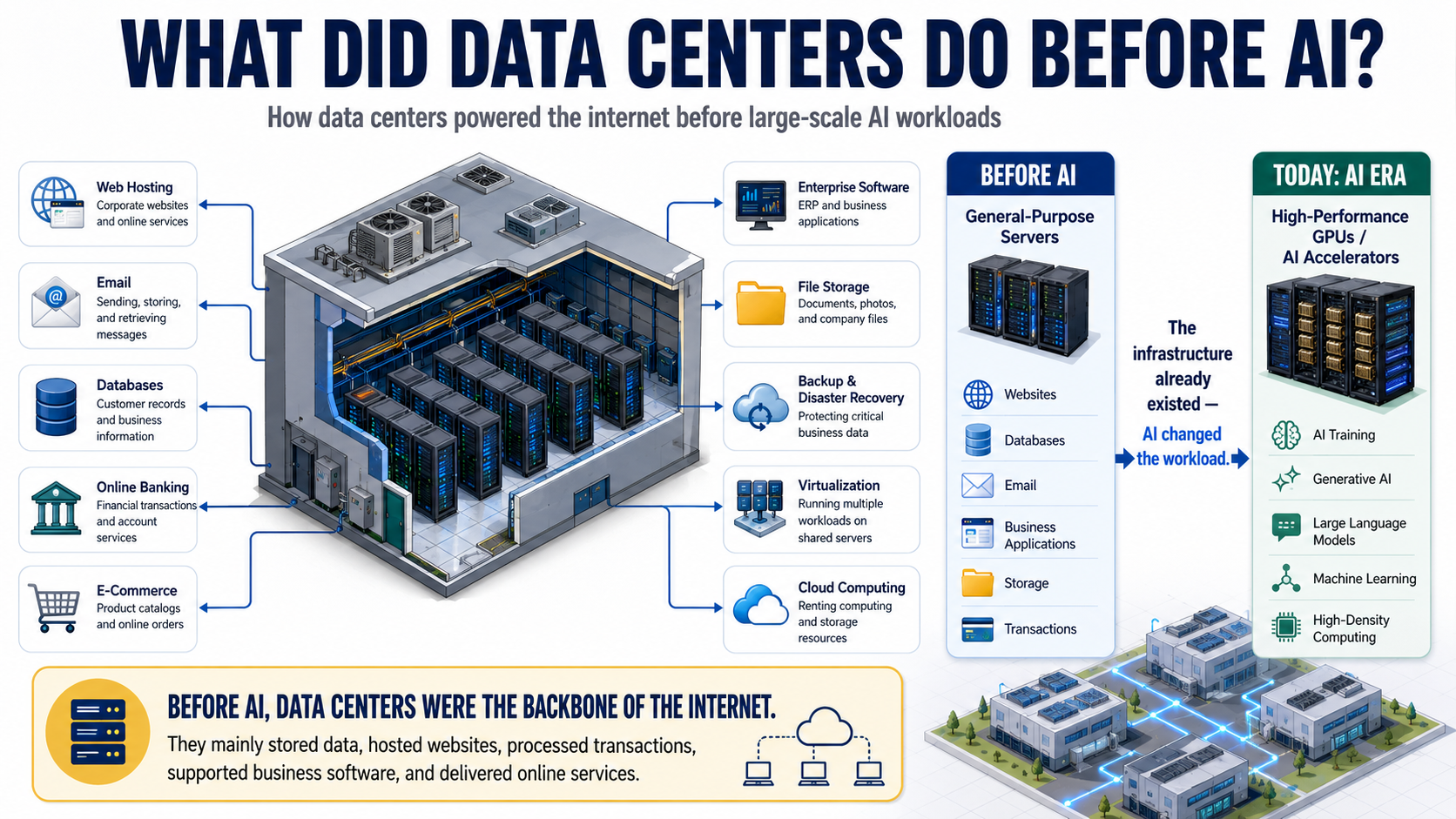
Long before generative AI and large language models dominated technology news, data centers already powered the digital economy. So, what did data centers do before AI became a major infrastructure driver? They hosted websites, stored business records, processed transactions, and supported everyday internet services. Banks, retailers, governments, and technology companies depended on reliable servers for critical operations.
These facilities also supported email, online banking, e-commerce, enterprise software, and disaster recovery. Their workloads were generally more predictable than today’s AI workloads. Traditional servers handled web requests, databases, file storage, virtualization, and business applications.
The U.S. Department of Energy has long emphasized efficiency in data center design. Earlier facilities still required substantial power and cooling, even without today’s high-density AI hardware.
As noted by the Upton Department of Energy, early infrastructure was designed primarily for energy efficiency in routine server tasks rather than intensive parallel processing.
Understanding this history explains how data center infrastructure evolved from conventional computing toward high-performance AI systems.
What were data centers used for before AI?
Before AI became a dominant workload, data centers handled a wide range of conventional computing tasks. Businesses used them to host corporate websites, operate internal applications, process transactions, and store customer information. Banks also relied on secure server infrastructure for financial records and online banking services.
Email was another major workload. Every message required servers to store, route, and retrieve information. E-commerce websites similarly depended on databases, application servers, and network infrastructure to process orders and manage product catalogs.
Data centers also supported enterprise resource planning, customer relationship management, virtualization, backup systems, and disaster recovery. Organizations often maintained redundant hardware to protect important information during outages or equipment failures.
Cloud computing later made these resources available as services. Instead of purchasing every server, businesses could rent computing capacity and storage through How Cloud Computing Works. This model helped smaller companies access reliable infrastructure without maintaining large private server rooms.

Powering Early Web Hosting and Enterprise Storage
Early data center workloads centered on web hosting, file storage, and relational databases. Companies rented dedicated servers or colocated their hardware inside specialized facilities. These systems supported websites, email platforms, business applications, and customer databases, much like the infrastructure described in What Does a Data Center Do? .
The workloads still required dependable electricity and cooling. However, most conventional servers produced lower rack-level heat than today’s dense AI accelerators. Operators therefore focused heavily on uptime, airflow management, hardware reliability, and efficient power distribution.
Data center cooling was never optional. Servers generate heat continuously, and cooling systems must maintain suitable operating conditions. The Department of Energy has documented how computing equipment and cooling systems form major portions of data center energy use.
Virtualization also became important before the AI boom. It allowed multiple workloads to share physical servers more efficiently. This improved utilization and helped companies reduce hardware requirements.
Overall, pre-AI data centers were optimized for reliable general-purpose computing, rather than massive parallel AI processing.
What is the history of data centers?
The history of data centers stretches back to the era of large mainframe computers. During the mid-twentieth century, organizations placed expensive computing systems inside controlled environments. Banks, governments, universities, and large corporations used these machines for calculations, records, and repetitive administrative tasks.
As computers became smaller, organizations began operating dedicated server rooms. The growth of the internet then created new demand for continuously available infrastructure. During the 1990s dot-com boom, companies needed reliable facilities to host websites and online services.
This growth encouraged the development of commercial colocation and hosting facilities. Businesses could place servers inside professionally managed buildings with strong network connections, backup power, and environmental controls.
The next major shift came with cloud computing and hyperscale infrastructure. Large technology companies built enormous facilities that could support millions of users and dynamically allocate computing resources.
Today, data centers support everything from websites and databases to scientific computing and AI. The underlying mission remains similar: provide reliable computing, storage, networking, and power at scale.
The Rise of Hyperscale Cloud Computing Facilities
The move from local server rooms to hyperscale cloud facilities transformed the data center industry. Instead of maintaining isolated systems, businesses could rent computing resources from large cloud platforms.
Hyperscale facilities use highly standardized hardware, automated management, extensive networking, and sophisticated power systems. Their scale allows operators to distribute workloads across thousands of servers and multiple locations.
This model became increasingly important during the late 2000s and 2010s. Cloud providers expanded infrastructure to support storage, databases, websites, enterprise applications, and software services.
Virtualization played a major role in this transition. A single physical server could host multiple virtual machines, improving hardware utilization. Automation also allowed providers to add or remove computing resources based on demand.
The result was a more flexible infrastructure model. Companies no longer needed to predict every hardware requirement years in advance. They could scale resources as their businesses grew.
Hyperscale data centers also created the foundation for modern AI infrastructure. Their power systems, networking, cooling, and operational models could later support increasingly demanding workloads.
How many data centers before AI?
There is no single reliable global number for how many data centers existed before the AI boom. The main reason is that definitions differ. Some statistics count only large commercial facilities, while others include enterprise sites, colocation buildings, government facilities, and smaller server rooms.
The global infrastructure base was already substantial before generative AI became mainstream. Thousands of facilities supported internet services, businesses, telecommunications, financial systems, and cloud platforms.
Large markets developed around strong electricity networks, fiber connectivity, business demand, and favorable operating conditions. Northern Virginia, Frankfurt, London, Singapore, and Tokyo became important data center hubs.
The important point is not one exact facility count. It is the scale of infrastructure already available before AI workloads expanded rapidly.
Modern AI growth is adding new capacity and increasing power density. The Department of Energy notes that data center electricity demand has risen sharply and projects further growth through 2028.
Therefore, many existing facilities became part of the foundation for today’s AI ecosystem. Others require major upgrades or are unsuitable for high-density AI hardware.
Global Distribution of Commercial Infrastructure
Data centers historically concentrated around major population centers, internet exchanges, fiber routes, and reliable power infrastructure. These locations helped companies reduce network latency and improve service availability.
Northern Virginia became one of the world’s most important data center markets. Frankfurt, Tokyo, London, Singapore, and other major connectivity hubs also attracted large facilities.
Several factors influence where operators build:
- Reliable electricity supports continuous server operation.
- Fiber connectivity enables fast communication between users and facilities.
- Land availability allows operators to expand capacity.
- Cooling conditions can affect operating costs.
- Business demand creates a strong reason to locate infrastructure nearby.
AI is changing some of these priorities. High-density computing can require substantially more electricity and advanced cooling systems. DOE research notes that rising AI demand is contributing to rapid growth in data center energy requirements.
Even so, location remains critical. AI systems still depend on networks, power infrastructure, storage, and physical facilities. The geography of data centers will therefore continue evolving rather than disappearing.
What will replace data centers?
Data centers are unlikely to disappear completely. Instead, future computing will probably combine centralized facilities with distributed infrastructure. Edge computing can process certain workloads closer to users and connected devices. This approach can reduce latency and limit unnecessary data transfers.
Micro-data centers may also serve specific locations, factories, telecommunications networks, and smart infrastructure. These smaller facilities can complement larger cloud and hyperscale sites.
Quantum computing represents another potential change. However, it is better viewed as a specialized computing architecture than a direct replacement for conventional data centers. Quantum systems still require physical infrastructure, environmental controls, and supporting classical computers.
The future will therefore involve multiple computing models rather than one universal replacement. Large facilities will continue handling massive storage, cloud applications, enterprise workloads, and AI processing.
Energy efficiency will also become increasingly important. Modern data center design focuses on efficient IT equipment, electrical systems, airflow, cooling, and heat recovery. he likely future is a hybrid infrastructure model. Centralized data centers will work alongside edge nodes, specialized computing systems, and increasingly efficient hardware.
The Emergence of Edge Computing Solutions
Edge computing moves certain processing tasks closer to the people or devices generating data. Instead of sending every request to a distant centralized facility, an edge node can process selected information locally.
This approach can reduce latency for applications that require fast responses. Examples include industrial automation, connected vehicles, telecommunications, security systems, and smart-city technologies.
Edge infrastructure does not eliminate traditional data centers. Instead, it extends the computing network. Central facilities can handle storage, large-scale analytics, model training, and other resource-intensive workloads. Smaller edge systems can manage time-sensitive tasks closer to their source.
This distributed architecture can also reduce unnecessary network traffic. A device may process or filter information locally before sending important data to a central cloud platform.
Edge computing is therefore a complement to data centers, not necessarily their replacement.
As connected devices continue expanding, organizations may use combinations of cloud, edge, and on-device computing. The best architecture will depend on latency, cost, security, bandwidth, and workload requirements.
This flexible model could become increasingly important as digital services grow more complex.
Can AI survive without data centers?
AI does not literally require every workload to run inside a traditional data center. Some AI applications can operate on personal computers, smartphones, embedded systems, or specialized edge devices. However, large-scale AI depends heavily on physical computing infrastructure.
Training advanced models requires substantial computing capacity, storage, networking, electricity, and cooling. Large AI systems often use accelerators such as GPUs to perform parallel calculations efficiently, as discussed in Optimizing Enterprise AI Pipelines.
Those systems generate considerable heat and can create much higher power densities than many conventional workloads. The Department of Energy notes that AI-driven growth is contributing to rising data center energy demand.
Modern facilities must therefore provide reliable power and increasingly sophisticated thermal management. Some high-density environments use liquid cooling, while others continue using advanced air-based approaches.
The relationship works both ways. AI needs data center infrastructure, while AI is also changing how operators design and expand that infrastructure.
So, AI can exist outside large data centers in some cases. Yet the training and large-scale operation of advanced AI systems remain closely tied to data centers and high-performance computing facilities.
The Vital Role of Specialized Cooling Systems
Cooling has always been essential to data center operations. Every active server produces heat, and that heat must be removed continuously. Before AI, many facilities relied primarily on air-based cooling, chilled water systems, and computer room air-conditioning equipment.
High-density AI hardware is changing those requirements. Modern accelerators can concentrate substantial computing power into relatively small physical spaces. This can increase rack heat density and create new cooling challenges.
Liquid cooling is one response. Direct-to-chip systems can transfer heat away from processors more efficiently than conventional air cooling in suitable high-density environments. However, liquid cooling is not required for every AI facility, and the growing demand for high-performance hardware is also explored in What Is Hardware-Rooted AI?
The Department of Energy is researching higher-performance cooling systems because cooling can represent a significant share of data center energy use.
Operators may combine air cooling, liquid cooling, heat exchangers, and other technologies depending on hardware density and facility design.
The goal remains the same: keep computing equipment within safe operating temperatures while minimizing energy and water use.
Frequently Asked Questions
Why do data centers require so much electricity?
Facilities require massive amounts of electricity to power thousands of high-performance servers running continuously without interruption. Additionally, powerful cooling systems, backup generators, and network switches consume significant energy to maintain optimal operating temperatures and ensure zero downtime for global users.
How do data centers handle physical security?
Security protocols inside these facilities are exceptionally strict to protect sensitive corporate and personal data. Measures include multi-factor biometric authentication, round-the-clock armed security personnel, continuous closed-circuit camera monitoring, Mantrap entry portals, and strict visitor logging procedures for all personnel.
What is a hyperscale data center?
A hyperscale facility is a massive industrial computing warehouse operated by major tech enterprises to provide cloud and distributed storage services. These massive complexes typically house tens of thousands of physical servers spread across hundreds of thousands of square feet of floor space.
Where are most data centers located globally?
Facilities are generally clustered near regions offering cheap, reliable electricity, cool climates for natural cooling, and robust fiber optic network connections. Northern Virginia in the United States currently serves as the largest data center market in the entire world.
Conclusion
Before artificial intelligence transformed today’s infrastructure conversation, data centers already formed the backbone of the digital economy. They hosted websites, stored business records, processed financial transactions, delivered email, and supported enterprise software.
The answer to what did data centers do before AI is therefore broader than simple data storage. These facilities provided the computing, networking, storage, backup, and reliability needed for the early internet and modern cloud services.
AI has not created the data center industry. Instead, it has dramatically changed its workload profile. High-performance accelerators, greater power densities, advanced networking, and new cooling requirements are pushing operators toward different designs.
The Department of Energy reports that U.S. data center electricity demand has grown significantly and expects further growth through 2028.
Future infrastructure will likely combine hyperscale facilities, edge computing, specialized processors, and more efficient cooling systems. The industry must also balance growth with energy efficiency, water management, reliability, and sustainability.
Understanding the pre-AI era makes today’s infrastructure transformation much easier to understand.