Using A Third-Party Charger Can Have An Unexpected Effect On Your Devices
We all reach for convenience when our phone battery hits a critical level. A third-party charger from a gas station or bedside drawer may seem harmless. However, charging involves sensitive electronics that need stable and properly regulated power. Modern smartphones use power management circuits to control charging and protect the battery from unsafe conditions.
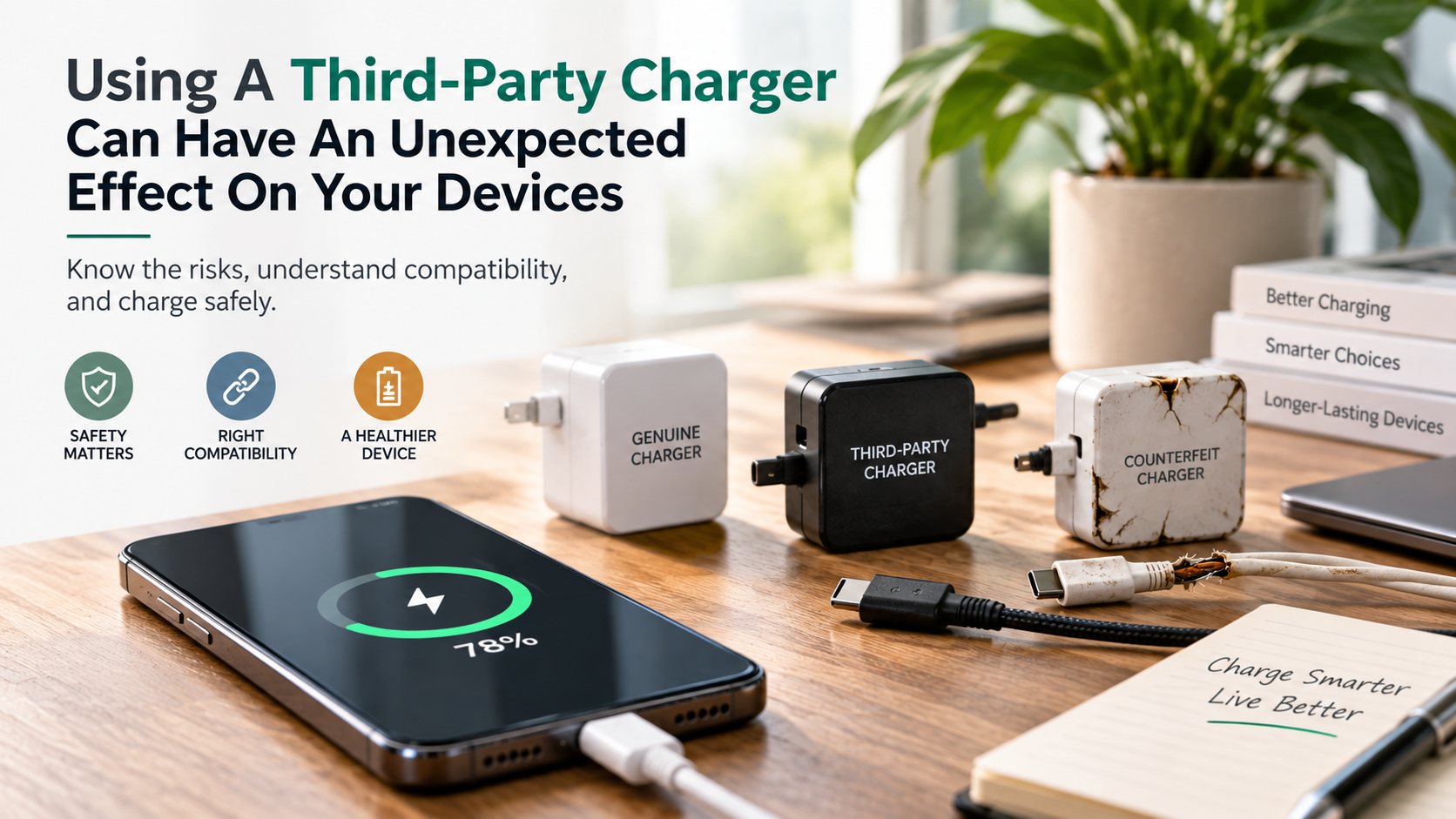
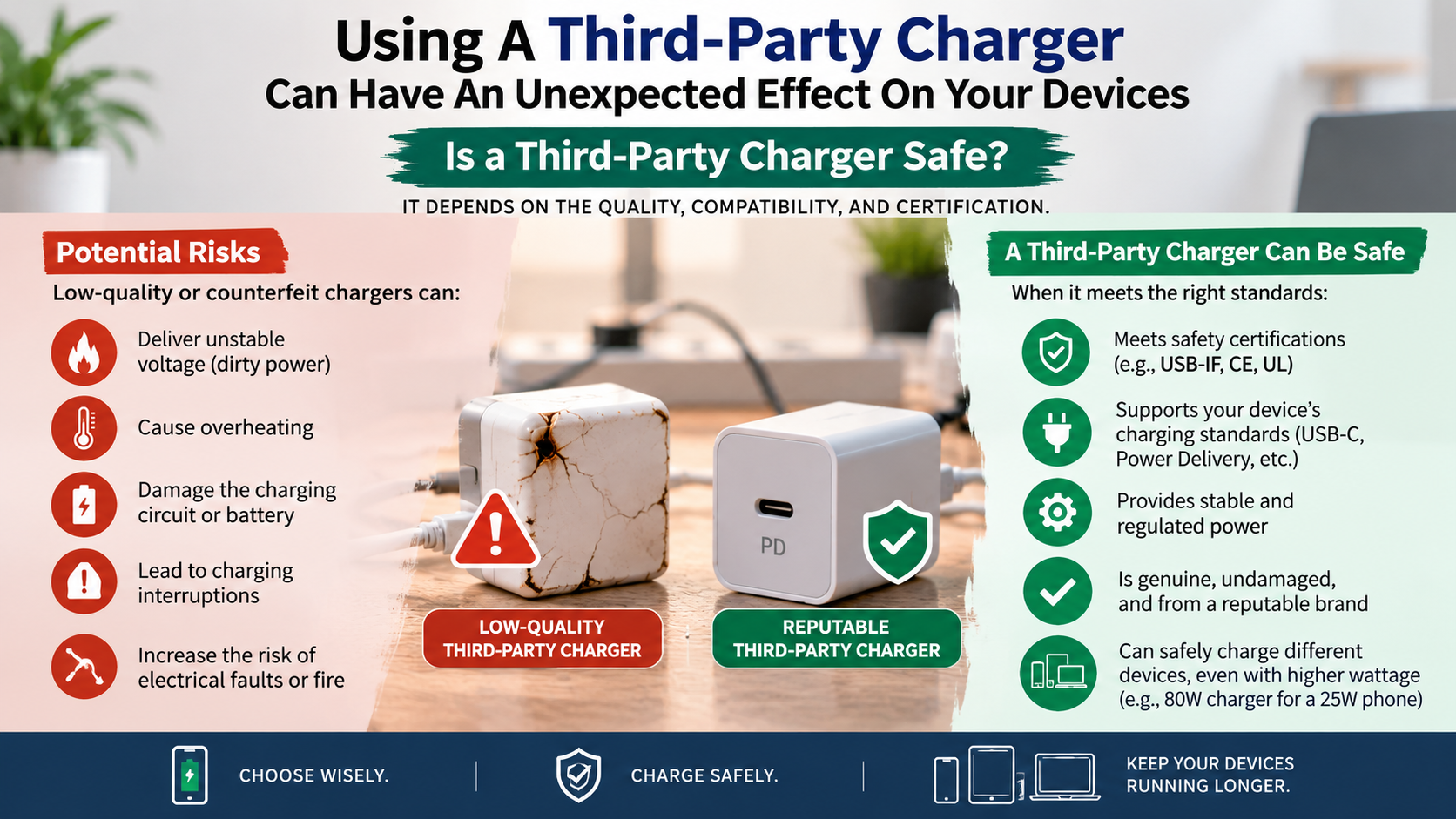
The real concern is not whether a charger is third-party. A reputable third-party charger can be safe and reliable when it meets appropriate standards. The bigger risks come from counterfeit adapters, damaged cables, poor-quality components, and unsafe charging environments.
A high-wattage charger does not automatically damage a lower-wattage phone. Likewise, borrowing a charger is usually safe when the accessory is genuine, undamaged, and compatible. Understanding these differences can help you choose a safe third-party charger without paying for unnecessary accessories.
For USB products, you can also check the official USB-IF certified product search to see products that have passed its applicable compliance program.
Can using a wrong charger mess up your phone?
Yes, a faulty or incompatible charger can damage your smartphone. However, the main concern is not simply using a charger with a higher current rating. Modern phones regulate the power they accept based on their charging system and supported protocols.
A quality third-party charger should provide stable output within the ranges your device supports. Problems can occur when a cheap or defective adapter has poor voltage regulation. Electrical faults can increase heat and place unnecessary stress on charging components. For more information about common charging misconceptions, see Stop Believing These 5 Myths About Charging Your Phone.
In severe cases, a faulty charger may damage the charging circuit, battery, or other internal components. Your phone includes protection systems, but those systems cannot compensate for every defect inside an unsafe adapter.
That makes charger quality, compatibility, and certification important when choosing a replacement.
Watch for unusual heat, charging interruptions, buzzing, burning smells, or repeated disconnections. If these symptoms appear, stop using the accessory. Replace it with a reputable third-party charger designed for your device and charging standard.
Recognizing Dirty Power Symptoms
“Dirty power” generally describes unstable or poorly regulated electrical output. A phone may not always show obvious symptoms when connected to a low-quality charger. Still, unusual behavior deserves attention, especially when it happens only during charging.
A charger should not become excessively hot during normal operation. Some warmth is expected, particularly during fast charging. However, extreme heat, burning smells, crackling sounds, or visible damage can indicate a serious electrical problem.
You may also notice intermittent charging, repeated connection and disconnection, or unexpected charging slowdowns. These symptoms do not automatically prove unstable voltage. The cable, charging port, battery, or phone software could also be responsible.
If your phone becomes unusually hot while charging, disconnect it and let it cool. Do not continue using an adapter with damaged insulation or exposed wiring.
For safer charging, replace questionable accessories with reputable equipment. A properly designed third-party charger should have clear specifications and appropriate safety protections.
Can I use an 80W charger for a 25W phone?
Yes, an 80W charger can generally charge a phone rated for 25W. The charger must support compatible charging standards and provide appropriate voltage profiles. The wattage printed on an adapter represents its maximum output capability. It does not mean the charger automatically forces that amount into every device. For a closer look at charging power, see 5V 1A Vs. 5V 2A: Which Is Better For Charging?
With standards such as USB Power Delivery, compatible devices and chargers negotiate an appropriate charging mode. A 25W phone can request a suitable power level instead of automatically receiving the charger’s full 80W capacity.
Using a higher-rated charger can therefore be perfectly normal. The important factors are charger quality, compatibility, and supported charging protocols.
A reputable high-wattage third-party charger may also support several devices with different power requirements. However, not every fast-charging technology is universal. Some manufacturers use proprietary systems.
Before buying an 80W adapter, check your phone manufacturer’s specifications. Choose a charger that supports the required USB-C, USB Power Delivery, or proprietary charging standard.
The wattage number alone does not determine safety. A quality 80W charger can safely charge a compatible 25W phone when the charging system negotiates correctly.
The Role of Power Delivery Handshakes
Modern charging systems use communication between the charger and device to determine an appropriate power level. USB Power Delivery, for example, allows compatible devices and chargers to negotiate supported voltage and current combinations.
This process prevents a compatible charger from simply delivering its maximum advertised wattage to every device. The phone determines how much power it can accept within the supported charging profile.
If the phone and charger do not support the same fast-charging profile, charging may fall back to a slower compatible mode. The exact behavior depends on the device, charger, cable, and charging standard.
This means an 80W third-party charger does not automatically push 80W into a 25W phone. The device controls the power it accepts.
However, power negotiation does not make every adapter safe. A poorly manufactured charger can still have inadequate insulation, thermal protection, or voltage regulation.
For reliable results, choose a quality third-party charger and suitable cable from a reputable manufacturer. Check that both support your phone’s charging protocol.
Can fake chargers damage an iPhone?
Yes, counterfeit or poorly manufactured chargers can damage an iPhone and create electrical safety risks. The problem is not simply that an accessory is third-party. The real concern is whether the accessory meets appropriate electrical and compatibility requirements.
Low-quality adapters may use inadequate insulation, poor voltage regulation, or insufficient protection against overheating and short circuits. These faults can potentially damage charging components or create fire and shock hazards.
Older iPhones and accessories also used different charging and authentication technologies. Newer iPhone models use USB-C, while many older models use Lightning. Compatibility therefore depends on both the iPhone and accessory.
A counterfeit product may imitate Apple’s branding or certification claims without meeting the relevant requirements. Do not assume expensive packaging proves authenticity.
For safer iPhone charging, buy from reputable manufacturers and established retailers. Look for appropriate safety certifications and compatibility information. You can also learn more about extending battery longevity in How to Improve iPhone Battery Life in 2026: The Ultimate Guide.
For Lightning accessories, MFi certification can also help identify licensed products. For USB-C charging accessories, MFi is not required simply because the product works with an iPhone.
The Importance of MFi Certification
Apple’s Made for iPhone (MFi) program covers third-party accessories that use Apple’s licensed technologies. MFi certification can be particularly relevant when buying Lightning accessories. It helps identify accessories that have gone through Apple’s licensing and certification process.
However, not every third-party charger needs an MFi logo. USB-C charging accessories that do not use MFi-licensed technologies are outside the MFi program.
Therefore, do not treat MFi branding as the only measure of charger safety. For USB-C products, consider the manufacturer’s reputation, electrical specifications, charging compatibility, and applicable safety certifications.
When buying a Lightning accessory, check the manufacturer’s MFi claims and purchase through a trustworthy retailer. Be cautious of products using vague claims, copied Apple branding, or unclear specifications.
The safest approach is to consider the complete accessory rather than relying on one logo. A reputable manufacturer, clear electrical specifications, suitable protection features, and trustworthy sourcing provide stronger evidence of quality. Battery performance also depends on everyday charging habits, as explained in Battery Health Vs. Cycle Count: Which Matters More?
If a product makes unrealistic performance claims or appears counterfeit, choose another option.
Is it safe to use someone else’s phone charger?
Yes, borrowing someone else’s phone charger is usually safe when the charger and cable are genuine, undamaged, and compatible with your device. Modern charging standards are designed to manage power between different devices and adapters.
For example, a quality USB-C power adapter can often charge phones from different manufacturers. The phone and charger determine an appropriate charging mode based on supported standards and power requirements. If you use several devices, understanding Are Chargers With Multiple Ports Slower Than Normal Ones? can also help you choose the right charging setup.
The bigger concern is the condition and quality of the borrowed accessory. Avoid chargers with frayed cables, cracked housings, bent connectors, exposed wires, or signs of overheating.
Unbranded adapters with unclear specifications are also best avoided. If you are unsure about a borrowed third-party charger, check its manufacturer and electrical ratings before using it.
Public USB charging ports create another concern because they can support data connections as well as power. A compromised port could potentially create privacy or security risks.
For everyday charging, using a wall outlet with your own reputable adapter is the simplest option. If you must use a public USB port, consider a charge-only cable or suitable USB data blocker.
Mitigating Public and Shared Hardware Risks
Shared charging equipment deserves more caution than a trusted wall adapter. Public USB ports can potentially establish a data connection between your phone and an unknown device. This has contributed to concerns about “juice jacking,” although the practical risk varies by device and setup.
A safer option is to use your own wall adapter and connect it directly to a power outlet. If you need a public USB charging point, a charge-only cable can reduce the possibility of unwanted data communication.
Always inspect borrowed cables before use. Look for cracked insulation, bent connectors, loose housings, or exposed wiring. Do not use a cable that feels excessively hot during charging.
You should also avoid connecting your phone to unknown computers simply to charge it. If you regularly carry a third-party charger, keep your own trusted adapter and cable available for travel.
These precautions are simple but effective. Power from a trusted wall adapter is generally preferable to connecting directly to an unknown USB port.
The goal is not to avoid all shared charging equipment. Instead, choose accessories and charging methods that minimize unnecessary electrical and data risks.
Are 3rd party chargers safe?
Yes, a third-party charger can be completely safe when it comes from a reputable manufacturer and meets appropriate electrical and charging standards. Many established accessory brands produce reliable chargers for smartphones, tablets, laptops, and other devices.
Modern chargers may use technologies such as gallium nitride (GaN) to reduce size and improve efficiency. They can also include protection against overcurrent, overvoltage, overheating, and short circuits.
These features matter more than whether the charger carries the phone manufacturer’s logo. The greatest risks come from counterfeit and poorly manufactured products.
Extremely cheap adapters may cut corners on insulation, components, thermal management, or quality control. That does not mean every inexpensive charger is unsafe. It means buyers should evaluate the manufacturer and product carefully.
Before purchasing a third-party charger, check the manufacturer’s reputation and technical specifications. Make sure it supports your device’s charging standard and required power range.
Do not assume every third-party product is unsafe. Likewise, do not assume every expensive charger is automatically safe. Build quality, compatibility, compliance, and trustworthy sourcing matter most.
Verifying Essential Electrical Safety Marks
Safety markings can help you evaluate a charger, but not every logo means the same thing. In the United States, UL certification can indicate that a product has been evaluated against applicable safety requirements. TÜV certifications can provide similar evidence in relevant markets.
CE marking indicates a manufacturer’s declaration of conformity with applicable European Union requirements. FCC requirements primarily concern electromagnetic compatibility and emissions. Therefore, an FCC mark should not be treated as a general electrical safety certification.
USB-IF certification can also be useful for compatible USB products. It relates to compliance with applicable USB specifications and certification requirements.
When shopping for a third-party charger, check the manufacturer name, model number, electrical ratings, and relevant compliance information. Avoid products with misspelled branding, copied logos, missing specifications, or suspicious packaging. Understanding charger design can also help, including Why Do Laptop Chargers Have A Box In The Middle Of The Cable?
Buy from reputable retailers whenever possible. A legitimate safety mark is more useful when you can verify the manufacturer and product.
If a charger becomes unusually hot, makes abnormal noises, smells burnt, or shows physical damage, stop using it immediately.
Frequently Asked Questions
Can slow charging damage your smartphone battery?
No, slow charging does not damage your smartphone battery. In fact, charging at slower speeds generates significantly less internal heat compared to fast charging. Reduced thermal stress preserves the lithium-ion chemistry, prolonging overall battery health over time. The only downside is waiting longer for your device to reach full capacity.
Why do cheap charging cables get hot during use?
Cheap cables use extremely thin, low-grade copper wires that create excessive electrical resistance under load. As current pushes through insufficient wiring, the resistance converts electrical energy into dangerous heat. This thermal buildup degrades the internal wire insulation and increases the likelihood of melted connectors, short circuits, and residential fire hazards.
Does fast charging degrade your phone’s battery faster?
Fast charging produces higher internal temperatures, which can slightly accelerate chemical wear on lithium-ion batteries. However, modern smartphones use dual-phase charging routines to manage this wear. They pull maximum wattage up to roughly 80 percent, then taper the power to trickle charging to keep heat levels low and preserve long-term battery longevity.
How can you tell if a phone charger is counterfeit?
Counterfeit chargers typically feel unusually lightweight, use cheap plastics, and feature blurry, misspelled certification logos. Genuine chargers feature clean, laser-etched typography and solid, balanced weight from internal heat sinks. If the price appears too good to be true or the adapter emits a faint buzzing noise, it is likely counterfeit.
Conclusion
Charging your phone should never feel like a gamble. Modern smartphones include sophisticated power management systems, but they still depend on safe and properly regulated electrical power. Choosing a reliable third-party charger can provide excellent performance without compromising device safety.
The biggest risks come from counterfeit adapters, damaged cables, poorly manufactured accessories, and unsafe charging ports. These products may lack adequate insulation, thermal protection, or voltage regulation. In severe cases, faulty charging equipment can damage internal components or create a fire and shock hazard.
A higher-wattage charger is not automatically dangerous. Compatible phones generally control how much power they draw. The key is using a reputable adapter that supports the required charging standard.
Take a moment to inspect the accessories you currently use. Replace frayed cables and questionable adapters. Buy from trusted manufacturers and retailers, and check specifications before connecting unfamiliar equipment.
A small investment in quality charging hardware can protect your phone, battery, and personal data while providing safer, more reliable everyday charging.