
Subjects That Should Be Mandatory in Schools: A Complete Guide
Deciding which subjects that should be mandatory in schools is one of the most important debates in modern education. Every student needs a balanced curriculum that builds practical skills, critical thinking, and academic confidence. Foundational education should combine academic knowledge with real-world abilities that support lifelong learning. UNESCO highlights literacy, numeracy, and social-emotional skills as important foundations for learning throughout life.
Parents, teachers, and policymakers must also consider workload. A strong curriculum should prepare students without creating unnecessary academic pressure. Schools need to balance traditional subjects with emerging skills, including digital literacy and financial awareness. The OECD also emphasizes the growing importance of digital and financial skills in modern education and everyday life.
The exact subjects required vary by country, education board, and grade level. There is no single curriculum that applies to every school system. However, certain subjects consistently provide a strong foundation for students.
This guide examines compulsory subjects, CBSE subject choices, essential academic disciplines, and challenging fields. It also explores how schools can create a balanced curriculum that prepares students for further education, work, and everyday life.

What are the compulsory subjects needed?
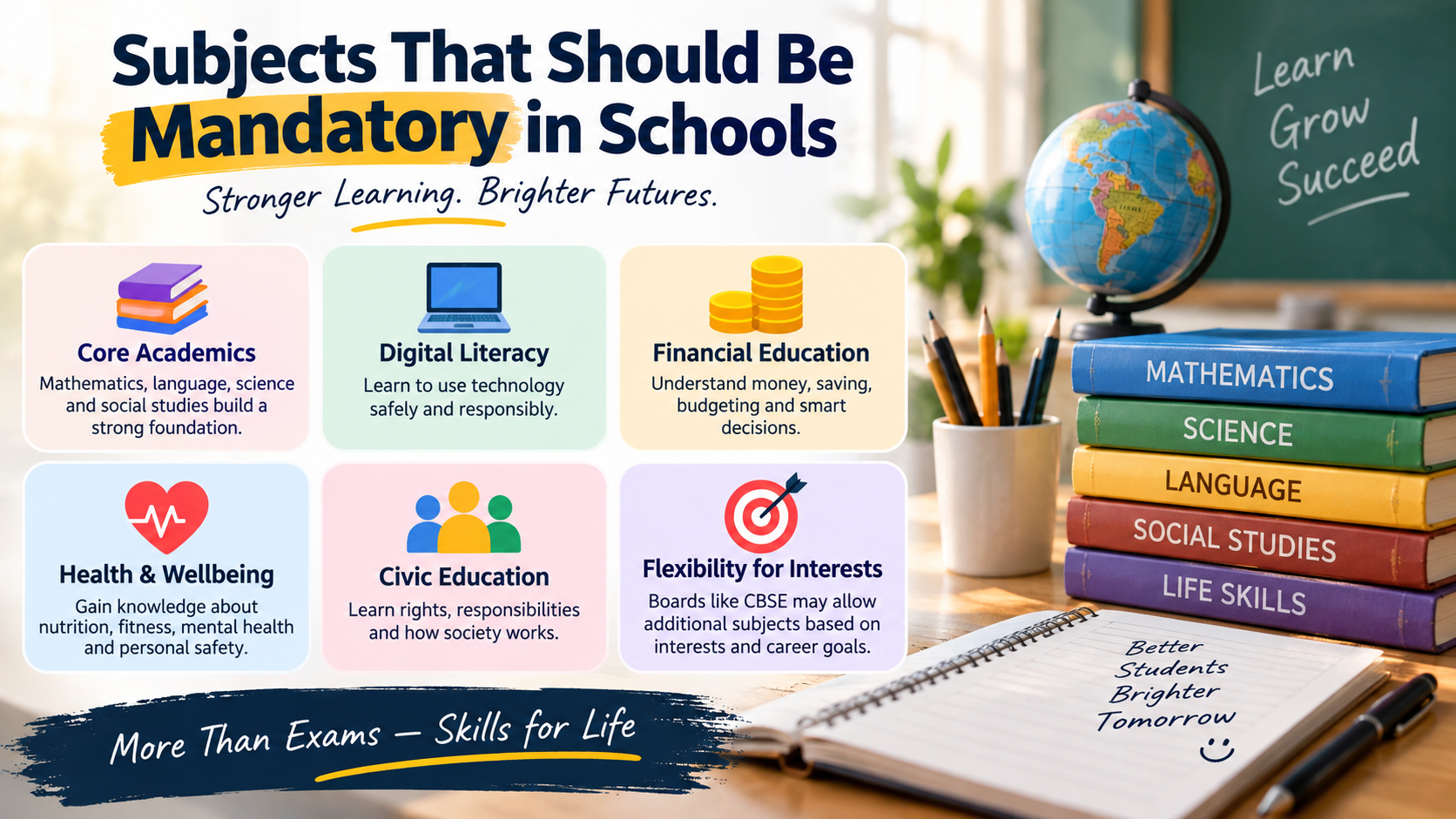
Compulsory subjects should give every student a strong academic foundation before specialization begins. Mathematics develops numeracy, logical reasoning, and structured problem-solving. A primary language builds reading, writing, vocabulary, and clear communication. Science introduces evidence-based thinking and helps students understand the natural world. Social studies also matters because students need basic knowledge of history, geography, government, and society. Students interested in teaching these foundational subjects can explore how to become a teacher and understand the qualifications and steps involved.
Modern schools may also include computing, health education, financial literacy, and civic learning within required programs. These areas address practical challenges students will face outside the classroom. Digital skills help students use technology safely. Financial education supports better decisions about saving, spending, credit, and future planning. Health education can strengthen knowledge about nutrition, wellbeing, and personal safety.
The exact list of compulsory subjects varies by country, board, grade level, and school system. There is no single global list. However, these areas represent strong candidates among the subjects that should be mandatory in schools.
Essential Real-World Competencies
Academic knowledge alone does not prepare students for every responsibility they will face as adults. Schools can strengthen compulsory learning by adding practical competencies alongside traditional subjects. Personal finance is especially useful because students eventually make decisions about budgets, savings, borrowing, taxes, and consumer choices. Basic lessons can provide a useful foundation for responsible financial behavior.
Digital literacy is another important area. Students should understand online privacy, passwords, misinformation, responsible communication, and basic cybersecurity. These skills help them navigate technology without treating every online source as trustworthy. Civic education also deserves attention because students need to understand rights, responsibilities, public institutions, and respectful participation.
Health and wellbeing can support this foundation as well. Age-appropriate education can cover nutrition, physical activity, stress management, relationships, and personal safety. Schools can integrate these competencies into existing subjects and projects. This keeps the curriculum manageable while making education more relevant to everyday life.
Does CBSE allow 7 subjects?
CBSE subject choices can be more flexible than a simple five-subject model suggests. However, students should always check the rules for their class and examination year. In senior secondary education, students may choose combinations that include additional subjects, subject substitutions, and skill-based options, subject to CBSE’s prescribed scheme. Students considering language requirements should also review the CBSE three language policy to understand how language choices fit within the curriculum.
- Additional Subject Options – Students may have the option to take an additional academic or skill-based subject alongside their core subjects.
- Explore Different Interests – An additional subject can help students explore areas such as computer applications, entrepreneurship, languages, or other electives.
- Consider the Workload – Taking another subject also means more assignments, lessons, revision, and examinations. Students should ensure they can manage the additional workload.
- Choose Based on Career Goals – Students should select subjects that match their interests, strengths, future education plans, and potential career paths.
- Check CBSE Requirements – Pass criteria, subject combinations, substitutions, and result calculations can depend on the applicable CBSE regulations.
- Verify Current Rules – CBSE policies can change, so students should consult the latest official CBSE guidelines before registering for additional subjects. Students can also compare CBSE, ICSE, and state boards to understand how different education systems structure subjects and requirements.
An additional subject can provide useful academic flexibility, but it should not be chosen simply because having more subjects appears advantageous. The best combination is one that supports the student’s goals while keeping the overall workload manageable.
What are the top 3 most important subjects?
Three subjects that deserve a strong place in any core curriculum are Mathematics, Language Arts, and Science. Mathematics develops quantitative reasoning, patterns, logical thinking, and problem-solving. These skills appear in everyday decisions and professional fields. Students do not need advanced mathematics for every career, but everyone benefits from basic numerical confidence.
Language Arts is equally important because students use communication skills across nearly every subject and workplace. Reading helps them evaluate information, while writing and speaking help them explain ideas clearly. Strong language skills also support critical thinking.
Science teaches students to examine evidence and ask testable questions. It introduces observation, experimentation, measurement, and evidence-based conclusions. Science also helps learners understand health, technology, the environment, and the physical world.
These subjects should not crowd out humanities, arts, physical education, or practical learning. They form a strong academic foundation. Their value comes from transferability as students build knowledge around their interests. Together, they provide skills that remain useful across education, employment, and everyday decision-making.
Interdisciplinary Value Across Careers
The value of Mathematics, Language Arts, and Science becomes clearer when students use them together. Real-world problems rarely fit inside one school subject. A student preparing a research report may need language skills to explain an argument, scientific methods to evaluate evidence, and mathematics to interpret numerical results.
This combination supports many career paths. Engineers use mathematics and science while communicating designs and findings. Healthcare professionals interpret evidence, calculate measurements, and communicate with patients. Business professionals analyze data and explain decisions. Creative careers also require research and clear communication.
Schools can strengthen this connection through interdisciplinary projects. Students might analyze environmental data, write a report, and present recommendations. Such activities show why subjects matter beyond examinations.
Students still need focused instruction in each discipline. A stronger approach lets students apply skills across subjects. This helps them transfer knowledge, solve problems, and connect different forms of learning. It also shows students that academic disciplines are not isolated areas. Instead, they work together when people solve complex problems in real situations.
What are the 5 main subjects?
A common five-subject core includes Mathematics, Science, Language Arts, Social Studies, and a Foreign Language. However, this is not a universal global standard. Different countries, education boards, and schools define core subjects differently. Some systems make a foreign language compulsory, while others require physical education, arts, technology, or another subject instead. For a broader understanding of how these systems vary, compare CBSE, ICSE, and state boards.
- Mathematics – Supports numeracy, logical reasoning, problem-solving, and quantitative thinking.
- Science – Develops evidence-based thinking and helps students understand natural systems, health, technology, and the environment.
- Language Arts – Builds reading, writing, speaking, vocabulary, comprehension, and effective communication.
- Social Studies – Introduces history, geography, government, economics, culture, and the development of society.
- Foreign Language – Strengthens communication skills, cultural awareness, and understanding of people from different backgrounds.
Together, these subjects provide broad exposure rather than early specialization. They balance quantitative, scientific, linguistic, and social knowledge. A balanced curriculum should still leave room for physical education, creative subjects, technology, and practical skills.
The most useful five-subject model should reflect students’ developmental needs and education-system requirements. The goal should be broad preparation rather than simply following a traditional subject combination.
What are the top 10 hardest subjects?
There is no objective global ranking of the ten hardest subjects. Difficulty depends on the learner, course level, teaching quality, and assessment. University courses can be more demanding than school versions. They are challenging because they combine abstract concepts, mathematics, laboratory work, design, or analysis.
Common examples include:
- Quantum mechanics
- Advanced mathematics
- Organic chemistry
- Biomedical engineering
- Electrical engineering
- Neuroscience
- Law
- Architecture
- Thermodynamics
- Computer science
These fields are demanding for different reasons. Quantum mechanics and advanced mathematics involve abstraction. Engineering and thermodynamics require mathematical modeling and applied problem-solving. Organic chemistry and neuroscience involve detailed scientific knowledge. Law requires analysis of complex rules and evidence. Architecture combines design, technical constraints, and spatial reasoning. Computer science can require algorithms, logic, mathematics, and debugging.
Difficulty should not be treated as a fixed measure of intelligence. A challenging subject often becomes more manageable with practice, strong foundations, effective teaching, and consistent study habits.
Frequently Asked Questions
Should personal finance be a mandatory subject in secondary schools?
Yes, personal finance should be one of the subjects that should be mandatory in schools because financial literacy is an essential life skill. Students should learn budgeting, compound interest, credit scores, taxation, saving, and responsible investing before entering adulthood and the workforce.
At what age should schools introduce compulsory computer programming?
Schools should introduce computer programming around ages seven to nine. Among the subjects that should be mandatory in schools, programming can develop logical thinking, creativity, sequencing, and problem-solving through age-appropriate activities such as block-based coding before students progress to languages like Python.
Why is physical education mandatory in most global school curricula?
Physical education is among the subjects that should be mandatory in schools because regular exercise supports cardiovascular health, emotional well-being, concentration, teamwork, and healthy habits. It also helps counter sedentary lifestyles while supporting students’ overall academic and personal development.
How do compulsory subjects differ from elective subjects in high school?
Compulsory subjects are core courses that all students must complete to meet graduation requirements, making them central to the subjects that should be mandatory in schools. Electives are optional courses selected according to students’ interests, talents, academic goals, or future career plans.
Conclusion
Curriculum design plays a fundamental role in shaping capable, confident, and socially responsible citizens. Establishing balanced subjects that should be mandatory in schools ensures that every student builds essential competencies in mathematical analysis, effective communication, and scientific inquiry. While institutions like CBSE provide helpful flexibility through additional courses, the primary responsibility of secondary education remains constant: providing an accessible, high-quality foundation for every child. Balancing academic rigor with practical life skills prepares students to face modern global challenges successfully. As educational frameworks evolve, teachers, administrators, and parents must advocate for curricula that prioritize critical thinking over rote memorization. Evaluate your student’s current academic track today, emphasize foundational subjects, and encourage electives that develop their distinct individual talents.