
Why We Do See Lightning Before Thunder
Watching a sudden flash light up the dark sky before a deep rumble reaches your ears is a striking experience. If you have wondered why we do see lightning before thunder, the answer involves the different speeds of light and sound. Lightning and thunder actually occur at nearly the same moment during an electrical discharge. However, our senses detect them at different times because light travels much faster than sound. The National Weather Service explains how lightning creates thunder and why the sound reaches us later.
This delay is more than an interesting weather fact. It can also provide useful information about a storm’s distance. By measuring the time between a lightning flash and the following thunder, you can estimate how far away the storm is. The NOAA National Severe Storms Laboratory provides further information about lightning, thunder, and how sound travels through the atmosphere.
Understanding why we do see lightning before thunder also helps explain other common weather experiences. These include seeing lightning without hearing thunder, calculating storm distance, and understanding lightning safety rules.
In this guide, we explain how lightning creates thunder and why the flash reaches you first. We also cover the five-second calculation, the 30-minute thunder rule, and the safest places to shelter during a storm.

What does it mean if you see lightning before thunder?
When you see a lightning flash before hearing thunder, the storm is usually some distance away. Lightning produces both light and sound during the same electrical discharge. However, the light reaches your eyes much faster than the sound reaches your ears. Wired vs wireless audio can also help explain the broader differences between how sound is transmitted and experienced.
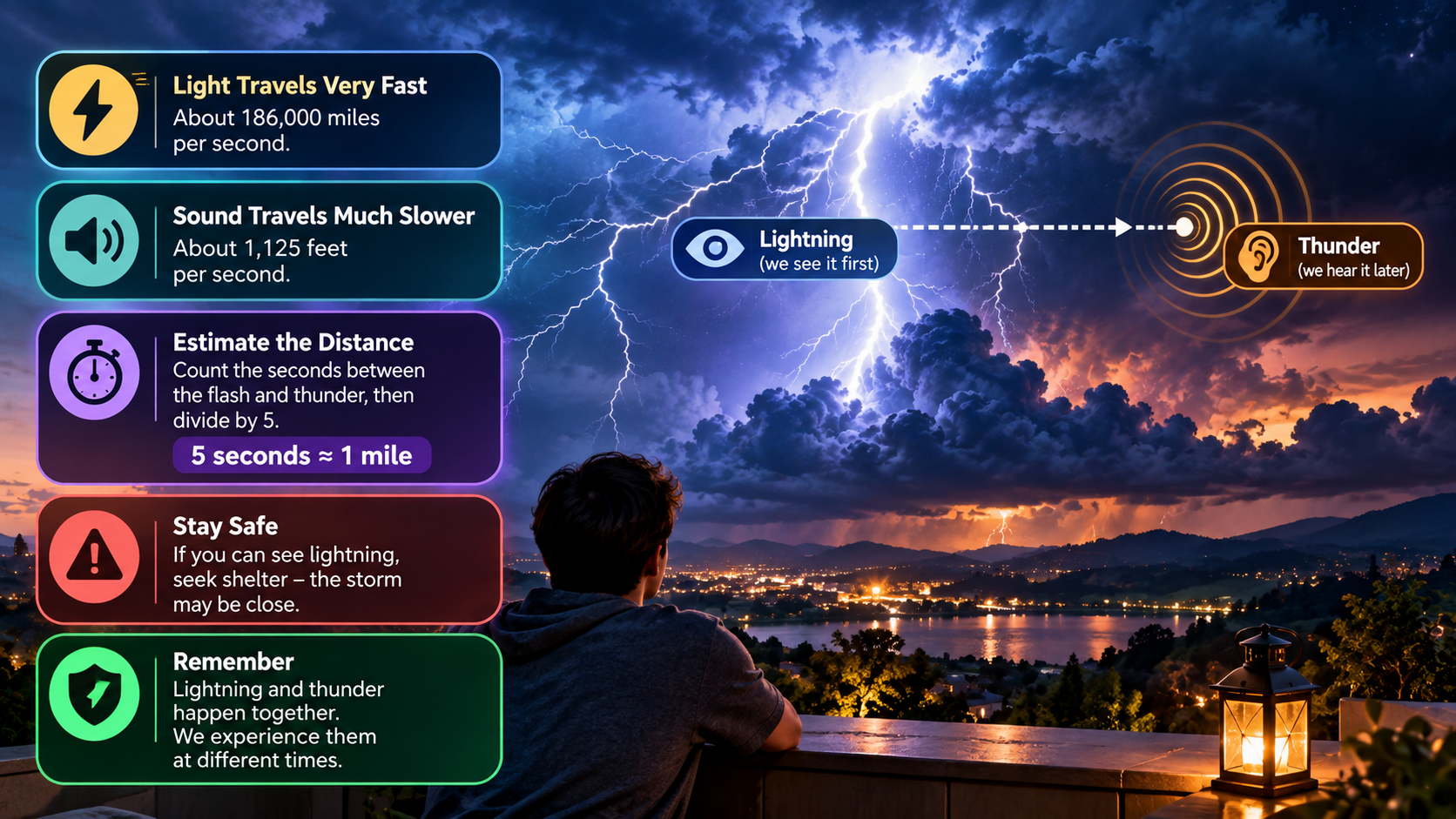
Light travels through the atmosphere at an extremely high speed. Sound, meanwhile, moves through air at roughly 1,125 feet per second under typical conditions. This difference creates the familiar delay between the flash and the rumble.
The length of that delay can help estimate the storm’s distance. A short gap suggests that lightning occurred relatively close to you. A longer gap usually means the strike happened farther away.
For example, a delay of five seconds indicates a distance of about one mile. A ten-second delay suggests roughly two miles. This method provides an estimate rather than an exact measurement.
Remember that nearby lightning requires immediate caution. Do not wait for thunder before seeking shelter. If you can see lightning, the storm may already be close enough to pose a serious risk.
Estimating Distance With the Five-Second Calculation
You can estimate the distance of a lightning strike by counting the seconds between the flash and the thunder. This simple method works because light reaches you almost immediately, while sound takes longer to travel through the atmosphere.
A useful rule is that five seconds of delay equals approximately one mile. Divide the number of seconds between the flash and thunder by five to estimate the distance.
For example:
- 5 seconds: about 1 mile away
- 10 seconds: about 2 miles away
- 15 seconds: about 3 miles away
- 30 seconds: about 6 miles away
The calculation becomes less reliable during unusual atmospheric conditions. Temperature, humidity, wind, terrain, and the storm’s location can affect how sound travels.
Even so, the calculation is useful for understanding storm proximity. A rapidly decreasing time gap means the storm may be approaching.
Most importantly, do not use the calculation to decide whether it is safe to remain outdoors. Any lightning activity means you should seek appropriate shelter.
Why do we see lightning before we heard thunder?
The main reason why we do see lightning before thunder is the enormous difference between the speeds of light and sound. A lightning strike creates both phenomena almost simultaneously. However, light travels through the atmosphere far faster than sound.
Light travels at approximately 186,000 miles per second in a vacuum. Its speed changes slightly when passing through air, but the difference is insignificant for everyday observation. Sound travels through air at roughly 1,125 feet per second under typical atmospheric conditions.
Because of this difference, the lightning flash reaches your eyes almost instantly. The resulting sound waves need more time to travel through the atmosphere before reaching your ears.
This explains why you can see lightning several seconds before hearing thunder. The longer the delay, the farther away the lightning occurred.
The process does not mean lightning happens first. Lightning and thunder are produced together, but you experience them at different times.
This simple difference in travel speed explains the familiar flash-and-rumble sequence during thunderstorms.
Superheated Air and the Origins of Thunder
Thunder begins when lightning rapidly heats the air surrounding its electrical channel. A lightning channel can reach temperatures of roughly 50,000°F, making the surrounding air extremely hot within a fraction of a second.
The sudden heating causes the air to expand explosively. This rapid expansion creates a pressure wave that moves outward from the lightning channel.
As the pressure wave travels through the atmosphere, it develops into the sound waves that we recognize as thunder. The sound may arrive as a sharp crack, a deep boom, or a long rolling rumble.
The type of thunder you hear depends on several factors. These include the distance from the lightning, the shape and length of the discharge, and atmospheric conditions.
A nearby strike may produce a loud, sharp crack. A distant discharge can sound like a prolonged rumble because different parts of the lightning channel reach you at slightly different times.
Therefore, thunder is essentially the sound produced by lightning’s rapid heating and expansion of surrounding air. The lightning flash and thunder happen together, but their signals reach you differently.
Why am I seeing lightning without thunder?
Seeing flashes without hearing thunder does not mean the lightning is somehow silent. In most cases, it means the lightning occurred far enough away that its thunder did not reach you clearly.
Thunder becomes harder to hear as it travels through the atmosphere. Sound waves lose energy with distance and can also be affected by wind, temperature differences, terrain, trees, buildings, and atmospheric conditions.
People often call distant flashes “heat lightning,” especially during warm summer evenings. However, heat lightning is not a separate type of lightning. It is ordinary lightning from a distant thunderstorm that is too far away for you to hear its thunder.
The visible flash can travel much farther than the audible sound. This happens because light loses relatively little energy over these distances compared with sound. The distinction between wired and wireless audio provides another example of how different transmission methods affect what we ultimately hear.
Still, silent-looking lightning should not be ignored. A distant storm can move closer, and lightning can sometimes occur outside the area where heavy rain is falling.
If you see repeated flashes, monitor the storm and move toward a substantial shelter when necessary.
Atmospheric Temperature Inversions and Sound Dissipation
Atmospheric conditions can influence how far thunder travels and how clearly you hear it. Temperature changes between layers of air can bend or refract sound waves as they move through the atmosphere.
Wind can also affect the direction and strength of sound. When sound travels through air with different temperatures or wind speeds, its path may curve rather than moving evenly toward the ground.
These effects can make thunder difficult to hear even when lightning remains visible. Terrain, trees, buildings, and background noise can further reduce the sound reaching an observer.
Sound also becomes weaker as it travels away from the lightning source. Eventually, the thunder may become too faint for human ears to detect.
This explains why distant lightning can appear completely silent. However, there is no fixed distance at which thunder always disappears.
Under favorable conditions, people may hear thunder from storms well beyond ten miles away. Under other conditions, thunder can become difficult to hear at shorter distances.
Therefore, silent lightning should not automatically be considered harmless. It may indicate a distant storm, but changing weather conditions can quickly increase the risk.
What is the 30 minute thunder rule?
The 30-minute thunder rule is a widely used lightning safety guideline. It recommends waiting at least 30 minutes after the last thunder before returning to outdoor activities.
When you hear thunder, lightning is close enough to pose a potential danger. The storm may also produce additional lightning after the rain appears to weaken or the sky begins clearing.
The 30-minute period provides an additional safety margin after the last observed thunder. If another thunderclap occurs during that period, the waiting time should begin again.
People sometimes leave shelter too quickly because the rain has stopped. However, rainfall and lightning do not always end at the same time. A storm can continue producing dangerous electrical activity even when conditions appear calmer.
During thunderstorms, remain inside a substantial building or an enclosed, hard-topped vehicle. Avoid open shelters because they do not provide adequate protection from lightning.
The rule is especially important during outdoor activities such as hiking, sports, camping, and swimming. Planning ahead can help you reach safe shelter before a storm arrives.
Lingering Electrical Danger in Trailing Clouds
Lightning can remain a threat even after the main part of a storm appears to have moved away. Thunderstorms can produce strikes from areas outside the heaviest rainfall.
One example is a “bolt from the blue.” This term describes a lightning strike that can travel outward from a thunderstorm and reach an area with clearer skies.
Such strikes are one reason people should not assume that improving weather means immediate safety. A storm may still contain strong electrical activity even when the rain has weakened or stopped.
Lightning can also strike several miles away from the main area of rainfall. The exact distance varies with the storm and atmospheric conditions.
This is why staying sheltered after the last thunder is important. The 30-minute waiting period allows additional time for the storm’s electrical activity to move away.
Outdoor plans should also include a reliable shelter strategy before the storm arrives. Do not rely on trees, small structures, or temporary shelters.
If thunder returns, treat the storm as an active lightning threat. Remain sheltered and restart the 30-minute waiting period.
What is the safest place during lightning?
The safest place during a thunderstorm is inside a substantial, fully enclosed building. A suitable building provides protection from direct lightning strikes and reduces exposure to electrical currents traveling through outdoor surfaces.
A fully enclosed, hard-topped vehicle can also provide effective protection. Its metal body helps direct electrical current around the passenger compartment rather than through the occupants.
However, not every structure offers reliable protection. Open picnic shelters, gazebos, tents, porches, and similar structures should not be treated as safe lightning shelters.
You should also avoid standing beneath isolated or tall trees. Lightning can strike trees and create dangerous electrical currents that reach people nearby.
If you are outdoors and hear thunder, move toward a proper shelter as quickly as possible. Do not wait for the next flash or thunderclap.
Once inside, remain there until at least 30 minutes have passed since the last thunder.
Planning ahead is especially important for outdoor activities. Identify substantial buildings or suitable vehicles before severe weather develops, including a suitable home office setup if you need to work indoors during severe weather.
The goal is simple: get inside a safe, enclosed shelter before lightning becomes a nearby threat.
Safe Behavior Inside Indoor Shelters
Getting inside a building is the first step, but you should also take sensible precautions while the storm continues. Lightning can travel through electrical wiring, plumbing, and other conductive pathways within a structure.
Stay away from corded electrical equipment and wired telephones during an active thunderstorm. Avoid using plumbing, including sinks, showers, and bathtubs, while lightning is occurring nearby. Third-party chargers can also pose device-safety risks, so use appropriate charging equipment.
It is also sensible to avoid contact with concrete surfaces and exterior doors or windows. Concrete can contain metal reinforcement that may conduct electrical currents.
Keep windows and doors closed and remain inside until the storm has safely passed. Do not stand on porches or near open entrances while lightning is active.
Wireless devices that are not connected to charging cables are generally safer than corded electrical equipment. However, if you need wired audio, use wired headphones without losing the charging port by choosing an appropriate connection method.
Most importantly, follow the 30-minute rule after the final thunder. A temporary break in rain does not necessarily mean the lightning threat has ended.
Taking these precautions reduces your exposure to electrical pathways and helps keep you protected throughout the storm.
FAQ SECTION
Can lightning strike the same place twice?
Yes, lightning frequently strikes the exact same location multiple times. Tall, isolated, and conductive structures like communication towers, skyscrapers, and mountain summits attract repeated discharges during a single thunderstorm. For instance, the Empire State Building sustains dozens of lightning strikes every year. Lightning naturally follows the path of least resistance through the atmosphere, making prominent elevated structures perpetual targets.
How far away can lightning strike from a storm?
Lightning can strike ground locations up to ten to fifteen miles away from the center of a thunderstorm cloud. These distant bolts, often called “bolts from the blue,” originate in the upper reaches of a storm and arc across clear skies before grounding. This long reach is precisely why meteorologists advise seeking shelter the instant you hear thunder.
Does rubber footwear protect you from lightning strikes?
No, rubber-soled shoes or rubber tires do not offer meaningful protection against a lightning strike. A typical lightning bolt carries up to one billion volts of electricity and has already traveled through miles of atmospheric air. A half-inch of rubber cannot insulate your body against such astronomical electrical potential; car safety actually relies on the metal vehicle frame.
What should you do if you are caught outside with no shelter?
If you are caught outdoors with zero accessible shelter, immediately move away from elevated terrain, isolated trees, and bodies of water. Crouch low to the ground on the balls of your feet, tuck your head down, and place your hands over your ears. Keep your feet touching to minimize ground current injury, and never lie flat.
CONCLUSION
Understanding why we do see lightning before thunder illuminates a fascinating dynamic between light, sound, and atmospheric energy. Light travels nearly instantaneously, while sound moves at a steady, measurable pace through the surrounding air. This significant speed gap provides an invaluable early warning system whenever severe convective storms roll across your region.
By paying attention to the time delay between visible flashes and audible shockwaves, you can quickly evaluate your direct environmental exposure and make smart safety decisions. Remembering practical guidelines like the five-second distance calculation and the non-negotiable thirty-minute thunder rule keeps you well out of harm’s way.
Storms are awe-inspiring displays of nature’s raw power, but they demand your utmost respect. The next time turbulent weather threatens your outdoor plans, pay close attention to the sky. Move inside an enclosed, sturdy shelter at the first sign of an electrical discharge, and wait patiently until the skies have safely cleared before stepping back outside.