
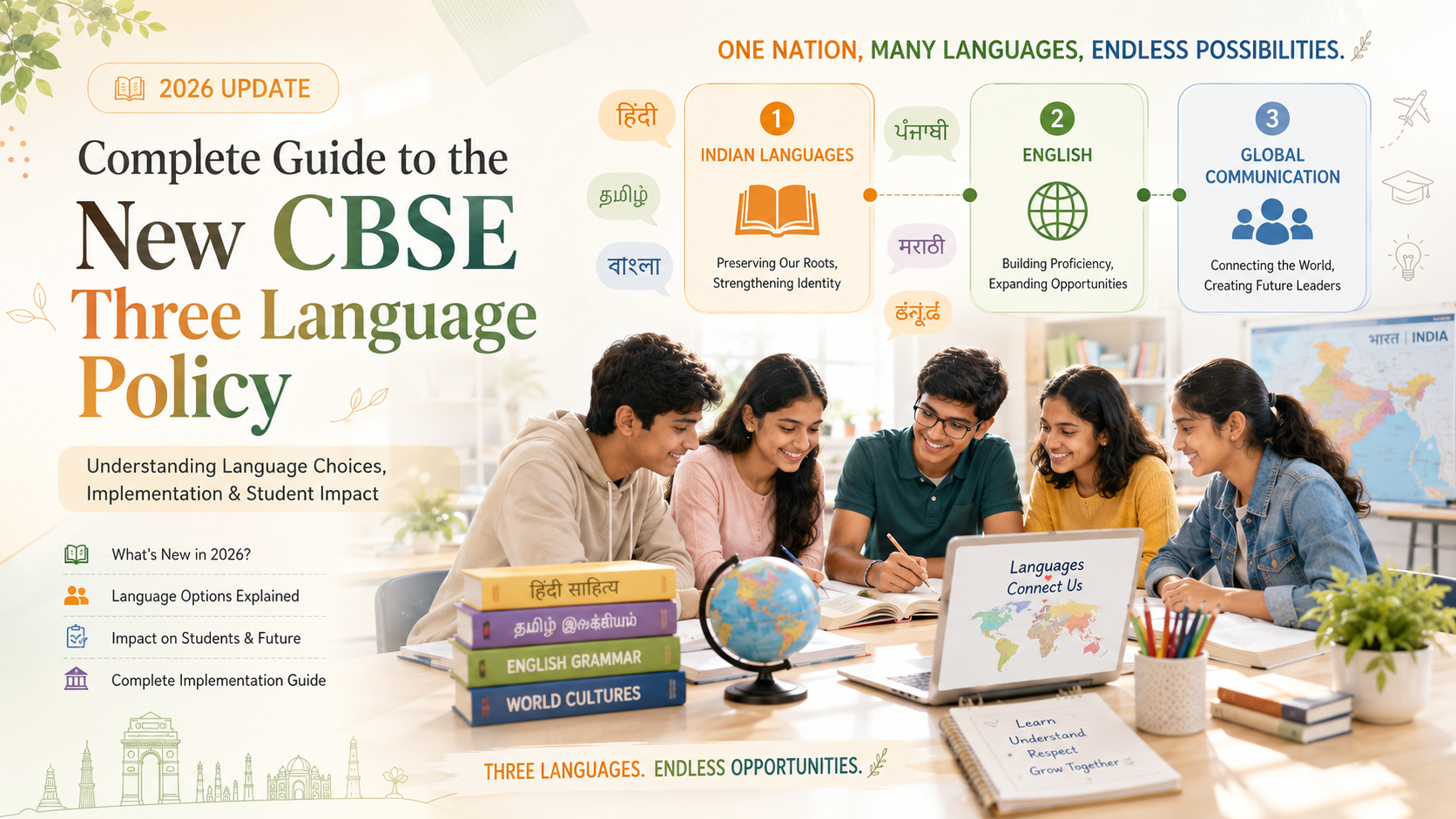
Complete Guide to the New CBSE Three Language Policy (2026 Update)
The cbse three language policy has become one of the most discussed educational reforms after the implementation of the National Education Policy (NEP) 2020. The Central Board of Secondary Education (CBSE) is gradually introducing this framework to promote multilingual learning while preserving India’s linguistic diversity. Many parents and students have questions about language choices, board examinations, exemptions, and the transition process. Understanding these changes is essential because language subjects affect academic planning from the middle school level onward.
The objective of the cbse three language policy is not simply to increase the number of language subjects. Instead, it encourages students to develop proficiency in multiple languages, improve communication skills, and appreciate India’s cultural heritage. At the same time, the policy provides flexibility to schools and states while respecting regional language preferences. Students and parents can review the official CBSE notification on the three-language policy for detailed implementation guidelines and updates.
Students who are already studying under the existing curriculum will continue according to transitional guidelines issued by CBSE. Meanwhile, younger students entering Class 6 under the new framework will gradually experience the revised language structure. This guide explains every important aspect of the policy in simple language, helping parents, teachers, and students understand what to expect in the coming academic years.
What is the CBSE Three Language Policy?
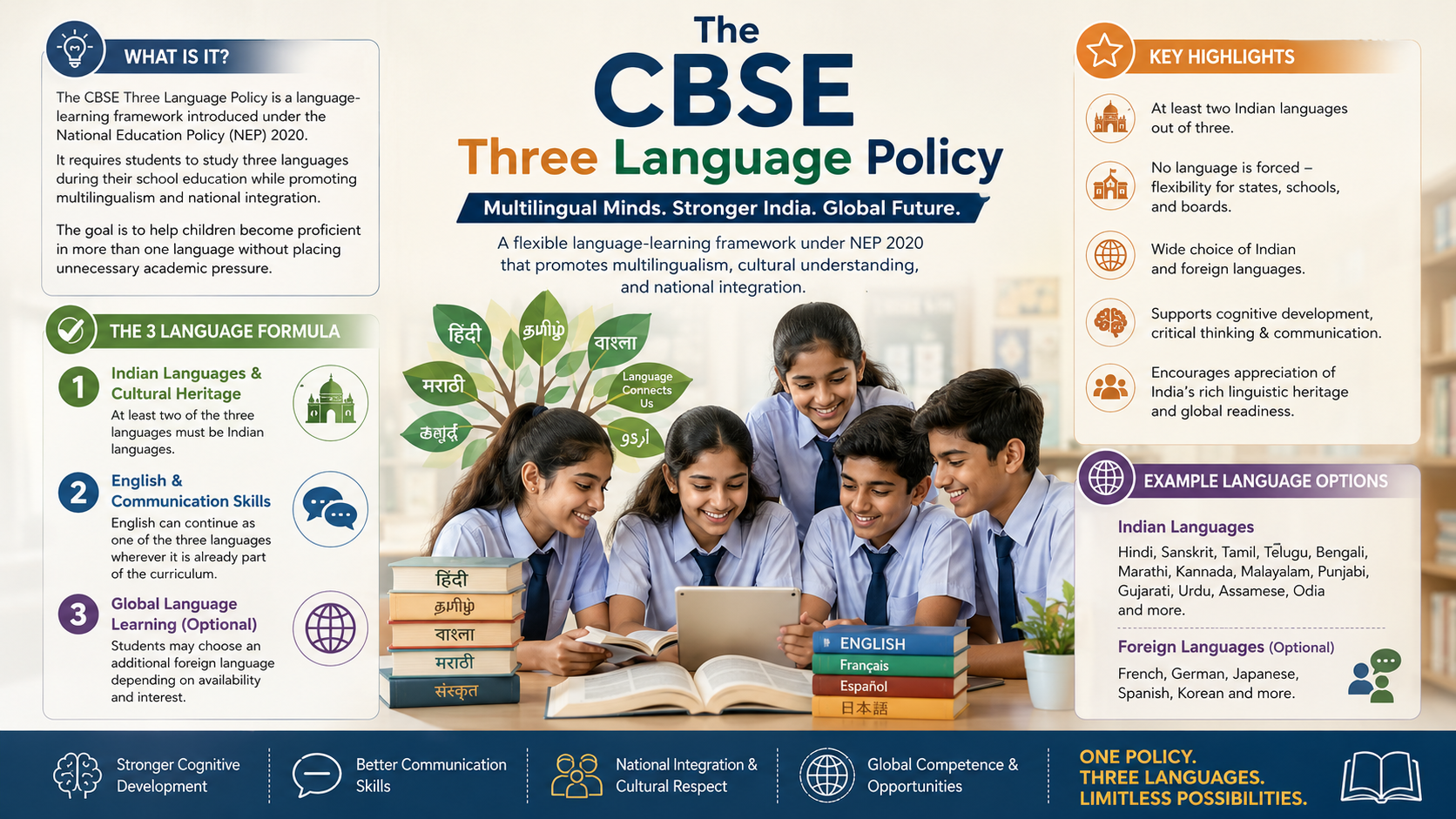

The cbse three language policy is a language-learning framework introduced in line with the National Education Policy (NEP) 2020. It requires students to study three languages during their school education while promoting multilingualism and national integration. The policy aims to help children become proficient in more than one language without placing unnecessary academic pressure on them.
According to NEP 2020, at least two of the three languages should be Indian languages. However, the policy does not force students to learn any specific language. States, schools, and education boards have flexibility when selecting language combinations based on regional needs and available teaching resources. English can continue as one of the three languages wherever it is already part of the curriculum.
Students may study languages such as Hindi, Sanskrit, Tamil, Telugu, Bengali, Marathi, Kannada, Malayalam, Punjabi, Gujarati, Urdu, Assamese, Odia, or other Indian languages offered by their schools. Foreign languages such as French, German, Japanese, Spanish, or Korean may also be offered by schools, usually as optional subjects depending on availability.
The primary objective of the cbse three language policy is to strengthen language skills, improve cognitive development, and encourage students to appreciate India’s rich linguistic heritage while remaining globally competitive.
Implementation of the Policy for Current Students
CBSE has introduced the cbse three language policy in a phased manner to ensure a smooth transition for schools and students. The board understands that many students have already selected language combinations under the previous curriculum. Therefore, it has issued transition guidelines to avoid disrupting their studies.
Students currently studying in higher classes will generally continue with their existing language subjects until they complete their present stage of education. Schools do not need to change language combinations midway through a student’s academic session. This approach protects students from unnecessary academic stress and allows schools enough time to prepare teachers, textbooks, and learning materials.
For younger students entering Class 6 under the revised curriculum, schools will gradually implement the new language structure. The rollout will continue as these students progress to higher classes. Schools also have flexibility in selecting appropriate Indian languages based on local demand and teacher availability.
CBSE has encouraged schools to plan language teaching carefully, provide qualified teachers, and inform parents well before students choose their language subjects. This phased implementation ensures that the cbse three language policy remains practical and student-friendly.
Understanding First, Second, and Third Languages
The three-language framework does not rank languages by importance. Instead, it helps schools organize language learning across different levels of proficiency. Each language contributes to a student’s overall communication skills and cultural understanding.
The first language is usually the student’s primary language of learning or strongest language. Schools teach this language in greater depth, including grammar, literature, comprehension, writing, and communication skills. Students spend more classroom time developing advanced proficiency.
The second language supports additional language development. It may be another Indian language or English, depending on the school’s curriculum and state guidelines. Students learn reading, writing, speaking, and listening skills through structured classroom instruction.
The third language introduces students to another language and encourages multilingual communication. Schools teach the third language at an appropriate level based on the student’s age and curriculum. The focus remains on building practical communication skills rather than creating excessive academic pressure.
This balanced approach allows students to become confident multilingual learners while maintaining manageable academic workloads throughout their school years.
Objectives of the CBSE Three Language Policy
The cbse three language policy supports several educational goals beyond language learning. One of its primary objectives is to strengthen multilingual abilities from an early age. Research suggests that learning multiple languages improves memory, problem-solving skills, creativity, and cognitive flexibility.
The policy also encourages students to appreciate India’s cultural and linguistic diversity. By learning more than one Indian language, students gain exposure to different traditions, literature, and regional histories. This promotes national integration while respecting local identities.
Another important objective is to improve communication skills for higher education and future careers. In today’s global economy, multilingual professionals often enjoy better academic and employment opportunities. Students who develop strong language abilities can communicate effectively in diverse social and professional environments.
The cbse three language policy also aligns Indian education with international best practices that encourage multilingual learning. Instead of memorizing languages only for examinations, students are expected to develop practical language skills through meaningful classroom activities and continuous learning.
Overall, the policy seeks to create confident, culturally aware, and globally competitive learners.
Frequently Asked Questions
What is the 3 language rule for CBSE?
The cbse three language policy is a language-learning framework introduced in line with the National Education Policy (NEP) 2020. Its main objective is to promote multilingual education while preserving India’s rich linguistic and cultural diversity. Under this framework, students study three languages during their school education. The policy encourages schools to include at least two Indian languages among the three language choices, wherever possible, while giving states and schools flexibility to decide the exact language combinations based on local needs and available resources.
The cbse three language policy does not make any single language compulsory for all students. Instead, it allows schools to offer combinations such as Hindi, English, Sanskrit, Tamil, Telugu, Bengali, Marathi, Kannada, Malayalam, Punjabi, Gujarati, Urdu, or other Indian languages. Many schools may also offer foreign languages such as French, German, Japanese, or Spanish as optional subjects, depending on teacher availability and school infrastructure.
The policy aims to improve students’ reading, writing, speaking, and listening skills in multiple languages. Research shows that learning more than one language can improve memory, critical thinking, and communication abilities. It also helps students understand different cultures and strengthens national integration by encouraging appreciation of India’s diverse linguistic heritage.
CBSE is implementing the cbse three language policy in phases so that schools have enough time to prepare teachers, learning materials, and language resources. Students who are already studying under the existing curriculum will generally continue with their current language subjects according to CBSE’s transition guidelines. Parents should always check the latest CBSE notifications because language options and implementation timelines may differ between schools and states.
Is third language compulsory in CBSE Class 10 2026?
Yes. The third language is compulsory under the revised CBSE three language policy. However, Class 10 students will not take a separate Board examination for it.
According to the latest CBSE circular, the revised language framework begins for students entering Class 9 from 1 July 2026. These students must study three languages during Classes 9 and 10. The three languages are classified as R1, R2, and R3. At least two of these languages must be Indian languages, in line with the National Education Policy (NEP) 2020.
CBSE has also clarified how the third language will be assessed. There will be no external CBSE Board examination for the third language (R3) in Class 10. Instead, schools will conduct internal assessments throughout the academic year. These assessments may include class tests, projects, assignments, oral activities, and other continuous evaluation methods.
The final R3 grade will appear on the student’s official CBSE certificate or marksheet. However, a student’s performance in the third language will not prevent them from appearing for the Class 10 Board examinations. This approach supports multilingual learning while reducing examination pressure on students.
Can Students Choose Two Foreign Languages?
No. Under the revised CBSE three language policy, students generally cannot choose two foreign languages as part of the mandatory three-language requirement. The policy follows the National Education Policy (NEP) 2020. It recommends that at least two of the three languages should be Indian languages. This approach promotes multilingual learning and helps students stay connected to India’s linguistic and cultural heritage.
For example, a student may study English and French. However, they must also study an Indian language such as Hindi, Sanskrit, Tamil, Telugu, Bengali, Marathi, Kannada, Malayalam, Punjabi, Gujarati, or Urdu. This combination satisfies the three-language formula.
Many schools also offer foreign languages like French, German, Japanese, Spanish, or Korean. These options depend on teacher availability and school infrastructure. However, foreign languages do not replace the requirement to study Indian languages under the core policy.
Students who want to learn another foreign language may do so if their school offers it as an elective or additional subject. Parents and students should check the latest CBSE guidelines. They should also confirm the available language options with their school before making a final choice.
Will There Be a Separate Board Examination for the Third Language?
No. Under the revised CBSE three language policy, students will not take a separate external CBSE Board examination for the third language (R3) in Class 10. Instead, schools will assess the subject through internal evaluation. This system reduces examination stress and encourages students to build practical language skills.
Schools will use different assessment methods throughout the academic year. These may include periodic tests, classroom participation, assignments, projects, oral activities, and other continuous evaluations. Students will not appear for a separate CBSE Board paper for R3. However, the school will record the final grade. The grade will also appear on the student’s official CBSE certificate or marksheet.
CBSE has confirmed that a student’s performance in the third language will not stop them from appearing for the Class 10 Board examinations. The policy supports multilingual learning without adding another high-pressure board exam.
Parents and students should check the latest CBSE circulars regularly. The board may update assessment rules or implementation timelines as the CBSE three language policy expands to more schools and academic batches.
What if a School Does Not Have Teachers for Certain Languages?
CBSE understands that some schools may not have qualified teachers for every language. This challenge is more common in remote and smaller areas. Under the CBSE three language policy, schools receive flexibility during implementation. This allows them to introduce languages based on available teachers and learning resources.
If a school lacks a teacher for a specific language, it can choose several practical solutions. It may recruit qualified language teachers or hire retired educators with relevant experience. Schools can also share teachers through Sahodaya school clusters. Another option is to use approved online or hybrid learning platforms. These methods help schools provide quality language education without delaying implementation.
CBSE encourages schools to offer only those languages they can teach effectively. School management should plan language choices carefully before the academic session begins. Parents should also confirm the available language options before selecting subjects for their children. As the CBSE three language policy expands across schools, more institutions are expected to recruit trained teachers and strengthen their language-learning facilities. This phased approach helps schools meet policy requirements while ensuring students receive proper instruction.
Conclusion
The cbse three language policy represents an important step toward implementing the vision of the National Education Policy 2020. Rather than increasing academic pressure, the policy aims to develop multilingual skills, strengthen cultural awareness, and improve communication abilities among students. CBSE has adopted a gradual implementation strategy so that schools, parents, and students can adapt without disrupting existing academic plans.
Parents should stay informed through official CBSE notifications because language options and implementation timelines may vary depending on the school and state. Students should choose language combinations based on their interests, future academic goals, and the subjects offered by their schools.
As the education system evolves, the cbse three language policy is expected to create learners who are confident in multiple languages, connected to India’s rich linguistic heritage, and well prepared for higher education and global opportunities. Understanding the policy early helps families make informed decisions and plan a balanced academic journey.
For students looking to improve their learning experience with digital tools, explore our detailed guide on best educational apps for students to discover useful resources that support modern education and better study habits.