
Software ROI for SMBs: How to Calculate It Correctly
Understanding software ROI for SMBs helps small and medium-sized businesses make better technology decisions. Every dollar spent on software should create measurable business value.
Without accurate tracking, companies can waste money on tools that look useful but deliver limited results. A proper ROI analysis helps identify which systems improve productivity, reduce costs, increase revenue, or support growth.
This guide explains how to measure software returns using practical financial methods. It covers the basic ROI formula, SaaS ROI, AI project ROI, the meaning of a 20% ROI, and software ROI in general.
The goal is simple: connect software spending with measurable business outcomes. This makes technology budgets easier to defend and helps businesses avoid costly investments with weak returns. The U.S. Small Business Administration’s financial management guidance also emphasizes tracking costs, benefits, and financial performance when making business decisions. For a broader explanation of how return on investment is calculated and interpreted, see Investopedia’s ROI guide.

Understanding Software ROI for SMBs
Calculating financial returns on digital tools requires looking beyond standard subscription price tags. Small businesses often focus solely on monthly licensing fees while ignoring implementation, training, and workflow migration expenses. A comprehensive financial assessment accounts for both direct cost savings and indirect productivity enhancements. Before committing to a technology purchase, businesses can also evaluate new technology before buying to determine whether the expected value justifies the investment.
Why Traditional Metrics Fall Short
Traditional accounting methods often miss the nuanced benefits that modern cloud platforms provide. When a team adopts a streamlined collaboration tool, the value manifests as hours saved rather than immediate cash generated. Consequently, decision-makers need a balanced evaluation framework that captures both quantitative financial metrics and qualitative employee satisfaction improvements.
Key Components of Financial Return
To build an accurate assessment model, business owners must categorize costs and returns meticulously. Separating these elements prevents distorted calculations and provides realistic expectations before signing multi-year vendor contracts.
-
Initial Licensing and Setup Costs: Implementation fees, custom configuration, and data migration expenses.
-
Ongoing Operational Expenses: Monthly subscription renewals, premium support tiers, and regular maintenance.
-
Tangible Financial Gains: Reduced labor hours, lower error rates, and decreased reliance on legacy hardware.
-
Intangible Benefits: Improved employee morale, faster customer response times, and enhanced data security compliance.
What Is the Formula to Calculate ROI?
The standard ROI formula measures the financial return generated by an investment compared with its cost. It provides a simple way to evaluate whether an investment creates enough value to justify its expense. For software investments, the calculation should include both the total cost and the measurable financial benefits.
The basic formula is:
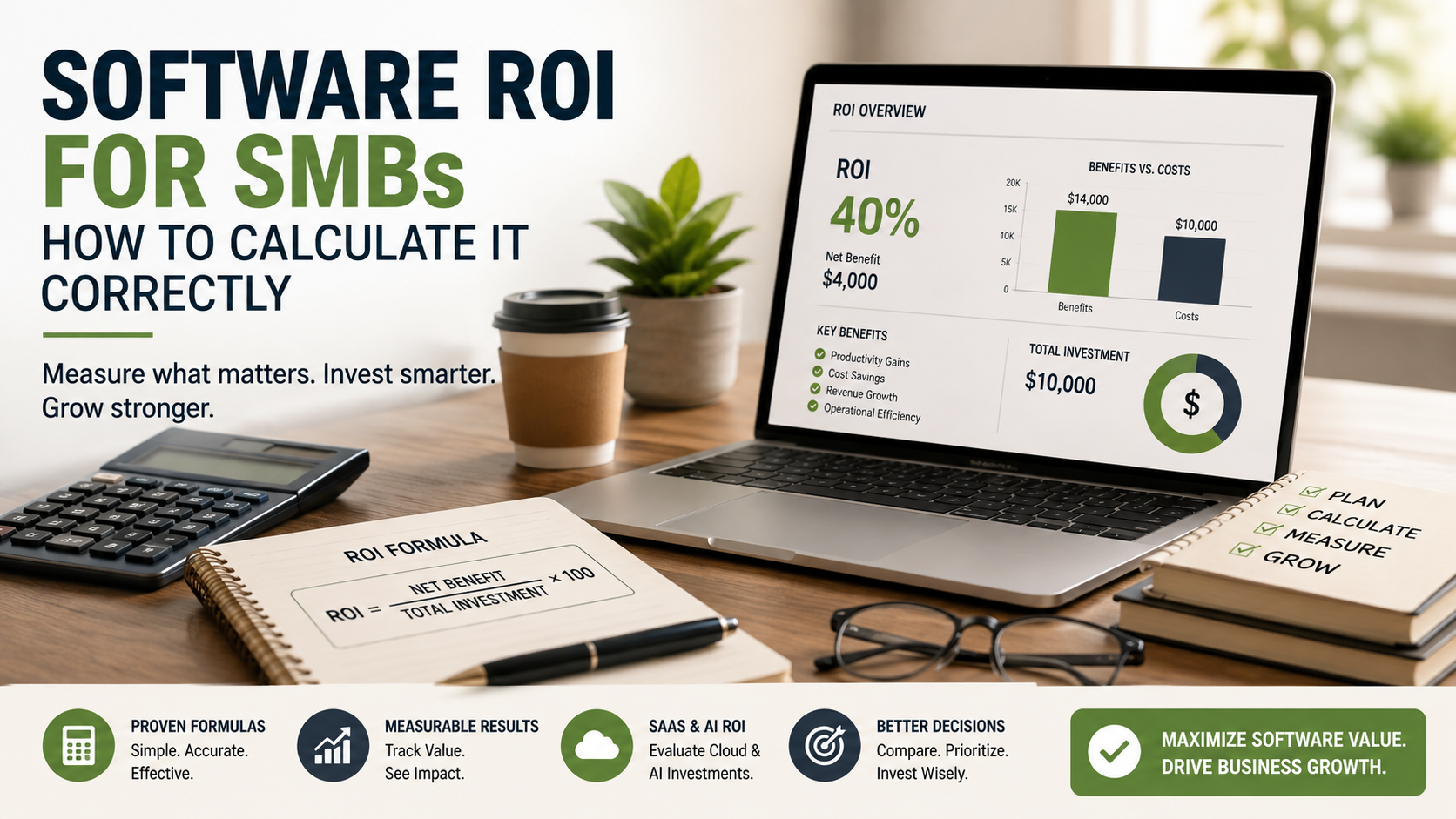
ROI = (Net Benefit ÷ Total Investment Cost) × 100
To calculate net benefit, subtract the total investment cost from the financial value generated. For example, if software costs $10,000 and produces $14,000 in measurable value, the net benefit is $4,000. The ROI is therefore 40%.
This calculation helps business leaders compare different technology investments using the same financial framework. It also reduces reliance on assumptions, marketing claims, or subjective opinions when making software purchasing decisions.

Applying the Basic Financial Equation
Start by identifying every relevant cost. Include subscription fees, implementation expenses, training, integrations, maintenance, and internal labor.
Next, calculate measurable benefits. These may include:
- Labor hours saved
- Additional sales
- Lower operating costs
- Fewer errors
- Reduced processing time
Subtract total costs from total benefits. Then divide the result by total costs and multiply by 100.
For example, software costing $8,000 that generates $10,000 in measurable value produces a $2,000 net benefit. Its ROI is 25%.
Use the same calculation method across projects. Consistency makes it easier to compare software investments and identify which tools deserve continued funding.
How to Calculate ROI for SaaS?
Calculating SaaS ROI requires more than comparing a subscription price with expected savings. Cloud software usually creates recurring costs, so businesses must evaluate its financial impact over a defined period. A monthly subscription can appear inexpensive but become significant when multiplied across employees and years.
Start by calculating the complete SaaS cost. Include subscription charges, setup fees, implementation services, employee training, integrations, and internal administration. Then identify measurable benefits created by the platform.
Productivity gains are often important. Suppose a SaaS platform saves an employee two hours each week. Multiply those hours by the employee’s hourly cost to estimate the financial value of that saved time.
Also consider revenue increases, reduced errors, faster processes, and lower administrative expenses. Compare the total financial benefits with the total SaaS costs.
A realistic SaaS ROI calculation should also account for adoption. Software that employees rarely use cannot deliver its projected financial value.
Factoring In User Adoption Metrics
User adoption can significantly affect SaaS ROI. A business may purchase an expensive platform, yet receive little value if employees avoid using it.
Track practical adoption indicators such as:
- Active users
- Login frequency
- Feature usage
- Workflow completion
- Employee participation
Compare these metrics with the expected usage levels from the original business case.
Low adoption often indicates training problems, poor usability, weak internal processes, or a mismatch between the software and employee needs.
For example, a platform expected to support 50 employees may produce weak returns if only 20 employees use it consistently. The subscription cost remains unchanged, but the expected productivity benefit falls.
Therefore, SaaS ROI should combine financial data with usage data. Improving adoption can sometimes increase ROI without purchasing new software.
How to Calculate ROI for AI Projects?
Calculating ROI for AI projects requires careful measurement because artificial intelligence can create value in several ways. Direct revenue is only one possible benefit. AI can also reduce manual work, improve accuracy, accelerate workflows, and help employees handle larger workloads. This is especially important when evaluating newer AI tools, since businesses should distinguish practical capabilities from claims about what AI agents can actually do in the workplace.
Begin by calculating the complete AI investment. Include software fees, implementation costs, integrations, consulting, employee training, data preparation, and ongoing maintenance.
Next, measure the tasks AI can automate or accelerate. For example, an AI customer support system may resolve routine questions without human intervention. The resulting reduction in support workload creates measurable labor savings.
AI can also improve productivity. If employees complete tasks faster, calculate the financial value of the time saved. Error reduction can provide another measurable benefit when mistakes previously created refunds, rework, or customer service costs.
Compare these measurable benefits with the complete AI investment. Avoid relying only on projected productivity claims. Actual performance data provides a more reliable basis for evaluating AI ROI, particularly when businesses spot hype versus real value before committing more resources.
Measuring Long-Term Efficiency Gains
AI systems can produce changing returns over time. Improvements may appear as employees become more familiar with the technology or workflows become better optimized.
Track performance regularly instead of calculating ROI only once. Useful metrics include:
- Processing time
- Automation rate
- Error frequency
- Labor hours saved
- Customer satisfaction
- Output per employee
Quarterly measurements can reveal whether the AI investment is improving or losing effectiveness.
Long-term analysis also helps separate temporary productivity gains from sustainable improvements. If an AI tool saves time initially but requires significant manual oversight later, its real ROI may be lower than expected.
For SMBs, this ongoing measurement is especially important. Limited technology budgets require businesses to confirm that AI continues generating value after implementation.
What Does a 20% ROI Mean?
A 20% ROI means the investment generated a net return equal to 20% of its original cost. It does not mean the business received only 20% of its money back. The original investment is included when calculating the total value received.
For example, suppose an SMB spends $10,000 on inventory management software. If the software generates $12,000 in measurable value, the net benefit is $2,000.
The calculation is:
($12,000 − $10,000) ÷ $10,000 × 100 = 20% ROI
The business recovered its $10,000 investment and generated an additional $2,000 in value.
Whether 20% is a good ROI depends on the project, risk, timeframe, and available alternatives. A low-risk software investment may be attractive at 20%, while a complex project with significant implementation risks may require a higher return. Businesses can also compare these factors with broader investment ideas and tips for financial success when deciding where limited capital should be allocated.
Therefore, SMBs should avoid judging software investments by ROI percentage alone. The quality and reliability of the underlying benefits also matter.
Evaluating Your Financial Threshold
Every business should establish a minimum acceptable ROI before approving major technology investments.
The appropriate threshold depends on several factors:
- Project risk
- Investment size
- Expected payback period
- Available capital
- Business priorities
- Alternative investments
A 20% ROI may be attractive for one company but insufficient for another. For example, a project requiring major operational disruption may need a higher return to justify the risk.
Businesses should also consider the time required to achieve the projected return. A 20% ROI achieved within six months differs significantly from the same return achieved over five years.
Set a clear financial threshold before evaluating software options. This prevents decision-makers from changing expectations after seeing vendor proposals.
What Is ROI in Software?
Software ROI measures the financial and operational value a software investment creates compared with its total cost. It helps businesses determine whether a technology purchase contributes enough value to justify its expense.
Software ROI can include direct financial benefits such as increased revenue and lower operating costs. It can also include measurable operational improvements. Faster project delivery, fewer errors, reduced administrative work, and improved employee productivity can all contribute to software value.
However, businesses must avoid ignoring hidden costs. Training, implementation, integrations, migration, maintenance, support, and internal administration can increase the actual investment significantly. This is why businesses should measure ROI before investing in new software rather than relying only on the advertised subscription price or expected benefits.
The strongest software ROI analysis therefore considers the total cost of ownership rather than the advertised purchase price alone.
For SMBs, this approach provides a clearer picture of technology performance. Instead of focusing on features, decision-makers can evaluate whether a tool solves a real business problem and produces measurable results.
Total Cost of Ownership Impact
Total cost of ownership (TCO) includes the expenses associated with software throughout its useful life. This can include:
- Licensing or subscription fees
- Implementation costs
- Employee training
- Data migration
- Integrations
- Maintenance
- Technical support
Ignoring these expenses can make projected ROI appear higher than it really is.
For example, software with a low subscription price may require expensive integration work. Another platform may cost more initially but require less training and maintenance.
A reliable software ROI calculation should therefore compare total expected benefits with total ownership costs.
This approach gives SMBs a more realistic view of whether a software investment is financially sustainable. It also helps businesses compare competing solutions on actual business value rather than headline pricing.
Ultimately, the best software investment is not necessarily the cheapest option. It is the solution that delivers measurable value relative to its complete cost and continues to support business goals over time.
FAQ SECTION
How Long Does It Take to See Software Returns?
For Software ROI for SMBs, measurable returns often begin within six to twelve months after full implementation. However, the timeline varies by software type, implementation complexity, and employee adoption. Simple tools may show benefits within weeks, while larger systems can take longer to deliver measurable savings. Track productivity, labor savings, reduced errors, and revenue changes from the beginning. Regular reviews help determine whether the software is meeting its expected financial targets and where improvements may be needed.
Should I Include Employee Training Costs in My Calculations?
Yes. Software ROI for SMBs should include employee training costs, onboarding time, implementation fees, and temporary productivity losses. These expenses contribute to the software’s total cost of ownership and can significantly change the final ROI percentage. For example, employees may spend several hours learning a new system instead of performing their regular duties. External training can also create additional expenses. Including these costs prevents inflated projections and gives your business a more realistic view of the investment’s actual financial performance.
Can Intangible Benefits Be Included in Software Calculations?
Yes, but Software ROI for SMBs should rely primarily on measurable financial benefits. Improvements such as employee morale, customer satisfaction, collaboration, and brand reputation can provide genuine business value. However, these benefits are difficult to convert into accurate monetary figures. Therefore, keep them separate from your core ROI calculation when possible. Focus your financial analysis on measurable outcomes such as saved labor hours, reduced errors, lower operating costs, increased productivity, and additional revenue. Intangible benefits can then strengthen the overall business case.
What Is a Good Return Percentage for Small Business Tech?
There is no single ROI percentage that works for every Software ROI for SMBs investment. A return between 15% and 30% may be reasonable for many small business technology projects, but the right target depends on risk, cost, timeframe, and expected benefits. Low-risk software may justify a lower return, while complex AI systems or custom solutions may require higher returns. Businesses should also consider the payback period and alternative uses for their capital before approving an investment.
Conclusion
Calculating Software ROI for SMBs helps businesses make better technology decisions while protecting limited budgets. A reliable calculation should include software costs, implementation expenses, training, adoption, and measurable financial benefits. SaaS investments require attention to recurring subscription costs, while AI projects need careful tracking of automation and productivity gains.
Focus on actual results rather than vendor promises or optimistic projections. Review your technology investments regularly and compare expected returns with real business outcomes. This approach can help identify wasteful spending, improve budget planning, and direct resources toward software that creates measurable long-term value by using practical investment strategies for financial success.