

How to Measure ROI Before Investing in New Software or Business Tools
Buying new software is exciting, but it can also be a major financial risk. If you want to protect your business budget, you must learn how to measure ROI before investing in any new digital tools. Too many organizations purchase expensive platforms that underdeliver. This mistake leads to wasted capital, abandoned subscriptions, and deeply frustrated teams. By calculating your return on investment early, you ensure that your technology stack actively drives long-term business growth. It also improves operational efficiency instead of draining your cash flow.
This comprehensive guide will break down the exact steps required to forecast software value accurately. We will look closely at hidden implementation expenses, quantifiable productivity gains, and deep strategic alignment. With this analytical framework, your procurement team can make data-driven purchasing decisions with total financial confidence. To protect your capital, you must routinely measure ROI before investing in enterprise platforms.
Why You Must Calculate Software Returns Early
Investing in business tools without a clear financial forecast is like driving in the dark. You might end up with software that your team actively dislikes. You could also buy redundant tools that duplicate existing features already available in your stack. Taking the time to analyze your potential return prevents these costly corporate mistakes. It also ensures resources go where they matter most. It forces your department heads to justify their technology requests with concrete data. This data is much better than emotional appeals about the latest tech trends. To build a highly reliable framework for evaluating these technological expenditures, enterprise procurement teams often rely on research from trusted global analysts like Gartner to guide their software procurement and budget allocation.
Moreover, a proactive financial evaluation helps you secure essential executive buy-in during budget reviews. CFOs and decision-makers rarely approve software expenses based on vague promises of “better workflows” or “happier teams.” They want to see hard numbers, clear payback periods, and definitive profit margins. Proving the financial viability of a platform beforehand builds deep internal trust. It also clarifies business priorities. Finally, it establishes a clear baseline for measuring the software’s success after deployment.
Step 1: Identify and Total All Hidden Implementation Costs
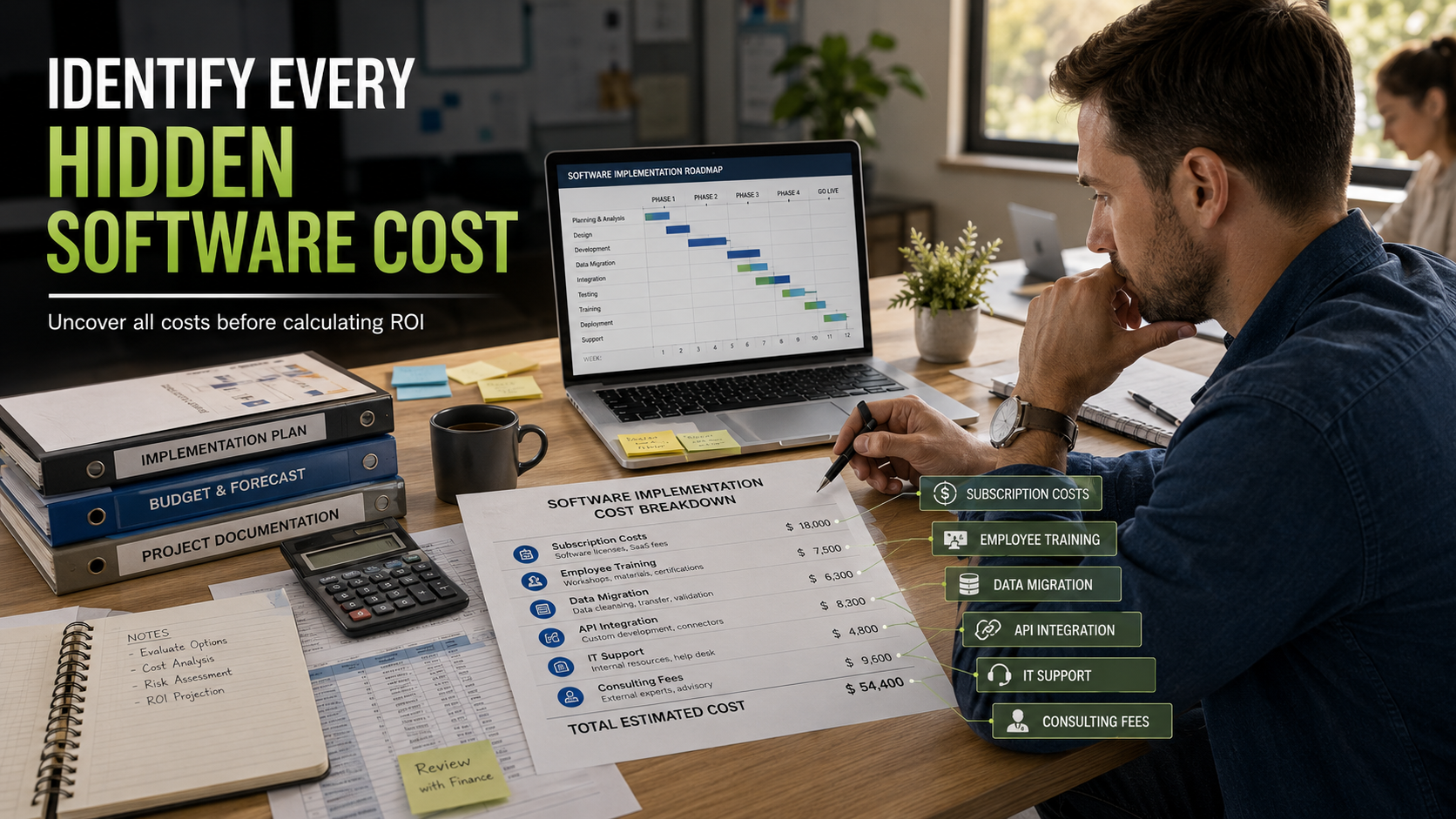
Most software buyers look only at the upfront monthly subscription price, but the true cost of enterprise software goes much deeper. To predict software returns accurately, you must uncover all hidden expenses during your initial research phase. Failing to account for these secondary costs will skew your calculations. It also leads to a false sense of financial security before deployment begins.
Onboarding and Training Expenses
New software always comes with a steep learning curve that temporarily slows down standard business operations. Think about the billable hours your team will spend in training sessions. This time is taken away from performing their core revenue-generating tasks. If the platform is highly complex, you might need to hire external consultants or certified specialists to train your staff. This addition adds substantial professional fees to your total cost of ownership.
Integration and Data Migration Costs
Will the new tool connect seamlessly with your current technology infrastructure? Custom API development, software bridge building, and historical data migration can quickly drain your corporate budget if complications arise. Consider these common technical expenses during your assessment:
-
Data cleansing, formatting, and secure transfer fees
-
Third-party integration platform subscriptions
-
Dedicated internal IT support hours during the initial rollout phase
Step 2: Quantify Expected Efficiency Gains and Cost Savings
Once you know the total cost, you need to calculate the financial benefits of the software. Business tools usually deliver tangible value in two primary ways: saving money or saving time. To build a trustworthy ROI model, you must convert these abstract improvements into concrete dollar values. Base these figures on your current operational metrics.
Calculating Time Reclaimed
If a new project management tool successfully saves each employee two hours per week, multiply those hours by their average hourly wage. For a growing team of twenty people, those saved hours quickly translate into thousands of dollars in reclaimed productivity each month. This saved time allows your staff to focus on high-value strategic tasks. These tasks actively drive business growth.
Eliminating Legacy Systems
A modern all-in-one platform can often replace multiple outdated tools that your company currently pays for. Look closely at your current software inventory. Identify which specialized subscriptions you can safely cancel after migration. Consolidating your software stack provides immediate, measurable monthly cost savings. These savings directly offset the purchase price of the new platform.
Step 3: Run the Numbers to Measure ROI Before Investing
Estimated Net Benefits - Estimated Costs
--------------------------------------- x 100 = Predictive ROI (%)
           Estimated Costs
To run this calculation, subtract your total implementation costs from your projected financial benefits over a specific timeframe. Divide that resulting number by the total costs, then multiply by 100 to get your final predictive ROI percentage. This mathematical formula gives you a standardized metric to compare different software options side by side. It is the most reliable calculation to measure ROI before investing.
For example, if a tool costs $10,000 to implement but brings $15,000 in efficiency gains, your net benefit is exactly $5,000. Dividing $5,000 by the initial $10,000 cost gives you a 50% predicted ROI. Always aim for a highly conservative estimate. Doing this ensures you do not overpromise results to leadership or create unrealistic expectations that your team cannot actually achieve.
Step 4: Evaluate Intangible Benefits and Strategic Alignment
Not every single business benefit fits perfectly into a financial spreadsheet, but qualitative advantages still heavily impact your bottom line over time. You must weigh these qualitative factors alongside your mathematical calculations. This approach gives you a complete picture of the software’s true institutional value.
Employee Experience and Retention
Frustrating, slow, or outdated tools cause severe employee burnout and lower workplace morale. Conversely, introducing modern, intuitive software improves the daily workplace experience, which directly boosts long-term talent retention. While harder to quantify instantly, reducing employee turnover saves your company significant money. It cuts recruitment, hiring, and onboarding costs over the fiscal year.
Data Security and Compliance
Upgrading to a highly secure platform drastically reduces the financial risk of catastrophic data breaches and cyberattacks. Avoiding industry compliance fines and legal fees protects your cash flow. It also safeguards precious customer trust. These are massive financial advantages that easily justify a higher upfront software investment for your organization.
Frequently Asked Questions
How do you calculate ROI on software before purchasing it?
To calculate ROI before making a purchase, you must diligently estimate both the total costs and the expected financial benefits over a set period. First, add up the obvious subscription fees, hidden training costs, data migration expenses, and internal IT support hours. Next, estimate the monetary value of the time your team will save through automation and identify any legacy software subscriptions you can safely cancel. Plug these final numbers into the standard ROI formula: subtract total costs from expected benefits, divide that number by the total costs, and multiply by 100. This gives you a clear, predictive percentage that guides your final buying decision and helps justify the investment to stakeholders.
What is a good projected ROI for business tools?
A good projected ROI varies by industry, but a return of 50% to 100% within the first year is generally considered highly successful for business software. If your financial forecast shows a positive return within six to twelve months, the investment is usually safe and justifiable. However, you should always build a conservative buffer into your calculations to account for unexpected delays. Assume that team adoption might take longer than expected, and ensure the tool remains profitable even under a worst-case adoption scenario. A lower but highly predictable ROI is often better than a massive, risky projection based on perfect execution.
How do hidden software costs affect your ROI calculations?
Hidden costs can completely wipe out your projected software returns if you ignore them during the initial evaluation phase. Expenses like custom API integrations, historical data migration services, mandatory staff training, and ongoing technical support often double or triple the initial sticker price found on the vendor’s pricing page. If you only calculate your returns based on the base subscription fee, your ROI percentage will be inaccurately high, leading to budget deficits later. For an authentic and trustworthy forecast, you must proactively uncover and include every single implementation expense in your upfront cost calculations before signing any long-term software contracts.
Can you measure the ROI of software that does not generate direct revenue?
Yes, you can easily measure the ROI of non-revenue-generating software by focusing heavily on cost reduction and operational efficiency gains. Tools like HR portals, internal communication platforms, or cybersecurity systems save money by automating manual tasks, reducing administrative errors, and preventing costly data breaches. To calculate their true value, carefully measure the total hours saved by your staff and convert that time into labor cost savings based on average corporate wages. Lowering operational expenses and mitigating business risks improves your bottom line just as effectively as generating brand-new sales revenue from marketing campaigns.
How long should it take for a new business tool to show a positive return?
Most mid-sized business software investments should show a positive return within six to twelve months after full deployment across the department. Enterprise-grade software systems with complex migration processes, extensive customization, and global team rollouts might take eighteen to twenty-four months to fully break even. If your initial calculations show that a tool will take more than two years to yield a positive return, you should carefully reconsider the purchase. Long payback periods increase the risk that the software will become obsolete or that your business needs will change before the tool pays for itself.
Conclusion
Learning how to measure ROI before investing in new software protects your business from expensive tech bloat and wasted capital. By diligently tracking hidden implementation costs and mapping out realistic efficiency gains, you can easily filter out low-value platforms before they drain your budget. Remember to keep your financial forecasts grounded in real data rather than the optimistic marketing promises found on vendor websites. Making data-backed technology decisions ensures your business tools always support long-term financial growth. It also enhances employee productivity and delivers measurable competitive advantages in your industry.
Taking the time to measure ROI before investing ensures that your organization remains lean and agile in a competitive market. Software should always serve as a tool for acceleration, not a source of financial strain or administrative confusion. When you establish a standardized, data-backed procurement process, you remove emotion and guesswork from your technology investments. This strategic approach empowers your leadership team to allocate resources with absolute precision, maximizing profitability and operational output across every department.
Just as a business must calculate its technological returns carefully, an individual must evaluate their personal capital strategy with equal discipline. For instance, balancing fixed corporate returns against market-driven growth requires a systematic comparison, much like looking at a SIP vs FD framework to determine which vehicle serves your financial timeline best. Ultimately, whether managing corporate software portfolios or private investments, a disciplined approach to evaluation safeguards your bottom line and sets your business up for sustainable scalability.