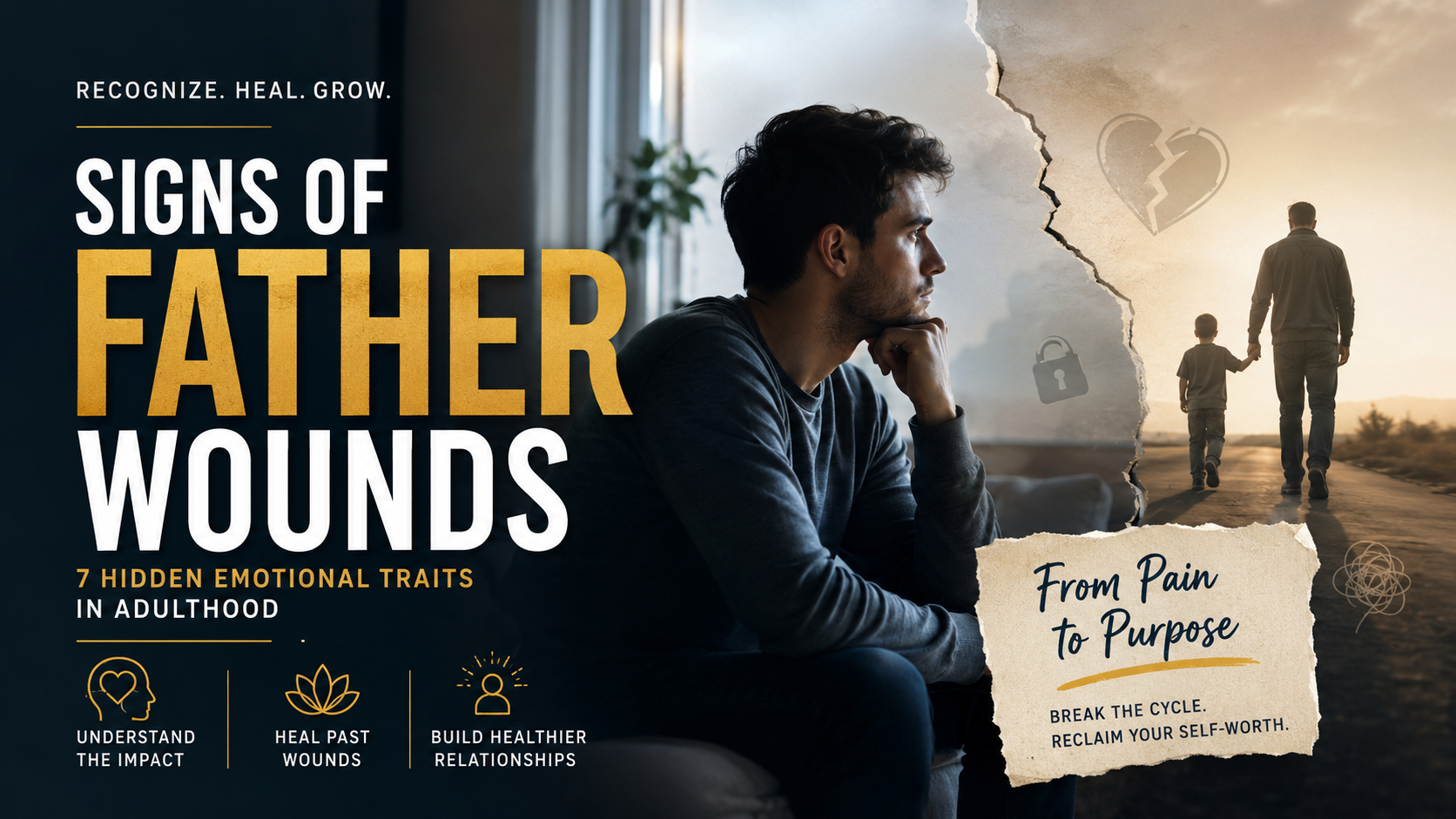
Signs of Father Wounds: 7 Hidden Emotional Traits in Adulthood
Recognizing the Hidden Signs of Father Wounds
Our early bonds with caregivers fundamentally shape how we view ourselves today. In addition, these early experiences influence how we connect with others in mature relationships. Consequently, when a father is absent or distant during childhood, deep emotional scars can form over time. As a result, many adults carry unaddressed emotional pain without ever realizing its true root cause. Therefore, recognizing the signs of father wounds is a vital step toward emotional healing. Ultimately, identifying these patterns helps rebuild your self-esteem while allowing you to form healthier adult relationships.
Furthermore, early paternal trauma can linger for decades across every area of your personal life. For example, experts at the American Psychological Association note that early attachment experiences strongly shape adult mental health. Furthermore, these developmental bonds influence how effectively we set personal boundaries in workplace and social settings. However, when a father fails to provide safety or consistent love, children naturally adapt to survive. Specifically, they build defensive habits that eventually turn into rigid adult coping mechanisms. By understanding the signs of father wounds, you can finally break these negative cycles and step into true emotional independence.
What Is a Father Wound?
Essentially, a father wound describes the lasting emotional impact of an absent, distant, or critical father figure. Although it is not an official mental health diagnosis in clinical manuals, professional therapists widely treat it as a real form of relational trauma. Typically, this internal injury develops during childhood when key emotional needs go completely unmet. For instance, children require physical safety, emotional validation, and warm guidance to thrive. Without these foundational elements, a child’s basic sense of personal security gradually breaks down.
Because fathers teach us how to handle authority and personal vulnerability, this core bond remains essential. Thus, when this key relationship fractures, your intrinsic self-worth inevitably suffers. Moreover, this developmental issue affects people of all genders and age groups equally. For many people, these emotional struggles begin with the experience of growing up without a father, which can shape confidence, attachment styles, and relationships well into adulthood. In adult life, this deep pain often causes chronic self-doubt while fueling an endless search for external approval. Fortunately, spotting the primary signs of father wounds helps you stop blaming yourself, allowing you to process past pain in a constructive way.
7 Common Signs of Father Wounds in Adult Behavior
While this type of trauma presents differently in everyone, several clear behavioral traits directly point back to early paternal neglect or household conflict.
1. Chronic People-Pleasing: A Core Sign of Paternal Neglect
If you grew up constantly trying to earn a distant father’s love, you likely carried that habit into your adult life. Consequently, adults with these trauma scars struggle to set clear personal boundaries with peers. Because they fear that saying “no” will lead to immediate rejection, they continuously compromise their own comfort. For example, you might say “yes” to unfair demands at work, or you might tolerate disrespect from romantic partners.
Indeed, this unhealthy behavior stands as one of the clearest signs of father wounds in adulthood. It directly stems from childhood environments where pleasing a parent felt necessary for basic emotional survival. Therefore, you learned to put other people’s needs far above your own personal well-being. Over time, this self-sacrificing habit creates deep resentment while causing severe mental burnout. Ultimately, healing requires you to learn that your personal worth does not depend on pleasing everyone around you.
2. Perfectionism and Fear of Failure: Performance-Based Paternal Trauma
Did your father only praise you when you achieved top grades or athletic wins? If so, you may have internalized the false belief that you are only valuable when performing perfectly. Later in adulthood, this rigid mindset creates extreme perfectionism alongside a constant fear of failure. As a result, you may find it nearly impossible to relax, since taking downtime triggers intense feelings of guilt.
Similarly, this driving compulsion serves as another common item on the list of signs of father wounds. Although perfectionism acts as a protective shield against potential criticism, it leads directly to high anxiety and emotional exhaustion. Because you constantly move the goalposts on your achievements, you rarely feel satisfied with your progress. Thus, real relief comes only when you separate your intrinsic human worth from your daily productivity.
3. Insecure Attachment: Emotional Signs of Father Wounds in Dating
Our earliest childhood bonds heavily shape how we handle intimacy in romantic partnerships. Therefore, unhealed paternal pain frequently creates unstable attachment styles during adulthood. For instance, adults with absent fathers often develop an anxious attachment style in dating. Consequently, they constantly fear abandonment while checking their partner’s changing moods for signs of distance.
Conversely, other individuals develop an avoidant attachment style to protect themselves. Instead of seeking closeness, they push partners away whenever emotional intimacy begins to grow deeper. Because they view vulnerability as dangerous, they rely on strict self-reliance so no one can hurt them again. Clearly, these unstable attachment struggles serve as major signs of father wounds in adult relationships. However, directly addressing this root trauma empowers you to build stable, lasting connections.
4. Struggles with Self-Worth: Chasing Status Due to Paternal Validation Gaps
Relying entirely on career achievements to feel adequate often points to early emotional neglect. Although you may build an impressive resume and earn high pay, you might still feel an empty space inside. Because your father did not value you simply for who you were, you learned to chase status as a substitute for love.
Thus, this endless drive for professional success is among the more subtle signs of father wounds. Unfortunately, the joy of reaching a new milestone fades quickly, forcing you to chase the next achievement just to stay ahead of self-doubt. However, status and material awards can never truly heal an old emotional injury. Instead, true self-worth emerges when you learn to value your internal character rather than your external work output.
5. Hostility Toward Authority: Behavioral Signs of Paternal Conflict
Unresolved childhood frustration often targets institutional leaders and authority figures later in life. For example, if your father was overly strict or unfair, you might feel an automatic anger toward workplace managers. Consequently, you may view every company directive as an attempt to control you, leading to unnecessary conflicts on the job.
On the other hand, if your father was passive or uninvolved, you might lack respect for leadership altogether. As a result, you might dismiss rules or resist helpful guidance from mentors. Because these reactive patterns hurt your career growth, they represent clear signs of father wounds. Healing means recognizing that current supervisors are not your parent, allowing you to respond to workplace situations with logic instead of past anger.
6. Low Emotional Tolerance: Suppressing Paternal Scars
Was showing emotion treated as a weakness in your childhood home? Whenever sadness brought harsh words or cold silence, you learned to hide your feelings to stay safe. Consequently, as adults, individuals raised in these environments develop a low tolerance for emotional vulnerability. Rather than expressing distress calmly, you might suppress your feelings until they explode as sudden anger.
Furthermore, this emotional shutdown remains one of the major signs of father wounds. To protect yourself, you might use humor or workaholism to keep loved ones at a safe distance. Similarly, you may feel uncomfortable when others express sadness around you, urging them to fix problems fast instead of listening. Overcoming this deep fear takes time, as you must create a safe internal space to feel emotions without harsh self-judgment.
7. Repeating Toxic Patterns: Relational Signs of Father Wounds
Naturally, people tend to choose what feels familiar, even when that familiarity causes deep pain. If you grew up with an emotionally distant or critical father, you might repeatedly choose partners with those exact negative traits. Subconsciously, you hope to rewrite your past story by finally winning the love of someone who resembles your parent.
Unfortunately, recreating this painful dynamic is one of the most destructive signs of father wounds. Instead of achieving healing, this cycle leads to fresh heartbreak and renewed self-doubt. You repeatedly find yourself chasing distant partners while mistaking emotional chaos for true connection. Therefore, breaking free requires conscious choices, as you must actively choose partners who offer steady respect, safety, and emotional availability.
The Path to Recovery: Healing Paternal Trauma
Spotting these emotional traits in your life can certainly feel painful at first. However, increased self-awareness opens the door to real, lasting personal growth. Fortunately, healing does not require your parent to apologize, since recovery focuses entirely on your peace and self-discovery.

Mourn the Loss of the Parent You Needed
First, real healing starts with radical acceptance and honest emotional grieving. You must allow yourself to mourn the supportive father you deserved but never had. Sadly, many adults delay their recovery by holding onto false hope while waiting for an abusive or detached parent to change.
However, facing this childhood sadness helps release its grip on your current life. Grieving validates your real experiences while stopping you from chasing approval from someone who cannot give it. As you move through this grief, you gradually separate your personal identity from your parent’s past choices. Consequently, you can focus your energy on building a bright, independent future.
Practice Self-Reparenting Techniques
In addition, self-reparenting means giving yourself the care and validation you missed out on during childhood. By doing so, you become the wise, caring guardian of your own inner child. Naturally, this practice transforms how you talk to yourself during stressful moments or personal setbacks.
-
Validate your feelings: Tell yourself that it is completely acceptable to feel sad, angry, or anxious without making excuses.
-
Show self-compassion: Notice your harsh inner critic and actively replace those negative thoughts with gentle, realistic words.
-
Set clear limits: Protect your mental health by setting firm boundaries with toxic family members and unsupportive friends.
Work With a Professional Therapist
Because deep relational trauma is difficult to resolve alone, seeking professional help is highly effective. A qualified therapist offers a safe, structured environment to process painful memories without judgment. Thus, professional support accelerates your recovery while teaching you practical tools for daily life.
For example, Cognitive Behavioral Therapy (CBT) helps you rewrite negative beliefs about your self-worth. Meanwhile, inner child work lets you reconnect with younger, hurting parts of yourself in a gentle way. Additionally, EMDR therapy effectively processes traumatic memories stored in the body. Ultimately, therapy provides the exact skills needed to navigate the signs of father wounds while building safe, healthy relationships.
Frequently Asked Questions
Do women and men show the signs of father wounds differently?
Yes, cultural norms often change how these trauma traits appear in daily life. For instance, men raised by distant fathers often hide their emotional pain behind extreme self-reliance or sudden anger. Consequently, they may bury their distress in long work hours, intense sports, or substance use. Conversely, women with similar backgrounds may struggle more visibly with low self-esteem in social settings. Often, they stay hyper-alert in dating or repeatedly choose emotionally distant partners to seek late validation. Nevertheless, despite these external differences, the underlying injuries remain identical across all gender identities. Specifically, these core issues include a deep fear of abandonment, low intrinsic self-worth, and severe trouble setting clear personal boundaries.
Can I heal from these emotional scars if my father refuses to apologize?
Yes, true healing is an internal process that depends entirely on your self-awareness and personal choices. Therefore, waiting for a critical parent to admit their past mistakes usually brings fresh disappointment and frustration. Instead, real healing means shifting your focus away from changing their behavior so you can focus on caring for yourself. By processing your feelings independently or through professional therapy, you can achieve genuine emotional closure over time. Furthermore, you learn to validate your own past experiences while setting realistic limits for any future contact with your father. Ultimately, this self-directed approach protects your long-term mental health regardless of how your parent chooses to act.
How can I stop bringing these childhood trauma patterns into my dating life?
Healing begins with actively noticing your personal triggers during relationship arguments or stressful moments. Thus, pay close attention to your automatic reactions whenever interpersonal conflict arises in your life. For example, ask yourself whether you tend to cling out of fear or pull away to protect your feelings. Furthermore, share these historical triggers openly with your partner so they can understand your emotional background better. In addition, practice mindfulness and grounding exercises to stay present during tense conversations rather than reacting on impulse. Finally, consider entering couples or individual therapy to learn healthy communication skills. Taking time to pause allows you to respond as a calm adult rather than an anxious, protective child.
What is the main difference between an absent father and an emotionally distant father?
An absent father is physically missing from your daily life due to desertion, divorce, incarceration, or death. Consequently, this physical absence leaves an obvious structural void in your home during crucial developmental years. On the other hand, an emotionally distant father lives with you or maintains regular contact throughout your life. However, he remains cold, critical, or detached from your emotional needs. While physical absence creates an obvious loss that is easy to name, emotional absence causes subtle confusion for a growing child. Often, you may wonder why a physically present parent refuses to connect with you, leading to self-doubt. Nevertheless, both situations break secure attachment bonds and leave deep emotional scars that require conscious effort to heal in adulthood.
Can self-help books and articles fully resolve childhood relational trauma?
Self-help books, podcasts, and educational articles certainly offer great value by providing language for your emotional experiences. Furthermore, reading these resources helps you realize that you are not alone in your recovery journey. However, complex relational trauma involves deep nervous system responses and subconscious defense habits that developed over many years. Therefore, reading alone rarely resolves these deeply ingrained behavioral patterns entirely on its own. Instead, professional therapy provides a safe, interactive environment where you can safely process painful memories in real time. Ultimately, a trained therapist guides you as you unlearn old defense mechanisms, helping you build real emotional safety in ways that solitary reading cannot achieve.
Conclusion
Carrying old emotional pain into adulthood often feels like carrying an invisible, heavy weight into every room you enter. From self-doubt and perfectionism to dating struggles, the signs of father wounds quietly shape choices until you consciously address them. However, spotting these traits in your life is not about placing endless blame on your parents for past mistakes. Rather, it is about taking full control of your present life and making healthier choices for your future.
By grieving past losses, practicing active self-compassion, setting firm limits, and seeking therapy, you successfully break painful generational cycles. Although healing takes time and steady effort, prioritizing your mental health brings deep personal freedom. Consequently, you can build secure, loving relationships while living life entirely on your own terms.