
The Screen Fatigue Revolution: Why the Next Big Tech Trend Is Completely Screen-Free
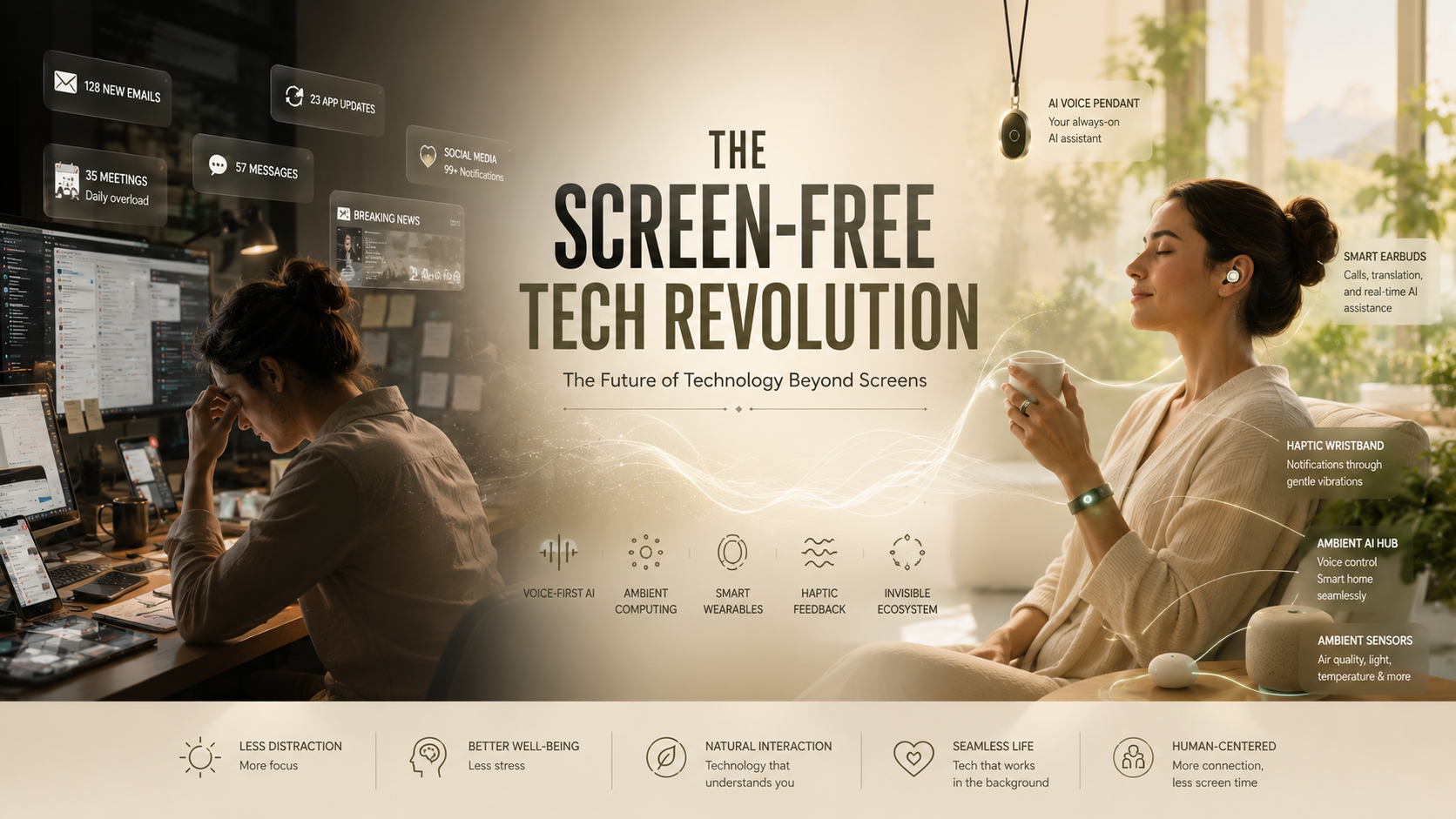
The screen-free tech trend is changing the future of technology by moving away from constant screen interaction and toward smarter, more invisible digital experiences. Instead of measuring innovation by bigger displays and brighter visuals, the industry is now exploring technology that works quietly in the background.
For years, the technology industry measured progress through bigger displays, sharper visuals, and faster devices. Smartphones, tablets, smartwatches, and computers became central parts of everyday life, creating an always-connected society. However, this convenience introduced a new challenge: digital exhaustion.
People now spend a significant portion of their day interacting with screens. Work, entertainment, communication, and even basic tasks require looking at a glowing display. Over time, this has contributed to:
- Digital eye strain and headaches
- Reduced attention spans
- Sleep disruption caused by excessive screen exposure
- Constant notification overload
- Difficulty disconnecting from technology
The growing frustration with these problems has created the screen-free tech trend, a movement focused on making technology less visible but more intelligent.
Companies working on next-generation human-centered technology, such as Apple Technology Newsroom and Google AI, are exploring ways for digital experiences to become more natural, contextual, and integrated into everyday life.
The goal is not to remove technology from our lives. The goal is to redesign technology so it supports human behavior rather than controlling it.

The Rise of Digital Fatigue Behind the Screen-Free Tech Trend
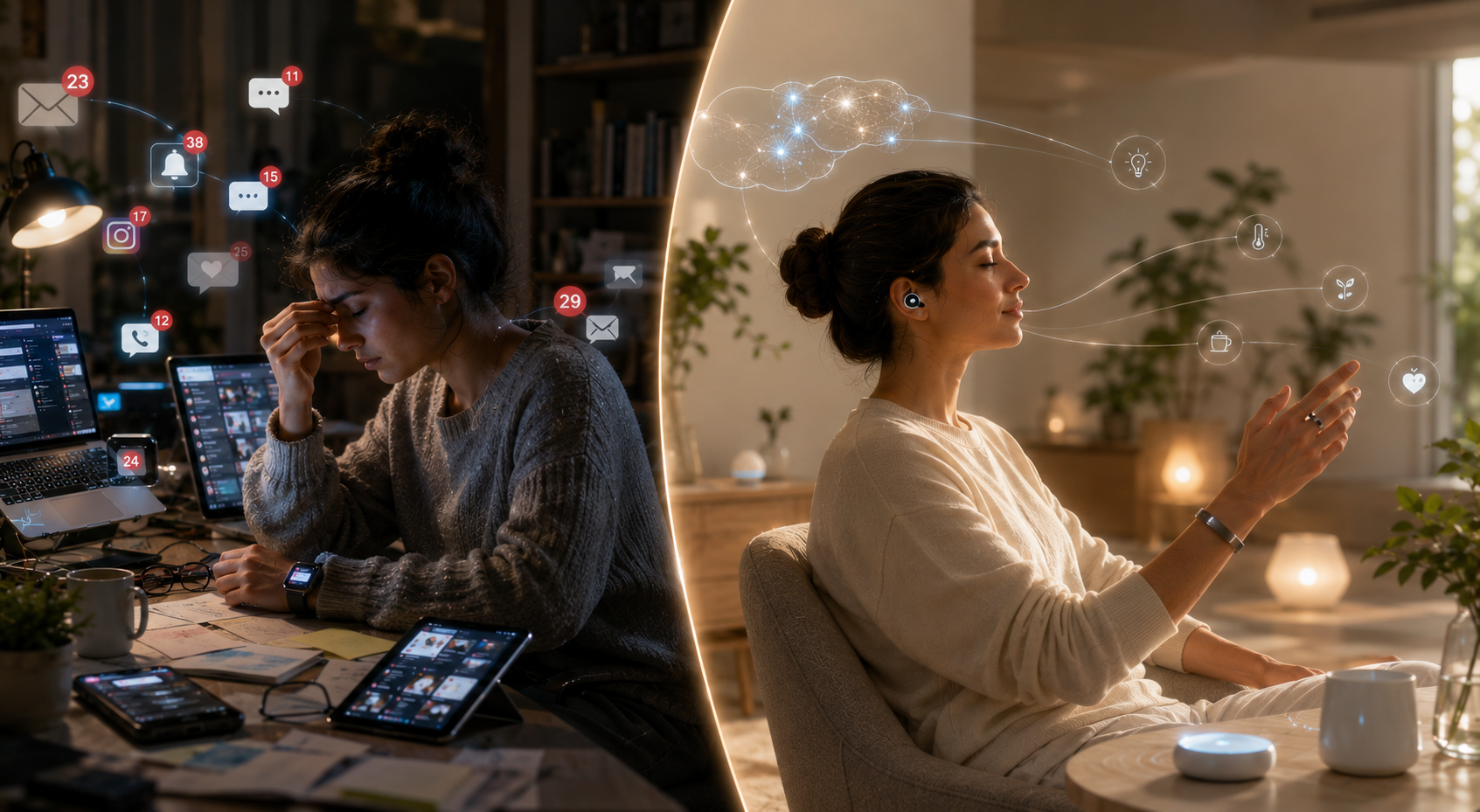
The challenge is not technology itself — it is the constant demand for our attention.
Modern digital life has become deeply connected to screens. Every morning, many people begin their day by checking notifications, replying to messages, and scrolling through updates. Throughout the day, work often requires hours in front of computers, while smartphones continue to compete for attention during breaks and personal time.
As a result, technology has created a cycle where people remain connected but mentally exhausted. Instead of simply supporting daily activities, digital devices often interrupt focus through constant alerts, updates, and endless streams of information.
Traditional screens come with several limitations:
- They compete for visual attention and reduce focus
- They encourage repetitive scrolling behaviors
- They create unnecessary digital interruptions
- They separate users from their physical surroundings
Furthermore, the human brain naturally responds to the environment around it. However, excessive screen usage forces people to divide their attention between real-world experiences and digital content. Over time, this can affect productivity, relaxation, and overall well-being.
Because of these challenges, consumers are searching for calmer and more intentional ways to interact with technology. The screen-free tech trend is emerging as a response to this demand by introducing more natural interfaces.
Instead of opening multiple apps, users can communicate directly through voice commands. Similarly, rather than checking every notification visually, people can receive important updates through audio summaries or gentle haptic feedback.
Ultimately, this movement represents a shift toward technology that respects human attention. The future is not about removing digital tools from everyday life, but about creating smarter systems that work quietly in the background.
Technologies Driving the Screen-Free Tech Trend
The future of computing is moving beyond glass and toward natural human interaction.
The rise of screen-free technology is powered by several innovations working together. These technologies allow users to stay connected without constantly staring at displays.
Voice-First Artificial Intelligence
Voice technology has become one of the strongest drivers of the screen-free movement.
Modern AI assistants can:
- Answer questions
- Manage schedules
- Send messages
- Control smart home devices
- Summarize information
Instead of navigating menus, users can communicate naturally through conversation.
Advanced Haptic Feedback
Haptic technology replaces visual alerts with physical sensations.
Examples include:
- Smartwatches using vibration patterns
- Wearable devices providing silent reminders
- Navigation systems guiding users through touch signals
This allows people to receive information without interrupting conversations or activities.
Audio Augmented Reality
Smart audio devices are becoming a major part of the screen-free ecosystem.
They can provide:
- Real-time directions
- Language translation
- Important notifications
- Environmental information
Users receive digital assistance while remaining focused on the world around them.
Ambient Projection and Smart Surfaces
Future environments may display information temporarily through:
- Smart walls
- Micro projectors
- Interactive surfaces
The information appears only when needed and disappears afterward.
Together, these technologies create a digital experience that is powerful without being visually overwhelming.
Screen-Free Tech Trend and the Future of Ambient Computing
The next stage of technology is not about using devices more — it is about needing them less.
Ambient computing changes the relationship between humans and machines. Traditional technology requires users to actively interact with devices. You unlock a phone, open an app, search for information, and complete a task.
Ambient computing removes many of these steps.
Examples include:
- Smart homes automatically adjusting temperature
- AI systems organizing schedules
- Wearable devices monitoring daily activities
- Digital assistants providing information at the right moment
Instead of demanding attention, technology becomes part of the environment.
This approach creates a smoother experience because devices understand context. A smart assistant may recognize that you are driving and provide only important updates. A home system may detect when you leave and automatically secure your property.
The screen-free tech trend is closely connected to ambient computing because both focus on making technology invisible.
The ultimate goal is simple: technology should help people accomplish tasks without forcing them to constantly interact with machines.
How the Screen-Free Tech Trend Is Changing Product Design
Without screens, designers must rethink what makes a device useful and enjoyable.
Traditional devices rely heavily on displays. A phone communicates through icons, colors, buttons, and animations. Screen-free products require a completely different approach.
Future devices will focus more on:
- Comfort and wearable design
- Premium materials
- Natural interactions
- Personalized experiences
Products such as smart earbuds, rings, and AI-powered wearables are becoming smaller and more discreet. They are designed to blend into daily life rather than attract attention.
Software design is also changing. Developers can no longer rely on bright notifications to capture attention. Instead, systems must understand:
- When information is important
- How urgent it is
- The best way to deliver it
This creates a more respectful relationship between users and technology.
The success of the screen-free future will depend on creating devices that feel helpful rather than distracting.
Benefits and Challenges of the Screen-Free Tech Trend
A less visible technology future comes with both opportunities and responsibilities.
The benefits of screen-free technology are significant.
Major Advantages:
- Reduced digital eye strain
- Better focus and productivity
- Improved sleep habits
- More natural interactions
- Greater accessibility
For children, screen-free tools may encourage creativity, physical activity, and hands-on learning.
For professionals, ambient technology can reduce distractions by delivering only essential information.
However, challenges remain.
Key Concerns:
- Privacy protection
- Data security
- AI accuracy
- Dependence on cloud systems
- User control over automated decisions
Because these devices rely on microphones, sensors, and artificial intelligence, companies must prioritize transparency and security.
The future of the screen-free tech trend will depend not only on innovation but also on building trust.
FAQ SECTION
What is the future of display technology?
The next generation of displays will focus on flexibility, intelligence, and invisibility rather than simply becoming larger.
For many years, display innovation was measured by screen size, brightness, and resolution. However, the future of display technology is moving in a different direction. Instead of placing screens everywhere, designers are creating smarter displays that appear only when they are genuinely useful.
Although high-resolution displays will continue to play an important role in areas such as professional design, gaming, entertainment, and data analysis, everyday interactions are expected to become less dependent on traditional glass screens. In the coming years, we will likely see more adaptable technologies, including transparent micro-LED surfaces, smart windows, projection-based interfaces, and interactive materials.
Moreover, these advanced displays will work together with artificial intelligence and ambient computing systems. For example, a wall, mirror, or tabletop could temporarily show important information and then return to its normal appearance when the task is complete. As a result, users will receive digital assistance without being constantly surrounded by active screens.
Furthermore, this shift supports the growing screen-free tech trend by reducing unnecessary visual distractions. Instead of demanding attention through notifications and glowing interfaces, future displays will become quieter, more contextual, and better integrated into daily environments.
Ultimately, the goal is not to eliminate displays completely but to make them more thoughtful. Technology will appear when needed, disappear when finished, and create a healthier balance between digital convenience and real-world awareness.
What are 5 technology we use every day?
Modern life depends on a connected ecosystem of technologies that make communication, work, and daily activities easier.
Technology has become deeply integrated into almost every part of our routine. From the moment we wake up until the end of the day, digital systems help us communicate, access information, manage tasks, and stay connected. Although many of these tools feel simple to use, they rely on complex networks and intelligent systems working behind the scenes.
The five major technologies we use every day include:
- Smartphones – Smartphones act as our primary digital companion. They allow us to communicate, access services, manage finances, navigate locations, and control other connected devices.
- Cloud Computing – Cloud technology stores data and applications online, allowing users to access files, photos, and services from almost anywhere. As a result, information can move seamlessly between multiple devices.
- Wireless Connectivity (Wi-Fi and 5G) – Wireless networks keep our devices connected in real time. Without them, modern communication, streaming, remote work, and smart devices would not function effectively.
- Smart Home Voice Assistants – Voice-controlled systems help manage lighting, temperature, security, and entertainment. Furthermore, they represent the growing shift toward the screen-free tech trend by reducing the need for manual interaction.
- Artificial Intelligence and Recommendation Algorithms – AI-powered systems personalize our experiences by suggesting content, improving searches, optimizing routes, and automating tasks.
As technology continues to evolve, these tools will become less dependent on traditional screens. Instead, they will move toward voice interaction, wearable devices, and ambient computing environments that blend naturally into everyday life.
What will tech look like in 5 years?
The future of technology will focus on intelligence, simplicity, and seamless integration rather than constant interaction with devices.
Over the next five years, technology is expected to become more connected, personalized, and naturally embedded into everyday environments. Instead of relying on a single smartphone as the center of digital life, users will increasingly interact with a network of smart devices that work together in the background.
For example, wearable sensors, AI-powered earbuds, smart glasses, and connected home systems will communicate with each other to provide assistance at the right moment. As a result, technology will become more proactive instead of requiring users to manually search for information or open applications.
Furthermore, computing will gradually move away from traditional screen-based experiences toward ambient technology. Voice assistants will become more conversational, allowing people to complete tasks through natural dialogue. Meanwhile, haptic feedback and smart wearables will provide subtle alerts through touch rather than visual notifications.
In addition, artificial intelligence will play a larger role in understanding user preferences, routines, and environments. Instead of interrupting daily activities, future technology will quietly support productivity, communication, and decision-making.
This evolution connects strongly with the screen-free tech trend, where devices become less noticeable but more helpful. Ultimately, the next generation of technology will not be about spending more time with machines — it will be about creating tools that help people stay focused on the real world.
Who founded AI?
Artificial intelligence was not created by one single inventor; instead, it developed through decades of research and collaboration between scientists, mathematicians, and computer pioneers.
The origins of artificial intelligence can be traced back to early ideas about machine intelligence, logical reasoning, and automated problem-solving. Although many researchers contributed to the field, John McCarthy is widely recognized as one of the founders of AI because he introduced the term “Artificial Intelligence” in 1955. Later, in 1956, he organized the historic Dartmouth Summer Research Project on Artificial Intelligence, which helped establish AI as a formal area of study.
However, McCarthy was not alone in shaping the future of artificial intelligence. Alan Turing made a major contribution by introducing the concept of the Turing Test, which explored whether machines could demonstrate intelligent behavior similar to humans. Similarly, researchers such as Marvin Minsky, Allen Newell, and Herbert Simon advanced AI through work in symbolic reasoning, cognitive science, and computer-based problem-solving.
Over time, these early discoveries became the foundation for modern technologies such as machine learning, neural networks, and generative AI systems. Furthermore, today’s AI development combines ideas from mathematics, computer science, neuroscience, and large-scale data processing.
As AI continues to evolve, it is becoming a central part of modern technology, including the growing screen-free tech trend, where intelligent systems help users interact with digital tools through voice, automation, and ambient computing rather than traditional screens.
Are screen-free devices less capable than smartphones?
Screen-free devices are not necessarily weaker than smartphones; instead, they are designed to solve different problems in a more focused way.
While smartphones combine hundreds of functions into one compact device, screen-free technology takes a different approach. Rather than depending on a visual interface, these devices use artificial intelligence, voice interaction, sensors, and automation to complete everyday tasks more naturally.
For example, screen-free devices can help users manage communication, organize schedules, control smart home systems, answer questions, and access important information without requiring constant screen interaction. Instead of opening multiple apps, users can simply speak a request and receive a response through audio or haptic feedback.
However, smartphones still have advantages in areas that require visual control. Tasks such as video editing, graphic design, gaming, photography, and detailed document work are better suited for traditional displays. Therefore, screen-free devices are not replacements for every smartphone function.
Instead, they represent a specialized evolution of technology. These devices are created to reduce distractions, improve focus, and support healthier digital habits. As part of the growing screen-free tech trend, they aim to make technology more supportive rather than attention-consuming.
Ultimately, the future may not involve choosing between smartphones and screen-free devices. Instead, both will work together, with each serving the purpose it handles best.
How does screen-free tech impact children and education?
Screen-free technology is changing the way children learn by creating more balanced and interactive digital experiences.
The growing use of technology in education has created many opportunities, but it has also raised concerns about excessive screen exposure. Children today often interact with tablets, smartphones, and computers from an early age. While these tools can support learning, too much screen time may contribute to reduced attention, limited physical activity, and difficulty maintaining focus.
The screen-free tech trend introduces an alternative approach by encouraging learning experiences that do not depend entirely on visual displays. Instead, children can interact with technology through voice, movement, touch, and real-world activities. For example, audio-based learning platforms, smart educational toys, and interactive physical devices allow children to explore concepts through active participation.
Furthermore, screen-free tools can support important developmental skills, including:
- Creative thinking through hands-on activities
- Better listening and communication abilities
- Problem-solving through interactive experiences
- Collaboration and social learning
Unlike traditional screens that often encourage passive consumption, screen-free technology promotes engagement and curiosity. As a result, children can benefit from digital innovation while still developing strong connections with the physical world.
However, balance remains important. Screen-free solutions are not about removing technology from education completely; instead, they aim to create healthier relationships between children and digital tools. By combining intelligent technology with active learning, the future of education can become more immersive, creative, and human-centered.
CONCLUSION
The growing screen-free tech trend shows that the future of digital innovation is not about increasing screen dependency, but about creating technology that understands human needs and works naturally within everyday life.
The transition toward a healthier digital lifestyle is no longer just a niche preference for tech minimalists. It represents a fundamental evolution in consumer electronics. As digital fatigue continues to impact global productivity and mental health, the demand for sophisticated, screen-free alternatives will only intensify.
Modern wearable technology is becoming an important part of this shift, with smart devices focusing on health tracking, subtle notifications, and more natural interactions. Exploring examples like the Amazfit Helio Strap Pro wearable technology guide shows how future devices are moving toward less intrusive and more human-centered digital experiences.
Ultimately, the goal of tomorrow’s technology is to disappear. By stepping away from the glowing glass, we reclaim our time, protect our well-being, and discover a more balanced relationship with the digital world. The future of tech is not on a display—it is happening all around us.