
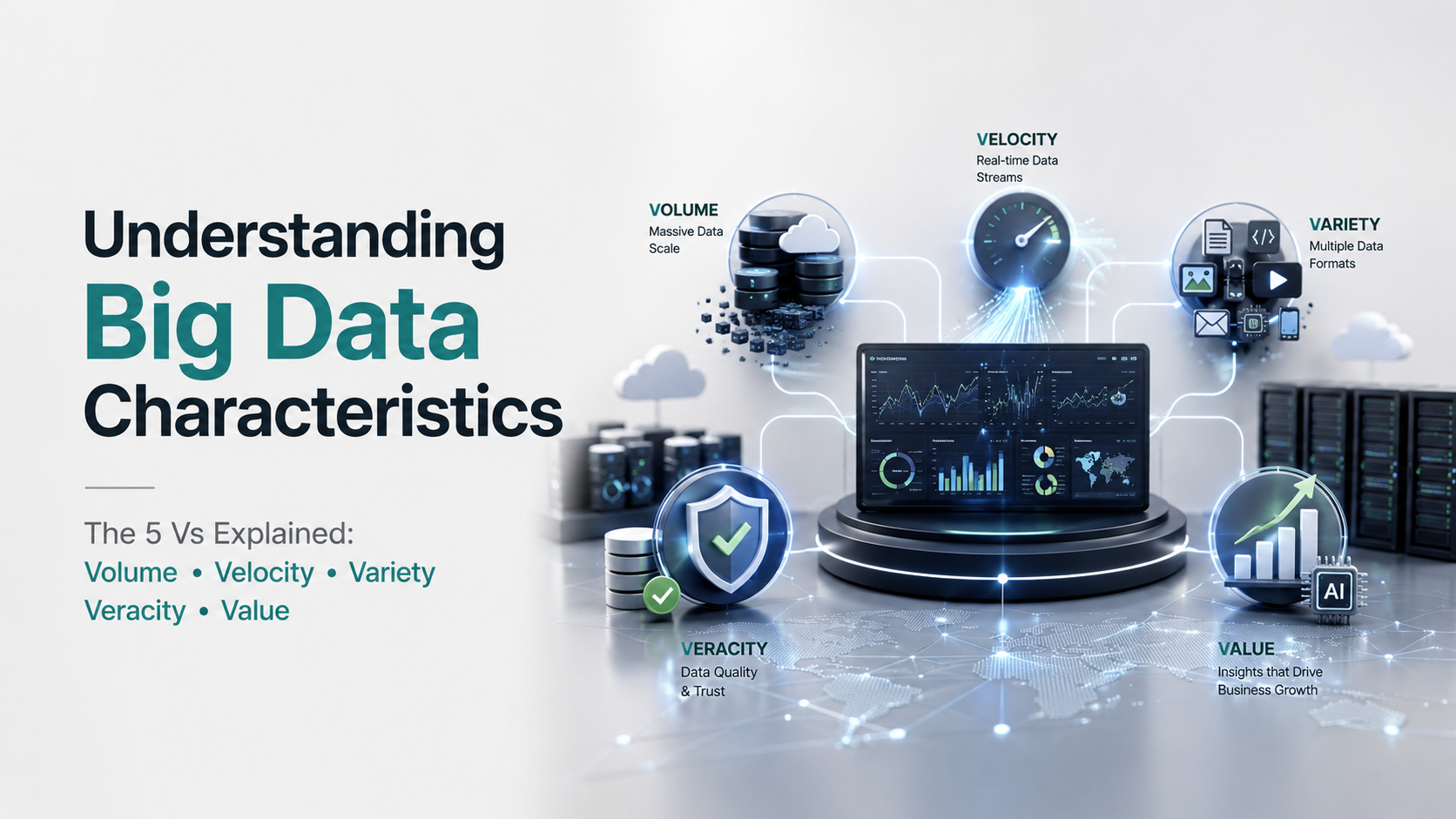
Understanding Big Data Characteristics: The 5 Vs Explained
Every second, organizations generate enormous amounts of digital information. Understanding Big Data characteristics helps businesses manage this growing data landscape and turn raw information into valuable insights.
Traditional databases were designed for smaller, structured datasets. Modern enterprises now handle massive data streams from websites, mobile applications, IoT devices, social platforms, and business systems. These changing requirements have created the need for advanced technologies that can store, process, and analyze information at scale.
Platforms such as Apache Hadoop help organizations process large datasets across distributed computing environments. Hadoop is an open-source framework designed to support distributed storage and large-scale data processing. You can learn more about its architecture and capabilities through the official Apache Hadoop Documentation.
Data management is no longer limited to IT departments. It directly influences business strategy, customer experience, operational efficiency, and revenue growth. Companies that understand their data characteristics can build stronger analytics systems and make faster decisions.
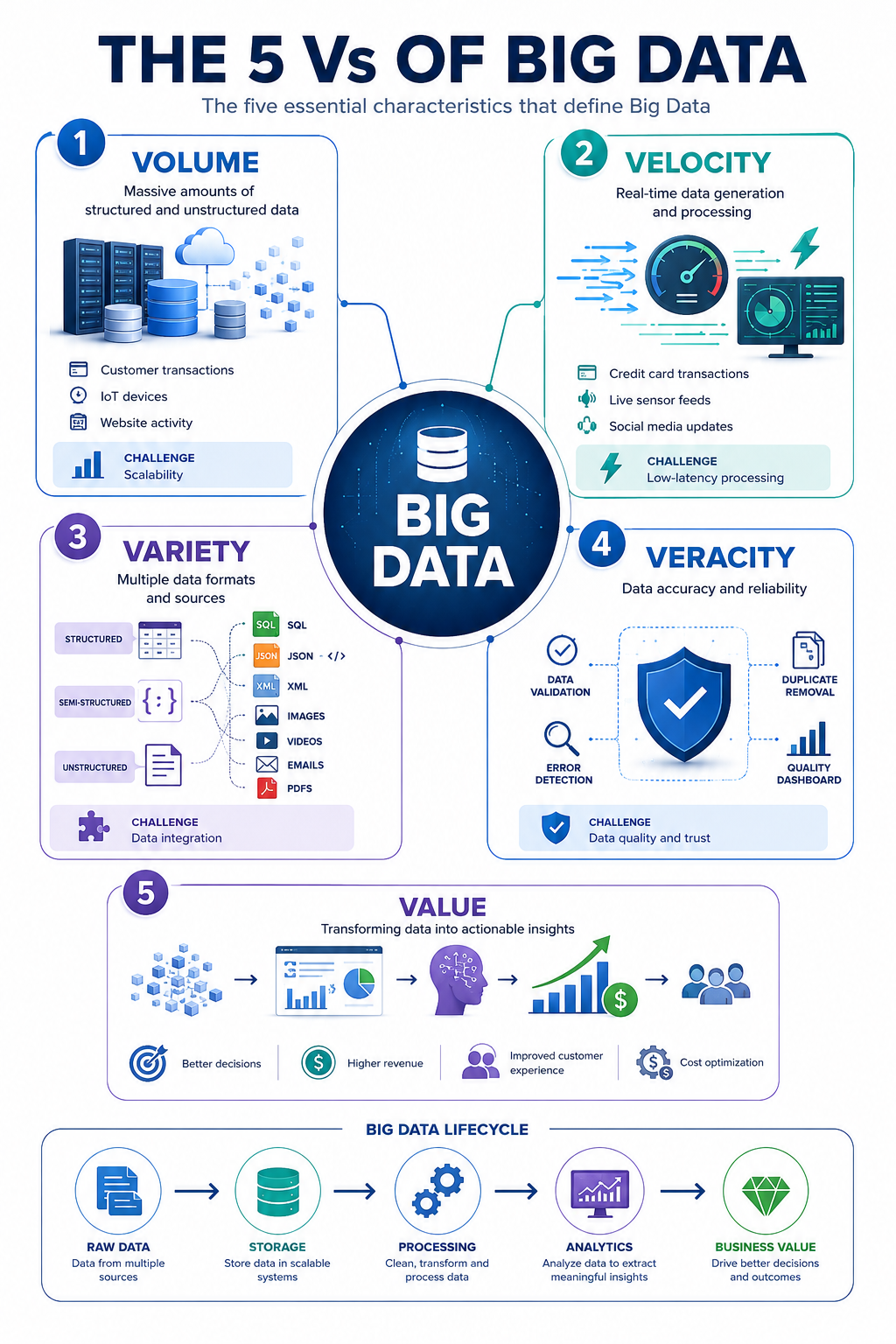
The most common framework for understanding modern data challenges is the 5 Vs of Big Data: Volume, Velocity, Variety, Veracity, and Value. These five characteristics explain how data grows, moves, changes, and creates business impact.
This guide explores each Big Data characteristic in detail and explains how these concepts shape modern enterprise architecture.
What Are the Core Big Data Characteristics?
The definition of enterprise data has changed significantly over the last few decades. Earlier database systems mainly focused on structured information stored in traditional relational tables. However, the rapid growth of digital platforms introduced new challenges in storing and processing information.
To explain these challenges, analysts developed the Big Data 3 Vs model, which included Volume, Velocity, and Variety. These three characteristics described the increasing size, speed, and diversity of modern datasets.
As organizations began focusing more on data reliability and business outcomes, two additional dimensions were introduced: Veracity and Value. Together, these five factors became known as the 5 Vs of Big Data.
Each characteristic represents a different challenge that businesses must solve:
- Volume focuses on the enormous amount of data generated.
- Velocity explains how quickly data is created and processed.
- Variety describes different data formats and sources.
- Veracity measures data accuracy and reliability.
- Value represents the useful outcomes gained from data analysis.
Understanding these Big Data characteristics allows organizations to design better storage systems, analytics platforms, and decision-making processes.
Modern businesses use this framework to evaluate their data strategies. It helps teams identify technical limitations, improve data quality, and create solutions that support long-term growth.

1. Volume: The Scale of Modern Datasets
Volume represents the massive quantity of data generated, collected, and stored by organizations. It is one of the most important Big Data characteristics because the amount of information produced today has moved far beyond traditional storage capabilities.
Previously, companies measured their data environments mainly in gigabytes and terabytes. However, large enterprises now manage petabytes and even exabytes of information. This growth happens because data is continuously generated from online transactions, customer interactions, smart devices, sensors, and digital platforms.
Therefore, managing large-scale datasets requires more than traditional database systems. Instead, organizations use distributed storage solutions that divide information across multiple servers. As a result, businesses can improve scalability and expand their infrastructure whenever data requirements increase.
Moreover, high-volume data creates challenges related to performance and storage costs. Companies must develop efficient methods for storing, organizing, and retrieving information quickly. Without proper planning, growing datasets can reduce system performance and increase operational expenses.
Real-World Example:
For example, e-commerce companies collect millions of customer interactions every day. They analyze clicks, searches, purchases, and browsing behavior to improve recommendations and create personalized shopping experiences.
Key Challenge:
As data volumes continue to grow, organizations must scale horizontally by adding more computing resources instead of depending on a single powerful server.
2. Velocity: The Speed of Data Processing
Velocity describes how quickly data is generated, transferred, and analyzed. Among the major Big Data characteristics, velocity has become increasingly important because modern businesses often require immediate insights.
In the past, organizations could rely on batch processing methods. However, many industries now require real-time data analysis. Therefore, companies need systems that can capture and process information instantly. This capability allows them to respond quickly to customer behavior, market changes, and operational challenges.
Furthermore, high-velocity data often comes from continuous sources such as financial transactions, sensors, social media activity, and application logs. Because these data streams arrive constantly, businesses require advanced processing systems that support low-latency data ingestion.
Similarly, organizations use event-driven architectures and real-time analytics platforms to manage fast-moving information. As a result, companies can identify patterns and take action without waiting for traditional processing cycles.
Real-World Example:
For instance, credit card companies analyze transactions instantly to detect suspicious activity. Their fraud detection systems evaluate purchase behavior while customers complete payments.
Key Challenge:
Ultimately, businesses must process continuous data streams efficiently while preventing delays, failures, or performance problems.
3. Variety: The Diversity of Data Formats
Variety refers to the different types, structures, and sources of data collected by organizations. It is one of the most important Big Data characteristics because modern information is no longer limited to simple database tables.
Traditionally, businesses mainly worked with structured data stored in rows and columns. However, today’s organizations manage a combination of structured, semi-structured, and unstructured data. This includes customer records, social media content, videos, emails, sensor readings, documents, and application logs.
Because data comes from many different sources, companies need flexible storage systems and advanced management strategies. Therefore, many organizations use data lakes, cloud storage platforms, and NoSQL databases to preserve information in its original format before analysis.
Unlike traditional databases, these modern systems do not always require a fixed structure before storing data. As a result, businesses can collect information from multiple sources and organize it later based on analytical requirements.
| Data Structure | Common Examples | Primary Storage Models |
|---|---|---|
| Structured | SQL tables, financial records, customer databases | Relational databases |
| Semi-Structured | JSON files, XML documents, server logs | NoSQL databases |
| Unstructured | Videos, images, audio files, PDF documents | Data lakes, cloud storage |
Additionally, managing data variety creates challenges in integration and analysis. Teams must combine information from different sources while maintaining consistency, accuracy, and accessibility.
Real-World Example:
For example, healthcare organizations combine structured patient records with unstructured information such as medical images, reports, and physician notes.
Key Challenge:
Therefore, engineering teams must transform different data formats into usable information without losing important details.
4. Veracity: Ensuring Data Quality and Trust
Veracity measures the accuracy, reliability, and consistency of data. Among the five Big Data characteristics, veracity is essential because inaccurate information can lead to poor business decisions.
Large datasets often contain errors, duplicate records, incomplete information, or inconsistent values. These problems may occur during data collection, storage, or processing. Consequently, organizations that analyze unreliable data may produce misleading insights.
To solve these issues, companies implement strong data governance practices. These practices include validation processes, data cleaning methods, quality checks, and continuous monitoring systems.
In addition, modern analytics platforms often include automated tools that identify unusual patterns and remove inaccurate records. As a result, businesses can improve confidence in dashboards, reports, and machine learning models.
Data accuracy is especially important in industries where decisions affect safety, finances, or customer experiences. Therefore, reliable information helps organizations build better predictions and develop more effective strategies.
Real-World Example:
For example, autonomous vehicles use sensor data to make driving decisions. These systems must remove incorrect readings caused by weather conditions or environmental noise.
Key Challenge:
However, businesses must improve data quality while maintaining fast processing speeds for real-time applications.
5. Value: Turning Raw Data into Actionable Intelligence
Value represents the business benefits organizations gain from analyzing data. It is the final and most strategic Big Data characteristic because information becomes useful only when it supports better decisions.
Although many companies collect enormous amounts of data, storage alone does not create competitive advantages. Instead, businesses must identify meaningful patterns and convert raw information into practical insights.
For this reason, data value can appear in many forms, including improved customer experiences, reduced operating costs, better forecasting, and increased revenue. Furthermore, advanced analytics, artificial intelligence, and machine learning help organizations discover hidden opportunities within large datasets.
However, successful companies do not focus only on collecting more information. Instead, they prioritize relevant data that supports clear business objectives. As a result, analytics investments can produce measurable improvements.
Expert Insight:
Data collection creates value only when organizations transform information into actions that improve business performance.
Real-World Example:
For instance, streaming platforms analyze customer viewing habits to understand preferences and decide which new content projects to develop.
Key Challenge:
Ultimately, organizations must connect technical data strategies with business goals. Otherwise, they risk collecting information without achieving meaningful results.
Frequently Asked Questions About Big Data Characteristics
What are the main characteristics of enterprise data?
The main characteristics of enterprise data are Volume, Velocity, Variety, Veracity, and Value. These five dimensions are commonly known as the 5 Vs of Big Data.
Volume explains the enormous amount of information generated by modern systems. Businesses now manage data measured in terabytes, petabytes, and beyond. Velocity describes how quickly data is created and processed, especially in real-time environments.
Variety focuses on the different formats businesses handle, including text, images, videos, and application logs. Veracity ensures that information remains accurate, consistent, and trustworthy.
Finally, Value measures how effectively organizations use data to improve decisions and achieve business goals. Together, these Big Data characteristics help companies design better storage systems, analytics platforms, and strategies for managing modern digital information.
Why is data velocity so important for modern businesses?
Data velocity is important because many business decisions depend on immediate information. In fast-moving industries, delayed insights can reduce opportunities and increase risks.
For example, financial institutions use real-time analytics to detect suspicious transactions before fraud occurs. Transportation companies analyze live location data to improve routes and manage demand.
Modern customers also expect quick responses from digital services. Businesses use high-speed data processing to personalize experiences, optimize operations, and respond to changing conditions.
Traditional batch processing methods may not meet these requirements. Real-time data systems allow organizations to analyze information as it arrives and take action immediately.
By managing velocity effectively, companies can improve efficiency and maintain a competitive advantage in data-driven markets.
How does data variety impact cloud storage architecture?
Data variety has a major impact on how organizations design their cloud storage architecture. Traditional relational databases work well with structured information, such as financial records and customer tables. However, they are less effective when handling modern data types like videos, social media content, images, and IoT sensor streams.
To manage these different formats, businesses often use flexible storage solutions such as data lakes, cloud object storage, and NoSQL databases. These technologies allow organizations to store structured, semi-structured, and unstructured information without requiring a fixed schema at the beginning.
This flexibility helps companies collect data from multiple sources and analyze it later based on business needs. For example, a company can store application logs, customer interactions, and machine-generated data in the same environment before processing it.
Data variety also affects data integration strategies. Engineering teams must create systems that can connect different sources while maintaining consistency and accessibility.
By managing variety effectively, organizations can build scalable cloud environments that support advanced analytics, artificial intelligence, and machine learning applications.
What is the difference between structured and unstructured data?
Structured and unstructured data differ mainly in how information is organized and stored.
Structured data follows a predefined format. It is usually arranged in rows and columns inside relational databases. Examples include customer information, sales records, account details, and inventory databases. Because it follows a fixed structure, structured data is easy to search and analyze using traditional database tools.
Unstructured data does not follow a specific format or predefined model. It includes images, videos, audio recordings, emails, documents, and social media content. This type of information requires more advanced processing methods because computers must first understand and organize the content.
Organizations increasingly manage both structured and unstructured data together. Modern analytics systems use technologies such as natural language processing, computer vision, and machine learning to extract insights from unstructured sources.
Understanding the difference between these data types helps businesses choose the right storage systems and analytical tools for their needs.
How do companies maintain data veracity?
Companies maintain data veracity by creating strong processes that improve data accuracy, consistency, and reliability. Since large datasets often contain errors, organizations must verify information before using it for analysis.
A common approach is implementing data governance frameworks. These frameworks define rules for collecting, storing, accessing, and managing information across the organization.
Businesses also use automated validation systems to identify duplicate records, missing values, and unusual patterns. Data cleaning tools help correct errors before information enters analytics platforms.
Many organizations also use data lineage tracking to understand where information comes from and how it changes over time. This improves transparency and helps teams identify potential quality issues.
Regular audits and monitoring processes ensure that business reports, dashboards, and machine learning models rely on accurate information.
Maintaining high data veracity allows companies to make confident decisions and reduces the risks caused by unreliable data.
Conclusion: Using Big Data Characteristics for Business Growth
Understanding Big Data characteristics is essential for organizations operating in today’s digital economy. The five key dimensions—Volume, Velocity, Variety, Veracity, and Value—help businesses understand the challenges and opportunities created by modern data environments.
Volume explains the growing size of datasets. Velocity highlights the need for faster processing. Variety focuses on managing different data formats. Veracity ensures information remains accurate. Value helps organizations transform data into meaningful business results.
When companies manage these five characteristics effectively, they can build stronger data strategies and create more reliable analytics systems. This allows them to improve customer experiences, reduce operational costs, and discover new growth opportunities.
Successful organizations do not treat data as a simple storage requirement. They view information as a strategic asset that can support innovation and competitive advantage.
By investing in scalable infrastructure, flexible technologies, and strong data governance, businesses can turn complex datasets into valuable insights. A well-designed data strategy ensures that every piece of information contributes to smarter decisions and long-term success.
As organizations continue adopting advanced analytics and artificial intelligence solutions, technologies such as Retrieval-Augmented Generation (RAG) are becoming increasingly important for connecting large data sources with intelligent systems. Understanding how RAG works can help businesses improve knowledge retrieval, enhance AI accuracy, and create more effective data-driven applications. Learn more about Retrieval-Augmented Generation (RAG) and how it improves AI-powered information systems in this detailed guide.