Project-Based Learning Explained: Benefits, Challenges, and Real-World Examples
Traditional classroom instruction often leaves students asking a familiar question: “When will I ever use this in real life?” Project-Based Learning addresses this gap. It shifts the classroom dynamic from passive listening to active problem-solving. According to educational research highlighted by PBLWorks, this method engages students in solving complex, authentic problems over time. Rather than memorizing facts for a test, learners construct deep knowledge by executing tangible projects.
Academic theory alone is no longer sufficient in today’s workforce. Employers consistently seek individuals who can collaborate and think critically. They need people who adapt to unpredictable challenges. This dynamic learning methodology creates an environment where students build these competencies naturally. By tackling meaningful issues, learners gain practical experience that mirrors the professional world.
Understanding this teaching model is vital for educators refining their curriculum. It is equally important for administrators evaluating teaching frameworks. In this guide, we will explore how this active framework functions in modern education. We will examine its primary advantages and analyze common implementation challenges. Finally, we will showcase inspiring, real-world examples across multiple grade levels.
What Is Project-Based Learning?
This teaching framework is a student-centered strategy. It relies on the fundamental principle of learning by doing. Students work on a project over an extended period. This can range from a single week to an entire semester. During this time, they investigate and respond to a complex question, problem, or challenge. The project itself serves as the primary vehicle for learning core curriculum content.
Through this process, students acquire key academic knowledge. At the same time, they develop vital soft skills. They do not simply read about science or mathematics in a textbook. Instead, they apply concepts directly to solve realistic issues. For example, students might analyze local water quality samples. They might interview local experts and compile a formal public report.
This model shifts the traditional role of the teacher. The instructor becomes a facilitator and coach rather than the sole source of information. Teachers guide student inquiry and offer targeted feedback. They provide structure while allowing learners to take ownership of their education. Consequently, students develop genuine agency, independence, and a deeper connection to the academic material.
Core Elements of Effective Student Projects
An inquiry-driven assignment must be far more than a creative craft activity. Educational research identifies several core standards for a rigorous educational experience. First, every project must begin with a compelling driving question. This open-ended prompt focuses the learning journey. It challenges students to think beyond simple memorization.
Second, students must engage in sustained inquiry over time. They do not just find a quick answer online. Instead, they ask follow-up questions and consult multiple sources. They refine their ideas through continuous research. Authenticity is another crucial element. The project must reflect real-world contexts, use professional tools, or address actual community needs.
Furthermore, student voice and choice play a massive role in maintaining engagement. Intrinsic motivation increases dramatically when learners have a say in their approach. Finally, effective projects require reflection, peer critique, and a public presentation. Presenting work to an audience beyond the teacher gives student effort real purpose and accountability.
Key Benefits of Project-Based Learning in Modern Education
Adopting an experiential learning framework transforms how students interact with knowledge. Learners see how ideas connect to create meaningful outcomes rather than viewing subjects as isolated rules.
Boosting Student Engagement and Information Retention
Enthusiasm for learning increases significantly when students see a direct connection to real-world issues. Traditional lectures often rely on extrinsic motivators like quizzes or grades. These tools rarely foster long-term interest. In contrast, working on a tangible project creates intrinsic motivation. Students actively care about solving the problem at hand.
This active participation directly enhances memory retention. Brain research demonstrates that deep learning occurs when students apply concepts and analyze data. Learners internalize information far better through trial and error than by reading a textbook. The knowledge gained through hands-on experience stays with students long after the final assessment concludes.
Developing Critical 21st-Century Skills
Modern careers demand strong interpersonal and analytical abilities alongside technical knowledge. Experiential learning serves as a natural training ground for key competencies. These include critical thinking, communication, collaboration, and creativity.
During group work, students learn to navigate different personalities and delegate responsibilities. They resolve interpersonal conflicts constructively. They practice articulating complex ideas clearly during team discussions and in project documentation. Furthermore, analyzing multi-layered problems forces learners to evaluate evidence critically. They develop creative solutions when initial attempts fail. These experiences prepare students directly for dynamic, team-oriented work environments.
Encouraging Cross-Disciplinary Connections
Real-world problems rarely fit neatly into a single academic subject. Solving an issue like urban pollution requires knowledge of biology, chemistry, mathematics, and public policy. Traditional educational structures often separate these subjects into isolated time slots. This structure makes it difficult for students to see the bigger picture.
Inquiry-driven learning naturally breaks down these artificial barriers. A single project can easily integrate multiple disciplines into a cohesive experience. For instance, students designing a community garden apply geometry to measure plot spaces. They study plant growth cycles in biology, budget for supplies using economics, and write proposals in language arts. This holistic approach helps learners realize that knowledge is interconnected.
Common Challenges in Project-Based Learning and Practical Solutions
Transitioning away from traditional lectures presents real challenges for educators and administrators. Identifying these common obstacles allows institutions to put effective solutions in place before starting.
| Common Challenge | Root Cause | Practical Solution |
| Time Constraints | Projects require more calendar days than standard lectures. | Integrate multiple subject standards into a single overarching project. |
| Assessment Difficulty | Grading open-ended group work can feel subjective. | Use clear, criteria-focused rubrics for both process and final product. |
| Classroom Management | Active movement and team debates can increase noise. | Establish clear team roles, daily goals, and expectations early on. |
| Resource Limitations | Authentic tasks often need specialized digital tools or materials. | Partner with local businesses or utilize free open-source software. |
Managing classroom time effectively is a major hurdle. Teachers often worry about covering required curriculum standards because inquiry takes time. Cross-curricular planning offers the best solution. Teachers save valuable instructional time by designing projects that address standards from multiple subjects simultaneously.
Fair assessment presents another frequent obstacle. Teachers struggle to grade group projects accurately without penalizing high-performing individuals. Educators solve this by using detailed rubrics that separate individual performance from overall team outputs. Incorporating daily learning logs, peer assessments, and short individual check-ins ensures fair grading for every student.
Real-World Examples Across Education Levels
This flexible teaching framework adapts successfully to any age group or subject area when designed thoughtfully.
Elementary School: Local Ecosystem and Biodiversity Audit
In this elementary project, third-grade students conduct a biodiversity audit of their school grounds. The driving question asks: “How can we improve our school environment to support local wildlife?” Students begin by mapping the campus. They identify plant species and log bird and insect populations over several weeks.
Working in small teams, they research native plants that attract beneficial pollinators. They construct simple wooden birdhouses and design native plant garden beds. To finalize the project, students write persuasive letters and deliver a presentation to the school principal. This hands-on experience teaches basic life science standards, data collection skills, and civic responsibility.
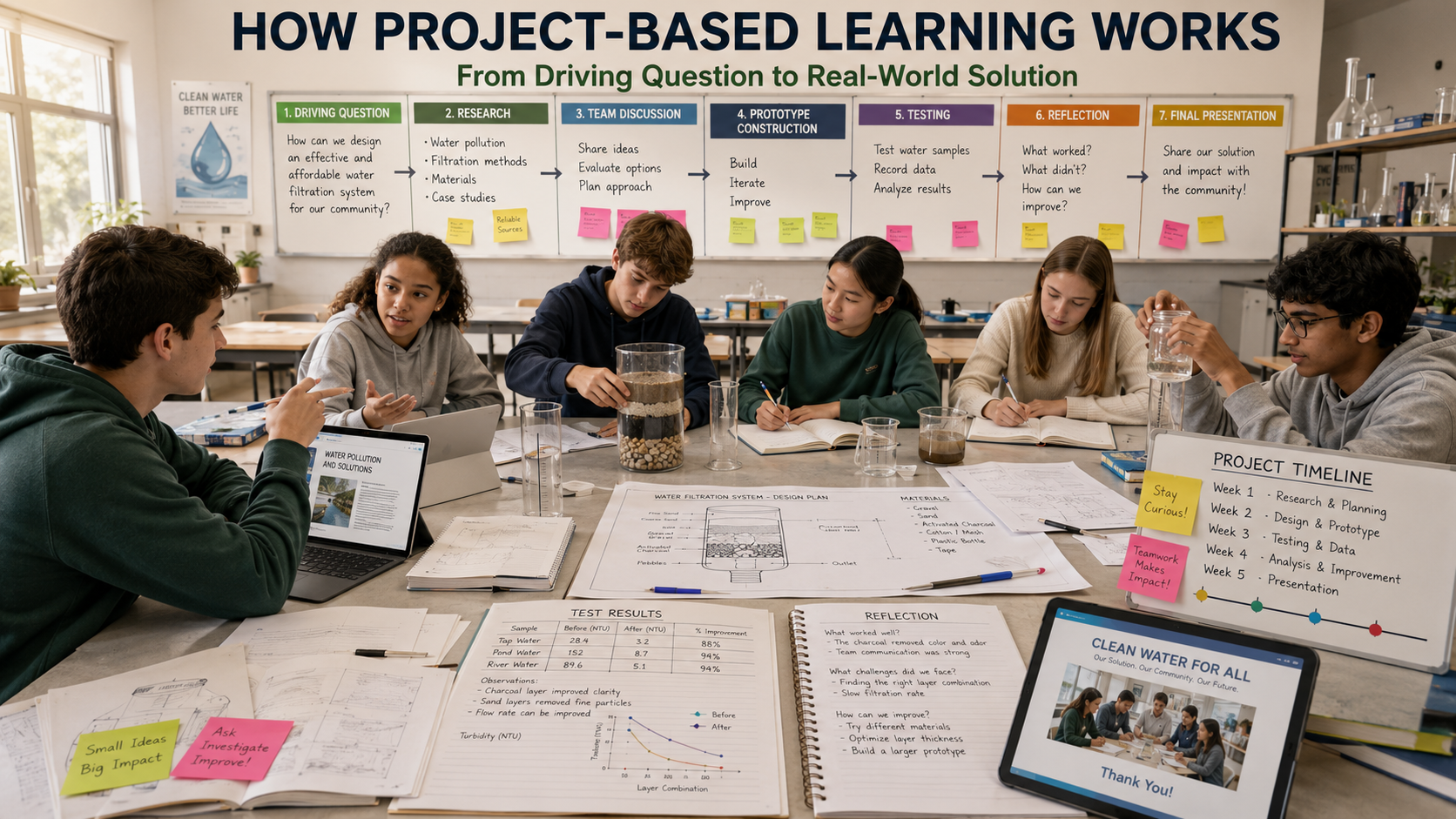
Middle School: Clean Water and Filtration Engineering Challenge
Seventh-grade science and social studies classes collaborate on an interdisciplinary project focused on global water scarcity. The project centers on a clear question: “How can we provide clean drinking water to resource-scarce communities?” Students analyze geographic regions affected by water pollution. They also study the biological risks of contaminated water sources.
Next, student teams build working water filters using low-cost materials like sand, charcoal, and gravel. They test their filtration prototypes and calculate cost-efficiency metrics. Teams refine their models based on initial results. Finally, students create multimedia public service announcements explaining the crisis and present their filter designs to local civil engineers.
High School: Urban Planning and Community Traffic Redesign
High school seniors in an advanced civics class take on a realistic urban planning challenge. Their driving question asks: “How can we redesign our city’s main intersection to improve safety?” Using actual traffic flow data from local municipal offices, students analyze congestion patterns and safety hazards.
Learners utilize computer-aided design software and statistical models to draft comprehensive redesign proposals. They account for pedestrian walkways, bike lanes, bus routes, and budget constraints. At the end of the semester, student teams present their blueprints directly to city council members. This authentic experience connects high-level mathematics and government concepts directly to civic action.
FREQUENTLY ASKED QUESTIONS
How does Project-Based Learning differ from traditional classroom assignments?
In a traditional classroom setting, a project typically occurs at the very end of a unit. It serves as a brief demonstration of facts that students already learned through lectures. In contrast, this experiential framework uses the project as the primary vehicle for teaching core concepts from start to finish. Students learn the required content by working through the real-world challenge. Additionally, authentic projects always feature real-world contexts, sustained inquiry over several weeks, student decision-making, and a public presentation. Traditional assignments usually remain private between the student and the teacher. They focus primarily on rote recall rather than deep application.
What age groups benefit most from Project-Based Learning?
Ultimately, learners of all age groups benefit significantly from this instructional approach. In fact, applications range from early childhood education all the way through graduate university programs. For instance, with younger elementary students, projects focus on tactile activities, simple direct observations, and local community interactions. Consequently, teachers use shorter timeframes to match these early developmental stages.
However, as students mature into middle and high school, projects gradually incorporate advanced scientific research, technical software, and cross-disciplinary data analysis. Furthermore, higher education institutions and vocational schools utilize this exact framework through capstone projects, client work, and laboratory research. Therefore, teachers simply adjust the complexity, duration, and degree of independent decision-making to match evolving student needs.
Is Project-Based Learning effective for standardized test preparation?
Yes, extensive educational research confirms that students taught through active inquiry perform as well as—or better than—their peers on standardized assessments. Standardized tests measure critical thinking, reading comprehension, data interpretation, and quantitative reasoning. They look beyond simple memorization. Active learners spend weeks analyzing complex information, evaluating competing evidence, and solving multi-layered problems. Consequently, they develop a far deeper conceptual understanding of the core subject matter. This deep mastery allows them to answer complex, higher-order test questions with confidence. Furthermore, active learning improves long-term information retention, whereas traditional drill-and-practice methods are quickly forgotten.
How do educators evaluate individual performance fairly during group work?
Educators ensure fair grading by combining individual accountability measures with team assessments using structured rubrics. Teachers break the grading process down into distinct components rather than assigning a single blanket grade to the group. Individual performance is tracked using daily learning logs, reflection journals, targeted oral check-ins, and specific assigned sections of the final deliverable. Peer evaluations also provide valuable insight into how effectively each team member contributed to group discussions and workload distribution. By combining these individual assessments with a rubric that evaluates the final group product, teachers award grades that accurately reflect each student’s personal grasp and effort.
Can Project-Based Learning work in online or hybrid learning environments?
Yes, this framework adapts exceptionally well to digital, online, and hybrid learning environments. Modern digital collaboration tools allow remote student teams to brainstorm ideas, manage project schedules, organize research, and build digital artifacts seamlessly. Online platforms enable students to conduct virtual interviews with industry experts around the globe. They gather authentic primary source data that would be difficult to access locally. Furthermore, digital environments expand the possibilities for the final public presentation. Instead of presenting only to a physical classroom, remote students can share their work through live webinars, polished video documentaries, interactive websites, or digital podcasts.
CONCLUSION
Project-Based Learning represents a fundamental shift in educational strategy. It moves modern classrooms away from passive listening and toward active, meaningful problem-solving. By embedding academic standards into authentic challenges, this approach equips learners with core subject mastery and essential lifelong skills. Students learn to collaborate across differences and analyze complex information critically. They adapt when initial ideas fail and articulate their thoughts with clarity. Understanding the broader role of culture in education can further enrich these inquiry-driven frameworks for diverse student bodies.
While implementing this methodology requires careful planning, structured criteria rubrics, and adapted classroom management, the long-term educational benefits far outweigh the initial hurdles. Schools and universities continue searching for ways to prepare students for an unpredictable, fast-paced future. In this environment, experiential learning stands out as a proven, highly effective framework. It turns passive consumers of information into active creators, critical thinkers, and community leaders.
By adopting these student-centered principles, educators can construct inspiring learning environments that make education truly meaningful. Consider starting small by introducing a single inquiry-driven unit this semester. Refine your approach through student feedback and watch your learners thrive as they connect their classroom education directly to the real world.