
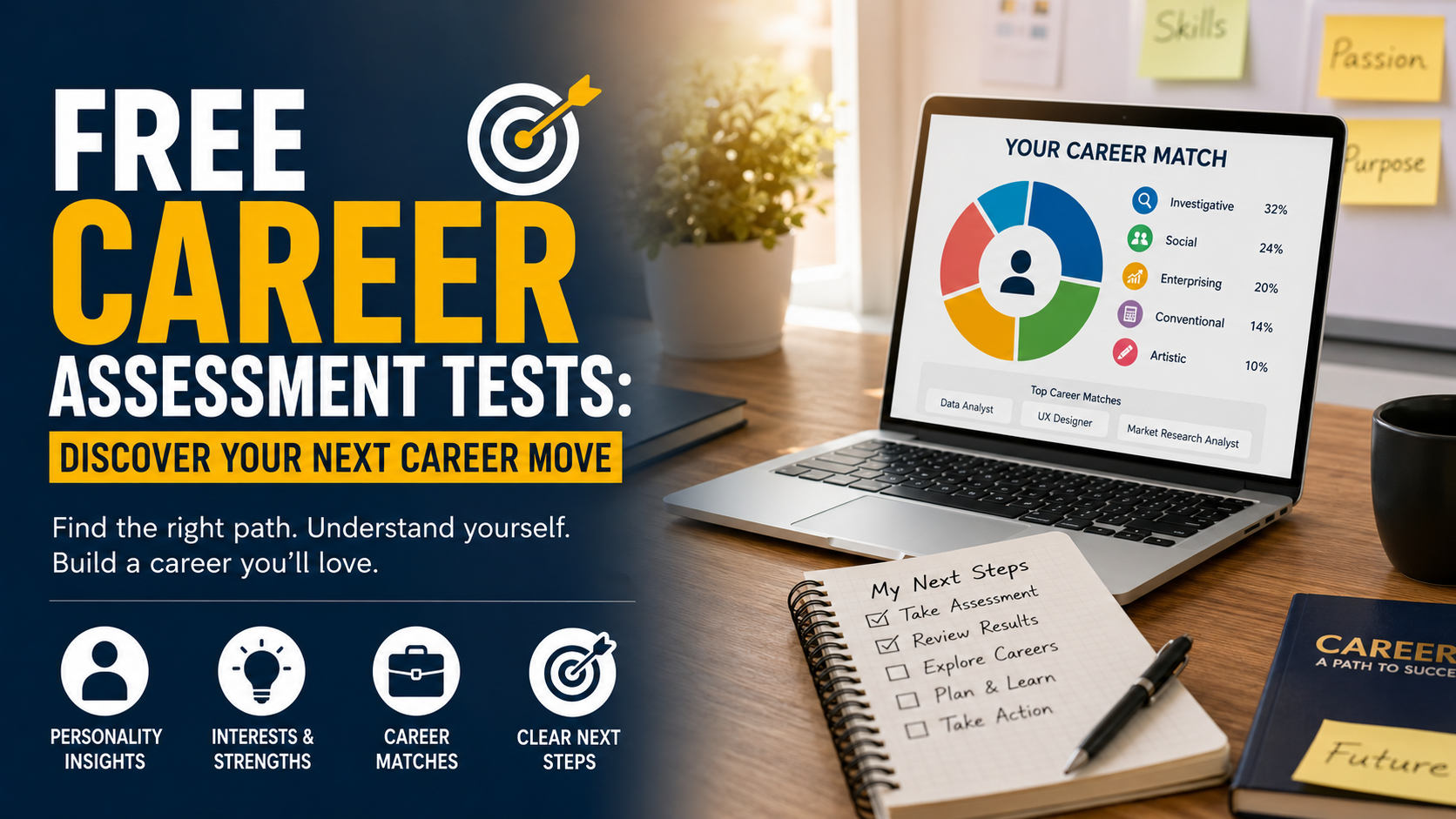
Free Career Assessment Tests: Discover Your Next Career Move
Finding the right career path often feels like navigating a dense fog without a map. Free career assessment tests offer a clear, science-backed way to evaluate your personality, workplace preferences, and core strengths without financial strain. Instead of making blind guesses about your professional future, you can rely on structured evaluations created by occupational psychologists. Specifically, according to official career resources like CareerOneStop, sponsored by the U.S. Department of Labor, self-assessment tools play an essential role in matching job seekers with fulfilling occupations that align with their personal values, interests, and skill sets. Consequently, taking free career assessment tests gives you immediate direction when planning your future.
The modern job market shifts rapidly. Therefore, staying in an unfulfilling role can cost you valuable time, energy, and earnings. In addition, taking time to assess your aptitudes using official frameworks like the U.S. Department of Labor’s O*NET Interest Profiler helps you avoid burnout and costly career missteps. Whether you are entering the workforce, seeking a promotion, or switching industries, free evaluations give you instant clarity. By using free career assessment tests, you can easily discover how you communicate, handle pressure, and perform under stress.
In this guide, we will explore top career testing tools available today. Furthermore, you will learn how to interpret your results accurately. Next, we will show you how to turn diagnostic scores into actionable career steps. Ultimately, you will learn how personality profiling, skills inventories, and work value matrixes fit together to build a rewarding long-term strategy.
How Free Career Assessment Tests Work
Career diagnostics evaluate specific psychological traits using structured frameworks. Indeed, these methods come directly from industrial and organizational psychology. Rather than giving you a simple list of job titles, these tools analyze how your mind processes information. Specifically, they evaluate how you solve complex problems and interact with teams. Moreover, reputable free career assessment tests draw from established theories to deliver reliable results. As a result, they help you understand why certain tasks energize you while others cause fatigue.
Two major framework models dominate modern vocational guidance and assessment systems worldwide:
-
The Holland Code (RIASEC): Categorizes individuals into six distinct personality types—Realistic, Investigative, Artistic, Social, Enterprising, and Conventional.
-
The Big Five Framework: Measures openness, conscientiousness, extraversion, agreeableness, and neuroticism to predict work performance and team fit.
When you complete a self-evaluation, algorithms process your answers against thousands of occupational profiles. Consequently, you receive tailored recommendations based on real workplace data rather than guesswork. Thus, understanding these underlying frameworks allows you to review your test scores critically. Eventually, you can apply your findings to real-world job openings with true confidence.
| Core Assessment Type | Primary Function |
| Personality Profiles | Matches traits to environments |
| Interest Inventories (Holland Code) | Connects passions to industries |
| Skill & Aptitude Matrices | Evaluates current competence |
| Work Value Frameworks | Aligns goals with culture |
Top Categories of Free Career Assessment Tests and Vocational Analysis Tools
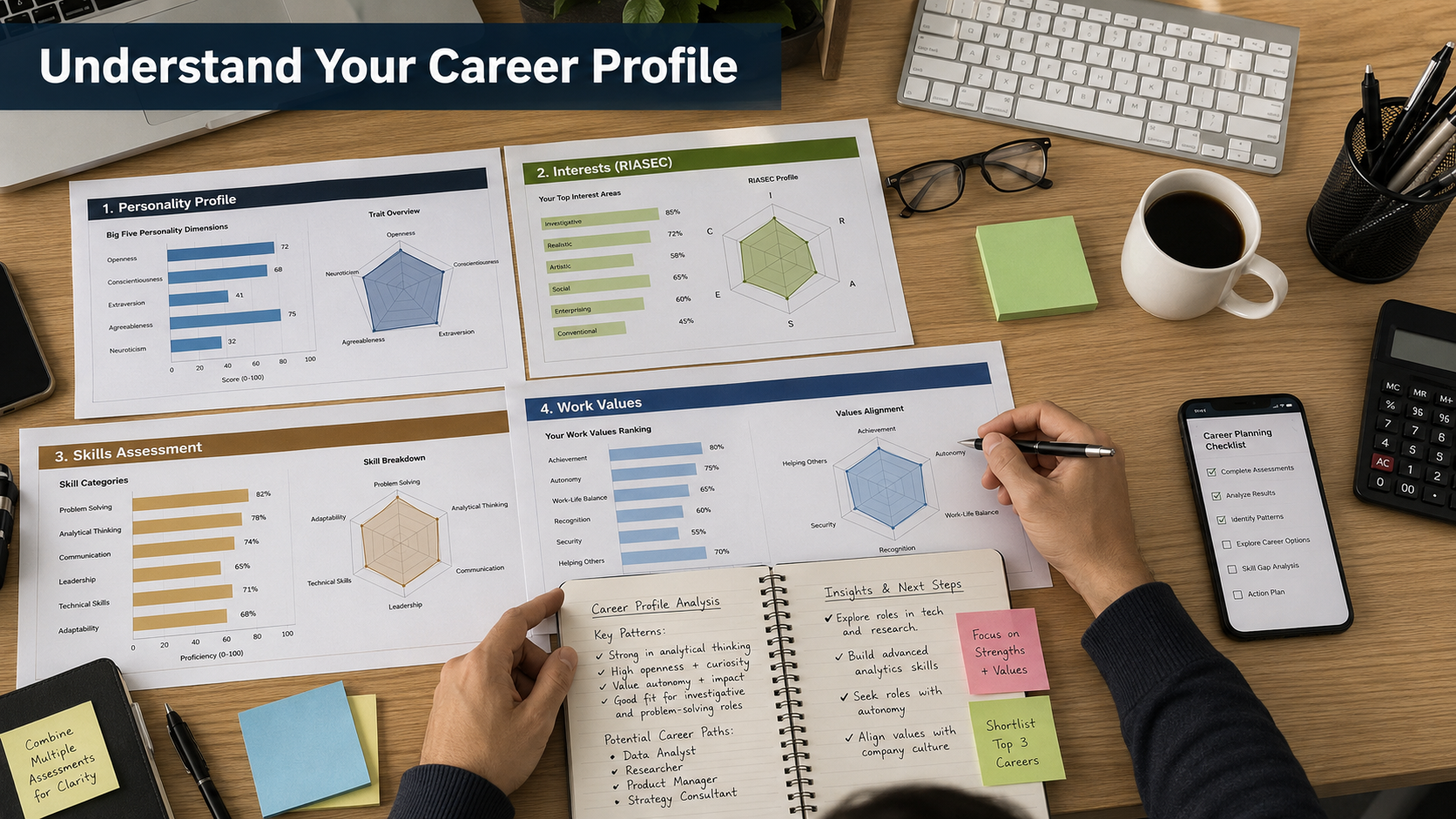
Not all evaluation tools serve the same purpose. For example, they do not all measure the same dimensions of your professional identity. Therefore, to get a complete picture of your career potential, use a balanced combination of different testing formats. In fact, do not rely on a single questionnaire. Instead, exploring multiple dimensions ensures you avoid choosing a job you dislike in daily practice.
-
Personality-Based Career Profilers: These evaluations analyze how you process information and make decisions under uncertainty. Hence, they help you determine whether you would excel in fast-paced startups or structured corporate hierarchies.
-
Skill and Competency Inventories: Skill inventories focus purely on what you can perform today. Additionally, they measure hard technical skills alongside vital soft skills like leadership, conflict resolution, project management, and cross-functional communication.
-
Work Values and Workplace Motivators: Understanding what you value in a workplace is crucial for long-term career satisfaction. For instance, value assessments measure how much you prioritize income stability, creative freedom, work-life balance, autonomy, and positive social impact.
| Goal | Best Test Type | Primary Metric |
| Industry Switch | RIASEC Interest Test | Occupational Fit |
| Role Optimization | Skill Matrix | Competency Gaps |
| Culture Fit | Work Values Profiler | Environmental Needs |
How to Get Accurate Results from Free Career Assessment Tests
To derive true value from free career assessment tests, approach them with a mindful and deliberate mindset. Otherwise, distorted answers yield inaccurate career advice. For this reason, following established testing practices ensures your diagnostic insights remain highly reliable. In short, treating the assessment like a self-discovery exercise produces the clearest results.
To maximize test accuracy, keep these three guidelines in mind:
-
Answer with Honesty, Not Idealism: Base your responses on how you actually behave today. In other words, do not answer based on how you wish you behaved in a perfect world.
-
Avoid Overthinking Questions: Your initial instinct usually reflects your genuine workplace preference. Because spending too much time over-analyzing individual scenarios often introduces cognitive bias into your results.
-
Ignore External Social Pressure: Answer strictly according to your personal preferences. Specifically, do not answer based on what managers, mentors, or family members expect from you.
Relying on a single evaluation provides an incomplete picture of your capabilities. However, when you cross-reference personality insights with concrete skill inventories, powerful patterns emerge. For instance, if an interest inventory highlights analytical roles, and your skill assessment confirms high mathematical ability, you have strong evidence pointing toward data analytics or risk management.
Turning Career Aptitude Results into an Actionable Strategy
Raw test scores and PDF reports mean very little unless you translate them into real progress. Thus, once you finish your evaluations, follow a clear framework to convert data into immediate career momentum. Ultimately, taking structured action transforms abstract personality traits into real interview opportunities and salary growth.
You can convert your diagnostic test data into real career progress using this step-by-step approach:
-
Highlight Recurring Themes: First, identify specific job categories, work settings, and responsibilities that appear consistently across multiple assessment results.
-
Conduct a Thorough Gap Analysis: Next, compare your current qualifications and experience level against the documented requirements for your target roles.
-
Draft a Targeted Skill Acquisition Plan: Then, identify specific online courses, professional certifications, or workplace projects required to bridge key competency gaps efficiently.
-
Update Your Professional Marketing Materials: Finally, align your resume, cover letters, and LinkedIn profile to naturally highlight strengths emphasized by your diagnostic results.
FAQ SECTION
How accurate are free career diagnostic tests?
Free career diagnostic tests offer remarkably high accuracy when built upon established scientific methodologies like the Holland Code (RIASEC) or Big Five personality frameworks. Although free options may not provide the multi-hour, one-on-one personal coaching found in expensive private services, they give valid, data-driven directions that narrow down your choices. Specifically, these tests evaluate your genuine preferences, communication tendencies, and workplace motivators using structured algorithms. However, their ultimate accuracy depends heavily on your self-awareness and honesty during the testing process. For instance, when you answer candidly rather than choosing ideal responses, these platforms produce highly reliable profiles. Consequently, they reveal your true strengths, uncover potential workplace blind spots, and help you filter out incompatible career options before investing significant time or money into retraining.
Can a free career assessment test tell me exactly which job to take?
No diagnostic tool can tell you precisely which specific job title to accept, nor should you expect one to do so. Instead, these evaluations serve as directional compasses by highlighting occupational families, work environments, and functional roles where you are statistically most likely to thrive. Thus, they narrow down thousands of possibilities into manageable categories aligned with your personality and aptitudes. Moreover, you must still evaluate these diagnostic insights alongside practical real-world factors, such as local job market demand, salary requirements, educational commitments, and personal life obligations. Therefore, use your test results as an objective foundation for deeper exploration, informational interviews, and target research, rather than treating them as a rigid or mandatory career instruction manual.
How often should I take a vocational assessment?
You should ideally take a vocational assessment every two to three years, as well as whenever you face a major career transition or life change. Because your workplace priorities, acquired technical skills, emotional maturity, and personal lifestyle needs naturally evolve over time, an assessment taken during college will rarely reflect your goals after five or ten years of professional experience. For example, periodically re-evaluating your traits ensures your current professional trajectory remains fully aligned with your updated values and long-term ambitions. In addition, regular testing helps you spot emerging skill gaps early. As a result, you can proactively upskill before stagnating in your current position or missing out on upcoming promotion opportunities.
What is the difference between a personality test and a skills assessment?
A personality test measures your innate psychological preferences, communication styles, emotional habits, and preferred organizational cultures. In short, it helps answer where and how you will feel most comfortable and motivated working day-to-day. In contrast, a skills assessment measures your concrete, practical competencies in performing specific tasks, such as computer programming, technical writing, data analysis, or financial modeling. Specifically, it answers what specific work tasks you can execute efficiently right now. Because both testing formats are highly complementary, relying on just one gives an incomplete picture. Therefore, combining personality insights with objective skill measurements ensures you choose a career that you are not only capable of performing well, but also genuinely enjoy sustaining over many years.
Are my test results kept private on free assessment platforms?
Data privacy standards vary significantly across different online assessment platforms. For instance, reputable platforms—especially those affiliated with universities, career centers, or government labor agencies—publish clear and transparent privacy policies. Specifically, they state that your personal diagnostic data will never be sold or shared with third-party advertisers. In contrast, some purely commercial free sites use assessments primarily as lead-generation tools. Consequently, they collect user contact details to populate recruitment databases or run targeted promotional campaigns. Therefore, to protect your personal information, you should always read a site’s terms of service before entering your name and email address. Alternatively, you can choose established platforms that allow guest participation, thereby eliminating the need for account registration or personal identification details.
CONCLUSION
Taking advantage of free career assessment tests is one of the most effective, zero-risk actions you can take to gain immediate clarity in your professional life. Indeed, these diagnostic tools remove expensive guesswork from career planning by evaluating your personality traits, natural aptitudes, and core workplace values against proven occupational models. Rather than drifting aimlessly between unfulfilling roles or staying in positions that lead to chronic burnout, structured evaluations empower you to make informed, strategic choices backed by real behavioral science.
It is important to remember that an assessment score is never a final or limiting verdict on your potential. Instead, view your results as a practical mirror reflecting your current strengths, preferences, and key growth areas. In addition, by pairing personality insights with objective skill evaluations, you create a clear roadmap for your career development. Furthermore, embracing continuous learning for career success alongside these insights allows you to target industries where you will truly excel, articulate your unique value clearly to hiring managers, and close skill gaps with purpose.
In conclusion, take full control of your professional growth today by taking a validated assessment. Simply select a trusted evaluation tool, answer every scenario with complete honesty, and use your diagnostic results to map out a clear, actionable career path. Ultimately, finding a fulfilling, well-aligned career becomes significantly easier when you have a reliable, data-driven map guiding every move you make.