How Musical Training Alters Development in Children

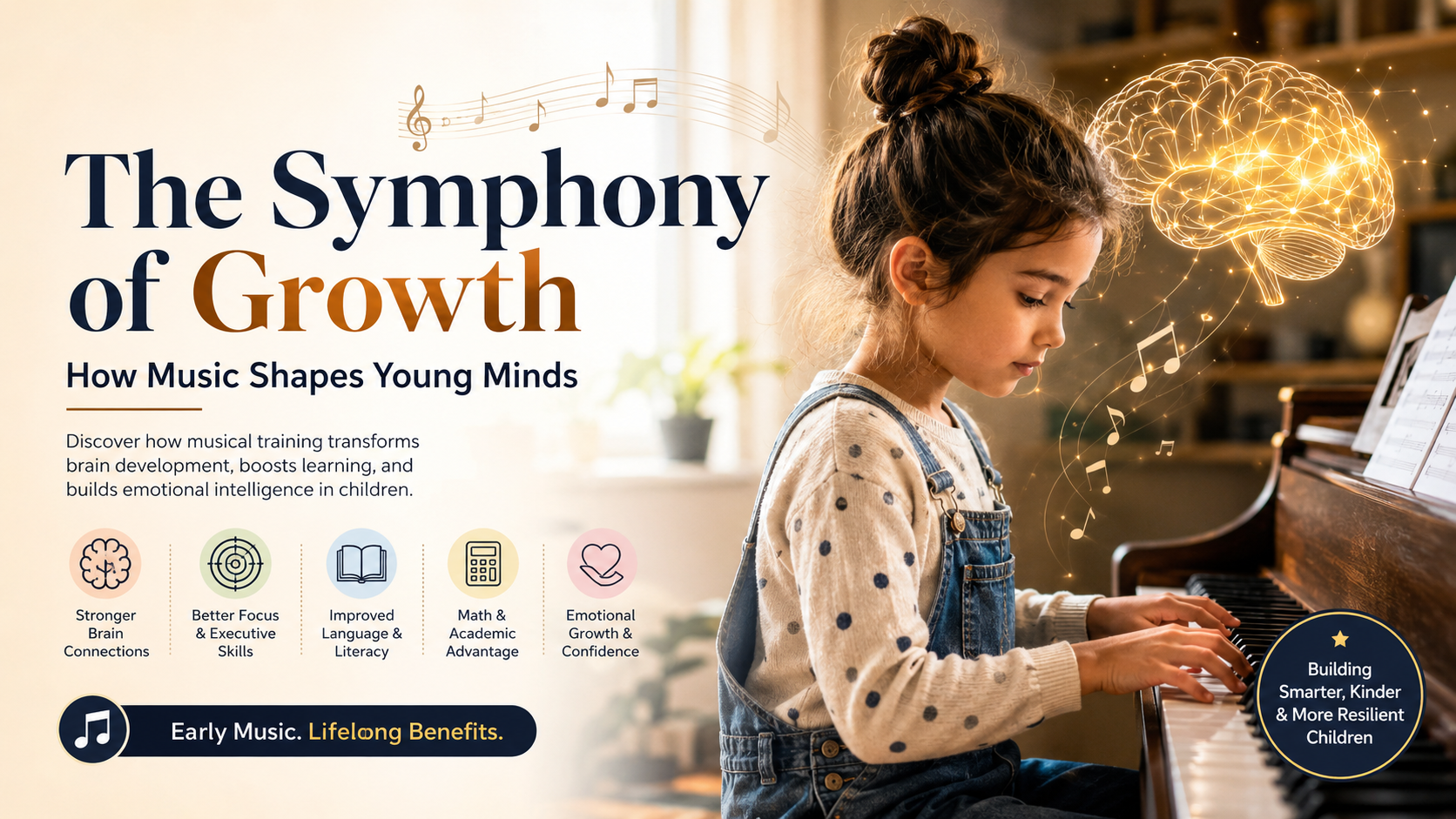
The Symphony of Growth: How Music Shapes Young Minds
Decades of neuroscientific research show that structured music education changes how children grow. Consequently, many experts agree that musical training alters development by rewriting brain architecture early in life. When a young child learns to play an instrument, they do not just pick up a transient hobby. Instead, they fundamentally change their underlying neurological framework. According to comprehensive research published by the National Endowment for the Arts, early arts education creates unique neural pathways that benefit young minds for a lifetime.
This profound transformation matters immensely because it directly impacts how children process sensory information. Furthermore, it changes how they manage complex emotions and interact with the surrounding world. Physical sports certainly build endurance and coordination. However, music lessons serve as an intense, comprehensive workout for the entire central nervous system. This continuous engagement permanently shapes their perception long before adulthood.
Every time a child presses a key, millions of neurons fire simultaneously. As a result, this activation strengthens the physical connections between different brain areas that handle vision, hearing, and motor control. Throughout this article, we will thoroughly explore the scientific evidence. You’ll also discover how music therapy supports cognitive, emotional, and developmental growth in children. Thus, we will see exactly how early music exposure optimizes childhood potential, academic milestones, and emotional maturity.
Cognitive Differences: The Musical Brain Advantage
How Early Music Lessons Reshape Brain Structure
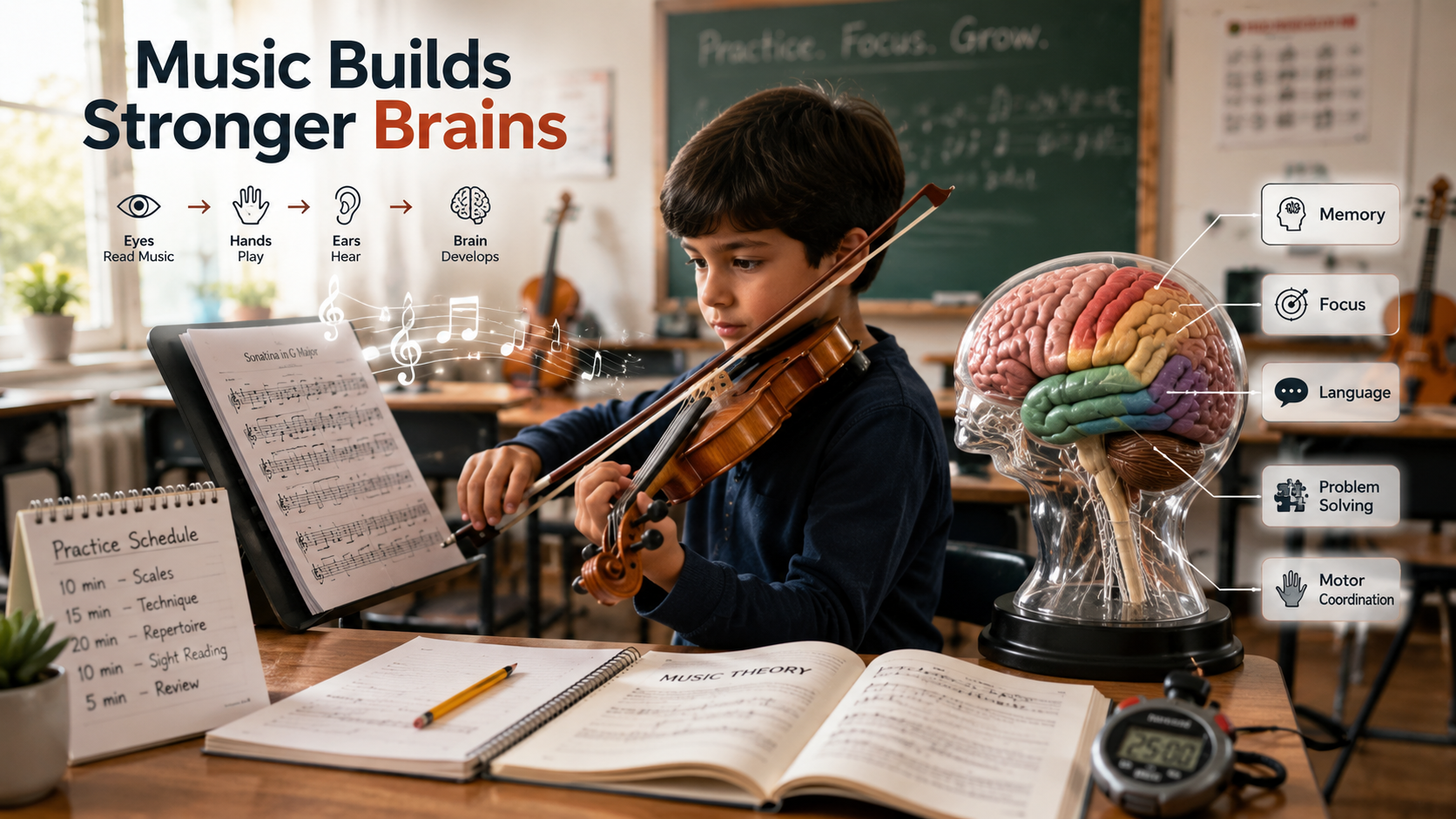
Scientists specializing in childhood growth have discovered that instrumental practice heavily influences brain anatomy. Therefore, musical training alters development primarily due to the power of neuroplasticity. Neuroplasticity is the brain’s natural ability to reorganize itself by forming new neural connections over time. For example, the brain of a young musician physically adapts to the rigorous demands of regular practice. Specifically, the corpus callosum grows significantly larger, which is the thick bundle of nerve fibers connecting the left and right hemispheres. Consequently, it becomes far more interconnected than it does in non-musicians.
This enhanced biological connectivity allows complex data to travel faster. Therefore, information moves more efficiently across different regions of the brain. Because of this, young musicians demonstrate superior problem-solving skills. They also show higher spatial-temporal intelligence, which is a skill that is critical for advanced engineering, architecture, and mathematics. Similarly, music forces the brain to translate visual symbols into physical movements while providing immediate auditory feedback. This complex loop accelerates gray matter development in areas that handle executive control, thereby optimizing processing capabilities.
Developing Stronger Mental Focus and Executive Functioning
Executive function refers to the core mental skills that help human beings plan, focus attention, and achieve goals. Furthermore, these skills help us remember explicit instructions and juggle multiple tasks successfully. Music lessons demand an intense amount of concentration from the very first day. Accordingly, a child must master working memory to succeed. They must remember notes, tempos, and finger positions all at the same time, which ensures they do not drop the rhythm of the piece.
Additionally, young musicians develop exceptional inhibitory control over time. This control allows them to suppress outside distractions and keep their focus entirely on the performance at hand. Meanwhile, they also cultivate cognitive flexibility, which is the ability to adjust to mistakes or changing tempos on the fly. Because these core pillars of executive function are exercised simultaneously during practice, children who play instruments show a marked advantage in school. Consequently, they display superior organization and self-regulation skills compared to their peers.
Linguistic and Academic Milestones in Young Musicians
How Learning an Instrument Changes Literacy and Language Skills
The human brain processes both music and spoken language through highly overlapping neural networks. Therefore, training a child’s ear to distinguish between subtle pitches directly enhances their literacy skills. For instance, young musicians can distinguish distinct speech sounds in noisy environments very well. This specific skill helps them focus in chaotic classrooms. Furthermore, this precise auditory processing allows them to absorb classroom instructions quickly, which leads to faster reading comprehension and rapid vocabulary development during early childhood.
Reading music involves translating visual symbols into a sequence of physical sounds. Thus, it mirrors the exact cognitive process required to read words on a page. Children who practice an instrument learn to track patterns from left to right. Likewise, they recognize subtle structural variations and predict upcoming sequences. This continuous cross-training of the brain provides massive academic benefits. As a result, young musicians often achieve advanced reading levels much earlier, helping them excel in language arts throughout their elementary school years.
The Mathematics and Rhythm Connection
Music is inherently mathematical because it is built entirely on a foundation of ratios, intervals, and precise timing. When children read sheet music, they constantly calculate fractions. Moreover, they recognize complex geometric patterns and divide time into precise metric units. Regular practice teaches children to understand abstract mathematical concepts through concrete physical actions. Ultimately, this approach bridges the gap between theoretical numbers and physical reality.
This tactile approach to fractions gives them a distinct cognitive advantage. For this reason, they do much better when transitioning to complex arithmetic, algebra, and geometry in school. Quarter notes, eighth notes, and triplets fit into a single musical bar. By understanding this relationship, a child inherently masters the concept of division. This artistic training removes the fear of abstract numbers. Instead, it turns mathematics into an intuitive, rhythmic language that they can easily manipulate and master.
Emotional and Social Growth Through Music
How Artistic Education Rebounds on Emotional Intelligence
Learning to play an instrument teaches children how to identify their internal feelings. In addition, they learn to express and safely regulate their emotions. Music provides a constructive, therapeutic outlet for stress, frustration, and anxiety. It allows children to channel their feelings into artistic expression rather than behavioral outbursts. Furthermore, interpreting the emotional tone of a complex piece helps children become deeply empathetic. They learn to listen for nuance, tension, and resolution.
Consequently, they learn to read subtle emotional cues in everyday speech, which improves their interpersonal relationships with family and classmates. In group settings, children must listen intently to those around them. For example, youth orchestras and school bands require this deep cooperation to maintain harmony. This collaborative dynamic requires deep social awareness and compromise. Therefore, it teaches children how to suppress their ego for the collective success of the ensemble, which builds lasting social intelligence.
Building Resilience Through Deliberate Practice
Mastering an instrument never happens overnight. Rather, it requires long hours of patience, meticulous repetition, and a high tolerance for temporary failure. A child might spend weeks correcting a single musical phrase. Similarly, they might spend days perfecting a difficult finger transition. Through this challenge, they learn the true value of grit and deliberate practice. This process shifts their mindset fundamentally. Instead of fearing failure, they learn to embrace it because they understand that mistakes are simply stepping stones toward mastery.
This psychological resilience easily transfers to other areas of life. For instance, it helps with conquering tough sports drills and studying for difficult science exams. Children who learn an instrument understand that human capability is not fixed. They realize that dedication and hard work can overcome initial weaknesses. By celebrating the eventual mastery of a difficult piece, they build an authentic sense of self-confidence. This confidence is grounded in real, measurable achievement rather than superficial praise.
Long-Term Benefits: Beyond the Childhood Years
How Early Musical Training Alters Development of Cognitive Reserve
The structural enhancements gained during childhood music lessons do not simply fade away. Instead, they remain long after a person stops playing their instrument. Neuroscientific studies indicate that early musical training builds a robust cognitive reserve. This biological reserve protects the brain from degeneration later in life. For this reason, adults who played instruments as children maintain sharper memory systems. Furthermore, they show faster speech processing speeds and superior auditory attention in old age, even if they discontinued practice in adulthood.
This lifelong benefit occurs because of dense neural networks formed during youth. These networks create alternative pathways for information retrieval, allowing the aging brain to bypass damaged or weakened areas. By investing in music lessons during early childhood, parents provide a great benefit. Specifically, they give their children an insurance policy for their long-term neurological health. This helps stave off age-related cognitive decline and dementia decades down the road.
Career and Academic Success
The intense discipline and time management learned in the music studio translate directly into adulthood. Consequently, these skills help in the modern corporate boardroom and competitive academic environments. The confidence gained from performing on stage reduces public speaking anxiety drastically. Moreover, it boosts overall adult self-esteem. As a direct result, former music students frequently excel in collaborative professional environments, complex project management, and high-stakes leadership positions.
They possess the rare ability to focus deeply on tedious tasks. Thus, they can work for extended periods while maintaining an analytical mindset. This discipline applies to analyzing corporate data, writing software code, or performing surgical procedures. The precision cultivated during childhood music lessons gives professionals a distinct competitive edge. Therefore, it proves that the benefits of music extend safely far beyond the notes on a page.
FAQ Section
Do children who take music lessons develop differently than those who do not?
Yes, extensive research proves that musical training alters development across multiple pathways. From a biological perspective, young musicians exhibit a much larger corpus callosum, which is the bridge connecting the left and right hemispheres of the brain. This physical change allows for rapid information transfer, thereby boosting spatial-temporal intelligence and problem-solving skills. Academically, they show advanced language processing and literacy because reading music uses the same neural networks as reading words. Socially, the patience required to master an instrument builds deep emotional resilience and self-regulation skills that non-musical children often take longer to cultivate.
What is the best age for a child to start formal music lessons?
Most child development experts and music educators agree on the ideal window. Therefore, they recommend beginning formal music lessons between the ages of 5 and 7. At this specific stage of growth, a child’s brain is incredibly adaptable and highly receptive to auditory training. Meanwhile, their hands and fine motor skills are sufficiently developed to handle small instruments like the piano, violin, or ukulele. Starting during this period takes full advantage of peak childhood neuroplasticity. However, it is vital that parents focus on fun and exploration at first, ensuring the child builds a positive, lifelong relationship with music instead of feeling overwhelmed by rigid expectations.
Can music lessons increase a child’s IQ or overall intelligence?
Long-term psychological research indicates a strong, measurable correlation between sustained music lessons and IQ. Specifically, it shows increases in a child’s full-scale IQ score over time. The rigorous multi-sensory engagement requires reading complex sheet music, coordinating precise finger movements, and maintaining perfect rhythm. Furthermore, it requires listening closely to pitch, which stimulates multiple regions of the brain simultaneously. This intense mental workout enhances overall cognitive capacity, improving areas related to spatial reasoning, memory, and logical thinking. Music lessons will not instantly turn a child into a genius, but they effectively optimize their inherent cognitive potential for school.
How exactly does playing an instrument improve a child’s reading and literacy skills?
Playing an instrument requires highly sophisticated auditory processing. Consequently, this training teaches the young brain to distinguish incredibly subtle variations in sound, highlighting variations in pitch, timbre, and duration. These precise auditory discrimination skills are identical to the tools children use to decode language. For example, they use these same tools for phonics, syllables, and verbal patterns in spoken language. Furthermore, reading music from left to right trains the eyes to track visual symbols sequentially. This directly mirrors the mechanical process of reading text. Because of this powerful crossover effect, young musicians generally read much faster and acquire expansive vocabularies quickly.
What if my child does not show any natural talent or passion for music?
Natural talent is absolutely not a prerequisite for enjoying the vast benefits of music education. The profound advantages of learning an instrument stem directly from the process of practicing, listening, and correcting mistakes rather than achieving flawless artistic perfection. For instance, a child who struggles with rhythm but continually perseveres gains the exact same neurological boosts. They experience increased gray matter and emotional grit just like a naturally gifted prodigy. Therefore, parents should view music lessons as an invaluable tool for general brain development and character building rather than a narrow pathway designed solely to create professional performers.
Conclusion
In summary, robust scientific data shows that musical training alters development in children. It provides a comprehensive, unmatched framework for holistic human growth. Music offers developmental advantages that few other childhood activities can match. For example, it physically reshapes the brain’s pathways and expands the corpus callosum. Furthermore, it accelerates early literacy and mathematical comprehension. The unique combination of visual, auditory, and motor training forces the young mind to operate at peak efficiency, creating strong cognitive foundations that support lifelong academic and professional success.
Moreover, the emotional maturity, empathy, and psychological resilience forged through daily practice are invaluable. They equip children with the essential coping mechanisms needed to navigate our complex world. Music transforms how they think, feel, and interact with others. Thus, it turns abstract discipline into a beautiful form of personal expression.
Investing in music education is not about forcing your child to become a professional virtuoso. Instead, it is about giving them a sharper mind, a more resilient heart, and a vibrant future. If you are looking for a meaningful way to enrich your child’s developmental journey, introducing them to a musical instrument is one of the greatest gifts you can provide.