Is a 1080p Dash Cam High Quality Enough for Your Car?
Choosing the right dashboard camera can feel overwhelming when manufacturers advertise confusing technical specifications. Many drivers wonder whether a 1080p dash cam still provides enough clarity for daily driving and insurance claims. A reliable dash camera can document road incidents and provide valuable video evidence when disputes arise.
Video quality matters because important details must remain visible during playback. You need a camera that captures road signs, traffic signals, vehicle movements, and potential hazards without exceeding your budget.
However, buying the most expensive camera available is not always necessary. Full HD resolution remains a practical choice for everyday drivers. It balances decent daytime video quality with manageable file sizes and affordable hardware.
In this guide, we answer common questions about dash cam resolution. We explain whether 1080p is sufficient, how it compares with 4K, and how much footage it stores. We also help you choose the right resolution for your driving habits.
Is a 1080p Dash Cam Good Enough?
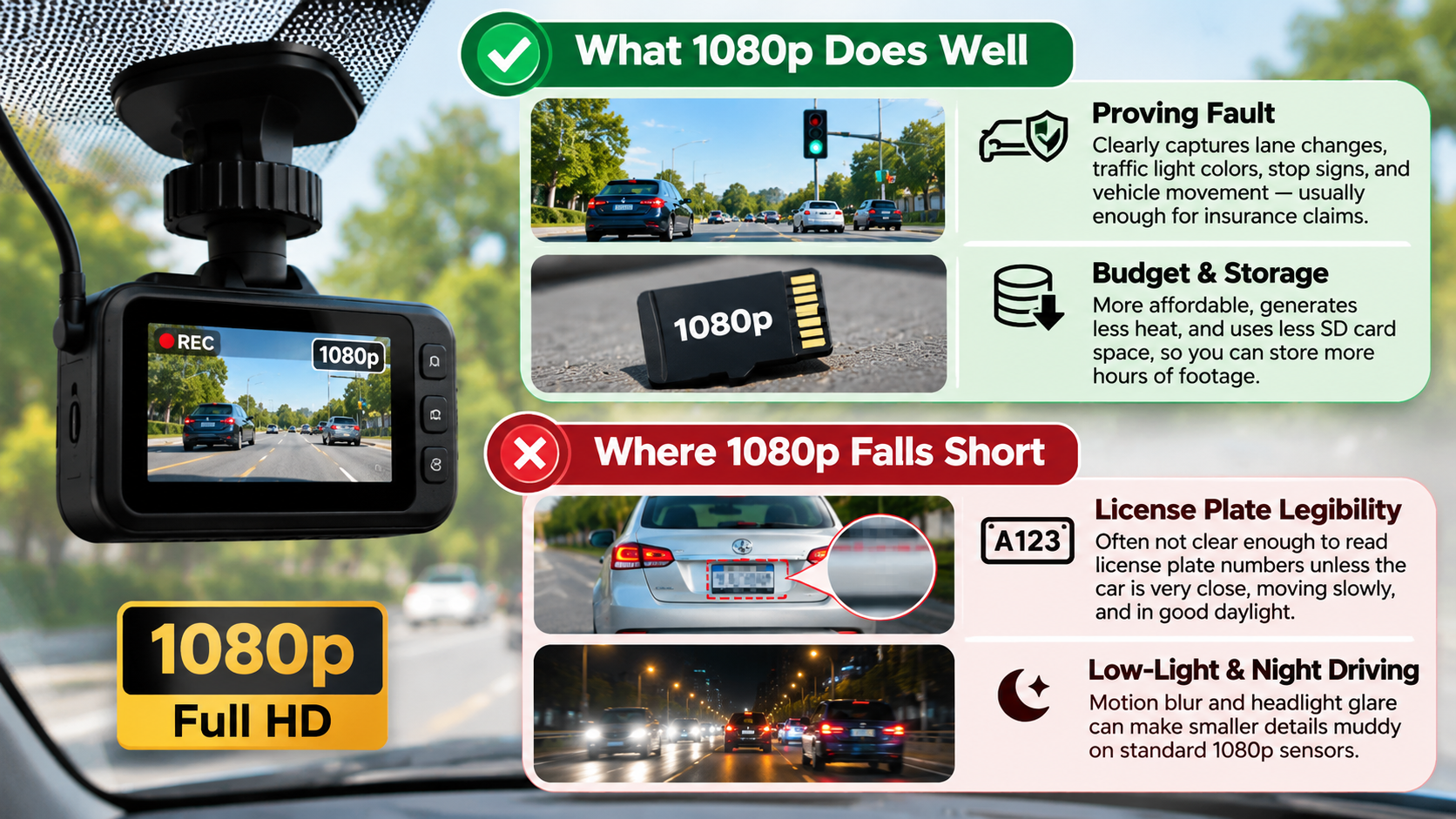
Yes, a 1080p dash cam provides sufficient video quality for most everyday drivers. Full HD resolution records at 1920 × 1080 pixels. This allows the camera to capture road lanes, traffic lights, nearby vehicles, and general driving conditions.
When an accident happens, clear footage can help establish what occurred. Insurance companies may use recordings to review traffic violations, collisions, and driver movements. A reliable 1080p camera can capture these details without requiring an expensive recording system.
However, performance depends on more than resolution. Nighttime recordings and fast-moving vehicles can challenge budget cameras. Reading distant license plates may also become difficult under poor lighting.
For everyday commuting, Full HD offers a reasonable balance between affordability and clarity. Drivers who frequently travel on highways or at night may benefit from higher-resolution cameras with better image sensors.
Sensor Quality Matters More Than Pixel Count
Resolution alone does not determine dash cam video quality. The image sensor, lens, aperture, and image-processing technology also influence recording performance. A well-designed 1080p camera can produce clearer footage than an inexpensive camera advertising higher resolution. Keeping the lens clean is equally important, so understanding how to clean both sides of a camera lens can help maintain image clarity.
Look for models featuring Sony STARVIS image sensors, where available. These sensors are designed to improve image capture in challenging lighting conditions. They can help preserve important details during nighttime driving.
Also consider cameras offering Wide Dynamic Range (WDR). This technology helps balance bright and dark areas within the same frame. It can improve visibility when sunlight, shadows, or headlights affect your recordings.
Before purchasing, check these important specifications:
- Image sensor: Look for a reputable sensor with good low-light performance.
- Lens quality: A quality glass lens helps maintain image clarity.
- Aperture: A wider aperture can improve light collection.
- WDR: Helps manage challenging lighting conditions.
These features can make a noticeable difference in everyday recording quality.
Is 4K Better Than 1080p for a Dash Cam?
Yes, 4K provides significantly more image detail than 1080p. A 4K dash cam records at 3840 × 2160 pixels. This provides four times as many pixels as standard Full HD resolution.
The additional detail can help when reviewing footage after an accident. You may have a better chance of identifying road signs, vehicle features, and distant objects. It can also provide more flexibility when zooming into recorded footage.
However, higher resolution does not guarantee better recordings in every situation. Image sensor quality, lens performance, frame rate, and lighting remain important factors. An inexpensive 4K camera may produce disappointing footage despite its impressive specifications.
There are also practical disadvantages to consider. 4K recording generally requires more storage space and processing power. Some models may also generate additional heat during continuous recording.
For everyday drivers, 1080p remains a practical option. However, drivers prioritizing additional image detail may prefer a quality 4K model.
The Hidden Trade-Offs of 4K Recording
Upgrading to a 4K dash cam introduces several practical considerations. Higher-resolution recordings generally require more storage space than Full HD videos. Consequently, you may need a larger, high-endurance microSD card for continuous recording.
Processing 4K footage also requires more computing power. Depending on the camera design, this can increase heat generation during operation. Poorly designed devices may struggle in hot environments, especially when exposed to direct sunlight.
Consider these potential disadvantages before purchasing:
- Higher storage requirements: 4K footage consumes more memory card space.
- Increased cost: Quality 4K cameras generally cost more than basic 1080p models.
- Heat management: Some devices may struggle during prolonged recording in hot conditions.
- Larger files: Transferring, storing, and reviewing recordings may take longer.
These disadvantages do not make 4K a poor choice. They simply mean you should consider the camera’s overall performance rather than resolution alone.
How Long Will a 1080p Dash Cam Record For?
A 1080p dash cam can typically store approximately 1.5 to 2 hours of footage per 16GB of memory card capacity. However, actual recording time depends on video bitrate, compression settings, frame rate, and camera configuration.
For example, a 64GB microSD card may store approximately 6 to 8 hours of Full HD footage. A 128GB card could provide around 12 to 16 hours under similar recording conditions.
Dual-channel dash cams record footage from both front and rear cameras. Because they generate additional video files, they generally reduce the total available recording time.
Most modern dash cameras also feature loop recording. This technology allows continuous recording without manually deleting older videos. When the memory card becomes full, the camera automatically overwrites older unlocked recordings.
Remember to choose a compatible high-endurance memory card. Dash cameras repeatedly write video files, so ordinary memory cards may wear out faster with continuous use.
How Loop Recording Protects Important Clips
Loop recording helps your dash cam operate continuously without requiring frequent manual maintenance. Instead of storing one enormous video file, the camera divides recordings into shorter segments. These commonly last one, two, or three minutes, depending on your settings.
When the memory card reaches capacity, the camera automatically replaces older unlocked clips. This creates space for new recordings while keeping the camera operational.
Most reliable dash cameras also include a built-in G-sensor. This sensor detects sudden movements, impacts, and certain braking events. When triggered, it can lock the corresponding recording to prevent automatic deletion.
Here is how the process generally works:
- The dash cam continuously records your journey.
- Video footage is divided into smaller segments.
- Loop recording replaces the oldest unlocked files.
- The G-sensor detects a sudden impact or movement.
- The camera protects the relevant recording from automatic overwriting.
However, protected files can still occupy valuable storage space. Review them periodically and back up important accident footage.
What Is a Good Resolution for a Dash Cam?
A good resolution for a dash cam depends on your driving habits, budget, and recording requirements. 1440p (2K) offers a useful middle ground between standard Full HD and 4K. It provides more image detail than 1080p without requiring the same storage capacity as many 4K configurations.
For everyday commuters, a reliable 1080p dash cam remains a sensible budget-friendly option. It can capture nearby vehicles, road markings, and general traffic conditions during normal driving.
However, drivers who frequently travel on highways may appreciate the additional detail offered by 1440p or 4K cameras. Higher resolution can provide more information when reviewing distant objects and surrounding traffic.
Nighttime drivers should also prioritize low-light performance. A quality image sensor and lens can matter more than resolution alone.
Ultimately, choose a camera that delivers consistent recordings under your typical driving conditions. Consider storage capacity, frame rate, and overall reliability before making your purchase.
Matching Resolution to Your Driving Routine
Your daily driving routine should influence which dash cam resolution you purchase. Different drivers have different recording requirements. A city commuter may need reliable footage of nearby traffic, while a frequent highway traveler may benefit from additional image detail.
Consider these recommendations when comparing dash cameras:
- 1080p: Suitable for budget-conscious drivers, short commutes, and everyday city driving.
- 1440p (2K): A practical upgrade for drivers who want additional image detail and reasonable storage requirements.
- 4K: Worth considering for drivers who prioritize maximum recording detail and have sufficient storage capacity.
Nighttime performance also deserves attention. Look for a camera with a capable image sensor, good lens quality, and effective exposure control.
Do not choose a dash cam based entirely on its advertised resolution. Check sample recordings, memory card compatibility, heat management, and warranty coverage before purchasing.
A dependable 1080p model can provide useful everyday protection. However, a quality 1440p or 4K camera may better suit demanding driving conditions.
Conclusion: Is a 1080p Dash Cam Worth Buying?
A 1080p dash cam is still a reliable choice for drivers who want clear recordings without spending too much. It captures everyday road conditions, nearby vehicles, traffic signals, and important driving incidents. For most commuters, Full HD provides a practical balance between video quality, storage space, and affordability.
However, your driving habits should determine the resolution you choose. Consider 1440p if you want additional image detail, or 4K if maximum recording clarity is your priority. Also, pay attention to image sensor quality, night vision, frame rate, and lens performance.
For additional road safety information, explore the National Highway Traffic Safety Administration (NHTSA) website.
Ultimately, the best dash cam is not necessarily the one with the highest resolution. Choose a dependable model that performs well in your usual driving conditions and fits your budget. A quality 1080p dash cam can provide valuable road footage and everyday peace of mind.