
Individualized Education Program: A Complete Guide for Educators and Parents
Every child learns at a different pace, yet traditional classrooms often follow a standard teaching approach. An Individualized Education Program (IEP) helps bridge this gap by creating a personalized educational roadmap. It supports students with disabilities who require specialized academic, developmental, or behavioral assistance.
According to the U.S. Department of Education, the Individuals with Disabilities Education Act (IDEA) protects eligible children. It ensures they receive a Free Appropriate Public Education (FAPE) tailored to their individual needs. An IEP documents the services, accommodations, and educational goals required to support each student.
Understanding how an individualized education program works helps parents, teachers, and school administrators collaborate effectively. Personalized teaching strategies can improve student confidence and support measurable progress. They also encourage inclusive classrooms where every learner receives appropriate educational opportunities.
In this comprehensive guide, we explore the meaning, purpose, and essential components of an IEP. You will also discover practical IEP goal examples and the teacher’s responsibilities. Additionally, we examine India’s National Education Policy (NEP) and explain how individualized educational planning supports special education in India.
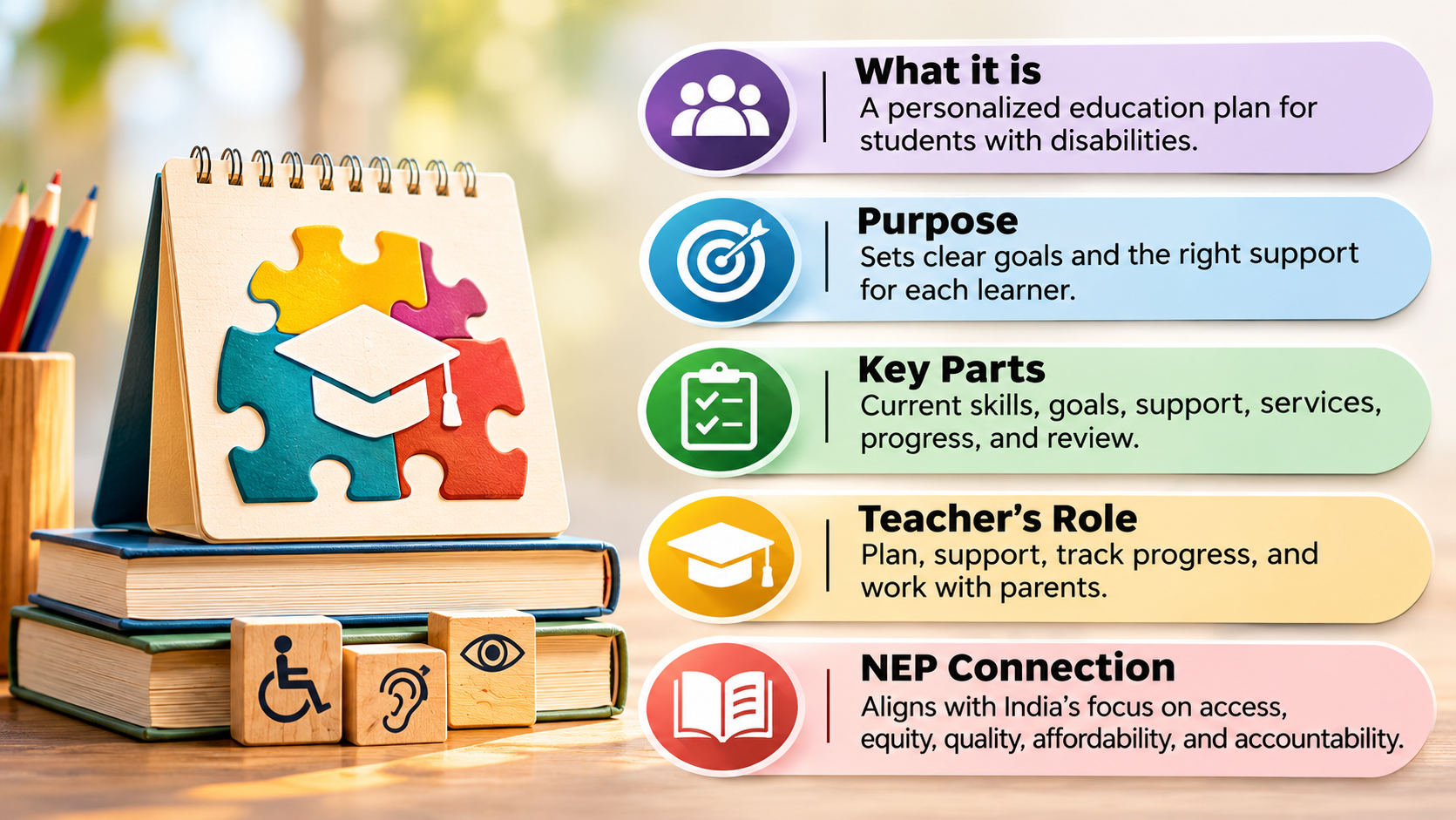

What is the individualized education program?
An Individualized Education Program is a formal, written educational plan developed for eligible students with disabilities in U.S. public schools. It identifies the specialized instruction, services, and support a student needs to access education. A team develops the document by considering the child’s individual strengths, challenges, and learning requirements.
The IEP team generally includes parents, general education teachers, special education teachers, and a qualified school representative. Other professionals, such as school psychologists and therapists, may participate when appropriate. Each member contributes information that helps create realistic educational goals.
The document describes a student’s current academic achievement and functional performance. It also establishes measurable annual goals, required accommodations, and methods for monitoring progress. These details guide classroom instruction throughout the school year.
Unlike a standard lesson plan, an IEP focuses on individual educational needs. It helps schools provide appropriate support while allowing students to participate in the general education curriculum whenever suitable. Schools can also explore different types of alternative education to understand how flexible educational approaches support diverse learners.
Why Legal Accountability Matters
Legal accountability makes an IEP different from an informal tutoring or classroom support plan. Under the U.S. IDEA framework, eligible students have specific educational protections. Schools must develop and implement appropriate services according to the student’s IEP.
The document identifies the accommodations, specialized instruction, and related services the school has agreed to provide. These may include speech therapy, occupational therapy, assistive technology, or additional learning support. Schools must also monitor progress and review the plan regularly.
This legal framework protects students from receiving inconsistent or inadequate educational assistance. It also gives parents an established process for participating in educational decisions and raising concerns.
However, an IEP does not guarantee identical outcomes for every student. Its purpose is to provide appropriate educational support based on individual needs. Clear documentation, regular communication, and proper implementation help schools maintain accountability throughout the academic year.
What are the five pillars of NEP?
India’s National Education Policy (NEP) 2020 emphasizes five foundational pillars: Access, Equity, Quality, Affordability, and Accountability. These principles aim to make education more inclusive, accessible, and effective. They also support improvements across different educational levels.
Each pillar addresses a specific challenge within India’s education system:
- Access: Ensures children can enter educational institutions regardless of their location, background, or circumstances. It encourages broader participation and reduces barriers to schooling.
- Equity: Promotes equal learning opportunities for disadvantaged communities and children with disabilities. It recognizes that different students may require different levels of educational support.
- Quality: Focuses on improving teaching methods, curriculum standards, learning outcomes, and teacher training.
- Affordability: Encourages affordable educational opportunities and helps reduce financial barriers that prevent children from accessing quality learning.
- Accountability: Promotes transparency and responsibility among educational institutions, teachers, and administrators.
Together, these five pillars support a learner-centered education system. They also complement inclusive education initiatives that recognize individual learning differences. However, these pillars should not be confused with the six components of an IEP under the U.S. special education framework.
What are the six components of an Individualized Education Plan?
An effective Individualized Education Plan includes several essential elements that guide a student’s educational development. These components help teachers understand current abilities, establish realistic targets, and provide appropriate assistance. Although the IDEA framework contains several specific IEP requirements, the following six areas provide a useful overview.
- Present Levels of Performance (PLAAFP): Describes the student’s current academic achievement and functional abilities. It identifies strengths, challenges, and areas requiring additional support.
- Measurable Annual Goals: Establishes specific academic, developmental, or behavioral targets for the student.
- Progress Monitoring: Explains how teachers will measure improvement and communicate progress to parents.
- Special Education and Related Services: Identifies required instruction and services, including speech therapy or occupational therapy.
- Accommodations and Modifications: Outlines adjustments such as extended examination time, assistive technology, or modified assignments.
- Transition Planning: Helps eligible older students prepare for further education, employment, and independent living.
These components work together to create a structured learning plan. They also help educators evaluate whether current teaching strategies meet the student’s needs. Using student performance tracking methods can further help teachers monitor progress and identify areas requiring additional support.
What is an IEP and its purpose?
An IEP, or Individualized Education Program, is a personalized educational document designed for eligible students with disabilities. Its primary purpose is to ensure that each student receives appropriate special education services. The plan considers individual academic abilities, developmental needs, and functional challenges.
One important purpose of an IEP is establishing clear educational expectations. It identifies measurable goals and explains how educators will support the student’s progress. Teachers can use these goals to adjust instructional methods and evaluate learning outcomes. Approaches such as adaptive and personalized learning can also help educators tailor instruction to individual student requirements.
An IEP also helps schools coordinate different support services. For example, a student experiencing communication difficulties may require speech therapy alongside classroom instruction. Similarly, a student with mobility challenges may need physical accommodations.
Beyond academic development, the plan encourages independence and participation. It helps students develop communication, social, and practical life skills. Regular assessments also allow educators to identify difficulties and update teaching strategies when necessary.
Ultimately, an IEP provides a structured approach to meeting individual educational needs. It does not simply focus on academic performance. It also supports the student’s overall development and participation in school activities.
Bridging Home and School Collaboration
Successful IEP implementation requires consistent communication between families and educators. Parents understand their child’s behavior, interests, strengths, and challenges outside school. Teachers contribute classroom observations, academic assessments, and information about learning progress.
Combining these perspectives helps the IEP team make informed educational decisions. For example, parents may explain which communication techniques work effectively at home. Teachers can then explore whether similar strategies improve classroom participation.
Regular meetings also help families understand progress toward established goals. They provide opportunities to discuss difficulties, review accommodations, and identify additional support requirements.
Parents should participate actively in IEP meetings and share relevant concerns. Educators should explain assessment results using clear, understandable language. This collaborative approach creates greater consistency between home and school.
When both environments support similar learning strategies, students may find it easier to develop essential skills. Strong communication also helps prevent misunderstandings and keeps everyone focused on the student’s educational progress. Parents can also explore how to choose the right school for their child to understand the importance of finding an educational environment that supports individual learning requirements.
What is the role of the teacher in an IEP?
Teachers play an essential role in developing and implementing an Individualized Education Program. They help identify learning requirements, recommend suitable teaching strategies, and monitor student progress. Their classroom observations provide valuable information during IEP development.
General education teachers explain grade-level expectations and identify areas where students experience difficulties. Special education teachers contribute specialized instructional methods and recommend appropriate learning accommodations. Both professionals work with parents and other specialists to establish achievable educational goals. As educational technology develops, understanding AI vs. human teachers and the future of classrooms can also help educators consider how technology may complement personalized teaching.
During daily instruction, teachers must follow the agreed accommodations and support strategies. These may include preferential seating, additional examination time, visual learning materials, or modified assignments. Teachers should also create opportunities for students to participate in classroom activities.
Their responsibilities continue throughout the academic year. They collect performance data, assess progress, and document changes in student behavior or academic achievement. When a student struggles to meet established goals, teachers can discuss alternative strategies with the IEP team.
Regular communication with parents is equally important. Teachers should share meaningful progress updates and explain any concerns. Their consistent involvement helps ensure that the educational plan remains relevant and effective.
What are examples of IEP goals?
Effective IEP goals should follow the SMART framework: Specific, Measurable, Achievable, Relevant, and Time-bound. This approach helps educators establish clear expectations and evaluate student progress. Goals should reflect the student’s current abilities rather than unrealistic grade-level assumptions.
Here are three practical examples covering different learning areas:
1. Reading comprehension goal
“By the end of the school year, the student will read an appropriately selected passage and answer four out of five comprehension questions correctly across three consecutive assessments.”
This goal measures reading understanding and helps teachers track improvement through regular assessments.
2. Mathematics goal
“Given ten two-digit addition problems involving regrouping, the student will solve at least eight correctly using visual learning materials within twenty minutes.”
This target measures mathematical accuracy and encourages students to develop problem-solving skills.
3. Behavioral goal
“During unstructured group activities, the student will use a visual cue card to request a break instead of shouting in four out of five observed opportunities.”
This goal encourages appropriate communication and self-regulation.
Teachers should regularly review these goals and document progress. If a target becomes unsuitable, the IEP team can discuss appropriate adjustments. Individualized goals should always reflect meaningful student development rather than simply completing classroom tasks. Parents seeking additional academic support can also compare tuition vs. coaching as learning options when considering supplementary educational assistance.
What is IEP in special education in India?
In India, an Individualized Education Program (IEP) is commonly used by special educators as a structured approach to supporting children with disabilities and additional learning requirements. It identifies a child’s abilities, educational challenges, and developmental needs. Teachers use this information to plan appropriate instruction and individualized interventions.
India’s inclusive education framework is supported by the Rights of Persons with Disabilities (RPwD) Act, 2016 and educational initiatives such as Samagra Shiksha. These frameworks promote educational access and support for children with disabilities. However, India’s IEP practices should not be confused with the specific legal requirements of the U.S. IDEA framework.
Special educators, resource teachers, parents, and relevant professionals can collaborate when developing an individualized plan. Depending on the child’s requirements, support may include communication activities, occupational therapy, assistive technology, and adapted learning materials.
Schools and specialized rehabilitation centers may also use individualized plans to develop academic, social, and practical skills. The approach helps educators address different learning needs within inclusive educational environments.
Ultimately, individualized educational planning encourages greater participation and independence. It also helps families and teachers work together toward meaningful developmental and educational outcomes.
Conclusion
Navigating special education becomes far less overwhelming once you understand how an Individualized Education Program works in practice. By combining clear baseline data, measurable goals, and dedicated teacher support, these personalized plans transform classrooms into spaces where every student can genuinely succeed. Whether examining the six foundational components, reviewing real-world SMART goal examples, or exploring how India’s NEP and RPWD Act champion inclusive education, the core message remains consistent: education works best when it adapts to the learner.
Parents and educators share a powerful responsibility in bringing these written documents to life. Regular communication, consistent progress tracking, and proactive adjustments ensure that support strategies evolve alongside the child’s growing abilities. If you are a parent preparing for an upcoming school meeting, review your child’s current performance notes and advocate confidently for measurable accommodations. If you are an educator, use daily classroom observations to refine your instructional approach and empower every diverse learner in your care.