

Tuition vs Coaching: Making the Right Choice for Academic Success
Choosing between private tuition and coaching can be difficult for students and parents. The right option depends on learning needs, academic goals, and the level of support required. The tuition vs coaching debate has become especially important as school curricula become more demanding and competitive entrance exams require focused preparation.
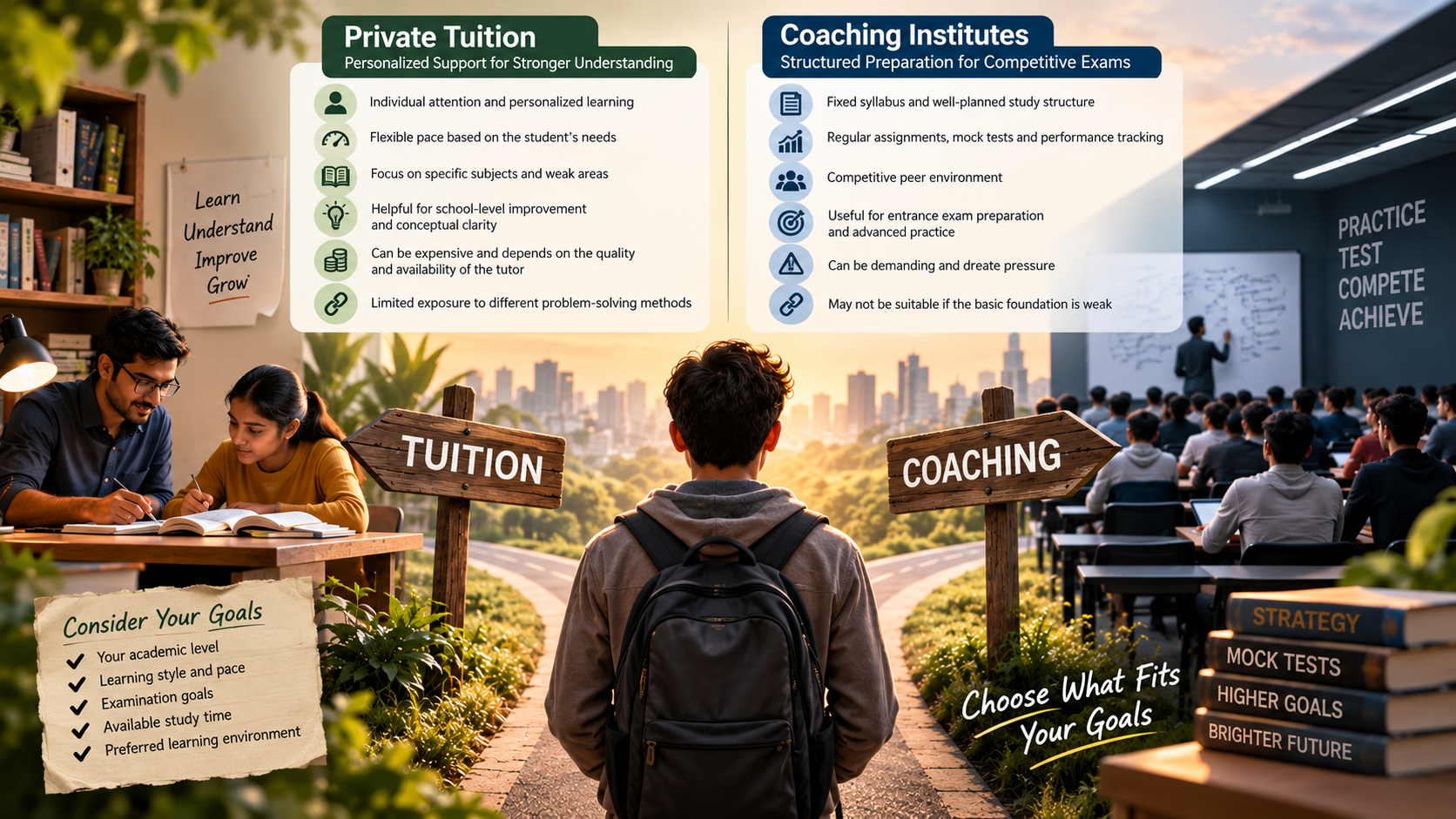
Private tuition usually provides personalized instruction, flexible pacing, and direct attention to individual weaknesses. Coaching institutes, meanwhile, offer structured courses, peer competition, regular testing, and specialized preparation for entrance examinations. Neither approach automatically produces better results. The value depends on how well the learning method matches the student’s needs.
This guide compares both options by examining their benefits, disadvantages, legal considerations, and appropriate use cases. It also explains when coaching may become counterproductive and why independent study remains essential. For broader insights into educational frameworks and learning approaches, you can explore resources from UNESCO.

Which is better, tuition or coaching?
There is no universal answer to whether tuition or coaching is better. The stronger choice depends on the student’s current academic level, learning style, and long-term objective. Private tuition is often more suitable for students who need individual attention, slower explanations, or help with specific subjects. A tutor can adjust lessons according to the student’s pace and address doubts immediately. Students can also compare different educational models through government vs private school options when evaluating their broader learning environment.
Coaching institutes follow a more standardized approach. They usually provide a fixed syllabus, scheduled classes, regular assignments, mock tests, and a competitive peer environment. This structure can benefit students preparing for demanding entrance examinations. Students can also understand how CBSE, ICSE, and state boards differ when considering how school curricula may affect their preparation needs.
Tuition may therefore work better for school-level improvement and conceptual clarity, while coaching can be useful for competitive exam preparation and structured practice. Students should assess their actual requirements before choosing either option.
Choosing based on specific learning goals
The most useful way to decide between tuition and coaching is to begin with the desired outcome. Students struggling with fundamental concepts may benefit from personalized tutoring because lessons can focus directly on their knowledge gaps. A tutor can also adjust the pace when a topic requires additional explanation.
Students preparing for national-level entrance examinations may benefit from coaching. These programs often provide structured syllabi, intensive problem-solving practice, mock examinations, and techniques designed for time-limited tests. The competitive environment can also encourage consistent preparation.
However, students should not choose coaching simply because it is popular. A demanding program may create unnecessary pressure if the student lacks the required foundation. Similarly, tuition may not provide enough exam-focused practice for highly competitive tests.
The decision should therefore consider academic level, learning pace, examination goals, available study time, and preferred learning environment rather than reputation alone.
What are the disadvantages of tuition?
Private tuition provides personalized attention, but it also has limitations. One major concern is cost. Individual tutors and small-group sessions can become expensive when lessons continue for several months. The total expense may increase further when students require tutoring across multiple subjects.
Another weakness is dependence on one tutor. The quality of learning can vary significantly based on the tutor’s subject knowledge, teaching ability, preparation, and availability. If the tutor becomes unavailable, the student’s regular learning routine can be disrupted.
Private tuition can also provide less exposure to different problem-solving methods. A student who studies with one tutor may become familiar with only one teaching style or approach. This can limit opportunities to compare alternative ways of solving difficult questions.
In addition, tuition does not automatically create strong study habits. Students may become dependent on explanations instead of developing independent problem-solving skills. Parents should therefore evaluate whether tutoring is actually improving understanding, confidence, and measurable academic performance before continuing indefinitely.
Quality control and consistency issues
Private tutoring has fewer standardized quality controls than established educational institutions. Independent tutors may follow their own teaching methods, materials, schedules, and assessment systems. This flexibility can be useful, but it also makes teaching quality harder to evaluate consistently.
Parents often have to judge effectiveness through test scores, homework performance, and the student’s feedback. A tutor who communicates well may not necessarily produce measurable academic improvement. Conversely, a demanding tutor may be effective even if the student’s immediate experience feels challenging.
Before selecting a tutor, families should consider subject expertise, teaching experience, communication skills, lesson structure, and assessment methods. Asking for a trial session can also help determine whether the teaching approach suits the student. Teachers and families may also benefit from using a teacher self-reflection routine to evaluate whether instructional methods are supporting student progress.
Progress should then be reviewed regularly. If grades, understanding, confidence, and independent study habits are not improving, the tutoring arrangement may need to change. Consistent evaluation prevents families from continuing with an ineffective learning setup simply because they have already invested time and money in it.
Is private tuition legal in India?
Private tuition is generally permitted in India, but the rules can vary depending on who provides the instruction and how the service operates. Individual tutoring and private coaching businesses can operate as educational services, subject to applicable local commercial, municipal, tax, and other legal requirements.
The situation can be different for government school teachers. Their service rules may restrict private commercial tutoring or create disciplinary issues if they conduct private tuition in violation of applicable employment regulations. Students and parents should therefore distinguish between independent tutors and teachers employed by government institutions.
Commercial coaching centres are also facing greater regulatory attention. Government guidelines have addressed areas such as student safety, fee transparency, advertising practices, and welfare. Coaching providers should ensure that their operations comply with applicable rules rather than assuming that every tutoring arrangement follows the same requirements.
Because regulations can change and may differ by jurisdiction, parents should verify current requirements before starting or operating a private tuition service. Legal compliance should be considered separately from the academic question of whether tuition or coaching is the better educational choice.
Regulatory oversight and government guidelines
Regulatory attention toward coaching centres has increased as concerns about student welfare, misleading advertising, excessive pressure, and unsafe facilities have received greater attention. Guidelines can require coaching providers to follow standards relating to safety, fee practices, advertising, and student welfare. These concerns are also closely connected to the importance of building a school culture where progress is valued, rather than relying solely on competition and performance pressure.
Private tutors operating independently may face a different set of requirements. Depending on their location and business structure, they may need to consider municipal rules, taxation, registration, and other applicable obligations.
Parents should also be cautious about exaggerated claims. Promises of guaranteed results or misleading success rates should not be treated as evidence of teaching quality. A coaching centre’s marketing material may highlight exceptional results without representing the experience of most students.
Before enrolling, families should examine the fee structure, refund terms, class size, teaching credentials, safety arrangements, and advertising claims. Checking the current rules applicable in the relevant state or locality is also important.
Regulatory compliance does not guarantee academic success. It simply establishes a basic framework within which educational services should operate. Students still need an appropriate learning environment, effective teaching, and sufficient independent study time.
What are the disadvantages of coaching?
Coaching institutes can provide structure and exam-focused preparation, but their scale can create serious disadvantages. Popular centres may have large batch sizes, making personalized attention difficult. Students who hesitate to ask questions may leave lessons with unresolved doubts. Teachers can use appropriate behavior remarks for kids to address classroom behavior positively and support a more productive learning environment.
The competitive environment can also increase academic pressure. Frequent tests, rankings, demanding schedules, and comparison with high-performing peers may motivate some students but overwhelm others. A rigid coaching schedule can become particularly difficult when combined with regular schoolwork.
Time is another concern. Students may spend several hours travelling to classes, attending lectures, completing assignments, and taking tests. This can reduce the time available for self-study, sleep, exercise, recreation, and family life.
Coaching may also encourage students to focus heavily on examination techniques. Shortcuts and repeated practice can be useful for competitive tests, but they should not replace conceptual understanding. Students need to understand why an answer is correct rather than simply memorize a method.
The best coaching environment should therefore balance exam preparation, conceptual learning, independent practice, rest, and student well-being.
The trap of rote learning
Some coaching environments can encourage students to prioritize memorization over understanding. Shortcut formulas, repeated question patterns, and rapid solving techniques can be useful when an examination rewards speed. However, relying on them too heavily can weaken deeper conceptual learning.
Students may perform well when questions closely resemble familiar practice problems. Difficulties can arise when an examination presents an unfamiliar situation or requires students to apply a concept differently. In such cases, memorized procedures may not be enough.
Conceptual understanding provides a stronger foundation. Students should be able to explain the reasoning behind a solution, identify the principles involved, and adapt those principles to new questions.
This does not mean exam techniques are useless. Time management, pattern recognition, formula recall, and repeated practice can all improve performance when combined with genuine understanding.
The problem begins when rote learning replaces conceptual clarity. Students should therefore use coaching materials as tools rather than substitutes for independent thinking. Regularly solving unfamiliar questions and explaining solutions without assistance can reveal whether knowledge is genuinely understood.
When should coaching not be used?
Coaching should not automatically be treated as the next step for every student. It may be unsuitable when a student has significant gaps in basic concepts and the coaching program moves too quickly. Fast-paced instruction can make existing weaknesses harder to identify and correct.
Early-stage learners may need patient, individualized support before entering a highly competitive environment. Personalized tuition or independent study can sometimes provide a better foundation during this stage.
Coaching can also become counterproductive when its schedule leaves insufficient time for schoolwork, revision, sleep, physical activity, or independent practice. More classroom hours do not necessarily produce better results. Students need enough time to process and apply what they learn.
The learning environment also matters. A highly competitive setting may motivate some students while creating excessive pressure for others. Families should consider whether the student’s temperament and current academic situation suit that environment.
Coaching is therefore less appropriate when the priority is building basic concepts, restoring academic confidence, or creating sustainable study habits. Entrance-focused preparation becomes more useful after students have developed the foundation needed to benefit from it.
Prioritizing conceptual foundation over speed
Students with weak academic foundations usually need development before acceleration. Competitive coaching often assumes that learners can absorb concepts quickly and apply them under time pressure. That assumption may not hold when fundamental knowledge is incomplete.
Strengthening basics can make later exam preparation more productive. Students should first understand essential concepts, practice straightforward problems, and gradually increase difficulty. This approach allows weaknesses to be addressed before advanced material creates additional confusion.
Gentle tutoring can be useful during this stage because the instructor can spend more time on individual difficulties. Independent study also matters because students need opportunities to work through problems without immediate assistance.
Once the foundation becomes stronger, competitive coaching may become more valuable. Students can then focus on speed, accuracy, advanced problem-solving, mock tests, and examination strategy without constantly revisiting basic concepts.
The goal should not be to enter coaching as early as possible. The goal is to enter it when the student can actually benefit from its pace and structure. Building strong fundamentals first can reduce frustration and make intensive preparation more effective later.
What is the 70/30 rule in coaching?
The 70/30 rule in coaching describes a commonly used learning principle in which students spend more effort on independent study than classroom instruction. Under this approach, roughly 70% of learning effort is devoted to activities such as revision, problem-solving, practice, and reflection, while around 30% comes from guided instruction.
This should not be treated as a scientifically fixed formula. Students differ in their learning needs, subjects, academic levels, and examination requirements. The useful idea is that attending coaching classes alone is not enough.
Classroom instruction provides explanations, direction, examples, and feedback. Independent study allows students to retrieve information, solve problems, identify weaknesses, and apply concepts without assistance. These activities turn passive exposure into active learning, while formative vs. summative assessment approaches can help evaluate student understanding and progress.
Students who spend most of their time attending lectures may feel productive without actually testing their understanding. Regular self-study provides a more realistic measure of whether concepts have been learned.
The tuition vs coaching decision should therefore consider what happens outside the classroom. Regardless of the chosen method, students need enough independent practice to convert instruction into lasting knowledge and stronger examination performance.
Maximizing output through independent practice
Independent practice is where students test whether classroom learning has actually become usable knowledge. After a lesson, students should attempt problems without immediately checking worked solutions or asking for help.
This process reveals gaps that may remain hidden during lectures. Students can then revisit notes, identify mistakes, and seek targeted clarification. Over time, this creates a feedback loop between instruction and independent practice.
Effective self-study can include:
- Solving problems without assistance
- Reviewing mistakes and incorrect answers
- Practicing active recall
- Revising difficult concepts
- Attempting unfamiliar questions
- Taking timed practice tests
The exact amount of self-study required varies by student and examination. The important point is that coaching hours should not replace independent learning.
Students who rely entirely on classroom instruction may struggle when they encounter unfamiliar questions. Independent practice builds confidence because learners become accustomed to finding solutions without immediate guidance.
Whether a student chooses tuition, coaching, or a combination of both, independent study remains a central part of academic progress. The strongest approach is one that uses instruction to guide learning while giving students enough time to practice, reflect, and solve problems independently.
Frequently Asked Questions
Can tuition and coaching be done simultaneously?
Yes, tuition vs coaching does not always require choosing one option exclusively. Students can use coaching for competitive exam preparation and tuition for difficult school subjects. However, combining both can create time-management problems, mental fatigue, and reduced self-study time. Students should combine them only when each method serves a specific purpose and the overall schedule remains manageable.
How do tuition and coaching impact school attendance?
School attendance is an important consideration when comparing tuition vs coaching. Intensive coaching centres may have long, fixed schedules that can conflict with regular school timings. This may encourage some students to prioritize entrance preparation over classroom attendance. Home tuition is generally more flexible and can be scheduled around school hours. Students should maintain regular school attendance while ensuring additional classes do not reduce essential study, rest, or revision time.
Are online platforms replacing traditional tuition and coaching?
Online learning platforms are changing the tuition vs coaching landscape by providing live classes, recorded lectures, digital study materials, and online test series. They offer greater flexibility and can reduce travel time. However, online learning requires strong self-discipline and consistent participation. Some students still benefit from face-to-face interaction, especially when they need motivation, personalized explanations, or immediate doubt resolution. Online education is therefore an alternative rather than a complete replacement for traditional learning.
Which option is more cost-effective for average families?
Cost is an important factor in the tuition vs coaching decision. Group coaching is generally more affordable per student than one-on-one private tuition because teaching costs are shared across multiple learners. However, total expenses vary according to the institute, location, course duration, study materials, and test series. Private tuition costs also depend on tutor experience, subject expertise, class frequency, and batch size. Families should compare the complete cost and expected academic value before choosing either option.
Conclusion
Choosing between tuition vs coaching requires careful consideration of a student’s academic needs, learning style, goals, schedule, and readiness. Tuition provides personalized attention and can strengthen weak concepts, while coaching offers structured preparation and competitive exam practice. Students considering education as a longer-term career direction can also explore teaching career opportunities to understand the wider possibilities within modern education. Neither approach guarantees success without consistent independent study. Families should choose the method that provides useful academic support without creating excessive pressure or reducing essential revision and rest. A balanced approach to tuition vs coaching can help students build stronger foundations, prepare effectively for examinations, and develop sustainable study habits.