
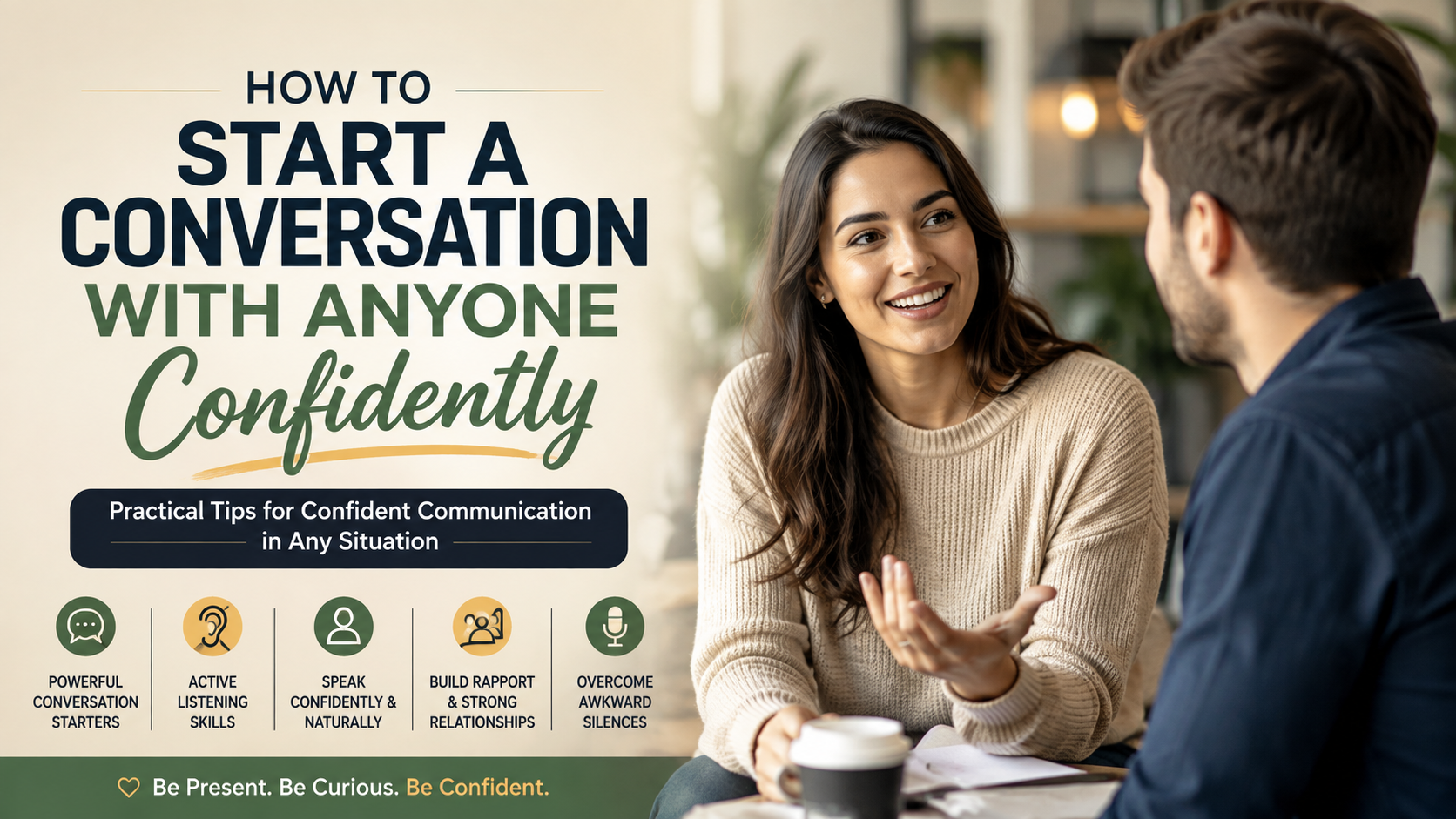
How to Start a Conversation with Anyone Confidently
Starting a conversation with a stranger or acquaintance can feel daunting. Learning how to start a conversation with anyone confidently can make social situations much easier. Whether you are at a networking event or waiting in a local cafe, communication shapes personal and professional relationships.
Communication experts at Harvard Business Review emphasize the importance of building rapport early. A strong first interaction can turn an awkward encounter into a meaningful exchange. If you want to improve your social skills, a few practical habits can help.
This guide explains conversation starters, active listening, confident speaking, and public speaking. It also covers how to avoid awkward silences and communicate clearly. The goal is not to sound perfect. Instead, focus on being present, curious, and comfortable.


What Are 5 Good Conversation Starters?
Having several reliable conversation starters can make social situations less stressful. The best options feel natural rather than rehearsed. They also encourage the other person to give more than a simple yes-or-no answer. Open-ended questions work especially well because they invite opinions, stories, and personal experiences.
You can begin with something connected to your surroundings. A shared experience often provides an easy opening because both people already understand the context. Keep your tone friendly and avoid making the question feel like an interview.
Here are five practical conversation starters you can use in different situations:
- Ask for a recommendation, such as a book, restaurant, or local activity.
- Comment genuinely on something happening around you.
- Ask about a shared experience or event.
- Ask about a project, hobby, or activity they enjoy.
- Give a sincere compliment about their style, work, or contribution.
The best opening is one that feels appropriate to the setting. Genuine curiosity makes even a simple question more engaging.
Simple Icebreakers for Any Setting
Simple icebreakers work because they reduce pressure for both people. You do not need a clever joke or memorable story to begin talking. You only need an observation, question, or genuine point of interest.
For example, you might ask, “Have you tried anything good here?” at a cafe. At a professional event, you could ask, “What brought you to this event?” These questions create an easy path into a longer discussion.
Another useful approach involves asking about interests. If someone mentions a book, project, or hobby, use that detail as your next opening. People usually respond more naturally when the topic already interests them.
You can also use sincere compliments, but avoid comments that feel overly personal. Focus on something appropriate, such as their presentation, professional work, or choice of book.
The key is to avoid treating an icebreaker as a performance. Conversation should feel like an exchange, not a test. Listen to the response and let it guide your next question.
How Can I Start a Conversation With Anyone?
Learning how to start a conversation with anyone confidently begins with changing your focus. Instead of worrying about how you appear, pay attention to the person in front of you. Most people feel some social uncertainty, so a friendly approach is often welcomed.
Start by observing your surroundings. Look for a natural topic that connects you to the situation. Make comfortable eye contact, smile briefly, and approach with relaxed body language. Then introduce yourself clearly when appropriate.
You do not need to be endlessly witty or entertaining. Trying too hard can actually make conversations feel forced. Your goal is simply to create an opening and give the other person room to respond.
Genuine curiosity is one of the most useful social skills you can develop. Ask questions because you want to understand the person, not because you need another line to say.
If the conversation becomes quiet, return to something they previously mentioned. Their answer may provide several new topics. With practice, you will become less focused on performing and more comfortable with natural conversation, a skill that can also help when dealing with rejection after an interview.
The Power of Active Listening
Active listening keeps conversations moving because it gives you useful information for your next response. Instead of planning your answer while someone speaks, focus closely on what they actually say.
Show that you are listening through natural eye contact, occasional nods, and brief verbal responses. You can also repeat an important detail in your own words. This confirms that you understood the speaker without interrupting their story.
Follow-up questions are especially valuable. If someone mentions a recent trip, ask what they enjoyed most. If they describe a project, ask what motivated them to start it.
Avoid turning every response into a comparison with your own experience. Sharing something relevant can build connection, but constantly redirecting the conversation toward yourself can make the other person feel ignored.
Active listening also helps when you are unsure what to say next. Their words already contain possible conversation topics. Listen for details, emotions, interests, and opinions, then respond to what matters most.
Good conversations rarely depend on having perfect answers. They depend on paying attention and showing genuine interest.
How to Talk Smartly With Anyone?
Talking smartly does not require complicated vocabulary or impressive jargon. Trying to sound intelligent can actually make your communication less natural. Strong communicators express ideas clearly and remain curious about different perspectives.
When you want to sound thoughtful, focus on asking useful questions. Instead of dominating a discussion, give others space to explain their ideas. This shows confidence without making the conversation competitive.
Building knowledge also helps. Stay informed about subjects that genuinely interest you. Read widely, follow reliable sources, and explore topics beyond your immediate profession. This lifelong learning gives you more ideas to discuss naturally.
However, you do not need an opinion about everything. Saying “I don’t know” when you lack information can demonstrate honesty and intellectual maturity. You can then ask questions and learn from someone else’s experience.
Avoid pretending to understand something when you do not. People often notice forced confidence. Clear communication, thoughtful questions, and genuine curiosity create a stronger impression than complicated language.
Ultimately, talking smartly means helping the conversation become more interesting. Your goal should be understanding, contributing, and learning rather than proving that you are the smartest person in the room.
Asking Insightful Follow-Up Questions
Follow-up questions can turn basic small talk into a meaningful discussion. Instead of immediately changing subjects, pay attention to an interesting detail in the person’s response. Then explore it naturally.
For example, if someone says they recently changed careers, avoid stopping at “That’s interesting.” Ask what motivated the change or what surprised them most. These questions encourage people to share experiences rather than simple facts.
You can also explore the why and how behind an answer. If someone mentions a hobby, ask how they became interested in it. If they describe a professional achievement, ask what they learned during the process.
Good follow-up questions should feel conversational rather than investigative. Avoid firing questions at someone without contributing anything yourself. Respond to their answer first, then ask something relevant.
You should also listen for emotional cues. Excitement, frustration, curiosity, or pride can reveal useful directions for the conversation, while paying attention to these signals can also support psychological safety at work.
The strongest follow-up questions come directly from what someone has said. They show that you are paying attention. Over time, this habit can make your conversations more engaging while helping you develop stronger communication skills.
How to Start a Conversation Without Being Awkward?
Awkwardness often comes from overthinking before you speak. You may rehearse every possible sentence, worry about the person’s reaction, or assume you must keep the conversation entertaining. These expectations create unnecessary pressure.
A better approach is to keep your opening brief and connected to the situation. Comment on something you both experience or ask a simple question. This gives the other person an easy opportunity to respond.
You should also accept that not every conversation will become a long interaction. Someone may be busy, distracted, or simply not interested in talking. That response does not automatically mean you did something wrong, just as explaining employment gaps in an interview requires avoiding unnecessary assumptions about how others may judge you.
Silence is also normal. You do not need to fill every second with words. A short pause can give both people time to think and choose what to say next.
Relaxing your expectations can improve your body language, voice, and overall presence. When you stop trying to create a perfect interaction, you become more natural.
If you want to learn how to start a conversation with anyone confidently, focus less on avoiding awkwardness. Focus more on being respectful, observant, and genuinely interested.
Embracing Natural Pacing and Pauses
Your speaking pace can strongly affect how confident you appear. Nervous speakers often rush because they want to finish before they make a mistake. Unfortunately, rushing can make their words harder to understand.
Give yourself permission to slow down. A short pause before answering can help you organize your thoughts. It can also make your response sound more deliberate.
You do not need to eliminate every pause. Natural pauses are part of normal conversation. They allow the other person to process information and create room for a thoughtful response.
Breathing also matters. Take a quiet breath when you notice yourself speaking too quickly. Relax your shoulders and continue at a comfortable pace.
Avoid using excessive filler words simply because silence feels uncomfortable. Words such as “um,” “like,” and “you know” can become distracting when repeated frequently.
Confident communication is not about speaking constantly. It is about communicating comfortably and clearly. When your pace matches the situation, you appear more relaxed and give others more opportunities to participate.
With practice, pauses stop feeling like mistakes. They become a natural part of confident conversation.
How to Be Confident While Speaking in Public
Public speaking requires preparation, practice, and a realistic view of your audience. Many people become nervous because they imagine listeners are waiting for them to make mistakes. That assumption can increase pressure unnecessarily, much like the pressure candidates can feel when answering behavioral interview questions.
Instead, treat your audience as people who want useful information. Organize your presentation into a clear beginning, middle, and end. This structure makes your ideas easier to remember and easier for listeners to follow.
Practice speaking out loud before the event. Reading silently does not prepare your voice, pacing, or breathing in the same way. Record yourself or practice with someone you trust.
Focus on your key ideas instead of memorizing every sentence. Memorization can make recovery difficult if you forget a phrase. Understanding your structure gives you more flexibility.
Breathing can also help regulate nervous energy. Take slow breaths before speaking and avoid rushing through your opening. A controlled start can settle your voice and establish confidence.
You may still feel nervous, and that is normal. Confidence does not require the absence of anxiety. It means continuing to communicate effectively despite those physical sensations.
Managing Physical Signs of Stage Fright
Stage fright can produce noticeable physical symptoms. You may experience a faster heartbeat, tense muscles, shaky hands, dry mouth, or rapid breathing. These reactions are common responses to high-pressure situations.
You can reduce their impact with simple grounding techniques. Place both feet firmly on the floor and relax your shoulders. Take several slow breaths before beginning your presentation.
Avoid interpreting every physical sensation as evidence that you are failing. Nervous energy does not necessarily mean your audience can see or judge it. The more attention you give those sensations, the more distracting they may become.
Instead, redirect your attention toward your message. Look at supportive or attentive faces when appropriate. Focus on explaining your ideas rather than monitoring your body.
Preparation also reduces uncertainty. Know your opening, your main points, and your conclusion. If you lose your place, pause and return to your structure.
Over time, repeated exposure can make public speaking feel more familiar. Practice builds confidence through experience, not through waiting until you feel completely fearless.
The goal is not to eliminate nervousness. The goal is to remain clear and composed while it passes.
How to Speak Confidently and Clearly
Speaking clearly requires control over your voice, pace, and articulation. Nervousness can cause people to mumble, rush, or lower their volume. These habits make otherwise strong ideas harder to understand.
Start by speaking at a comfortable volume. You do not need to shout, but your voice should reach the people listening. Practice projecting your voice without straining your throat.
Your pace matters just as much. Slow down when explaining an important idea. Short pauses can separate key points and give listeners time to process your message.
Clear articulation also improves understanding. Pronounce words fully rather than allowing sounds to disappear when you speak quickly. Reading aloud can help strengthen this habit.
Try replacing filler words with brief pauses. Instead of saying “um” while searching for an idea, stop for a moment. The silence usually sounds more confident than repeated fillers.
You can also record yourself speaking for one or two minutes. Listen for unclear words, rushed sections, and unnecessary repetition. Then practice the same message again.
Clear speech makes confident ideas easier to trust and understand. You do not need a dramatic voice. You need controlled, deliberate communication.
Eliminating Filler Words From Speech
Filler words can weaken your message when they appear too frequently. Common examples include “um,” “uh,” “like,” and “you know.” Occasional use is normal, but repeated fillers can make your speech sound uncertain.
The first step is identifying your patterns. Record yourself answering a question or explaining a familiar topic for two minutes. Listen carefully and count the fillers you use.
Once you know your common habits, practice replacing them with silence. A short pause gives you time to organize your thoughts without interrupting your message.
You can also practice speaking from simple outlines. Instead of memorizing complete sentences, write down three or four key points. This approach encourages natural speech while keeping you focused.
Do not become obsessed with eliminating every filler word. Excessive self-monitoring can make your speech less natural. The goal is to reduce distracting habits, not to sound artificially perfect.
When you pause, maintain relaxed body language and continue normally. Most listeners will simply hear a thoughtful pause.
Over time, these changes can improve both clarity and confidence. Intentional pauses often sound more polished than rushed speech, especially during interviews, presentations, and professional conversations such as video interviews.
FAQ SECTION
What should I do if the conversation goes completely silent?
If you are learning how to start a conversation with anyone confidently, remember that a quiet moment is completely normal. Take a breath instead of rushing to fill the silence. Introduce a fresh topic, comment on your surroundings, or ask an open-ended question about their interests, weekend plans, or recent experiences. A relaxed response can quickly bring the conversation back to life.
How can I overcome shyness when meeting new people?
Learning how to start a conversation with anyone confidently becomes easier when you practice in small, low-pressure situations. Begin with simple actions such as making eye contact, smiling, saying hello, or asking a casual question. Focus less on how you appear and more on making the other person comfortable. Consistent practice gradually reduces anxiety and makes social interactions feel more natural.
How do I gracefully exit a conversation?
Knowing how to start a conversation with anyone confidently also means knowing when and how to end one. Wait for a natural pause, smile, and politely explain that you need to leave. You might say, “It was really nice talking with you,” before wishing them well. If you genuinely want to stay connected, suggest exchanging contact information before leaving.
Is body language really that important during a chat?
Yes, body language strongly influences how confident and approachable you appear. When practicing how to start a conversation with anyone confidently, keep your shoulders relaxed, maintain comfortable eye contact, avoid closed-off gestures, and face the person naturally. Your posture and facial expressions should support your words rather than contradict them. Open, relaxed body language can make conversations feel easier for both people.
Conclusion
Mastering the art of communication is one of the most valuable investments you can make in your personal and professional life. By learning how to start a conversation with anyone confidently, you unlock doors to new friendships, career opportunities, and deeper human connections. Remember that confidence is not an innate trait; it is a skill built through consistent practice and patience with yourself. Start applying these simple strategies today, whether you are breaking the ice with a stranger or speaking to a larger audience. With every interaction, you will grow more comfortable, authentic, and naturally magnetic while developing stronger workplace communication skills.