
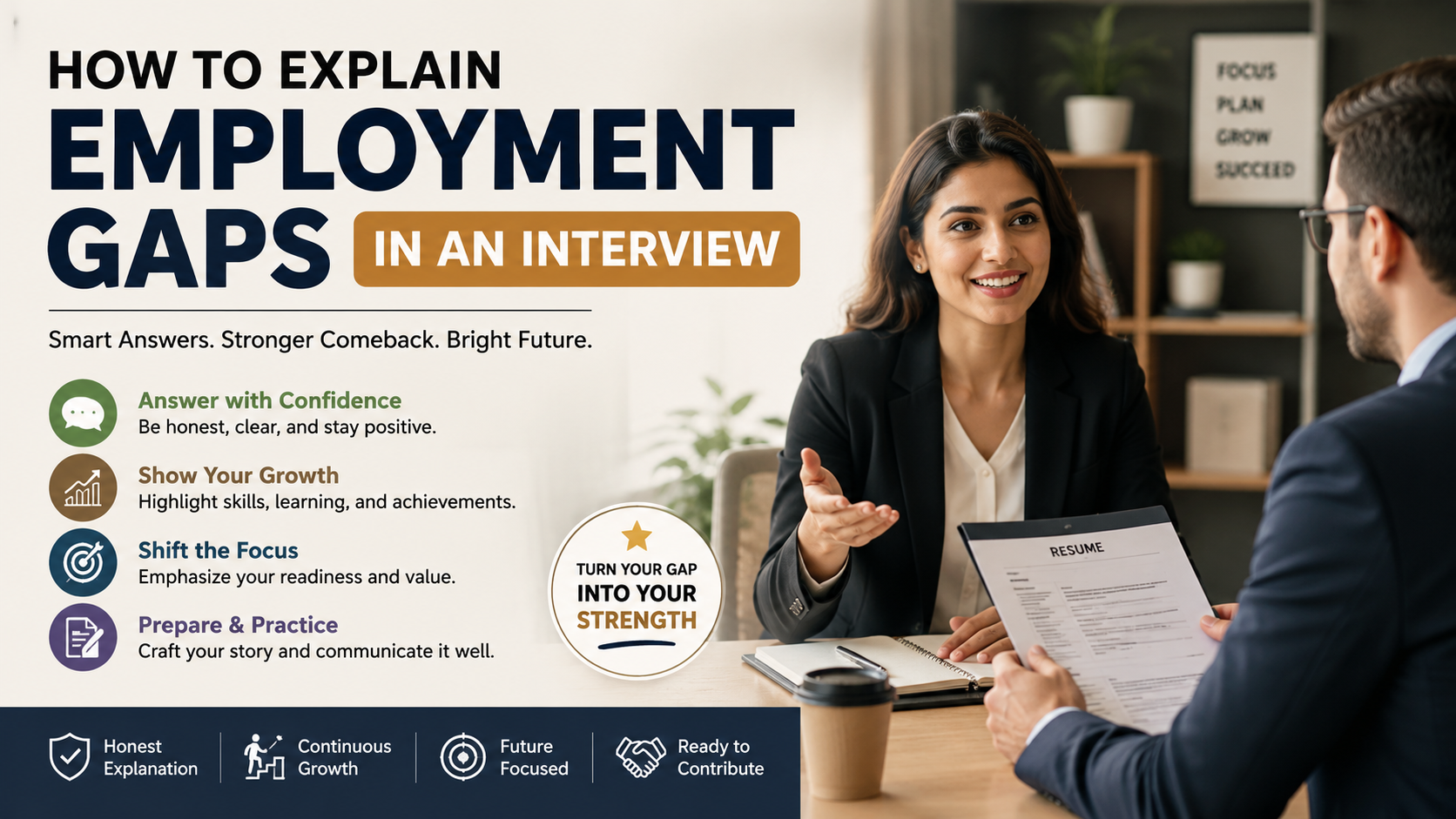
How to Explain Employment Gaps in an Interview
Navigating career pauses can feel daunting, but learning how to explain employment gaps in an interview is a vital skill for modern job seekers. Whether you took time off for personal reasons, further education, or unexpected layoffs, hiring managers care less about the pause itself and more about how you frame your story. According to career guidance from the U.S. Department of Labor, honesty and professional growth remain paramount during career transitions. This guide explores how to answer specific interview questions, justify pauses effectively, prepare application letters, and handle gaps as a fresher with confidence.


How to Answer “Can You Explain Your Employment Gap?”
Answering questions about employment gaps in an interview requires honesty, confidence, and a clear focus on your current readiness. Hiring managers usually want to understand what happened and whether you remained proactive during your time away from work. Preparing for broader interview questions, such as how to answer “Tell Me About Yourself” in an interview, can also help you present your career story more confidently.
Start by addressing the gap directly. Keep the explanation simple and avoid sharing unnecessary personal details. You can briefly mention caregiving, health recovery, further education, job searching, or professional upskilling. The goal is to provide enough context without becoming defensive.
Then, move the conversation toward what you can offer today. Explain how you used the period productively, if applicable, and highlight skills that remain relevant to the role. If the gap resulted from circumstances outside your control, state that calmly.
Most importantly, show that the situation is resolved and that you are ready to contribute. A confident, forward-looking answer can help employers see the gap as one part of your career story.
Shifting Focus to Your Current Readiness
Keep your explanation concise and quickly redirect attention toward your professional value. Interviewers are more interested in what you can contribute now than in every detail of your past circumstances.
Explain that your core skills remain relevant and that you have taken steps to stay prepared. Mention recent learning, practical projects, industry knowledge, or other activities that demonstrate continued development. If you used the gap to learn new skills, upskilling can strengthen your career prospects and show that you remained committed to professional growth.
Avoid apologizing repeatedly for the gap. Doing so can make an ordinary career interruption appear more serious than it is. Instead, communicate your situation with calm confidence and move naturally into your qualifications.
For example, you might say that you took time away for personal responsibilities, completed the necessary commitments, and are now ready to return to full-time work.
This approach keeps the discussion balanced. You acknowledge the employment gap without allowing it to dominate the interview. Your objective is to reassure the hiring manager that your previous absence will not prevent you from performing effectively in the position.
What Is the Best Answer for a Gap in an Interview?
The best answer about a career gap in an interview combines honesty, context, and a strong focus on professional growth. Hiring managers generally do not expect every candidate to have a perfectly continuous employment history. What matters is whether you can explain the timeline clearly and demonstrate that you are ready to work.
Begin with a straightforward explanation. If you spent time learning new software, earning certifications, searching for suitable opportunities, or managing personal responsibilities, state that without unnecessary detail.
When possible, connect your experience to the position you want. Explain how the period helped you develop useful knowledge, improve your skills, or clarify your career direction.
If the gap followed a layoff, avoid criticizing your previous employer. A simple explanation about restructuring or the end of your role is usually enough.
Finish by emphasizing your current availability and motivation. Your answer should leave the interviewer thinking about your skills, experience, and potential contribution, rather than focusing on the time you were unemployed.
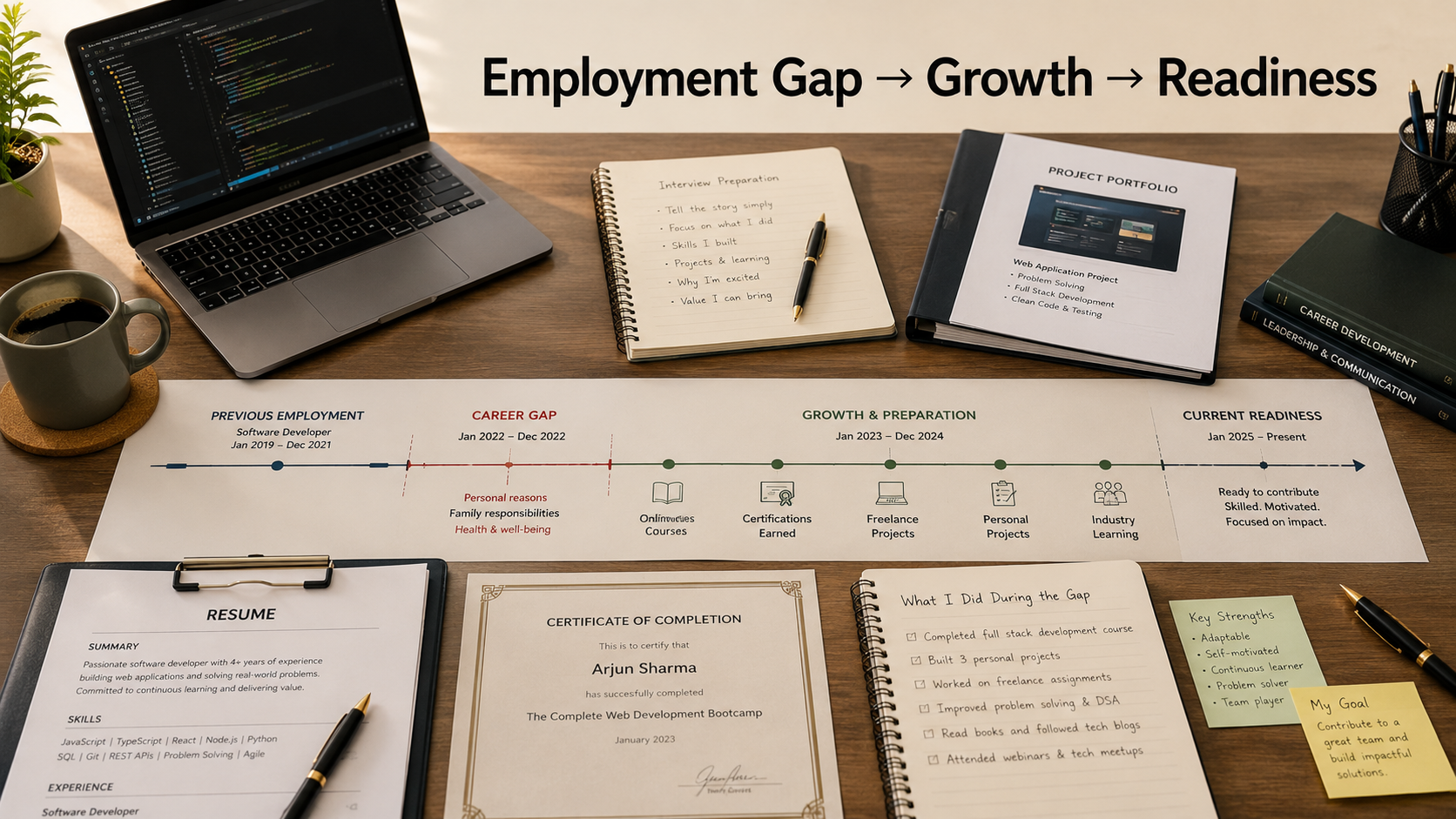
Demonstrating Continuous Growth and Initiative
Showing initiative during an employment gap can make your explanation more convincing. Employers want evidence that you remained engaged with your career, even when you were not working in a formal position.
Mention activities that demonstrate relevant effort and learning. These might include online courses, certifications, freelance assignments, personal projects, volunteering, industry events, or independent study. These experiences can also help you demonstrate the skills employers look for in graduates, particularly when your formal work history has a gap.
You do not need an impressive list of activities. A few relevant examples are more effective than mentioning everything you did during the gap. Choose experiences that connect naturally with the job you are applying for.
For example, a candidate applying for a technology position could explain how they used the period to strengthen programming skills and build practical projects. A marketing candidate might discuss freelance work or independent campaigns.
The key is to demonstrate continuous growth and initiative without exaggerating your achievements. Be prepared to explain what you learned and how you applied it.
This approach changes the conversation from “Why were you unemployed?” to “How did you use that time?” That shift can strengthen your overall interview narrative.
How to Justify Employment Gaps?
You do not need to “justify” an employment gap as though you have done something wrong. Instead, explain employment gaps in an interview by providing reasonable context and showing that you are ready to move forward.
Start with the basic reason. You may have taken time away for family responsibilities, education, health recovery, relocation, travel, or a difficult personal situation. Keep the explanation professional and share only information you are comfortable discussing.
Next, explain what changed during the period. If you developed new skills, gained perspective, completed responsibilities, or prepared for your next career step, mention those outcomes.
Avoid turning the answer into a long personal story. Interview time is limited, and excessive detail can distract from your qualifications.
Instead, use the gap to demonstrate qualities such as responsibility, adaptability, resilience, or planning. Then connect those qualities to the role you are seeking.
A strong answer should make three things clear: what happened, what you learned or accomplished, and why you are ready now. That structure provides context while keeping the discussion focused on your professional future. It is equally important to avoid common application problems, including resume mistakes recruiters notice immediately, that could create additional concerns about your background.
Framing Personal Challenges as Strengths
Personal challenges can sometimes reveal valuable professional qualities, but avoid forcing a positive interpretation onto every difficult experience. The goal is to explain what you genuinely learned rather than turning hardship into an unrealistic success story.
If you cared for a family member, for example, you might mention the responsibility involved and explain that the situation has now stabilized. If you managed a major personal transition, you can briefly describe how it helped you develop greater focus or clarify your career priorities.
Do not disclose sensitive personal information unless you genuinely want to. An interviewer usually needs context, not intimate details.
When appropriate, connect your experience to transferable qualities such as resilience, organization, problem-solving, adaptability, or emotional maturity. Give a specific example if the interviewer asks for more information.
The strongest answers remain factual and measured. Avoid suggesting that a difficult experience automatically made you a better employee. Instead, explain the practical lessons you gained and how those lessons can support your performance.
This approach demonstrates maturity without oversharing or sounding rehearsed.
How to Write a Letter Explaining Gaps in Employment?
A letter explaining an employment gap should be concise, professional, and consistent with your resume. In most applications, such a letter is not necessary unless an employer specifically requests additional clarification. If you do need one, avoid turning it into a lengthy personal explanation.
Begin by expressing your interest in the position. Then explain the employment gap briefly, including its general duration and reason. You do not need to provide private information or describe every event that occurred during that period.
Next, mention relevant activities that demonstrate continued development. These could include consulting, freelance work, certifications, courses, volunteering, or independent projects.
Finish by returning the focus to your qualifications. Reinforce the skills and experience that make you suitable for the position, and express your interest in discussing your background further.
Keep the tone factual rather than emotional. The letter should clarify the timeline, not persuade the employer to overlook it.
Most importantly, make sure your written explanation matches what you would say during an interview. Consistency builds credibility and prevents your explanation from creating additional questions about your career history.
Maintaining Transparency and Professionalism in Writing
Your written explanation should be straightforward and professional. Avoid emotional language, defensive statements, or lengthy explanations that make the employment gap appear more complicated than it is.
Use clear wording to describe the situation. For example, you can state that you took time away to manage family responsibilities, complete further education, or search for a suitable position.
If you completed productive activities during the gap, mention only those that are relevant to your career. A short explanation is usually stronger than a detailed timeline covering every month.
Your letter should also remain consistent with your resume and interview responses. Do not describe the same period differently across documents. Inconsistencies can create unnecessary doubts about your background.
Before sending the letter, check the dates carefully. Make sure the employment dates, course dates, project periods, and other details are accurate.
A professional explanation does not need to sound overly formal. It simply needs to communicate the facts clearly and confidently.
The objective is to remove uncertainty while keeping attention on your qualifications, relevant experience, and readiness for the role. That balance creates a stronger overall application.
How to Explain Employment Gaps in an Interview for Freshers
Explaining an employment gap can feel especially difficult for freshers because they may already have limited professional experience. However, a delayed start does not automatically make you a weak candidate.
Fresh graduates may experience gaps because of entrance exam preparation, further education, family responsibilities, health recovery, relocation, or difficulty finding their first suitable opportunity. Explain the reason honestly and avoid pretending the period never happened.
Then focus on how you used the time. Mention certifications, academic projects, workshops, internships, coding practice, portfolio work, or other activities that helped you prepare for employment. If the gap also gave you time to reconsider your direction, a career change guide for navigating paths at 30, 40, and 50 can provide useful perspective on making a deliberate career transition.
If you did not complete formal training, do not invent achievements. Instead, discuss genuine activities that demonstrate discipline, learning, or preparation.
You can also explain what you learned about your career direction during the period. Employers understand that graduates often need time to identify the right professional path.
Keep your answer positive but realistic. Your goal is not to prove that the gap was beneficial in every way. You simply need to show that you are prepared, motivated, and ready to begin your professional career.
Showcasing Academic and Personal Projects
Projects can provide useful evidence of initiative when freshers have limited employment experience. They show employers that you applied your knowledge instead of relying only on classroom learning.
Choose projects that relate to the position. A technology candidate might discuss a website, application, database project, or coding assignment. A business candidate could describe a research project, market analysis, presentation, or simulation.
Explain your contribution clearly. Mention what you built, which tools you used, and what problem you tried to solve. Avoid listing technologies without explaining how you applied them.
Personal projects are also useful when you completed them independently. They can demonstrate curiosity, consistency, and the ability to learn without constant supervision.
If you completed certifications or workshops, connect them to your career goal. Explain why you selected them and what practical knowledge you gained.
You do not need dozens of projects to make your answer convincing. One or two meaningful examples are enough when you can explain them confidently.
For freshers, these examples can shift attention from the lack of formal employment toward practical skills, initiative, and readiness to learn. Building relevant skills and understanding the connection between education and career success can further help candidates demonstrate how their preparation supports their professional goals.
How to Explain Employment Gaps in an Interview: Sample Answer
Having a prepared sample can help you answer questions about employment gaps in an interview without becoming nervous or losing focus. However, avoid memorizing a script word for word. Your response should sound natural and reflect your actual circumstances. Broader preparation can also help you interview like a pro by using practical interview tips that improve your confidence and communication.
For example, you could say: “After my previous company downsized, I took six months away from work to care for an aging parent. During that time, I also completed an advanced data analytics certification. My family situation is now stable, and I am ready to return to work and apply those skills in a professional environment.”
This answer works because it provides context without unnecessary detail. It also shows that the candidate remained professionally active during the gap.
Your own explanation should follow a similar structure. State what happened, briefly mention how you used the time, and explain why you are ready now.
Do not copy the example if it does not match your circumstances. An inaccurate explanation can create more problems during follow-up questions.
The strongest response is honest, concise, relevant, and forward-looking.
Customizing Your Personal Script for Success
A prepared structure can make difficult interview questions easier, but your response should remain conversational. Interviewers may ask follow-up questions, so you need to understand your explanation rather than simply memorize it.
Start by writing down the basic facts. Identify when the gap occurred, why it happened, what you did during that period, and what changed afterward.
Then reduce those details into a short response. Aim to explain the situation in roughly 30 to 60 seconds unless the interviewer asks for more information.
Practice your answer aloud several times. This helps you identify awkward phrases and reduces hesitation. However, avoid repeating it so often that it sounds robotic.
Prepare for likely follow-up questions as well. An interviewer may ask what you learned, whether the situation is resolved, or how you kept your skills current.
Most importantly, do not treat the gap as something you must apologize for. Career interruptions happen for many legitimate reasons.
Your objective is to provide enough context, demonstrate your current readiness, and return the conversation to your skills, experience, and value as a candidate.
Frequently Asked Questions
How Long of an Employment Gap Looks Bad to Employers?
There is no fixed length of an employment gap that automatically looks bad to employers. A gap of a few months may not concern an employer if you can explain it clearly and confidently. Longer gaps, especially those lasting a year or more, may lead to additional questions during employment gaps in an interview. However, the gap itself does not determine your chances of getting hired. Employers also consider your skills, experience, recent achievements, and overall suitability for the role. Be prepared to explain why the gap happened and how you used that time. Mention relevant learning, certifications, freelance projects, family responsibilities, or job-search efforts when appropriate. Keep your explanation brief and focus on why you are ready to return to work now.
Should I List Freelance Work on My Resume to Hide a Gap?
You should list freelance or consulting work on your resume if you genuinely completed projects during your employment gap. However, do not create freelance experience simply to make your career history appear continuous. Employers may ask about your clients, responsibilities, projects, or results during employment gaps in an interview. False information can damage your credibility and create problems during reference checks or background verification. If your freelance work was legitimate, describe it clearly and include relevant responsibilities and achievements. You can also mention independent projects, contract assignments, or consulting work when they accurately represent what you did. If you did not work during the gap, there is no need to hide it. Instead, provide an honest explanation and highlight genuine courses, certifications, personal projects, or other productive activities.
Can I Lie About an Employment Gap to Get an Interview?
No, lying about an employment gap is a risky strategy that can create bigger problems later. Changing employment dates, inventing a previous employer, or claiming experience you never gained can damage your credibility if the information is discovered. Background checks do not always reveal every detail, but employers may verify information through references, employment records, documents, or follow-up questions. During employment gaps in an interview, inconsistencies can also make employers question other parts of your resume. Instead of changing your timeline, prepare a short and honest explanation. State why the gap occurred, explain anything relevant you did during that period, and emphasize your current readiness. A genuine explanation gives you more control over the conversation than a false story. Honesty also helps you build trust from the beginning of the hiring process.
How Do I Address a Gap Caused by Mental Health Struggles?
You do not need to share detailed medical information simply because an employer asks about an employment gap. You can protect your privacy while providing enough context to explain your career timeline. For example, you could describe the period as time away from work for a personal health matter and explain that you are now prepared to return. Avoid sharing details that make you uncomfortable or that are unrelated to your ability to perform the job. During employment gaps in an interview, focus on your current readiness, relevant skills, and ability to meet the role’s responsibilities. You can also mention professional training, personal projects, or other activities you completed while away from work. Keep your answer calm, concise, and factual. You are explaining the gap, not defending your private medical history.
Conclusion
Mastering how to explain employment gaps in an interview empowers you to take control of your professional narrative. By embracing transparency, demonstrating continuous growth, and keeping your answers concise, you transform potential concerns into proof of your resilience. Remember that hiring managers value authenticity and competence above a perfectly linear resume. Apply the strategies and sample approaches you learned here to step into your next interview with absolute confidence. Your unique journey brings valuable perspective, so own your story and look forward to your next career chapter.