

How to Make Students Feel Valued in Modern Classrooms
When young people enter your classroom, they bring their experiences, concerns, interests, and goals with them. Research highlighted by the U.S. Department of Education shows that supportive learning environments can benefit students’ emotional well-being and academic outcomes. Teachers therefore need practical ways to make students feel valued from the first bell.
A strong classroom culture depends on more than academic performance. It grows through trust, respectful communication, active listening, and meaningful relationships. Students need to know that their ideas and experiences matter.
Every learner wants recognition that goes beyond grades. However, providing meaningful encouragement across diverse classrooms can be challenging. Teachers may also wonder which actions create genuine connections and which forms of praise actually build confidence.
This guide explores practical strategies educators can use every day. You will learn how to recognize effort, encourage positive character traits, appreciate individual contributions, and use supportive language. These approaches can help create a classroom where students feel respected, included, and confident in their ability to grow.
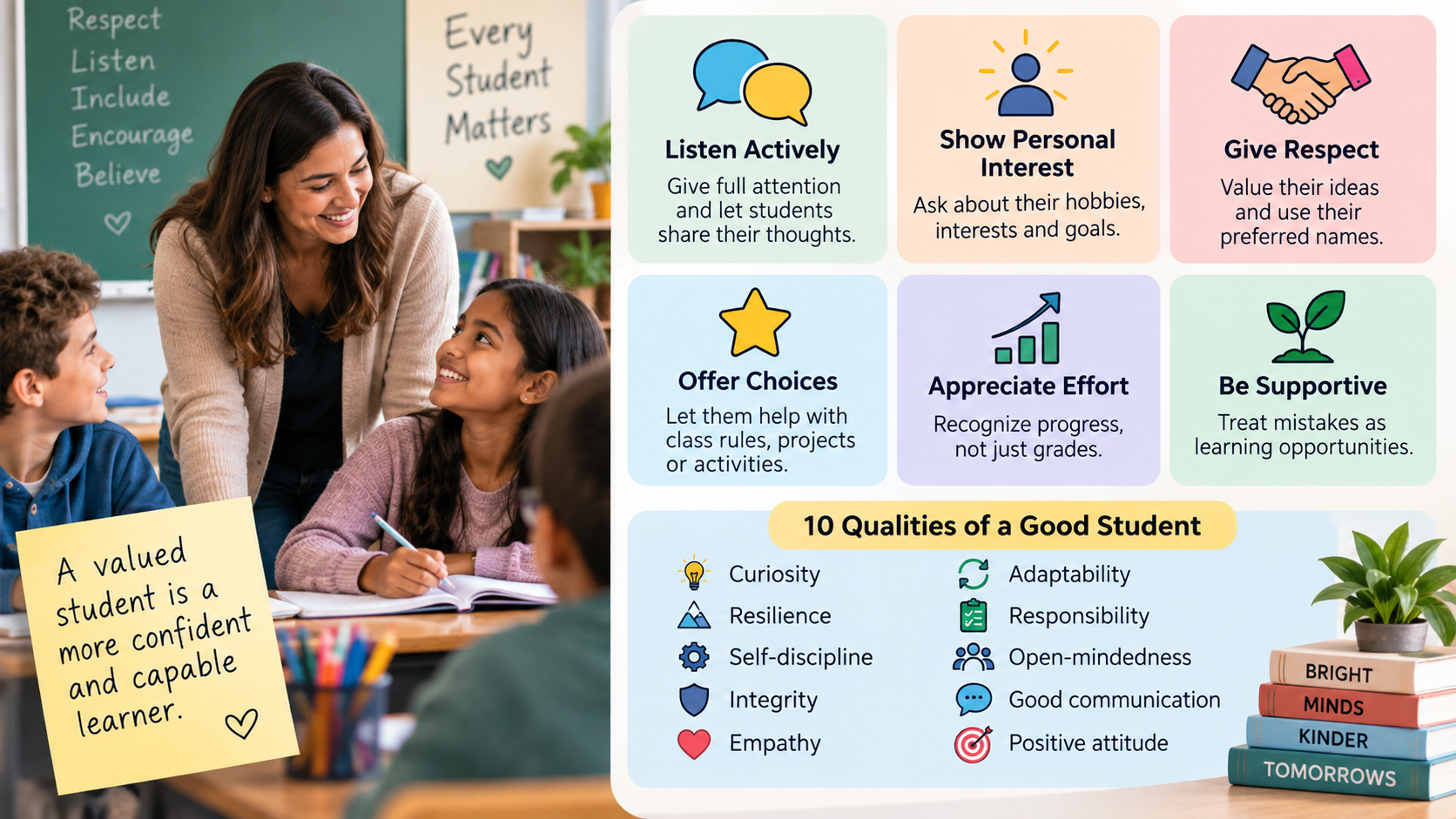
How to make students feel valued in the classroom?
To make students feel valued in the classroom, teachers should prioritize listening, personal interest, respect, and shared decision-making. Start by learning about students beyond their academic performance. Greet them by their preferred names and ask about hobbies, interests, sports, or creative activities. These small interactions show that you see them as individuals.
Give students meaningful opportunities to influence classroom routines. They might help create class rules, suggest project formats, or contribute ideas about group activities. When their opinions shape the learning environment, students develop a stronger sense of ownership.
Teachers should also respond to mistakes with patience. Treat errors as opportunities for learning instead of immediate reasons for criticism. Ask what went wrong and what could be tried next.
Other useful approaches include:
- Recognizing effort and improvement.
- Listening without interrupting.
- Giving students appropriate choices.
- Celebrating positive contributions.
- Checking in with quieter students.
Consistent actions matter more than occasional gestures. When respect becomes part of daily classroom practice, students are more likely to feel secure, included, and valued. This contributes to a school culture where progress is valued, rather than one focused only on performance.
What are 10 qualities of a good student?
A good student demonstrates qualities that support both academic development and positive relationships. Grades alone cannot fully measure these characteristics. Curiosity, resilience, self-discipline, integrity, and active participation all contribute to meaningful learning. Helping children grow into responsible individuals can also strengthen these qualities beyond the classroom.
A strong learner also shows empathy toward classmates. They listen to different perspectives and contribute respectfully during group activities. School friendships can shape emotional and academic success, making positive relationships an important part of students’ overall development. Adaptability is equally important because students regularly encounter unfamiliar concepts and changing expectations.
Ten valuable qualities include:
- Curiosity – A desire to understand how and why things work.
- Resilience – The ability to continue after setbacks.
- Self-discipline – Consistent effort without constant reminders.
- Integrity – Taking responsibility for honest academic work.
- Empathy – Considering other people’s feelings and perspectives.
- Adaptability – Adjusting when tasks or expectations change.
- Responsibility – Completing commitments and managing deadlines.
- Open-mindedness – Considering ideas that differ from personal views.
- Engagement – Participating actively in learning activities.
- Willingness to improve – Using feedback to develop skills.
Teachers can encourage these qualities without expecting perfection. Students are still developing their habits and character. Recognizing progress in these areas can help learners understand that success involves much more than test scores.
What are 5 ways to appreciate students?
Appreciating students does not always require elaborate rewards. Small, specific actions can communicate genuine respect. The most effective approaches recognize students for their effort, character, improvement, and contributions rather than focusing only on grades.
Five practical ways to appreciate students include:
- Write personal notes. Leave a short message that recognizes persistence, kindness, creativity, or improvement.
- Have individual check-ins. Spend a few minutes discussing a student’s interests or progress.
- Acknowledge positive contributions. Recognize helpful actions during appropriate classroom moments.
- Offer meaningful choices. Let responsible students choose project formats, topics, or suitable classroom roles.
- Contact families with positive news. Share specific examples of improvement, kindness, or effort.
Specific appreciation is more powerful than vague praise. Instead of saying, “You’re amazing,” explain what the student did well. A statement such as, “You helped your group stay organized during a difficult task,” gives students useful information. This kind of feedback also complements a well-designed school assessment system that looks beyond simple scores.
Appreciation should also remain genuine. If every action receives exaggerated praise, students may stop viewing it as meaningful. Balanced recognition helps students understand which behaviors contribute to their own growth and the classroom community.
What is the best way to encourage students?
The best way to encourage students is to focus on effort, strategies, progress, and perseverance. Generic praise may feel positive, but it does not always tell learners what they did well. Specific encouragement gives students information they can use again. Schools can also strengthen engagement by exploring why STEM education is important in schools today and connecting learning with practical problem-solving.
Instead of saying, “You’re very smart,” describe the action that supported success. You might say, “You tested two different methods before choosing the stronger solution.” This shows that effective strategies matter.
Encourage students to notice their own progress. Ask them to compare current work with earlier assignments. They may discover improvements in organization, accuracy, confidence, or problem-solving.
Useful encouragement can include:
- Recognizing persistence after an unsuccessful attempt.
- Highlighting effective strategies.
- Praising thoughtful questions.
- Noticing improvements over time.
- Giving clear next steps.
Teachers should also avoid praising effort when the strategy needs improvement. Encouragement should remain honest and useful. If a student worked hard but used an ineffective method, recognize the persistence and discuss a better approach.
This balance helps students develop realistic confidence. They learn that ability can grow through practice, feedback, and adjustment. Over time, encouragement becomes less about making students feel good temporarily and more about helping them become capable, independent learners.
Shifting Focus Toward Process-Based Feedback Routines
Process-based feedback focuses on how students approach learning. It identifies useful strategies instead of treating ability as a fixed personal trait. This approach can help learners understand which behaviors support improvement.
For example, rather than saying, “You’re naturally good at writing,” identify the specific process. You could say, “Your outline helped you organize each argument clearly.” The student then understands what contributed to the stronger result.
The same principle applies to mathematics, science, reading, and creative subjects. Point out how a learner checked calculations, revised an explanation, tested an idea, or used evidence.
A simple feedback routine can include three steps:
- Identify the action. Explain what the student did.
- Explain its value. Show why the action helped.
- Suggest the next step. Give one practical improvement.
This structure keeps feedback specific and actionable. It also reduces dependence on broad labels such as “gifted” or “talented.”
Students gradually learn to evaluate their own methods. They can ask whether a strategy worked and decide what to change. This builds independence and supports independent learning habits as students become more comfortable managing their own progress and adjusting their approach.
What are 10 good thoughts for students?
Positive thoughts can help students approach learning with greater perspective. However, these messages work best when they feel realistic rather than overly inspirational. Students should understand that growth includes mistakes, uncertainty, and difficult moments.
Ten useful thoughts for students include:
- Mistakes can show that you are learning.
- Your worth is not determined by one test score.
- Progress matters more than perfection.
- Asking for help is a strength.
- Your unique voice can contribute something valuable.
- Practice can improve your skills over time.
- Every expert started as a beginner.
- Kindness toward yourself can support learning.
- Small, consistent efforts can create meaningful progress.
- You can develop new skills throughout your life.
Teachers can use these ideas during class discussions, reflection activities, or morning routines. The goal should not be to force students into constant positivity. Instead, these thoughts can provide practical reminders during stressful academic periods.
Encourage learners to choose one statement that connects with a current challenge. They can then write about how it applies to their situation. This makes the message more personal and useful.
When students regularly reflect on realistic growth principles, they can develop healthier attitudes toward mistakes, effort, and progress.
Embedding Daily Affirmations Into Morning Agendas
Morning affirmations can give students a short opportunity to reflect before academic work begins. However, they should not become repetitive slogans that students automatically ignore. The most useful messages connect with real classroom experiences.
Display one thought at the beginning of the school day. Invite students to consider how it might apply to their current goals. For example, a message about asking for help could lead into a short reflection about an upcoming challenging assignment.
Teachers can also rotate different themes throughout the week:
- Monday: Growth and progress
- Tuesday: Persistence
- Wednesday: Kindness
- Thursday: Confidence
- Friday: Reflection
Keep the activity brief. One or two minutes may be enough. Students could write a single sentence, discuss the thought with a partner, or simply consider it privately.
Avoid requiring students to share personal feelings publicly. Reflection should feel supportive rather than intrusive.
Affirmations are most effective when teachers model the same principles. If the classroom promotes growth but punishes every mistake, students will notice the contradiction. Daily messages should therefore match everyday classroom behavior.
When words and actions remain consistent, reflective routines can reinforce a learning environment where students feel respected and supported.
What are some good words to praise students?
Good praise should be specific, sincere, and connected to observable behavior. Simply calling a student “smart” may sound positive, but it provides little information about what they did well. Descriptive language gives learners a clearer understanding of their strengths.
Useful words include:
- Resourceful for finding practical solutions.
- Persistent for continuing after setbacks.
- Perceptive for noticing important details.
- Collaborative for working effectively with others.
- Conscientious for showing care and responsibility.
- Creative for developing original approaches.
- Thoughtful for considering ideas carefully.
- Diligent for maintaining consistent effort.
- Empathetic for responding sensitively to others.
- Articulate for explaining ideas clearly.
The best praise combines a positive word with a specific example. Instead of saying, “You are resourceful,” explain how the student solved a problem using available materials.
Avoid using praise so frequently that it loses meaning. Students benefit more from occasional, accurate observations than constant compliments.
Also remember that different students respond to recognition differently. Some enjoy public acknowledgment, while others prefer private feedback.
Specific praise can help students identify behaviors worth repeating. Over time, they become better able to recognize their own strengths and make intentional choices. This supports intrinsic motivation while helping teachers make students feel valued for more than their academic results.
Frequently Asked Questions
How do you validate an introverted student without causing them embarrassment?
Validate quiet learners through private gestures rather than public announcements. Write thoughtful sticky notes praising their written analysis or project detail, placing them discreetly on their desks. You can also send a positive message directly to their parents or offer gentle verbal praise during quiet individual work periods. Giving introverted students adequate time to write responses before group discussions also honors their reflective nature without placing them on the spot.
What should a teacher do if a student rejects positive praise?
When a learner resists praise, they may possess low self-worth or fear future failure. Shift away from broad compliments and transition toward neutral, observational feedback. State objective facts, such as noting that they completed all five revisions or drafted two extra paragraphs. Asking for their own opinion on the assignment allows them to internalize pride privately without feeling vulnerable or pressured by external expectations.
How does emotional safety affect daily student learning?
Emotional safety directly controls cognitive performance because the human brain cannot focus on complex learning while experiencing chronic social stress. When learners know their ideas are respected and errors will not bring ridicule, their working memory functions at its peak. Feeling secure allows students to participate actively, ask clarifying questions without hesitation, and tackle creative problem-solving projects that stretch their current capabilities.
Can peer-to-peer recognition help individual learners feel more valued?
Peer-to-peer recognition strongly reinforces emotional connection across the room. Implementing weekly shout-out boards or ending group tasks with classmate acknowledgments encourages children to validate one another. When praise comes from peers alongside teachers, it reinforces an inclusive classroom culture. Students feel deeply respected by their social equals, which strengthens overall community bonds and minimizes isolated behavior across all age groups.
Conclusion
Transforming an ordinary classroom into an inspiring learning environment requires consistent, daily dedication. When you commit to methods that make students feel valued, you shift the focus from strict performance metrics to whole-person development. Simple habits—such as greeting learners warmly, sharing specific praise, and encouraging resilient thinking—turn your room into a true intellectual haven. Each deliberate word of encouragement shows young minds that their unique contributions, lived experiences, and creative ideas truly matter.
Emphasizing strong character traits and celebrating incremental progress helps learners overcome academic hurdles without crippling fear. The positive reflections and vocabulary you model daily become the supportive internal voice your learners carry forward throughout life. As their self-assurance expands, their academic curiosity and natural empathy follow suit.
Begin applying these straightforward practices today. Start by leaving one encouraging note, adopting descriptive feedback, or sharing a positive phone call with a family tonight. Your intentional appreciation will empower your students to realize their true capabilities and thrive with confidence.