

Why Students Struggle to Pay Attention in Class and How to Engage Them
Walk into any modern classroom, and you will notice a common challenge: many students struggle to pay attention in class. It is easy to assume that distraction results from poor discipline or a lack of effort. However, research from the American Psychological Association demonstrates that classroom attention depends on several interconnected factors, including brain development, mental fatigue, emotional well-being, and the learning environment.
A student’s ability to concentrate can change throughout the school day. Background noise, social pressures, digital distractions, and complicated lessons can make focusing difficult. Even motivated learners sometimes struggle to follow instructions or retain information during lengthy lessons.
Understanding these challenges helps teachers and parents support students more effectively. Instead of blaming learners for losing focus, educators should identify the underlying causes and adjust their teaching methods.
This guide explores why students lose attention during lessons, how to improve classroom engagement, and which behaviors indicate academic difficulties. It also explains why concentration matters and shares practical strategies for creating a more engaging learning environment.
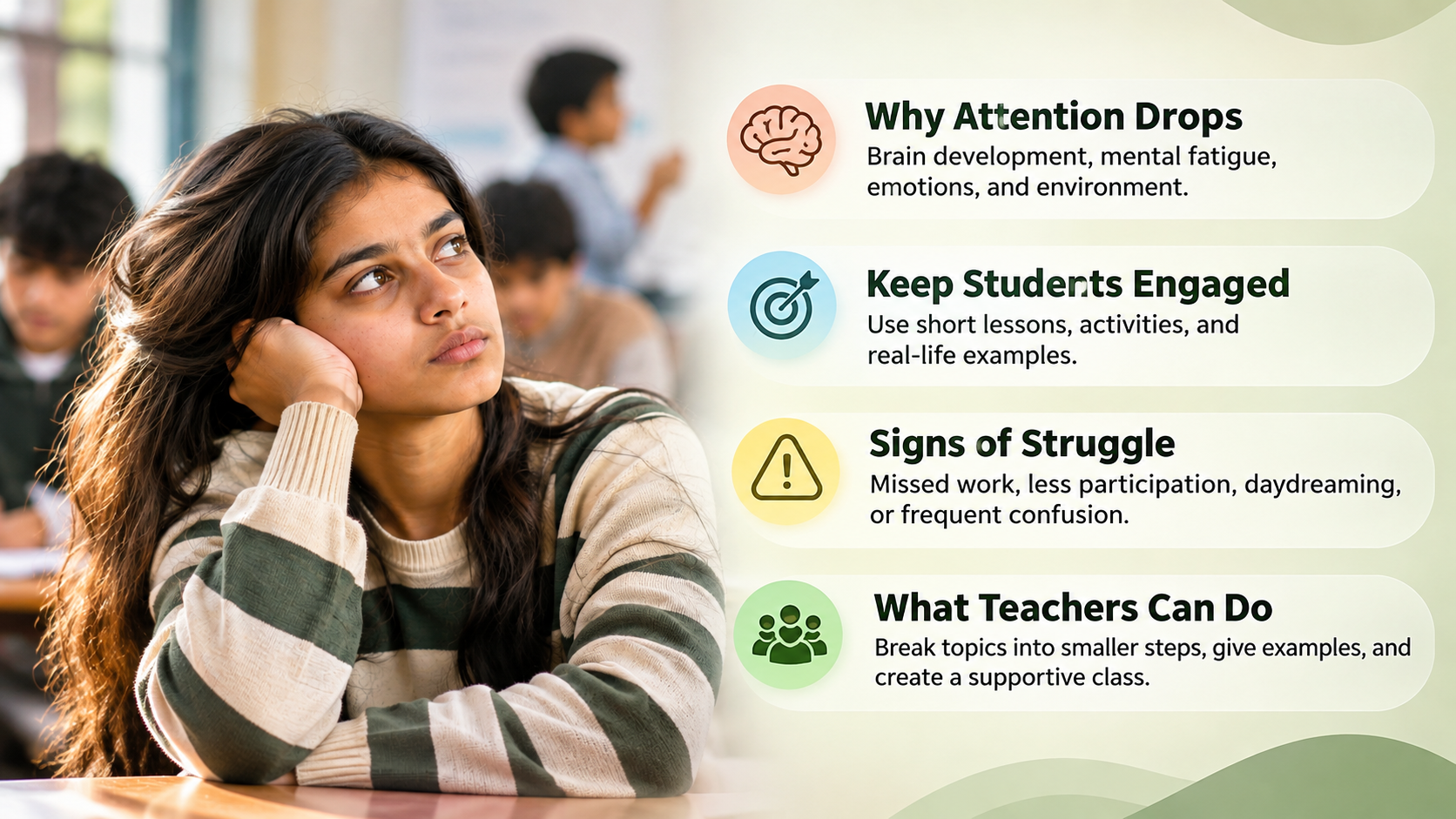

Why don’t students pay attention in class?
Students rarely choose to ignore classroom instruction deliberately. Several cognitive, physical, and emotional factors influence their ability to pay attention in class. One common reason is cognitive overload. When teachers introduce too many complicated concepts without allowing processing time, students may struggle to follow the lesson.
Physical conditions also influence concentration. Insufficient sleep, hunger, dehydration, and tiredness can reduce alertness throughout the school day. Additionally, developmental differences, including ADHD, may affect attention regulation and impulse control.
Emotional challenges create another barrier. Family problems, academic pressure, friendship conflicts, and anxiety can occupy a student’s thoughts. Consequently, even simple classroom activities may become difficult.
Teaching methods also matter. Repetitive lectures and irrelevant examples can reduce interest. Students generally engage more when lessons connect with their experiences, interests, and learning goals. Allowing learners to make decisions about classroom activities through student choice in learning can further improve participation and motivation.
Neurological Development and Cognitive Overload
The brain’s prefrontal cortex plays an important role in planning, decision-making, attention regulation, and impulse control. These abilities continue developing throughout adolescence and into early adulthood. Therefore, younger students may find it difficult to maintain concentration during extended classroom activities.
Cognitive overload creates another challenge. Working memory has limited capacity, making complicated instructions difficult to process simultaneously. When teachers introduce several new concepts without explanations or breaks, students may lose track of the lesson. Teachers can also explore how failure can improve learning to understand why mistakes and reflection are important parts of academic development.
For example, explaining multiple mathematical formulas at once can overwhelm learners. They may remember individual steps but struggle to understand how everything connects.
Teachers can reduce cognitive overload through practical adjustments:
- Introduce complicated concepts in smaller steps.
- Provide examples before assigning independent exercises.
- Repeat important instructions when necessary.
- Allow short pauses for reflection and questions.
- Use diagrams and visual explanations to support learning.
These strategies make information easier to process and help students maintain attention throughout lessons.
How to get a student to pay attention?
Getting a student to concentrate requires more than repeatedly asking them to listen. Teachers should create opportunities for active participation and meaningful learning. Students often engage more when they can discuss ideas, solve problems, and apply information themselves.
Start by dividing longer lessons into manageable sections. For example, introduce a concept for ten to fifteen minutes before including an activity or discussion. This approach gives students opportunities to process information instead of listening continuously.
Teachers can also introduce interactive exercises, classroom demonstrations, and short quizzes. Asking questions throughout a lesson helps identify misunderstandings before they become larger problems. Incorporating engaging school assembly ideas can also create additional opportunities for students to participate and develop confidence in expressing themselves.
Movement can improve engagement, particularly for younger learners. Short stretching activities, classroom discussions, and group assignments provide useful changes in activity.
Most importantly, create a supportive classroom environment. Students should feel comfortable asking questions and making mistakes. When learners feel included and understand the purpose of a lesson, they are more likely to participate actively.
What are the signs of a struggling student?
Recognizing academic difficulties early can prevent small learning problems from becoming serious challenges. However, struggling students do not always communicate their difficulties directly. Teachers must observe changes in classroom behavior, participation, and academic performance.
One possible warning sign is difficulty completing assignments within the expected time. Some students repeatedly avoid answering questions or hesitate when teachers request participation. Others frequently lose track of instructions or require additional explanations.
Behavioral changes can provide further clues. Excessive daydreaming, unusual irritability, constant fidgeting, and reduced classroom participation may indicate difficulties with concentration or emotional well-being.
Physical signs also deserve attention. A student who regularly appears tired or struggles to remain comfortable may find classroom activities challenging.
Academic performance provides additional information. Missing assignments, declining grades, and incomplete classwork can indicate underlying difficulties. However, teachers should avoid making assumptions based on individual behaviors. Instead, they should consider the student’s circumstances and identify appropriate support. Parents should also understand the importance of supporting a child without controlling them when addressing academic challenges.
Identifying Silent Disengagement and Avoidance Habits
Some students hide academic difficulties through avoidance behaviors. Rather than admitting that they do not understand a lesson, they may find reasons to avoid challenging activities. These behaviors can make it difficult for teachers to recognize learning problems immediately.
For example, a student might repeatedly request bathroom breaks during independent assignments. Another may volunteer for unrelated classroom tasks whenever difficult exercises begin. Some learners remain quiet during discussions because they fear giving incorrect answers.
These behaviors do not automatically indicate academic difficulties. However, repeated patterns deserve attention, especially when accompanied by declining participation or incomplete work.
Teachers can identify silent disengagement by observing:
- Students who regularly avoid challenging assignments.
- Learners who rarely participate in classroom discussions.
- Children who frequently copy answers without understanding.
- Students who become frustrated when asked to explain concepts.
- Learners who consistently depend on classmates for basic instructions.
Instead of criticizing these behaviors, teachers should investigate their underlying causes. Individual guidance, additional explanations, and supportive feedback can help students rebuild confidence.
Why is it important to pay attention in school?
Developing concentration during school years supports academic achievement and important lifelong skills. Most educational subjects build on previously learned concepts. Missing basic mathematical principles, reading skills, or scientific explanations can make advanced lessons increasingly difficult.
The ability to pay attention in class also supports memory formation and information processing. Students who actively follow lessons have more opportunities to understand explanations, identify important details, and connect new information with existing knowledge.
Concentration also strengthens independent learning. Students must focus when completing assignments, researching topics, reading instructions, and solving unfamiliar problems. These abilities become increasingly valuable as academic responsibilities grow.
Beyond education, sustained attention supports professional development and everyday decision-making. Many careers require individuals to analyze information, solve problems, and complete tasks accurately.
Learning to concentrate does not mean remaining silent throughout every lesson. It means participating actively, processing information, and managing distractions. These habits help students become more confident, independent, and capable learners.
What is the biggest distraction for students?
Students encounter several distractions throughout the school day. Conversations, classroom noise, environmental activity, and personal worries can interrupt concentration. However, smartphones and digital devices have become particularly important challenges in modern education.
Social media platforms, messaging applications, online videos, and mobile games constantly compete for attention. Notifications encourage students to check their devices, even when they are completing important academic activities.
Smartphones can also interrupt concentration without producing any sounds. Students may think about incoming messages or upcoming notifications while attempting to follow classroom instruction. This divided attention can make complex information harder to understand and remember.
However, digital devices are not always harmful to learning. Educational applications, online research tools, and interactive learning platforms can support classroom activities when used appropriately.
The main challenge is managing unnecessary digital interruptions. Teachers and parents should establish clear expectations about device usage. Creating designated periods for technology can help students enjoy its educational benefits without allowing it to dominate their attention.
The Hidden Toll of Continuous Digital Notifications
Digital notifications can interrupt students while they read, write, solve problems, or listen to explanations. Even a brief interruption may force learners to shift their attention away from the original activity.
After checking a notification, students must redirect their attention toward the classroom task. This switching between activities can increase mental effort and reduce learning efficiency.
Frequent interruptions also encourage habitual phone checking. Students may begin anticipating notifications instead of concentrating fully on their assignments. Over time, this behavior can make uninterrupted study sessions more challenging.
Schools can address this problem through consistent classroom technology policies. Practical approaches include:
- Keeping personal smartphones away during instructional activities.
- Allowing devices only for teacher-approved learning tasks.
- Establishing clear rules for classroom technology usage.
- Encouraging students to disable unnecessary notifications.
- Teaching responsible digital habits and self-management.
Parents can reinforce these practices at home. Consistent expectations help students develop healthier relationships with technology while protecting valuable study time.
How will I gain student attention in the classroom?
Gaining student attention requires preparation, creativity, and consistent classroom management. Simply raising your voice or repeatedly asking students to become quiet may not produce lasting engagement. Instead, teachers should create an environment that naturally encourages participation.
Begin each lesson with something interesting. A surprising fact, thought-provoking question, short demonstration, or practical example can encourage students to become curious about the topic. Connecting lessons with real-world situations also makes unfamiliar concepts easier to understand.
Teachers should use varied teaching techniques throughout the lesson. Combine explanations with discussions, visual presentations, group activities, and short exercises. This variation helps maintain interest and provides different opportunities for students to participate.
Clear instructions are equally important. Students should understand what they need to do and why the activity matters.
Building positive relationships also improves classroom engagement. Learn students’ interests, acknowledge their contributions, and provide constructive feedback. When learners feel respected and involved, they are more willing to participate.
Ultimately, effective teaching makes concentration easier by giving students meaningful reasons to engage with every lesson.
FAQ SECTION
Can diet and sleep affect classroom attention?
Yes, nutrition and sleep directly drive cognitive performance and focus. A child who sleeps less than eight to ten hours suffers from diminished executive functioning, reduced memory consolidation, and heightened irritability. Similarly, diets high in refined sugars cause rapid glucose spikes followed by severe energy crashes. Providing balanced breakfasts with complex carbohydrates, protein, and adequate hydration stabilizes blood sugar, enabling sustained mental focus and emotional regulation throughout morning lessons.
What role does teacher-student rapport play in attention?
Strong student-teacher relationships serve as the emotional foundation for classroom engagement. Students naturally pay closer attention to educators who demonstrate authentic empathy, respect, and interest in their personal success. When learners feel valued and emotionally safe, their brains produce less cortisol, the stress hormone that impairs working memory and rational thought. Positive rapport fosters a supportive environment where students feel secure taking academic risks without fearing embarrassment.
Is daydreaming always a bad sign in class?
No, occasional daydreaming is a normal part of cognitive processing and creative reflection. While chronic inattention during critical direct instruction signals trouble, brief mental pauses allow the brain’s default mode network to consolidate newly acquired facts and form original connections. The key is balance: educators should gently guide students back when focus drifts during vital tasks, while recognizing that human concentration naturally waxes and wanes.
CONCLUSION
Helping students consistently pay attention in class requires moving past the outdated belief that concentration is purely a matter of personal willpower. Attention is an involuntary cognitive mechanism governed by neurological development, sensory stimuli, emotional security, and energy levels. When learners drift off, their brains are not choosing defiance; they are simply responding to cognitive fatigue, conceptual confusion, or overwhelming digital distractions.
By restructuring lectures into interactive segments, removing smartphones, and cultivating curiosity, educators can align their teaching with the biological realities of how young minds operate. The goal is never to enforce rigid, compliant silence, but rather to inspire authentic engagement. When teachers build structured, predictable, and supportive learning environments, they make it substantially easier for every student to pay attention in class, master challenging material, and discover the true joy of learning.