
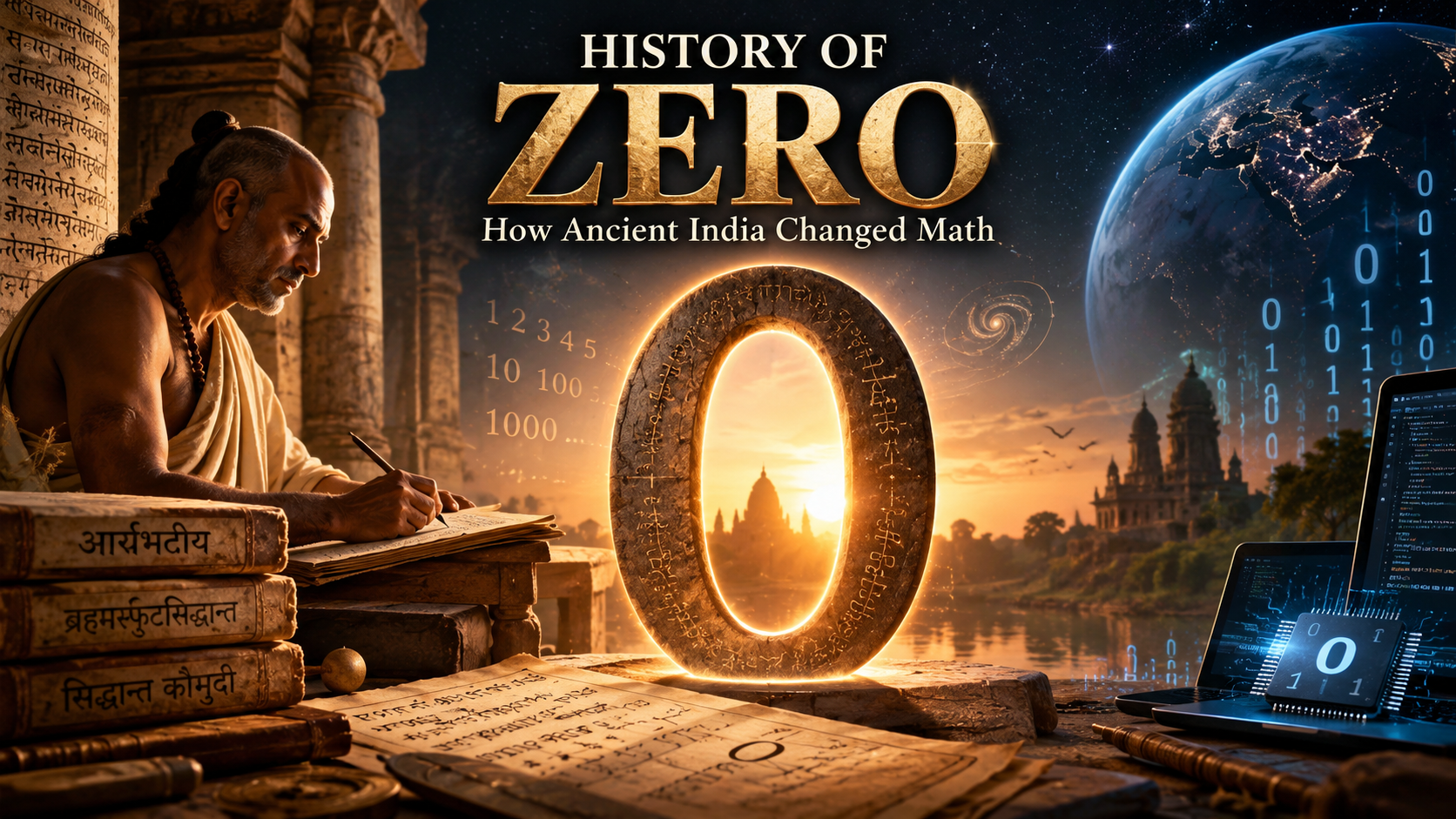
History of Zero: How Ancient India Changed Math
Today, we take counting for granted. We enter numbers into calculators, check bank balances, and write computer code without thinking about their origins. Yet modern mathematics depends on one revolutionary idea: the history of zero. Ancient counting systems needed ways to represent an empty place in larger numbers. Indian mathematicians eventually went further by treating nothingness as a number with mathematical properties.
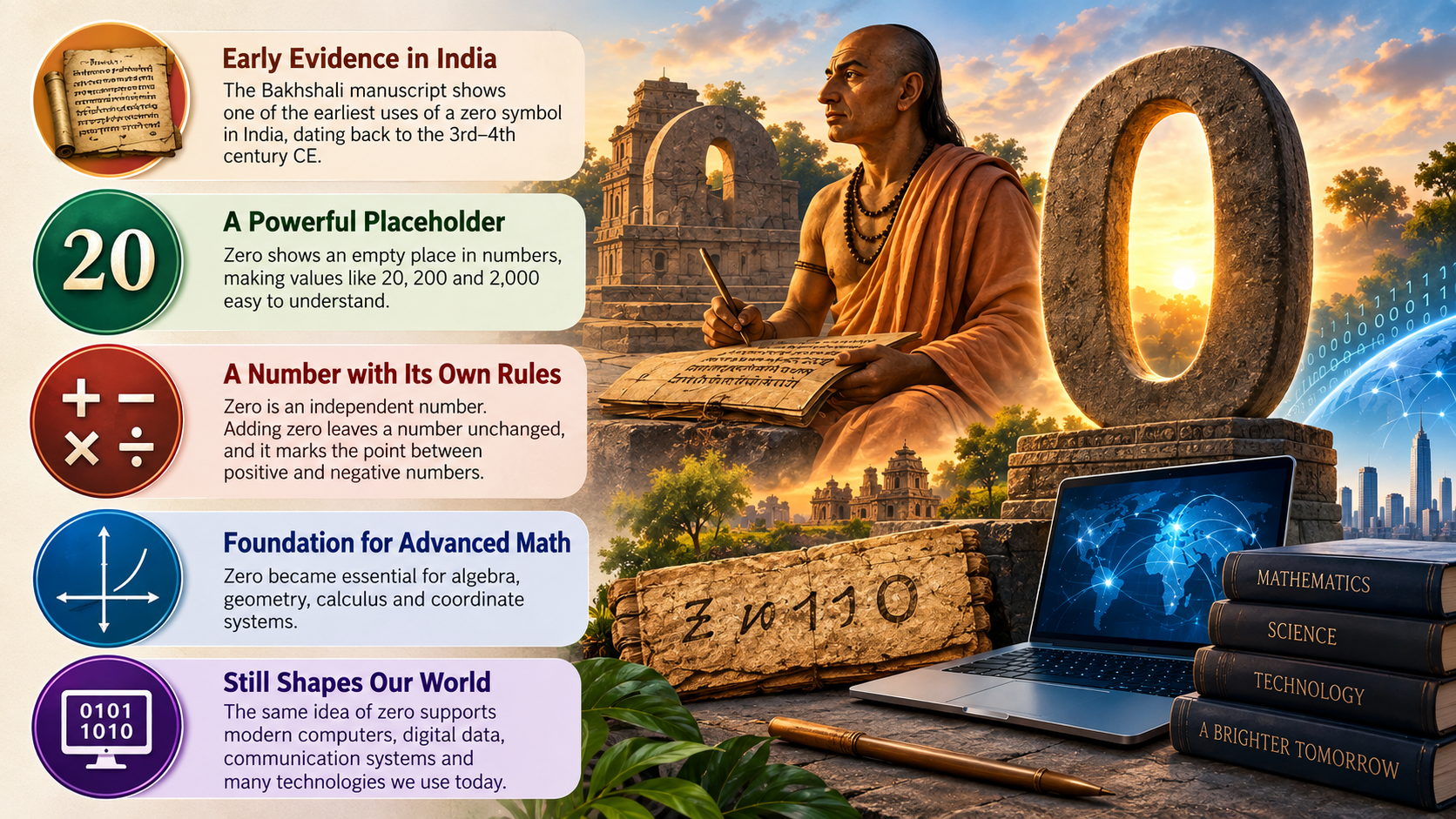
Research on the famous Bakhshali manuscript provided important evidence about the early use of a zero symbol in India. Radiocarbon testing conducted by researchers associated with the University of Oxford placed different manuscript folios in periods ranging from the third to fourth century CE. This evidence pushed the history of the zero symbol much further back than many scholars had previously believed.
This breakthrough changed arithmetic, science, trade, and later computing. But how did zero develop? Who gave it formal mathematical rules? And why does this seemingly empty number remain so important today?
Below, we explore the origins and development of this revolutionary mathematical idea. You will discover how Indian scholars shaped zero and why its history still matters. For additional historical context, you can also explore the MacTutor History of Mathematics archive, which documents the development of important mathematical ideas and the mathematicians behind them.

How did zero change mathematics?
Zero transformed mathematics by serving two important roles: a placeholder and a number in its own right. As a placeholder, zero shows that a particular position in a number is empty. This distinction makes values such as 20, 200, and 2,000 immediately understandable.
The idea became especially powerful within the decimal place-value system. Instead of creating separate symbols for increasingly large quantities, mathematicians could reuse a small set of digits according to their positions. This made written calculations far more efficient and scalable. For a modern example of how numerical systems support everyday work, see unexpected uses for Google Sheets.
Zero also became an independent number with its own arithmetic behavior. It acts as the additive identity because adding zero leaves a number unchanged. It also provides the boundary between positive and negative numbers.
These properties became essential to algebra, geometry, calculus, and later computer science. Modern coordinate systems rely on zero as a reference point. Calculus also uses values approaching zero when describing continuous change.
The development of zero therefore changed mathematics at both a practical and theoretical level.
Bridging Arithmetic and Modern Computation
Zero eventually became important far beyond traditional arithmetic. Its role in the place-value system helped create a flexible numerical language for increasingly complex calculations. Centuries later, the same concept became fundamental to mathematical notation used in science and engineering.
Modern computers use binary systems based on two states, commonly represented as 1 and 0. Zero does not single-handedly create binary computing, but it provides one of the two basic symbols used to represent digital information. Computer memory, instructions, images, and software ultimately depend on combinations of these states. This digital infrastructure also relies on data centers before AI, which have long supported large-scale computing and storage.
Zero also provides a reference point for coordinate systems and mathematical models. Engineers use zero values when defining positions, measurements, and changes. Scientists use it when describing equilibrium, differences, and boundaries. These applications connect to technologies such as fiber optic technology, which supports modern communication and data transmission.
Its importance therefore extends from simple counting to highly complex technologies. The ancient development of zero helped create a numerical framework that could represent both quantity and absence. That framework later supported the mathematics behind modern computation and digital technology.
Did Aryabhata actually invent zero?
Aryabhata did not invent zero as the written numeral we recognize today. However, his work played an important role in the development of Indian place-value mathematics. Born in the fifth century CE, Aryabhata used a sophisticated system for expressing very large numbers in his astronomical and mathematical work.
His Aryabhatiya used Sanskrit syllables as part of a system for representing numbers. Scholars have also discussed his use of the concept of an empty place within numerical calculations. However, there is no surviving evidence that Aryabhata wrote the familiar circular zero symbol.
This distinction matters when discussing the history of zero. The concept of an empty position existed before zero became a fully developed numeral. A placeholder allows a positional system to distinguish values such as 10 and 100, even when no quantity occupies a particular position.
Later Indian mathematicians developed the idea further. Brahmagupta, writing in the seventh century, provided explicit rules for calculating with zero as a number.
Aryabhata therefore contributed to the mathematical environment in which zero could develop, but calling him its inventor oversimplifies the historical evidence.
Why is 0 so powerful?
Zero is powerful because it performs several unique mathematical functions. On the number line, it separates positive numbers from negative numbers. It also provides a natural reference point for measuring direction, distance, and change. This foundational role in mathematics also connects naturally with Buddhism and science, where ideas about emptiness and scientific thought can be explored from a broader perspective.
In arithmetic, zero has important identity properties. Adding zero to a number leaves that number unchanged. Subtracting zero also leaves it unchanged. Multiplying any finite number by zero produces zero.
Division is different. Division by zero is undefined in ordinary arithmetic. It cannot simply be treated as another standard operation because no number can satisfy the required multiplication relationship.
Zero also plays a central role in algebra. Equations often become easier to solve when expressions are rearranged so that one side equals zero. In geometry, zero provides an origin for coordinate systems. In science, it can represent a starting point, equilibrium, or a measured absence.
Its importance extends into computing as well. Digital systems commonly use zero alongside one to represent binary states.
Zero is therefore far more than a symbol for nothing. It provides structure, balance, and a reference point across mathematics and science.
The Engine Behind Limits and Dynamic Change
Zero became especially important in the development of calculus, although calculus does not depend on treating zero as an infinitesimal quantity. Instead, calculus studies what happens as a value approaches zero or another specific value.
For example, the derivative measures how quickly one quantity changes compared with another. Mathematicians can understand this change by examining increasingly small intervals. The limiting process allows them to describe instantaneous rates without dividing directly by zero.
Isaac Newton and Gottfried Wilhelm Leibniz independently developed the foundations of calculus during the seventeenth century. Their work provided powerful methods for studying motion, growth, curves, and changing quantities.
Calculus later became essential to physics and engineering. Scientists use it to model planetary motion, fluid behavior, acceleration, population growth, and many other processes.
Zero also appears throughout calculus as a boundary condition and reference value. Expressions approaching zero can reveal important behavior that would remain hidden through ordinary arithmetic alone.
This makes zero a crucial part of the mathematical language used to describe continuous change. Its role extends well beyond simple counting and place-value notation.
Who invented 0 in mathematics in India?
The development of zero in India was gradual, so calling one person its sole inventor oversimplifies the history of zero. However, the seventh-century mathematician Brahmagupta played a decisive role in turning zero into a formal mathematical number.
In 628 CE, Brahmagupta wrote the Brahmasphutasiddhanta. The text described zero, known as shunya, and established rules for performing arithmetic with it. This was a major step because zero was no longer merely an empty position in a numerical system.
Brahmagupta explained how zero behaves when added to or subtracted from other numbers. He also addressed multiplication and operations involving positive and negative numbers. His treatment helped establish zero as part of a broader arithmetic framework.
His work also included rules involving division by zero. Some of those rules do not match modern mathematics, which treats division by zero as undefined. Therefore, it would be inaccurate to claim that Brahmagupta completely solved division by zero.
Nevertheless, his contribution was foundational. By giving zero explicit mathematical rules, Brahmagupta helped transform it from an idea of absence into an operational component of arithmetic.
How to write “I love you” in math?
You can express “I love you” in math through playful visual puzzles rather than through a genuine mathematical equation. One commonly shared example uses the expression 128√e980. The trick depends on how the symbols appear when viewed or interpreted in a particular visual arrangement.
This type of puzzle is better understood as mathematical wordplay. It does not represent a standard mathematical formula with an established meaning. The expression becomes a message because its symbols can be manipulated visually to resemble letters.
Another popular approach uses graphs. Mathematical equations can create curves that form recognizable shapes, including hearts. For example, certain cardioid equations can produce heart-like graphs when plotted on a coordinate plane. These examples also show how music therapy uses patterns and structured forms of sound to connect mathematical ideas with human experience.
These examples show how mathematics can be used creatively to communicate ideas beyond calculation. They combine symbols, patterns, geometry, and visual interpretation.
However, such puzzles should not be confused with historical mathematical discoveries. The history of zero concerns the development of a genuine numerical concept and its rules. “I love you” equations are modern recreational creations designed mainly for entertainment.
They offer a fun way to connect mathematics with creativity and romance.
Is zero a real story?
Yes. The history of zero is supported by archaeological evidence, manuscripts, mathematical texts, and inscriptions. However, the story is more complicated than saying one person suddenly invented zero.
Evidence from ancient India shows that the zero symbol developed within a broader tradition of place-value mathematics. The Bakhshali manuscript is particularly important. Radiocarbon testing found that different parts of the manuscript date to different periods, with some material dating as early as the third or fourth century CE. Researchers have identified dot-like symbols representing zero within the manuscript.
Another important piece of evidence comes from India’s Gwalior inscription, dated to the ninth century CE. It contains clear examples of zero used in numerical notation.
Brahmagupta’s seventh-century mathematical work provides another crucial milestone. He described zero as a number and established arithmetic rules involving it.
Together, these sources show that zero developed through multiple stages. It moved from representing an empty position toward becoming a fully recognized number.
The story is therefore not a myth. It is a documented mathematical development that began in ancient traditions and eventually influenced numerical systems across the world.
Frequently Asked Questions
What is the origin of the word zero?
The word zero originates from the Sanskrit term shunya, which translates directly to “void” or “empty.” When Arab scholars translated Indian mathematical texts, they translated shunya into the Arabic word sifr, meaning empty. Later, Italian mathematicians adapted this term into Latin as zephirum. Over generations of colloquial European trade and speech, the term naturally evolved into the Italian zero, giving us our modern term.
Why did ancient Greeks reject the concept of zero?
Ancient Greek mathematicians rejected zero because their geometric worldview linked numbers directly to measurable physical lengths and shapes. Thinkers like Aristotle argued that a void could not exist in nature. Because one cannot draw a line of zero length or build a shape from nothing, Greek logic viewed zero as a logical paradox. Consequently, their rigid geometric focus delayed their adoption of functional place-value arithmetic.
How did zero spread from India to Europe?
Zero traveled from India through the Middle East via trade networks and translation movements. Arab scholars like al-Khwarizmi studied Indian arithmetic in Baghdad and compiled comprehensive algebraic manuals. Centuries later, Italian merchant Leonardo Fibonacci encountered these Arabic numerals while traveling in North Africa. In 1202, Fibonacci published Liber Abaci, introducing Hindu-Arabic numerals to European merchants, which permanently displaced slow Roman numerals across Western banking.
Is zero considered an even or odd number?
Zero is definitively an even number according to all standard mathematical definitions. By rule, an integer is even if it produces a whole integer without a remainder when divided by two. Dividing zero by two yields zero, which is an integer. Furthermore, zero sits neatly between negative one and positive one on the number line, adhering perfectly to the alternating pattern of odd and even numbers.
Conclusion
The emergence of zero stands as one of the greatest intellectual milestones in human history. What began as a philosophical contemplation of emptiness in ancient India transformed into an engine that powers modern global society. Without the courage of thinkers like Aryabhata and Brahmagupta, mathematics might have remained chained to clumsy counting boards and restrictive geometric models.
Indian scholars did not merely see nothingness as an absence; they recognized it as a measurable, functional presence. Their revolutionary insight provided the foundational groundwork for modern algebra, calculus, engineering, and the digital binaries executing software code every millisecond.
Understanding the history of zero reminds us that simple, elegant ideas often spark massive technological leaps. The next time you glance at a digital screen, calculate your personal budget, or run code, remember the ancient Indian scholars who gave the world the power of nothing. Embrace the profound mathematical logic behind everyday numbers, and apply that same inventive thinking to your own analytical pursuits.