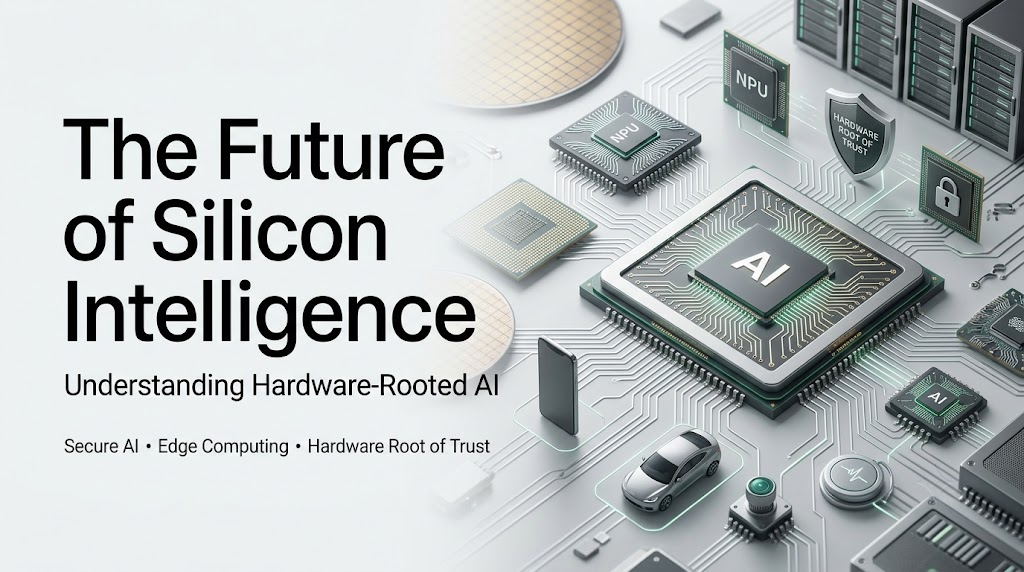
The Future of Silicon Intelligence: Understanding Hardware-Rooted AI
Artificial intelligence is moving beyond cloud data centers and into the devices people use every day. Smartphones, autonomous vehicles, industrial equipment, and medical devices increasingly rely on on-device AI for faster and more secure processing. As this shift continues, hardware-rooted AI has become a key technology for building intelligent systems that combine high performance with strong security.
Unlike traditional software-based AI, hardware-rooted AI embeds machine learning capabilities and security features directly into the silicon. This approach allows devices to process sensitive data locally instead of sending it to remote cloud servers. Local processing reduces latency, improves privacy, and strengthens protection against cyber threats.
Leading technology companies, including NVIDIA, continue to invest in secure AI hardware. Modern processors now integrate Neural Processing Units (NPUs), secure enclaves, and hardware-based cryptographic functions. These technologies help protect AI models, sensitive data, and system integrity throughout the device’s lifecycle.
This shift is becoming increasingly important. Software security alone cannot fully defend modern AI workloads against sophisticated attacks. When trust begins at the hardware level, devices gain a stronger security foundation before the operating system even starts. As a result, organizations can deploy AI systems with greater confidence across industries where security and reliability are critical.
In this guide, you’ll learn how hardware-rooted AI works, its core architectural components, its security advantages, and the industries that benefit most from this next generation of intelligent computing.
Why Hardware-Rooted AI Matters for Modern Security
For many years, cybersecurity focused mainly on software. Firewalls, antivirus solutions, encryption software, and operating system updates formed the first line of defense. While these tools remain essential, they also share a common weakness. Software can contain vulnerabilities, and attackers continually develop new ways to exploit them.
Hardware-rooted AI changes this security model by establishing trust directly within the processor. Instead of relying solely on software, the chip itself verifies system integrity, protects cryptographic keys, and safeguards AI workloads. This creates a trusted computing environment before applications even begin running.
Because critical security functions operate in isolated hardware, attackers cannot easily alter AI models or access confidential data through traditional software exploits. Even if an operating system becomes compromised, the processor continues to protect sensitive assets using built-in security mechanisms.
This architecture also supports the growing demand for edge AI and confidential computing. Devices can process information locally while keeping data private and reducing dependence on cloud infrastructure. As AI becomes part of critical systems, hardware-level security provides the resilience needed to defend against increasingly advanced cyber threats.
The Core Pillars of Hardware-Rooted AI Architecture
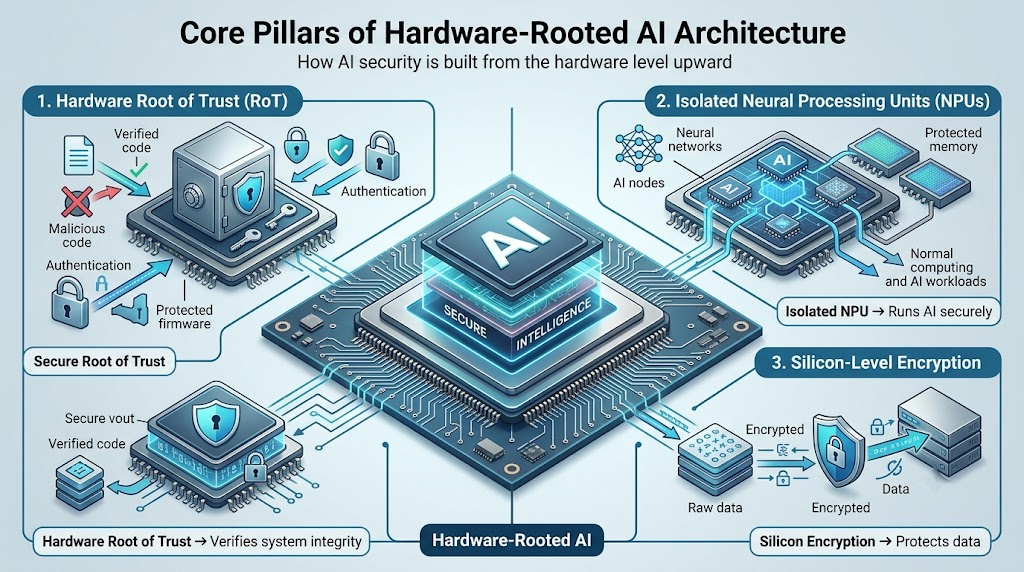
Understanding hardware-rooted AI begins with its underlying architecture. Unlike conventional processors, secure AI chips combine dedicated hardware with built-in security functions. This design protects sensitive data while accelerating machine learning workloads. Instead of depending on software alone, the processor establishes trust at the hardware level before the operating system loads.
Three core technologies make this possible. These components work together to create a secure and efficient environment for on-device AI and edge AI applications. Each plays a unique role in protecting AI models, verifying system integrity, and processing data safely.
Together, these architectural pillars reduce the risk of data tampering, unauthorized access, and software-based attacks. They also improve performance by allowing AI workloads to run on specialized hardware rather than general-purpose processors. As organizations deploy AI across critical industries, these technologies have become essential for building intelligent systems that are both fast and trustworthy.
Hardware Root of Trust (RoT)
A Hardware Root of Trust (RoT) is the foundation of security in modern processors. It is an isolated hardware component that stores cryptographic keys and performs security operations independently of the operating system. Because it operates separately, malware cannot easily modify or bypass its functions.
During system startup, the Root of Trust verifies that every stage of the boot process uses authentic, untampered code. This process, often called secure boot, prevents unauthorized software from loading before the operating system starts. If any component fails verification, the system can stop the boot process or trigger recovery procedures.
Beyond startup protection, the Root of Trust also manages encryption keys, validates firmware updates, and supports secure authentication. These capabilities ensure that sensitive AI models and confidential data remain protected throughout the device’s lifecycle. In hardware-rooted AI, the RoT serves as the trusted foundation upon which every other security feature depends.
Isolated Neural Processing Units (NPUs)
Modern AI processors include dedicated Neural Processing Units (NPUs) that handle machine learning tasks more efficiently than traditional CPUs. These specialized accelerators are designed for operations such as image recognition, speech processing, and natural language inference while consuming significantly less power.
In hardware-rooted AI, NPUs often operate within isolated execution environments. Their memory regions remain separated from standard applications, making it much harder for malicious software to access active AI workloads or extract valuable model data. This isolation strengthens both security and system stability.
Dedicated NPUs also improve overall performance. While the CPU manages general computing tasks, the NPU focuses exclusively on AI calculations. This division allows applications to respond faster while reducing energy consumption. As demand for edge AI continues to grow, isolated NPUs enable secure, real-time intelligence in smartphones, vehicles, industrial systems, and healthcare devices without relying heavily on cloud processing.
Silicon-Level Encryption
Protecting data during processing is just as important as protecting stored information. One of the strongest features of hardware-rooted AI is silicon-level encryption, which safeguards data as it moves between processors, memory, and other hardware components.
Traditional encryption often focuses on protecting data at rest or during network transmission. However, information can also be vulnerable while traveling across internal memory buses. Silicon-level encryption addresses this risk by encrypting data in real time before it leaves the processor. It is then decrypted only when it reaches an authorized destination within the system.
This approach significantly reduces the risk of hardware-based attacks, including memory snooping and physical interception. Even if attackers gain physical access to the device, intercepted data remains unreadable without the appropriate cryptographic keys. Combined with secure boot and isolated NPUs, silicon-level encryption forms a critical layer of protection that helps keep AI workloads, sensitive information, and intellectual property secure.
Key Benefits of Hardware-Rooted AI for Secure Computing
The adoption of hardware-rooted AI offers advantages that extend beyond faster computing. By integrating intelligence and security directly into silicon, devices can process data more efficiently while reducing exposure to cyber threats. This approach eliminates many of the limitations associated with cloud-dependent AI, especially in environments where speed, privacy, and reliability are essential.
Some of the most significant benefits include:
- Zero-latency processing: AI workloads run locally, allowing devices to respond in microseconds without waiting for cloud servers.
- Enhanced data privacy: Sensitive information remains on the device, reducing the risk of interception or unauthorized access.
- Greater resistance to software attacks: Hardware-based security protects AI models even if the operating system is compromised.
- Improved energy efficiency: Dedicated AI accelerators perform complex calculations using far less power than general-purpose processors.
- Higher reliability: Local processing ensures consistent performance, even when internet connectivity is unavailable.
These advantages make hardware-rooted AI an ideal solution for applications that require real-time decisions, secure data handling, and dependable performance.
Real-World Applications of Physical-Layer AI
The impact of hardware-rooted AI is already visible across multiple industries. As organizations move more intelligence to the edge, secure AI hardware enables devices to process information locally while protecting sensitive data. This combination of performance and security supports applications where delays or security breaches could have serious consequences.
From autonomous transportation to healthcare and industrial automation, hardware-based AI is improving decision-making while reducing dependence on cloud infrastructure. Devices can analyze data in real time, respond instantly, and continue operating even with limited network connectivity.
The following examples demonstrate how physical-layer AI is transforming industries through secure, efficient, and reliable computing. Each application highlights why integrating AI directly into silicon has become increasingly important for mission-critical systems.
Autonomous Vehicles
Autonomous vehicles generate enormous amounts of data from cameras, radar, LiDAR, and other sensors. Processing this information in real time is essential for safe driving. Even a brief delay can affect braking, steering, or obstacle detection.
Hardware-rooted AI enables vehicles to analyze sensor data directly within the car instead of sending it to remote servers. Dedicated AI processors make rapid decisions while maintaining low power consumption. This local processing reduces latency and improves overall reliability, particularly in areas with limited network coverage.
Security is equally important. Hardware-based protection helps prevent attackers from modifying driving algorithms or accessing sensitive vehicle systems. Secure boot, isolated processing environments, and encrypted memory work together to defend critical software from unauthorized changes. As autonomous technology advances, hardware-level security will remain essential for building safer and more trustworthy transportation systems.
Edge Medical Devices
Healthcare increasingly relies on intelligent medical devices that monitor patients continuously and respond in real time. Wearable monitors, portable imaging systems, and smart implants all benefit from fast, secure AI processing.
With hardware-rooted AI, these devices analyze patient data locally rather than transmitting sensitive information to external servers. This approach improves response times while strengthening patient privacy. Medical professionals can receive faster insights without exposing confidential health records to unnecessary network risks.
Hardware-based security also helps protect medical devices from cyberattacks. Secure processors safeguard patient information, encryption keys, and AI models against unauthorized access. This protection is particularly important for connected healthcare environments, where compromised devices could affect patient safety. As medical technology becomes more intelligent, hardware-rooted AI provides the trusted foundation needed for secure and dependable healthcare solutions.
Industrial IoT and Smart Grids
Factories, power plants, and utility providers depend on thousands of connected sensors to monitor equipment and optimize operations. These Industrial IoT (IIoT) systems generate continuous streams of operational data that require immediate analysis and strong security.
Hardware-rooted AI allows industrial devices to process information at the edge without relying on constant cloud connectivity. Local AI identifies equipment failures, predicts maintenance needs, and detects operational anomalies before they become costly problems. Faster analysis improves efficiency while reducing downtime.
Critical infrastructure also faces growing cybersecurity threats. Hardware-level security protects industrial controllers, gateways, and smart grid devices from unauthorized firmware changes, malware, and physical tampering. Secure boot, encrypted memory, and trusted execution environments help maintain system integrity even in hostile environments. As industries continue expanding connected infrastructure, hardware-rooted AI plays a vital role in protecting essential services while enabling intelligent automation.
Hardware-Rooted AI Frequently Asked Questions
What exactly is hardware-rooted AI?
Hardware-rooted AI is an approach that embeds both artificial intelligence capabilities and security features directly into a device’s physical hardware. Instead of relying only on software, it uses specialized silicon, dedicated AI accelerators, secure enclaves, and a Hardware Root of Trust (RoT) to protect data and AI models.
This architecture allows machine learning workloads to run in isolated environments while safeguarding cryptographic keys and system integrity. Because security begins at the hardware level, devices can resist many attacks that target operating systems or application software.
Hardware-rooted AI is especially valuable for edge AI devices that require fast, secure, and reliable local processing. By combining high-performance AI with built-in hardware security, it provides a trusted foundation for next-generation intelligent systems.
How does hardware-rooted AI differ from cloud AI?
The main difference lies in where AI processing takes place. Cloud AI sends data to remote servers for analysis, while hardware-rooted AI performs those tasks directly on the device using dedicated AI hardware.
Local processing significantly reduces latency because information does not need to travel across the internet. It also improves privacy since sensitive data remains on the device instead of being transmitted to external cloud platforms.
Another advantage is reliability. Devices powered by hardware-rooted AI can continue operating even when network connectivity is limited or unavailable. This capability makes the technology ideal for autonomous vehicles, industrial automation, healthcare equipment, and other real-time applications where delays are unacceptable.
Why is software security insufficient for machine learning?
Traditional software security protects systems after the operating system has started. Although these protections are important, attackers can exploit software vulnerabilities, gain administrative access, or modify AI applications through malware and other techniques.
Hardware-rooted AI strengthens security by establishing trust before software loads. Components such as the Hardware Root of Trust, secure boot, and isolated execution environments verify that only authorized firmware and software can run on the device.
Even if an attacker compromises the operating system, hardware security continues protecting encryption keys, AI models, and confidential data. This layered approach provides stronger protection against modern cyber threats and helps preserve the integrity of machine learning systems.
Can hardware-rooted AI chips be hacked?
No technology is completely immune to attacks, including hardware-rooted AI. However, processors designed with hardware-level security are significantly more resistant to compromise than software-only systems.
Most traditional cyberattacks target software vulnerabilities through malware, phishing, or remote code execution. These techniques are far less effective against processors that use secure enclaves, encrypted memory, trusted execution environments, and hardware-based authentication.
Successful attacks often require highly specialized laboratory equipment, advanced technical expertise, and direct physical access to the device. Such attacks are costly, time-consuming, and far less practical than conventional software exploits, making hardware-rooted AI one of today’s strongest approaches to securing intelligent computing systems.
What industries benefit most from hardware-rooted AI?
Many industries benefit from hardware-rooted AI, particularly those that require real-time decision-making, strong cybersecurity, and reliable local processing.
Some of the most important sectors include:
- Automotive: Autonomous vehicles process sensor data with minimal latency while protecting driving systems.
- Healthcare: Medical devices analyze patient information locally and safeguard sensitive health records.
- Industrial IoT: Smart factories use secure AI to monitor equipment and prevent operational disruptions.
- Energy and utilities: Smart grids detect anomalies while protecting critical infrastructure from cyber threats.
- Defense and aerospace: Secure hardware helps protect communications, navigation systems, and mission-critical AI applications.
As edge computing continues to grow, more industries are adopting hardware-rooted AI to improve both performance and security.
Conclusion: The Path Forward for Secure Intelligence
Artificial intelligence is rapidly becoming part of everyday life. From smart devices and autonomous vehicles to industrial automation and healthcare, organizations increasingly depend on AI to make fast, reliable decisions. As these systems handle more sensitive information, security must begin long before software starts running.
Hardware-rooted AI addresses this challenge by embedding trust directly into the silicon. Features such as Hardware Roots of Trust, Neural Processing Units (NPUs), secure enclaves, and silicon-level encryption create a secure foundation for modern AI workloads. Together, they improve performance, strengthen privacy, and protect systems against sophisticated cyber threats.
As edge computing continues to expand, hardware-based intelligence will play an even greater role in delivering secure, real-time AI experiences. Organizations that invest in trusted hardware architectures today will be better prepared for tomorrow’s increasingly connected world. Hardware-rooted AI is more than a technological advancement—it represents the future of secure, reliable, and intelligent computing.
Hardware-rooted AI is more than a technological advancement—it represents the future of secure, reliable, and intelligent computing. To better understand how organizations can avoid common challenges when adopting AI technologies, explore this guide on common AI mistakes businesses should avoid.