
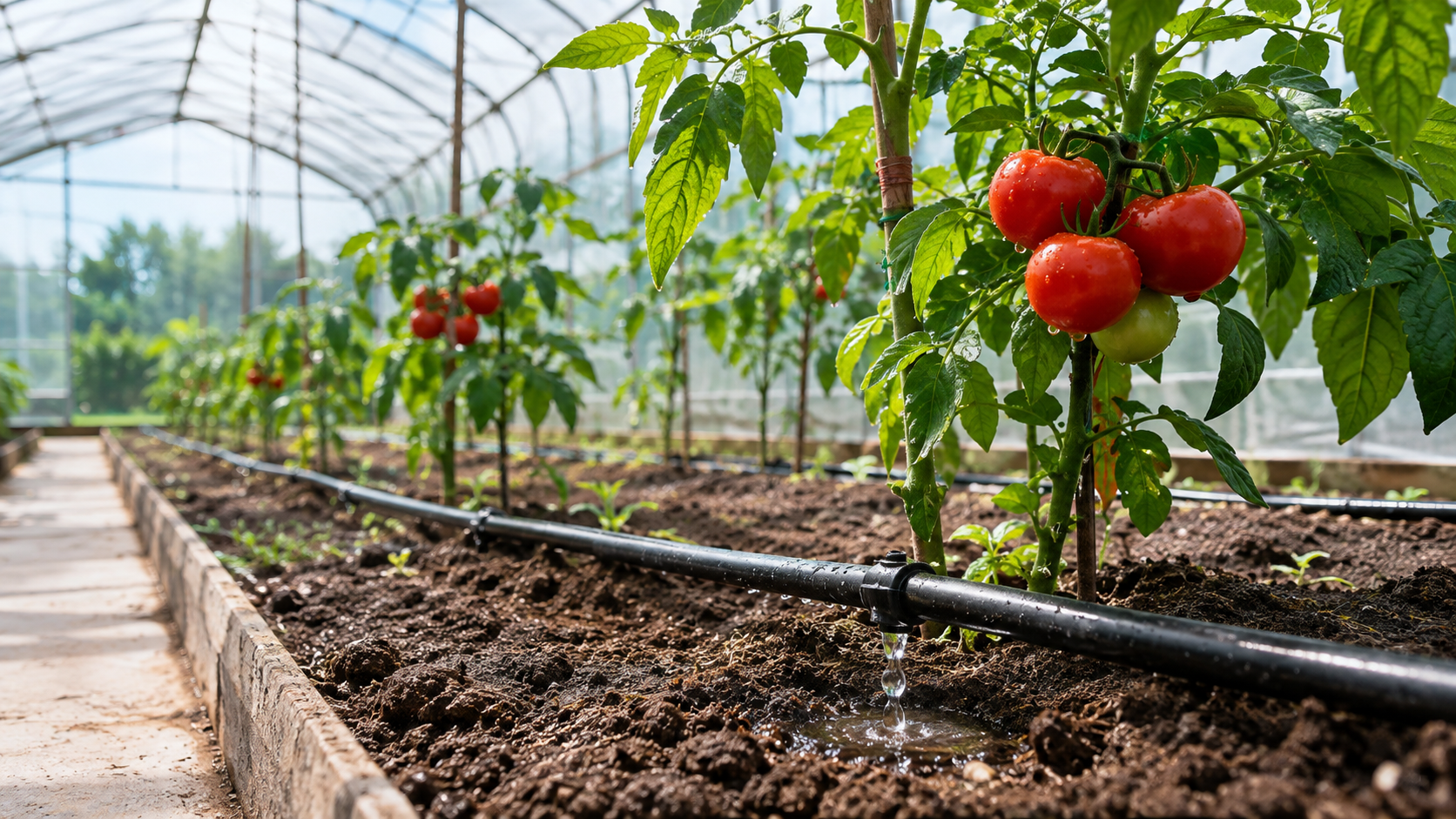
Complete Guide to Greenhouse Drip Irrigation Setup and Benefits
Greenhouse drip irrigation is an efficient way to maintain consistent soil moisture inside enclosed growing environments. Greenhouses trap heat and accelerate plant transpiration, making manual watering inconsistent and labor-intensive. When moisture levels fluctuate, plants may experience root stress and increased disease risks.
Greenhouse drip irrigation addresses these problems by delivering controlled amounts of water directly to plant root zones. According to the USDA Natural Resources Conservation Service, micro-irrigation systems help conserve water by reducing evaporation and runoff. These systems support efficient water management across commercial and small-scale growing operations.
Whether you grow delicate seedlings on benches or heirloom tomatoes in raised beds, targeted watering improves moisture consistency. It also reduces unnecessary water consumption and supports healthier root development.
This guide explains everything you need to know about greenhouse irrigation systems. You will learn how to choose suitable equipment, build a drip irrigation setup, and understand its agricultural applications. We will also explore seven major benefits, compare three common drip irrigation types, and identify the best watering system for your greenhouse.
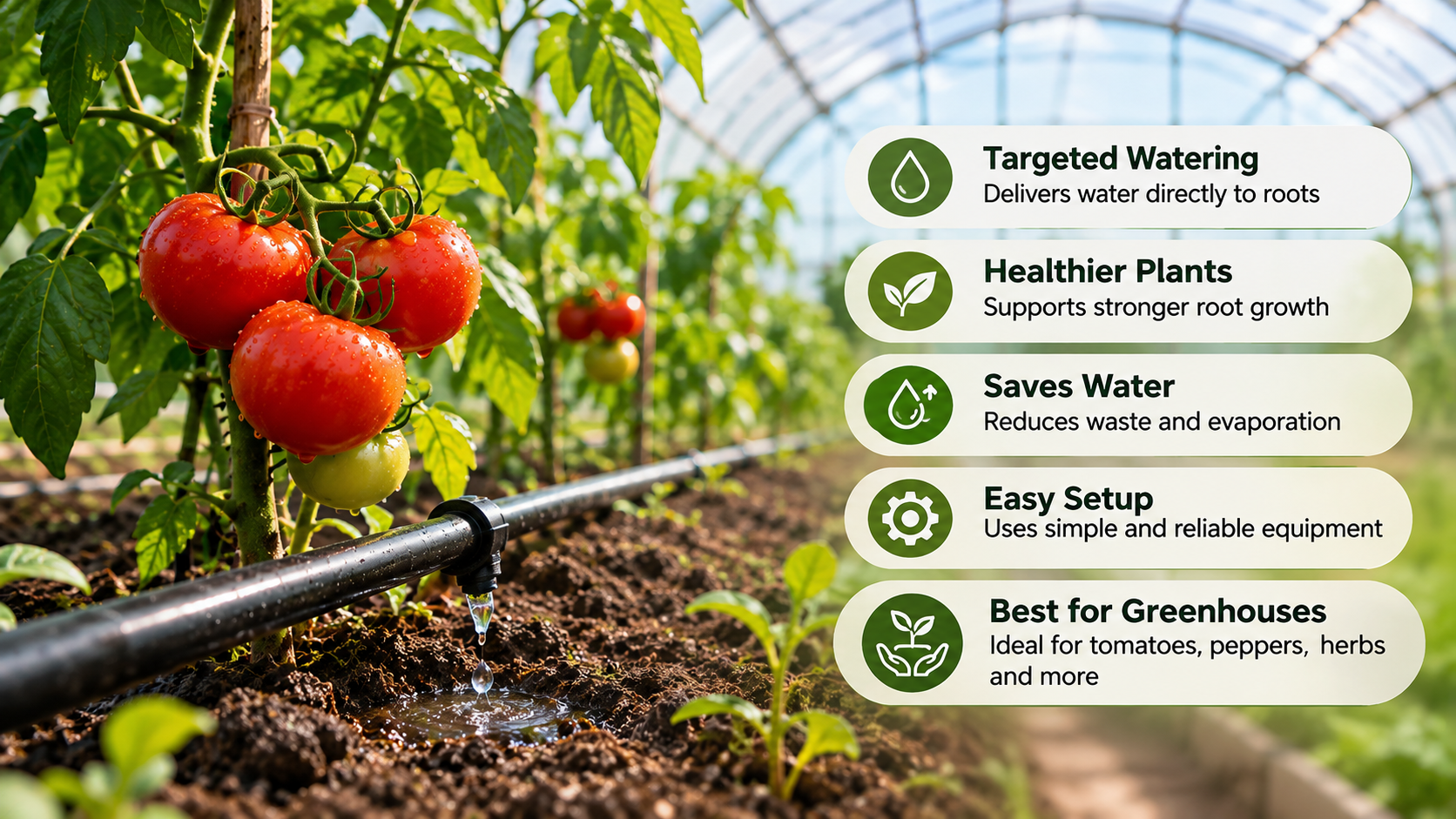

Which irrigation system is used in a greenhouse?
Greenhouses use several irrigation methods depending on crop requirements, growing layouts, and container sizes. Common options include micro-sprinklers, overhead misting systems, boom irrigation, and flood-and-drain benches. Each method serves a different purpose within controlled growing environments. For outdoor gardening applications, proper garden irrigation techniques can also help maintain consistent soil moisture. Therefore, growers should consider their crop types and watering needs before choosing a system.
However, drip irrigation systems remain one of the most popular choices for general greenhouse cultivation. This is because they deliver water directly to plant roots through specialized tubing and emitters. As a result, they reduce unnecessary moisture on leaves and surrounding surfaces. Additionally, they help growers maintain consistent soil moisture throughout the growing cycle.
Drip systems work particularly well for tomatoes, peppers, cucumbers, and container-grown herbs. Furthermore, growers can adjust emitter placement and water output according to individual plant requirements. Meanwhile, pressure regulators and filters help maintain reliable water distribution across long growing rows. Consequently, this method supports efficient water use and healthier plant development.
Choosing the right irrigation method depends on several factors:
- Micro-sprinklers: Suitable for wider coverage and certain propagation applications.
- Overhead misting: Useful for maintaining humidity around delicate seedlings.
- Ebb-and-flow benches: Designed for watering compatible potted plants.
- Drip irrigation: Ideal for delivering targeted moisture to individual plants.
Matching Irrigation Types to Crop Staging
Different plant growth stages require different watering approaches. Seedlings need careful moisture management because their developing roots are particularly sensitive. Fine misting systems can help maintain suitable humidity during propagation. However, excessive moisture may encourage fungal problems.
As plants mature, their water requirements generally increase. Fruiting crops such as tomatoes and cucumbers benefit from localized drip emitters. These devices deliver water near developing root systems without unnecessarily wetting foliage. This helps maintain more consistent growing conditions inside enclosed structures.
Growers should also consider container sizes and planting distances. Small pots may require low-flow emitters, while larger containers can accommodate higher water output. Similarly, closely spaced crops may benefit from drip lines with appropriately positioned outlets.
Adjusting irrigation equipment to each growth stage offers several advantages:
- Supports healthy seedling development.
- Prevents unnecessary water consumption.
- Helps maintain suitable root-zone moisture.
- Reduces excessive humidity around plant foliage.
- Improves watering consistency across different crop varieties.
How to make a greenhouse irrigation system?
Building a functional greenhouse drip irrigation system requires a reliable water source, filtration equipment, distribution tubing, and suitable emitters. Start by identifying your greenhouse dimensions and calculating the number of plants. This helps determine the required tubing length and water output. If you are planning a larger protected cultivation project, this polyhouse farm setup guide can help you understand the broader setup requirements.
Next, assemble the main water connection. Install a backflow preventer where required, followed by a suitable filter, pressure regulator, and irrigation timer. Check the manufacturer’s recommended installation order before connecting the components.
Run 1/2-inch UV-resistant polyethylene tubing along the greenhouse aisle or growing benches. Secure the mainline using suitable clips or stakes. Then, use an emitter punch tool to create openings for individual connections.
Insert 1/4-inch micro-tubing into the mainline fittings. Connect the other ends to drip stakes or appropriate emitters near plant roots. Finally, flush the system, inspect every connection, and test water distribution.
Basic equipment checklist:
- Water supply connection and backflow protection.
- Mesh or disc filtration unit.
- Pressure regulator.
- Automatic irrigation timer.
- UV-resistant polyethylene mainline.
- Micro-tubing and connector fittings.
- Drip emitters or irrigation stakes.
- Tubing clips and end caps.
Pressure Regulation and Filtration Safeguards
Pressure regulation and filtration are essential for maintaining reliable greenhouse irrigation. Without proper controls, excessive pressure can damage fittings and cause leaks. Meanwhile, sediment and mineral deposits can gradually block small emitter openings. Maintaining a dependable water supply is equally important, making water security and resilience strategies relevant to long-term agricultural planning.
Install a pressure regulator suitable for your selected drip equipment. Some residential drip systems operate around 25 PSI, but the correct setting depends on manufacturer specifications. Always check the operating pressure recommended for your emitters and tubing.
Filtration also protects the system from suspended particles. A 120-mesh screen filter is commonly used in many drip irrigation applications. However, the required filtration level depends on emitter design and water quality. Disc filters provide another option for certain installations.
Follow these maintenance practices to prevent common irrigation problems:
- Clean filters regularly to maintain consistent water flow.
- Flush mainlines and lateral tubing periodically.
- Inspect fittings for cracks, leaks, and loose connections.
- Check emitters for blockages or uneven discharge.
- Monitor pressure during normal irrigation cycles.
These simple precautions help extend equipment life and maintain uniform watering. They also reduce unexpected maintenance costs during important growing periods.
What is the use of drip irrigation in agriculture?
Drip irrigation plays an important role in modern agriculture by delivering controlled amounts of water directly to plant root zones. Farmers use this technology across open fields, commercial greenhouses, and protected growing structures. It helps manage irrigation more efficiently than traditional surface watering methods.
Conventional flood irrigation can lose water through runoff, deep soil percolation, and uneven distribution. Drip systems reduce these losses by placing water outlets close to individual plants. This allows growers to manage moisture according to crop requirements and local soil conditions.
Another important application is fertigation, which combines irrigation with fertilizer delivery. Farmers introduce suitable water-soluble nutrients into the irrigation network. These nutrients travel through the tubing and reach plant roots alongside irrigation water.
Agricultural drip irrigation offers several practical applications:
- Vegetable cultivation: Supports tomatoes, peppers, cucumbers, and other crops.
- Fruit production: Delivers controlled moisture to orchards and fruit plants.
- Greenhouse farming: Maintains consistent moisture in protected environments.
- Fertigation: Distributes suitable dissolved fertilizers through irrigation lines.
- Water management: Helps reduce unnecessary irrigation losses.
However, successful implementation requires proper system design. Water quality, soil characteristics, crop spacing, and emitter selection all influence performance. Regular monitoring also prevents blockages and uneven water distribution.
What are the 7 advantages of drip irrigation?
Drip irrigation provides several agricultural advantages for greenhouse operators and outdoor growers. Its biggest strength is delivering water directly to plant roots. This reduces unnecessary watering across surrounding soil and helps maintain more controlled growing conditions.
The following seven benefits explain why many growers prefer drip irrigation over conventional watering methods.
- Water conservation: Targeted delivery reduces evaporation, runoff, and unnecessary water application. Actual savings depend on soil conditions and the existing irrigation method.
- Reduced leaf diseases: Keeping foliage relatively dry can lower the risk of certain moisture-related plant diseases.
- Fewer weeds: Watering specific root zones limits moisture availability in surrounding areas, potentially reducing weed growth.
- Efficient fertigation: Suitable fertilizers can travel through irrigation lines and reach plant roots directly.
- Adaptability: Properly designed systems work across different planting layouts and uneven terrain.
- Reduced soil erosion: Low-volume water delivery helps minimize surface runoff and soil disturbance.
- Lower operating costs: Efficient water application can reduce pumping requirements and labor expenses, depending on system design.
These advantages make drip irrigation useful for many agricultural applications. However, the benefits depend on proper installation and maintenance. Clogged emitters, incorrect pressure settings, and unsuitable irrigation schedules can reduce overall efficiency.
What are the three types of drip irrigation?
Drip irrigation systems generally fall into three common categories: soaker hoses, drip tape, and emitter-based tubing networks. Each option uses a different method to distribute water across growing areas. Choosing between them depends on crop spacing, installation requirements, and irrigation frequency. Beginners planning smaller growing spaces can also benefit from this guide to starting a backyard vegetable garden.
Soaker hoses release water through porous materials along their length. They work well for closely spaced plants, garden beds, and certain greenhouse layouts. However, water distribution can vary with pressure and hose positioning.
Drip tape contains internal water channels and regularly spaced outlets. It is commonly used for seasonal vegetable cultivation and relatively uniform planting rows. Its lightweight construction makes installation convenient, although durability depends on material quality and operating conditions.
The third option uses polyethylene tubing with individual button emitters or inline drippers. Growers can position outlets according to individual plant requirements. This makes the system particularly useful for container cultivation and irregular planting arrangements.
Here is a quick comparison:
| Irrigation type | Best suited for | Main characteristic |
|---|---|---|
| Soaker hoses | Garden beds and closely spaced plants | Porous water distribution |
| Drip tape | Uniform crop rows | Pre-spaced water outlets |
| Emitter tubing | Containers and individual plants | Adjustable emitter placement |
Understanding these differences helps growers select equipment that matches their greenhouse layout and watering requirements.
What is the best watering system for a greenhouse?
A point-source drip irrigation system with pressure-compensating emitters is an excellent option for many greenhouse environments. It delivers measured amounts of water directly to individual plant containers or growing beds. This approach provides better control than conventional overhead watering in many cultivation settings.
Greenhouses often experience elevated humidity because of enclosed spaces and limited air circulation. Overhead watering can increase moisture on leaves and surrounding surfaces. Under unsuitable conditions, this may encourage diseases such as botrytis and other fungal infections.
Drip irrigation helps address this challenge by keeping most foliage dry. Pressure-compensating emitters can also maintain relatively consistent water output across different pipe elevations and distances. However, their performance depends on operating pressure and manufacturer specifications.
When selecting a greenhouse watering system, consider these factors:
- Crop requirements: Different plants need different water quantities.
- Greenhouse size: Larger structures may require multiple irrigation zones.
- Water quality: Filtration prevents sediment from blocking emitters.
- Operating pressure: Suitable pressure supports consistent water delivery.
- Automation: Timers and controllers simplify irrigation scheduling.
- Maintenance: Accessible filters and fittings make servicing easier.
Whether you grow twenty tomato plants or hundreds of nursery containers, a properly designed drip system offers precise irrigation control. Combine suitable emitters with regular maintenance and appropriate watering schedules. This helps maintain healthier growing conditions throughout the production season.
CONCLUSION
Building an automated greenhouse drip irrigation network transforms everyday garden management from a demanding chore into a smooth, reliable process. By delivering water directly to thirsty root zones, this system conserves vital water resources, reduces excess ambient humidity, and helps protect valuable crops against destructive leaf blights. Moreover, it minimizes water waste while maintaining consistent soil moisture for healthier plant development.
Throughout this guide, we explored how different watering configurations operate, how essential headworks components fit together, and why micro-watering remains a cornerstone of sustainable agricultural production worldwide. Therefore, choosing the right equipment and installation method is essential for achieving reliable results.
By selecting high-quality pressure-compensating drippers, matching delivery lines to your pot layouts, and installing proper filtration, you can establish a resilient irrigation foundation. Additionally, regular maintenance helps prevent blockages and ensures consistent water distribution. Instead of spending hours on irregular hand-watering, take the next step toward efficient greenhouse management. Start by measuring your aisle dimensions, mapping plant spacing, and selecting suitable components. Ultimately, installing your own low-volume micro-irrigation system can support healthier root systems, conserve water, and deliver more productive harvests throughout the year.