
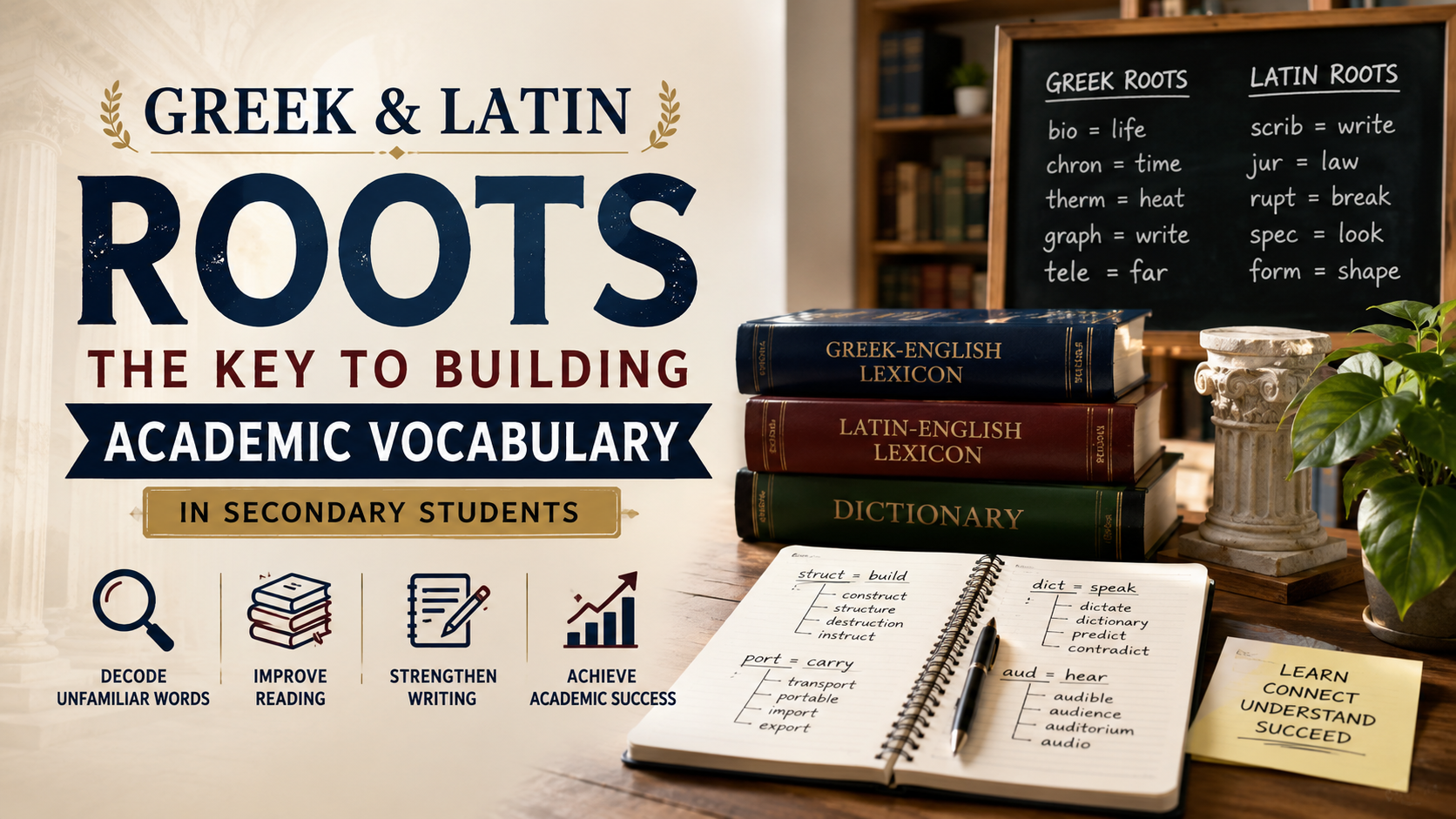
Greek and Latin Roots: The Key to Building Academic Vocabulary in Secondary Students
Unlocking the power of Greek and Latin roots is one of the most effective strategies for secondary students aiming to boost their academic vocabulary. As students transition into high school and college-prep coursework, they encounter complex texts filled with unfamiliar terminology across science, literature, and history. Instead of memorizing thousands of isolated definitions, students who learn word origins can decode unfamiliar terms instantly. According to insights from the Harvard Graduate School of Education, morphological awareness significantly enhances reading comprehension and language proficiency. This guide directly explores what are 10 Latin root words, does Greek have Latin roots, how can I learn Greek and Latin roots, what are some common Greek and Latin roots, what are 10 Greek words, and is 60% of English Latin? By exploring these core questions, students will gain actionable tools to elevate their reading, writing, and overall academic performance.

What Are 10 Latin Root Words?
Learning Latin root words gives students a practical way to decode unfamiliar English vocabulary. Many academic terms contain Latin word parts, especially in science, law, history, and literature. When students recognize one root, they can connect several related words and infer meaning from context.
Ten useful Latin roots include aud meaning “hear,” dict meaning “speak,” spec meaning “look,” port meaning “carry,” scrib meaning “write,” vert meaning “turn,” jur meaning “law” or “swear,” rupt meaning “break,” form meaning “shape,” and struct meaning “build.”
For example, aud appears in audible, audience, and auditorium. The root dict appears in dictate, dictionary, and predict. These connections make difficult vocabulary less intimidating. Students can also combine roots with prefixes and suffixes to understand unfamiliar words. This approach supports reading comprehension, vocabulary development, and performance on classroom assessments and standardized tests.
Essential Latin Roots in Daily Academic Texts
High-utility Latin roots can accelerate vocabulary growth for secondary students who regularly encounter complex academic texts. Teachers can make root study more effective by introducing each root with familiar derivatives and common prefixes or suffixes.
For example, struct means “build” and appears in construct, destruct, instruction, and structure. Students can compare how prefixes change the meaning of the same base. This process builds morphological awareness and helps learners analyze unfamiliar words.
Root instruction also works best when students see the same word parts across different subjects. A history lesson might include jurisdiction, while science may use structure or construction. Repeated exposure strengthens recognition and recall over time.
Rather than treating Latin roots as isolated vocabulary facts, students should connect them to real reading and writing tasks. This method turns classical word parts into practical tools for understanding academic language and expanding vocabulary efficiently.
Does Greek Have Latin Roots?
Greek does not have Latin roots in the historical or etymological sense. Greek and Latin are separate classical languages with different origins, although both belong to the larger Indo-European language family.
Latin developed within the Italic branch, while Greek represents its own branch of the family. Their shared ancestry explains some similarities, but Greek did not develop from Latin, and Latin did not develop from Greek.
Both languages, however, have had a major influence on English. Greek contributes heavily to scientific, medical, mathematical, and philosophical vocabulary. Latin contributes strongly to legal, administrative, academic, and formal English.
Modern scholars also combine Greek and Latin elements when creating technical terms. This practice can make their relationship seem closer than it actually is. Understanding the distinction helps students study Greek and Latin roots accurately.
It also shows why English contains classical vocabulary from two different linguistic traditions. Students can therefore appreciate both languages without assuming that one developed from the other.
The Indo-European Connection Between Classical Languages
Greek and Latin belong to the Indo-European language family, but they represent separate branches within that larger family. This shared ancestry provides useful historical context for students studying classical languages and English vocabulary.
Over many centuries, Greek and Latin developed their own grammatical systems, sound patterns, and vocabularies. Some related words, known as cognates, reflect older connections within Indo-European rather than direct borrowing between Greek and Latin.
English later borrowed thousands of words and word parts from both languages. Greek became especially important in science, medicine, and philosophy. Latin became influential through Roman culture, Christianity, law, education, and later French, including topics explored through the intersection of religion and media.
Studying these connections helps students see vocabulary as part of a larger linguistic history. It also makes unfamiliar academic terms easier to analyze.
Instead of viewing Greek and Latin roots as random word fragments, learners can understand them as pieces of two influential classical traditions. Both traditions continue to shape modern English vocabulary today.
How Can I Learn Greek and Latin Roots?
Learning Greek and Latin roots works best when students use them actively rather than relying on rote memorization. Start with one root each day and learn its meaning, pronunciation, and several English derivatives.
Then use those words in short examples or identify them while reading. Flashcards can help with quick review, while a vocabulary journal can organize roots into related word families.
Students should also practice breaking unfamiliar words into prefixes, roots, and suffixes. When encountering an unfamiliar science term, they can identify each part and use the surrounding sentence as a clue.
Teachers can reinforce this skill with root-of-the-week activities, short quizzes, and subject-specific examples. Digital vocabulary tools can provide extra repetition, but active analysis matters more than memorizing long lists.
Consistent practice helps students transfer their knowledge into reading, writing, and classroom discussion. Over time, Greek and Latin roots become useful decoding tools rather than isolated vocabulary facts.
The goal is to build a repeatable strategy for understanding unfamiliar academic words across subjects.

Daily Habits for Mastering Classical Word Parts
Small, consistent habits make classical word-part study more effective than last-minute memorization. Students can spend five to ten minutes each day identifying roots in textbooks, news articles, or assigned readings.
When they find an unfamiliar word, they can underline the prefix, identify the root, and predict the meaning before checking a dictionary. Keeping a running list of useful roots also makes review easier.
Teachers can display a weekly root and ask students to find related words across different subjects. For example, a class studying port, meaning “carry,” might identify transport, portable, import, and export.
Students can then discuss how prefixes change the meaning of the base. These short activities build recognition through repeated exposure. They also encourage learners to test predictions against context.
Over time, this routine strengthens vocabulary, reading comprehension, and confidence. The goal is not to memorize every classical word part. Instead, students should develop a reliable strategy for decoding unfamiliar academic language.
What Are Some Common Greek and Latin Roots?
Common Greek and Latin roots appear throughout middle and high school curricula. They are especially useful because the same word parts often appear across several academic subjects.
Greek roots frequently support scientific and technical vocabulary. Examples include bio for “life,” geo for “earth,” graph for “writing,” photo for “light,” and therm for “heat.”
These roots help students approach words such as biology, geology, autograph, photograph, and thermometer. Latin roots are equally valuable. Rupt means “break,” while dict means “speak” or “say.”
Other useful Latin roots include cred for “believe,” port for “carry,” and struct for “build.” Because these roots recur in many contexts, learning them can provide strong value for study time.
Students do not need to memorize every word separately. Recognizing familiar morphemes lets them make informed predictions about unfamiliar terms and use context to confirm those predictions.
Maximizing Vocabulary Growth Through Frequent Morphemes
Students can improve vocabulary efficiently by prioritizing roots that appear in many English words. Instead of studying dozens of obscure word parts, begin with a focused group of high-frequency Greek and Latin roots.
Roots such as bio, geo, graph, dict, port, struct, cred, and rupt can generate many useful derivatives. Teachers can organize these roots into word families and compare how prefixes or suffixes modify meaning.
For example, transport, import, and export share the Latin root port, but their prefixes create different meanings. This comparison encourages deeper word analysis and improves morphological awareness.
Students should also revisit previously learned roots while adding new ones. Spaced review helps move vocabulary from short-term recognition into longer-term memory.
Most importantly, root study should remain connected to authentic reading. When learners encounter familiar roots in textbooks and articles, they reinforce meanings through context.
This targeted approach builds a practical mental vocabulary bank without overwhelming students. It also helps learners become more independent when facing challenging academic vocabulary.
What Are 10 Greek Words?
Ancient Greek has contributed many important words and word parts to modern English, especially in science, medicine, mathematics, and philosophy.
Ten useful Greek elements include bios meaning “life,” ge meaning “earth,” logos meaning “word” or “study,” phobos meaning “fear,” phone meaning “sound” or “voice,” phos meaning “light,” skopeo meaning “look at,” techne meaning “art” or “skill,” chronos meaning “time,” and hydro meaning “water.”
Modern English often uses related forms rather than the original Greek words unchanged. For example, bios contributes to biology, geo appears in geology, and chronos appears in chronology.
The element hydro occurs in words such as hydrology and hydrophobic. Learning these Greek roots helps students recognize patterns in unfamiliar technical vocabulary.
It also gives learners useful context when they encounter specialized terms in science, literature, and other academic subjects. Root knowledge can therefore support both vocabulary development and reading comprehension.
Exploring Greek Origins in Modern Scientific Terminology
Modern scientific vocabulary relies heavily on Greek because ancient Greek provided precise terms for ideas related to nature, medicine, mathematics, and philosophy.
Scientists often combine Greek-derived word parts to create terms that describe specific processes, structures, and conditions. Students may recognize hydro in hydrology, therm in thermodynamics, and photo in photosynthesis.
Other Greek elements appear in fields such as astronomy, biology, anatomy, and psychology. Learning these parts can make technical vocabulary easier to approach because students can analyze a word before looking up its full definition.
For example, identifying a familiar root can provide a useful clue about a scientific term’s subject or function. However, students should treat root meanings as clues rather than complete definitions.
Historical changes can alter how a root appears in modern English. Combining root analysis with context produces more reliable results.
This approach turns unfamiliar scientific vocabulary into recognizable linguistic patterns. It also helps students understand why many technical terms seem difficult at first but become easier after their component parts are identified.
Is 60% of English Latin?
The claim that 60% of English is Latin is useful as a rough description of vocabulary influence, but it needs context. Estimates vary depending on how researchers count words and whether they examine dictionaries, technical vocabulary, or everyday speech.
A large share of English vocabulary has Latin or Romance-language origins, often through French after the Norman Conquest. However, the most common words in everyday English are largely Germanic and descend from Old English.
Words such as house, bread, water, and child illustrate this Germanic core. Latin influence became especially strong in law, religion, education, science, and formal writing, including the historical relationship between religion and violence.
English also borrowed extensively from Greek and many other languages. Therefore, saying that “60% of English is Latin” oversimplifies a much more complex history.
A better conclusion is that Latin has had a major influence on English vocabulary, particularly formal and academic language. Understanding that influence helps students interpret Greek and Latin roots more accurately.
It also explains why academic English often sounds different from everyday conversation.
The Influence of History on Modern English Vocabulary
English vocabulary reflects centuries of migration, conquest, cultural exchange, education, and technological change. Its Germanic foundation comes from Old English, while later contact introduced words from Latin, French, Greek, Norse, and other languages. Studying different history niches effectively can provide additional context for understanding how these linguistic influences developed over time.
The Norman Conquest of 1066 greatly increased French and Latin influence in government, law, and administration. Later developments in education and science brought even more classical vocabulary into English. The Intersection of Religion and Media also illustrates how cultural institutions can influence language and communication over time.
The Renaissance encouraged renewed interest in Greek and Latin. Scientific communities also used classical word parts to create precise technical terms.
This history explains why English often contains multiple words with related meanings but different origins. Everyday language may use a Germanic word, while academic writing uses a Latinate alternative.
Learning Greek and Latin roots helps students recognize these layers and understand unfamiliar vocabulary. More importantly, it shows that English is not a single-source language.
Its richness comes from centuries of borrowing, adaptation, and linguistic change. Understanding these influences can make vocabulary study more meaningful and improve students’ ability to decode complex academic words.
Frequently Asked Questions
Why are Greek and Latin roots important for secondary students?
Greek and Latin roots are essential because they provide a powerful decoding system for advanced academic vocabulary. Secondary students face increasingly complex texts in science, history, and literature filled with unfamiliar multisyllabic words. By learning foundational root words, prefixes, and suffixes, students can easily decipher the meanings of thousands of derivative terms. This morphological awareness directly improves reading comprehension, writing precision, and performance on standardized tests without requiring tedious memorization of every single vocabulary word.
How do Greek roots differ from Latin roots in English?
Greek and Latin roots differ primarily in their historical usage and thematic focus within the English language. Greek roots are predominantly found in scientific, medical, and technical terminology, such as biology, telephone, and microscope. Latin roots tend to dominate legal, administrative, and general academic vocabulary, such as legislature, audience, and construct. While both classical languages contributed immensely to English vocabulary, recognizing their distinct thematic patterns helps students predict word meanings based on the subject matter they are reading.
Can learning word roots help improve standardized test scores?
Learning word roots significantly boosts scores on standardized tests like the SAT, ACT, and state assessments. These exams frequently test advanced vocabulary and reading comprehension using dense, passage-based questions. Students who understand classical roots can successfully deduce the definitions of challenging words they have never seen before. This skill saves valuable time during exams and ensures higher accuracy when answering rigorous vocabulary-in-context questions.
Are there digital tools available for studying word roots?
Numerous digital tools and apps make studying Greek and Latin roots engaging and interactive for modern students. Flashcard applications like Quizlet offer pre-made decks featuring common roots, prefixes, and suffixes alongside interactive study games. Educational websites and gamified platforms also provide daily root challenges and quizzes. Integrating these digital resources into a weekly routine helps secondary students reinforce their morphological knowledge effectively both inside and outside the classroom.
Conclusion
Mastering Greek and Latin roots is a transformative strategy for any secondary student looking to build a formidable academic vocabulary. By exploring essential root words, understanding the distinctions between classical languages, and utilizing daily study habits, learners can decode unfamiliar texts with confidence. As demonstrated, these language patterns unlock thousands of English derivatives across science, literature, and history. Encouraging students to apply morphological analysis during their daily reading turns vocabulary acquisition into an empowering, logical process. Embrace these foundational word origins today to elevate reading comprehension, boost standardized test scores, and achieve long-term academic excellence.