
Frequencies of Colors: The Complete Scientific Spectrum Guide
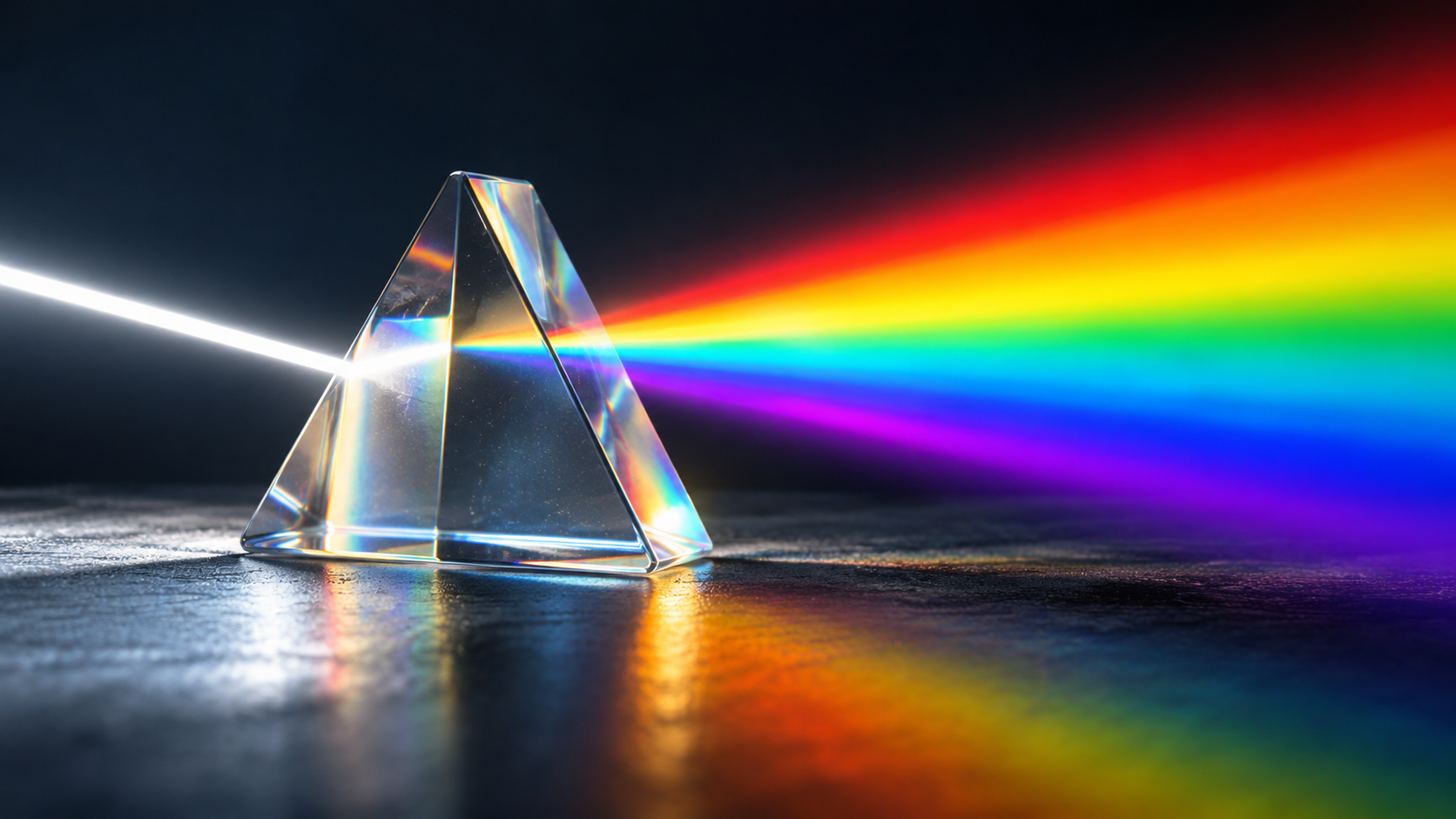
Light shapes everything we see, yet its underlying physics often goes unnoticed. Every visible color corresponds to electromagnetic radiation within a specific range of wavelengths and frequencies. Understanding the frequencies of colors reveals how light carries energy and produces the visual experiences we encounter daily.
Human eyes detect only a small portion of the electromagnetic spectrum. According to NASA Science, visible light occupies a narrow region between infrared and ultraviolet radiation. Its wavelengths are commonly approximated as 380–750 nanometers, although the boundaries vary slightly across scientific references. Understanding the human eye and its functions also helps explain how we detect and perceive these different wavelengths.
Studying these electromagnetic waves helps scientists understand vision, optical technology, and the behavior of light. This guide explores the frequency of each visible color, explains which colors have the highest and lowest frequencies, and examines the relationship between wavelength and photon energy. It also separates established optical physics from popular claims about color vibrations. Finally, you will learn how primary colors work in pigment mixing and why the longest wavelength does not mean the highest frequency.
What is the frequency of each color?
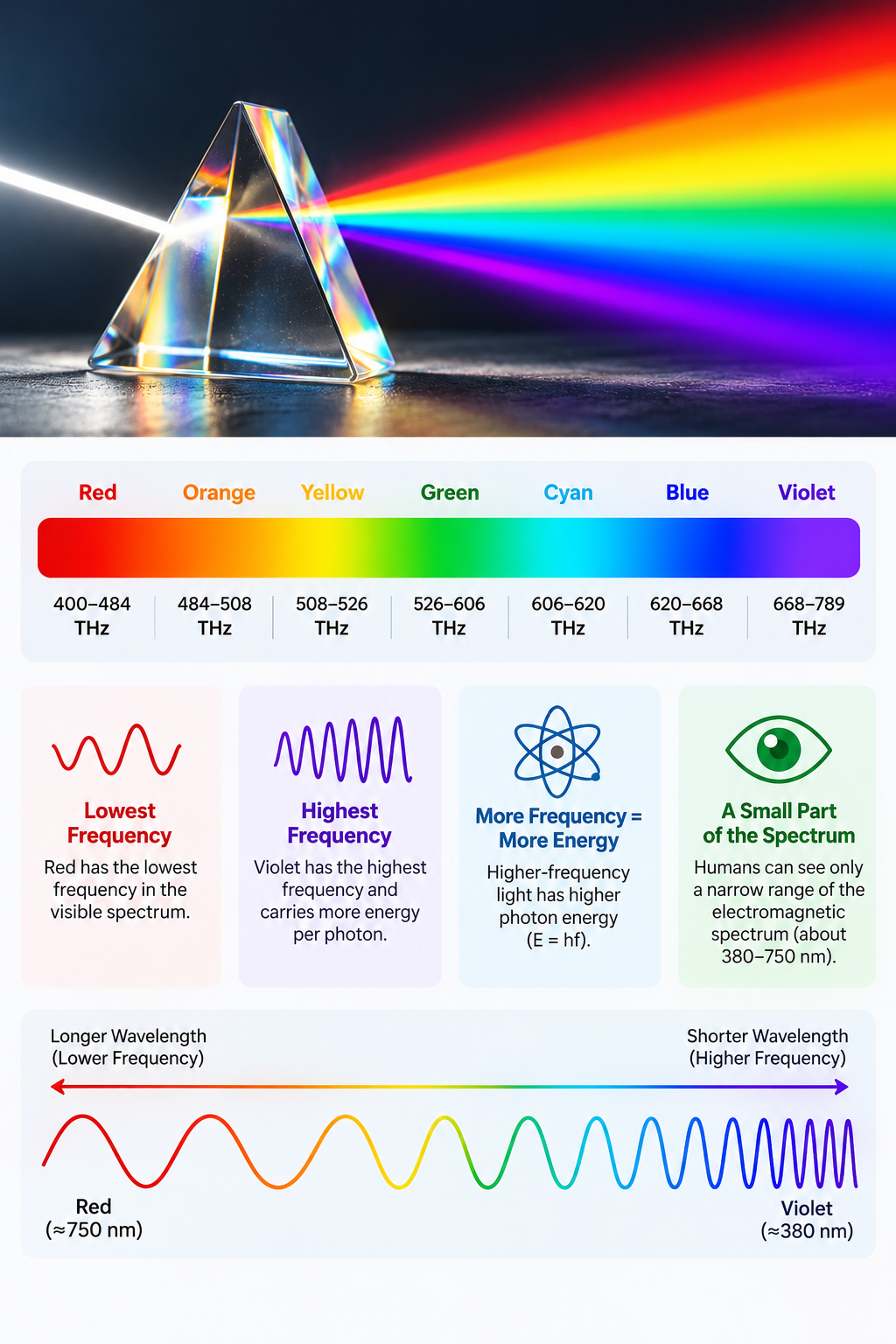
Visible light spans approximately 400–790 terahertz (THz), depending on the wavelength boundaries used. One terahertz equals one trillion cycles per second. Red occupies the lower-frequency end of the spectrum, while violet occupies the higher-frequency end. Orange, yellow, green, cyan, and blue fall between these extremes.
The following ranges provide useful approximations for understanding the frequencies of colors. However, visible colors do not have perfectly defined boundaries. Their perceived appearance depends on wavelength, lighting conditions, and how the human visual system responds.
| Color | Approximate frequency |
|---|---|
| Red | 400–484 THz |
| Orange | 484–508 THz |
| Yellow | 508–526 THz |
| Green | 526–606 THz |
| Cyan | 606–620 THz |
| Blue | 620–668 THz |
| Violet | 668–789 THz |
These values are approximate divisions, not universal boundaries. Different references may use slightly different ranges because the visible spectrum forms a continuous distribution.
Each frequency corresponds to a particular wavelength. Together, these properties influence the energy carried by individual photons. Your eyes detect this light through specialized retinal cells, and your brain interprets their signals as color.
The Role of Terahertz Measurements in Light Physics
Terahertz measurements help scientists describe the extremely rapid oscillations of visible light. One terahertz represents one trillion cycles per second. Because visible-light frequencies are so high, terahertz provides a convenient unit for comparing different parts of the spectrum.
Optical engineers use frequency and wavelength measurements when developing lasers, optical sensors, communication systems, and scientific instruments. These measurements help determine how light interacts with materials and how optical systems transmit or detect particular wavelengths.
Frequency also matters in fiber-optic communication. Different optical wavelengths can carry information through specialized systems, while precise control helps engineers manage signal transmission. In displays, color reproduction involves controlling the light emitted by red, green, and blue subpixels. Their combined output produces a broad range of perceived colors.
Understanding these measurements also clarifies an important distinction: frequency is a physical property of electromagnetic radiation, while perceived color is a response produced by the human visual system. A specific frequency does not always correspond to one universally perceived shade under every viewing condition.
What color has the strongest frequency?
Violet has the highest frequency among the commonly recognized colors of visible light. Its approximate frequency ranges from 668 to 789 THz, depending on the boundaries used. At the upper end of this range, violet approaches ultraviolet radiation, which human eyes generally cannot see.
The relationship between frequency and photon energy is described by Planck’s equation:
E = hf
Here, E represents photon energy, h is Planck’s constant, and f is frequency. This equation shows that higher-frequency photons carry more energy than lower-frequency photons.
Consequently, violet photons carry more energy individually than red photons. However, this does not mean that every violet light source is more powerful or brighter than every red source. Total emitted power also depends on the number of photons and the source’s intensity.
Violet light is also associated with the transition toward ultraviolet radiation. Ultraviolet photons can cause photochemical damage, depending on their wavelength, exposure, and intensity. Understanding these differences helps explain why frequency matters in optics, spectroscopy, and light-based technologies.
Photon Energy and the Ultraviolet Boundary
Photon energy increases directly with electromagnetic frequency. Using Planck’s equation, violet photons near 380 nanometers carry approximately 3.26 electron volts of energy. This value is higher than the energy of red photons, which typically have wavelengths near 620–750 nanometers.
The distinction matters because ultraviolet radiation begins at shorter wavelengths than violet light. Ultraviolet photons carry more energy per photon than visible violet photons, although their biological effects depend on wavelength, intensity, and exposure duration.
It is also important to distinguish photon energy from the intensity of a light source. A dim violet light can deliver less total power than an intense red light, even though each violet photon carries more energy.
Optical manufacturers consider these properties when designing lenses, filters, sensors, and protective equipment. Appropriate filters can reduce unwanted ultraviolet exposure while allowing selected visible wavelengths to pass through. The exact protection required depends on the radiation source and intended application.
Which color has the longest frequency?
The phrase “longest frequency” is scientifically inaccurate because frequency describes how many wave cycles occur per second. When people ask about the longest frequency, they usually mean the color with the longest wavelength. Red has the longest wavelengths among the commonly recognized visible colors.
Red light typically occupies wavelengths of approximately 620–750 nanometers. Because electromagnetic waves travel at the same speed in a vacuum, longer wavelengths correspond to lower frequencies. Red therefore sits at the low-frequency end of the visible spectrum.
Longer wavelengths can also affect how light interacts with particles. Under Rayleigh scattering, shorter wavelengths scatter more strongly than longer wavelengths when particles are much smaller than the light’s wavelength. This helps explain some atmospheric effects involving sunlight, including why the sky appears blue.
However, red light does not always pass through fog, dust, or moisture without scattering. These conditions can involve larger particles and more complex scattering processes. Red is widely used in warning signals because it is recognizable and often remains distinguishable over useful distances, not because it is immune to scattering.
Do colors have a vibrational frequency?
Yes, visible light has a measurable electromagnetic frequency. Light consists of changing electric and magnetic fields that propagate through space. These fields oscillate at rates of hundreds of trillions of cycles per second within the visible spectrum.
The frequencies of colors are physical properties that scientists can measure using optical instruments. Different frequencies correspond to different photon energies and wavelengths. These relationships help explain how light interacts with matter and how the human visual system detects color.
However, the scientific meaning of vibration differs from its use in spiritual or metaphysical discussions. Claims that colors possess specific emotional, spiritual, or healing frequencies are not established by electromagnetic physics alone.
Color can influence human perception, attention, and mood, but those effects involve several factors. Lighting conditions, personal associations, cultural experiences, and environmental context can all affect responses. When selecting colors for visual projects, understanding how to discover which colors suit you can help guide personal choices. A color’s measurable frequency does not independently establish that it produces a particular emotion or therapeutic result.
Differentiating Optical Physics From Esoteric Vibration Claims
Optical physics describes light through measurable properties such as frequency, wavelength, amplitude, and photon energy. Scientists can measure these properties with instruments and test predictions through controlled experiments. These measurements provide an objective foundation for understanding how light behaves.
Esoteric theories sometimes use the word “vibration” to describe emotional states, spiritual energy, or healing effects. Such interpretations may have personal or cultural significance, but they should not be confused with scientifically measured electromagnetic frequencies.
Research into color psychology examines how people respond to different colors in particular settings. For example, a room’s lighting and color scheme may influence perceived comfort or visual attention. However, these effects are not universal, and they cannot automatically be attributed to a color’s electromagnetic frequency.
The distinction is important when evaluating claims about color therapy or spiritual vibrations. A measurable property of light does not prove a proposed health benefit. Reliable conclusions require appropriate evidence, controlled testing, and clear definitions of the outcomes being measured.
Which color has the highest vibration?
Violet has the highest electromagnetic frequency among the commonly recognized visible colors. The frequencies of colors increase from red to violet, with violet reaching approximately 668–789 THz. This places it above blue, green, yellow, and orange in the visible spectrum.
In scientific terms, a higher frequency means that more wave cycles occur each second. It also means that each photon carries more energy, according to Planck’s equation. These are measurable physical properties, not descriptions of a color’s emotional intensity.
The word “vibration” is sometimes used more broadly in art, wellness, and spiritual discussions. In those contexts, violet may symbolize creativity, reflection, or spirituality. Such associations depend on cultural traditions and personal interpretation rather than a universal law of electromagnetic physics.
Violet can appear visually striking, but it is not necessarily more stimulating than every other color. Perceived brightness and intensity depend on the light source, surrounding colors, viewing conditions, and human visual sensitivity. Therefore, violet has the highest frequency among visible colors, while claims about its emotional or spiritual effects require separate evidence.
The Biological Impact of Rapid Light Oscillations
Human vision begins when light reaches the retina and interacts with photopigments in specialized cells. Cone cells contribute to color vision, while rod cells are particularly important for vision in low-light conditions. Signals from these cells travel through neural pathways to the brain, where visual information is processed.
Short-wavelength light, including violet, can stimulate the visual system differently from longer-wavelength light. However, violet perception is not simply a matter of the brain processing faster electromagnetic vibrations. Neural responses depend on receptor sensitivity, light intensity, adaptation, and interactions among different visual pathways.
The effects of colored lighting on mood, attention, or alertness also depend on context. Brightness, exposure duration, time of day, and individual differences can influence responses. These factors make it difficult to attribute a psychological effect to color frequency alone.
In interior design, violet can create a distinctive visual atmosphere when used thoughtfully. Choosing complementary shades and understanding the colors to include with your company’s branding can also help create a consistent visual identity. Yet there is insufficient evidence to claim that violet light universally improves artistic focus or increases mental alertness simply because it has a high frequency.
What three colors cannot be mixed together?
In traditional subtractive color theory, red, yellow, and blue are treated as primary pigment colors. They serve as starting points for mixing many other colors with paints and similar materials. Under this traditional model, the primary colors are selected as the foundation of a mixing system rather than produced from other colors within that system.
Mixing pigments differs from mixing light. Pigments absorb certain wavelengths and reflect others, so combining paints changes the spectrum of light reflected toward your eyes. The resulting color depends on the pigments’ properties, their proportions, and the surface on which they are applied.
The traditional red-yellow-blue model is useful for basic art instruction, but it is not the only color system. Modern printing commonly uses cyan, magenta, yellow, and black, known as CMYK. These colors support a wider and more practical range of subtractive color reproduction.
For digital displays and many lighting applications, red, green, and blue are the primary additive colors. They combine through emitted light rather than pigment absorption. This distinction explains why primary colors depend on the color model and medium being used.
Which color has low frequency?
Red has the lowest frequency among the commonly recognized visible colors. Its approximate frequency ranges from 400 to 484 THz, although exact boundaries vary across references. Red also has the longest wavelength in the visible spectrum, typically around 620–750 nanometers.
Frequency and wavelength have an inverse relationship when light travels through a vacuum. As wavelength increases, frequency decreases. Because red lies at the long-wavelength end of visible light, its photons carry less energy individually than photons of violet or blue light.
Infrared radiation lies beyond the red end of the visible spectrum. Human eyes cannot directly see infrared, although infrared radiation can transfer energy that we experience as warmth. Infrared detection devices make this invisible region useful for thermal imaging, remote sensing, and other technologies.
Red light’s lower frequency does not mean it is always dimmer, weaker, or less useful than other colors. Brightness depends on light intensity and human visual sensitivity. Red serves as a popular choice for indicators, signals, and displays because it offers practical visibility and carries strong conventional associations. These visual differences also help explain why the world is losing color and how color choices influence the appearance of everyday environments.
In summary, the frequencies of colors follow a clear physical relationship: red occupies the low-frequency end, while violet occupies the high-frequency end. Wavelength, frequency, and photon energy explain these differences, while the color we perceive depends on how our visual system responds to light.
Conclusion
Understanding the diverse frequencies of colors gives you a clear scientific lens through which to view the visual world. From the slow, expansive waves of red anchoring the low end of the spectrum to the energetic, rapid cycles of violet at the peak, each hue represents a distinct packet of measurable electromagnetic energy. Recognizing how these frequencies function—alongside the physical boundaries of subtractive primary pigments—demystifies why certain shades command attention while others recede quietly into the background.
Applying this knowledge can transform how you interact with light in your daily routines. Whether you are fine-tuning evening illumination to protect your sleep, choosing high-contrast palettes for design projects, or selecting paint pigments for a creative endeavor, color physics provides practical guidance. Embracing the relationship between frequency, wavelength, and perception enables you to curate environments that enhance focus, support well-being, and communicate visual ideas with precision and intent.