
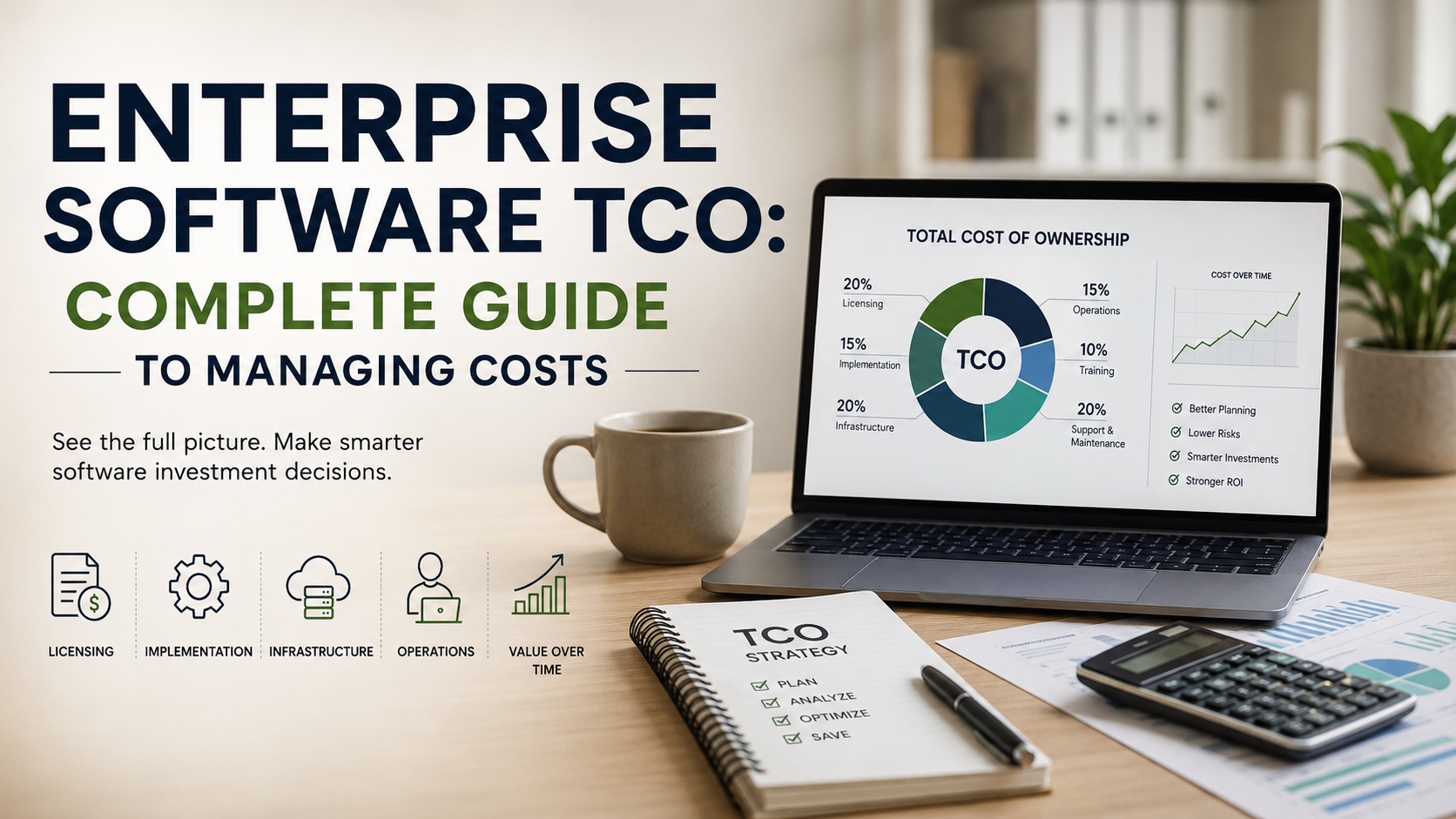
Enterprise Software TCO: Complete Guide to Managing Costs
Software procurement often looks straightforward until unexpected operational expenses appear. Many organizations compare enterprise solutions using only sticker prices or baseline subscription rates. However, Enterprise Software TCO provides a more complete view of the financial commitment.
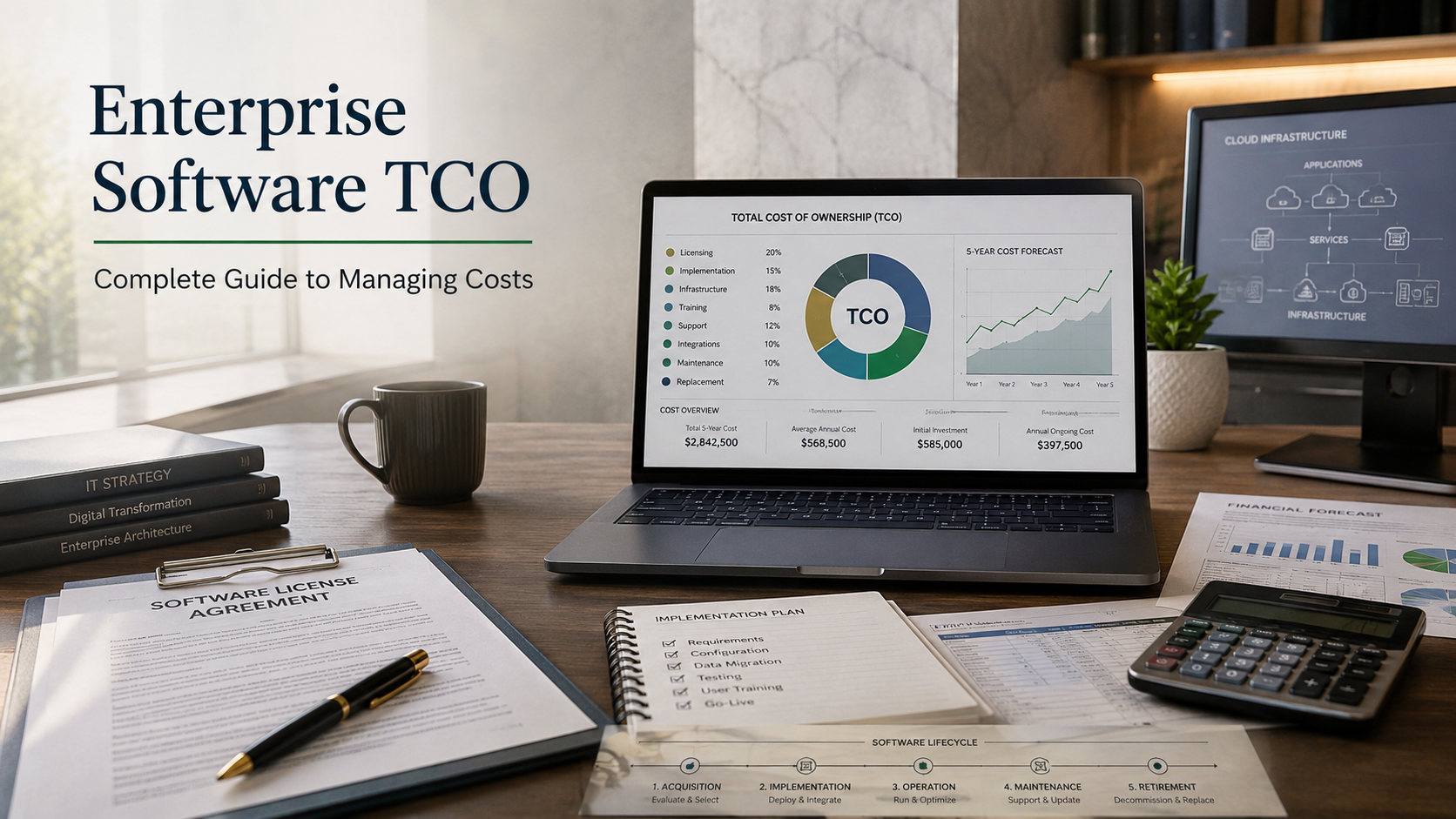
Total Cost of Ownership considers expenses across the software lifecycle. These expenses can include licensing, implementation, infrastructure, maintenance, training, support, integrations, and eventual replacement. Looking beyond the purchase price helps organizations avoid unrealistic budgets and costly procurement decisions.
According to financial guidance from the U.S. General Services Administration, evaluating end-to-end lifecycle costs provides a stronger basis for assessing technology investments.
Beyond licensing, ongoing operational expenses can quietly increase IT spending. Integration work may require additional technical resources. Training can also reduce productivity during adoption. Vendor price increases may further affect long-term budgets.
This guide explains how to measure and manage software costs. You will learn what TCO software means, how to calculate TCO, and how cloud computing changes ownership costs. You will also see how TCO applies to entrepreneurship and growing businesses.
What is TCO software?
TCO software refers to financial and analytical tools that help organizations calculate, track, and forecast the total cost of technology ownership. These platforms provide a structured alternative to basic spreadsheets. They can model expenses across deployment, daily operations, maintenance, upgrades, and eventual decommissioning.
A TCO platform typically combines direct expenses with less visible operational costs. Direct costs may include licensing, subscriptions, infrastructure, and implementation services. Indirect costs can include administration, integration work, downtime, training, and productivity losses.
This broader view helps procurement and finance teams compare technology investments more accurately. It can also reveal expenses that are easy to overlook during vendor selection.
Organizations can use TCO software to evaluate competing proposals and estimate future spending. Teams can also model different contract terms and usage scenarios. This makes it easier to identify potentially expensive assumptions before signing a long-term agreement.
Ultimately, TCO software supports more informed purchasing decisions. It connects technology spending with financial planning and helps organizations manage software costs throughout the ownership lifecycle.
Key Capabilities of Modern TCO Platforms
Modern TCO platforms can automate cost discovery by connecting with enterprise resource planning systems, financial platforms, and IT asset inventories. These integrations reduce the need for manual data collection and create a more consistent view of technology spending.
Many platforms also support predictive analytics and scenario modeling. Procurement teams can test different licensing structures, renewal assumptions, infrastructure requirements, and usage levels. This helps decision-makers understand how costs may change over several years and supports evidence-based decision making when comparing technology investments.
Benchmarking is another useful capability. Organizations can compare spending patterns against internal targets or relevant industry benchmarks. This can highlight unusual costs and identify opportunities for optimization.
Modern TCO tools can also support vendor evaluation. Teams may compare competing proposals using consistent cost categories instead of relying on headline pricing alone. This approach makes hidden implementation or operating expenses easier to identify.
Scenario analysis can be especially useful before contract negotiations. Teams can model price increases, user growth, infrastructure changes, and contract renewals.
By combining these capabilities, TCO platforms help organizations build clearer financial forecasts. They also give procurement, finance, and IT teams a shared framework for evaluating long-term technology investments.
What is the total cost of ownership (TCO)?
Total cost of ownership (TCO) is a financial metric that measures the complete direct and indirect costs associated with acquiring, deploying, operating, maintaining, and retiring an asset. In technology management, TCO goes beyond the initial purchase price.
Software ownership can involve many additional expenses. These may include implementation services, software updates, security requirements, employee training, technical support, integrations, and data migration. Some costs may also result from downtime or reduced productivity during system changes.
Calculating TCO gives decision-makers a broader financial picture. A software product with a low purchase price may become more expensive if it requires extensive customization or ongoing administration. Evaluating new technology before you buy can help identify these potential costs. Conversely, a higher initial investment may deliver lower operating costs over time.
TCO therefore helps organizations compare technology options using their full lifecycle costs. It also supports more realistic budgeting and financial forecasting, particularly when teams measure ROI before investing in new software.
For enterprise software, this approach is particularly important because contracts often extend across several years. Evaluating ownership costs before procurement can reduce budget surprises and improve long-term return on investment.
Direct Versus Indirect Ownership Costs
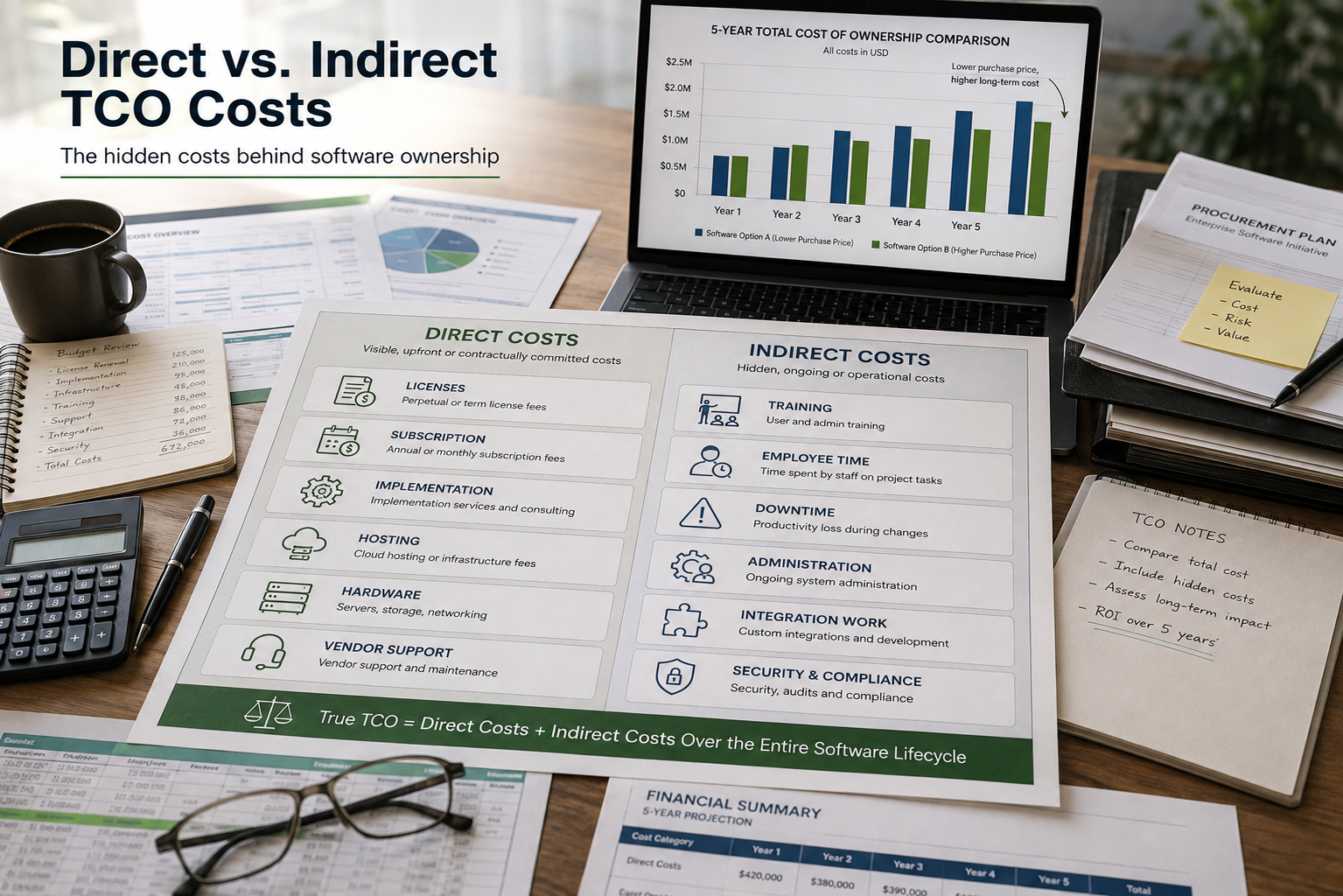
Direct ownership costs are expenses that organizations can usually identify and measure easily. These may include software licenses, subscription fees, implementation services, hardware, hosting, and vendor support contracts.
Indirect costs are less visible but can still materially affect Enterprise Software TCO. Examples include employee training time, productivity losses, system downtime, administrative work, and the effort required to maintain integrations.
Consider an enterprise platform that appears inexpensive based on its annual subscription. If employees require extensive training, internal teams may spend significant hours supporting implementation. Those labor costs form part of the broader ownership calculation.
Security and compliance work can also create indirect or operational expenses. Organizations may need additional processes, tools, or staff to maintain required controls.
Separating direct and indirect costs makes financial analysis more complete. It also helps procurement teams avoid comparing vendors using incomplete pricing information.
A useful TCO assessment should therefore capture both visible invoices and internal resource requirements. This approach gives leadership a clearer picture of the software’s real financial impact over its expected lifecycle.
How do I calculate the total cost of ownership (TCO)?
To calculate total cost of ownership, combine acquisition expenses with operating and maintenance costs across a defined period. Then subtract any applicable residual value. The timeframe should match the expected software lifecycle or contract period.
Start by identifying acquisition costs. These may include licensing, implementation consulting, configuration, migration, hardware, and integration work. For subscription software, initial setup and onboarding expenses should also be considered.
Next, estimate recurring operating costs. Include subscription renewals, technical support, cloud infrastructure, internal administration, security requirements, and employee training. If usage is expected to increase, model that growth rather than assuming costs remain constant.
Downtime and productivity impacts may also matter. These costs can be estimated when reliable historical or operational data exists.
Finally, combine the figures to create the total lifecycle estimate. Comparing this figure across vendors can reveal which solution offers the strongest financial value.
A consistent calculation method improves procurement decisions. It also gives finance and IT teams a baseline for monitoring actual spending after deployment. This makes it easier to identify cost overruns and optimize Enterprise Software TCO over time.
The Basic Lifecycle Formula
A basic TCO formula is: TCO = Acquisition Costs + Operating Costs + Maintenance Costs – Resale Value.
The formula provides a simple starting point for evaluating technology investments. However, organizations should define each category carefully. Otherwise, important expenses may remain outside the calculation.
Acquisition costs can include licenses, implementation, migration, hardware, configuration, and professional services. Operating costs may include subscriptions, hosting, administration, support, and infrastructure. Maintenance costs can cover upgrades, security work, troubleshooting, and ongoing technical resources.
For enterprise software, resale value may be limited or nonexistent. In such cases, organizations should avoid assigning an unrealistic residual value simply to reduce the calculated TCO.
The calculation becomes more useful when applied consistently across competing solutions. Teams can compare vendors using the same categories and time period.
Employee labor should also be included when internal staff spend significant time managing the platform. Hours devoted to maintenance, troubleshooting, administration, or training represent real organizational costs.
Applying the formula across multiple fiscal periods can reveal recurring expenses. This helps organizations distinguish between one-time implementation costs and long-term operational commitments.
What is the total cost of ownership (TCO) in cloud computing?
In cloud computing, total cost of ownership measures the complete expense of provisioning, operating, managing, and scaling cloud resources. It can also help organizations compare cloud environments with traditional on-premises infrastructure.
Cloud services can reduce the need for large upfront hardware purchases. However, they do not eliminate technology costs. Instead, spending often shifts toward recurring and usage-based expenses.
Cloud TCO may include compute resources, storage, network traffic, data egress, managed services, monitoring tools, security services, and technical labor. AI data centers and cloud storage data centers can have different infrastructure and cost considerations. Architecture and administration requirements can also affect the total cost.
Usage variability makes cloud TCO more dynamic than many traditional infrastructure models. A workload that grows unexpectedly can increase monthly spending. Poor resource management can also create unnecessary costs through idle instances or excessive storage.
Calculating cloud TCO helps organizations understand these trade-offs before migration or expansion. It can support decisions about workload placement, infrastructure design, and service selection.
For SaaS environments, organizations should also consider user growth, integrations, support requirements, and contract changes. A complete Enterprise Software TCO analysis therefore considers both technical consumption and organizational resources.
Managing Variable Cloud Cost Drivers
Cloud pricing can make technology spending more flexible, but flexibility can also create financial uncertainty. Organizations should monitor the resources that contribute most directly to monthly cloud bills.
Common cost drivers include compute usage, storage consumption, network traffic, data replication, and managed services. Idle virtual machines and unused storage can generate expenses without delivering meaningful business value.
Cloud cost management should begin with visibility. Teams need reliable information about which applications, departments, and workloads generate spending. Clear ownership also makes it easier to investigate unusual increases.
Rightsizing is another important practice. Organizations can adjust computing resources when workloads consistently use less capacity than provisioned. Automated scaling can help match resources more closely with demand.
Teams should also review storage policies and data retention practices. Keeping unnecessary data in expensive storage tiers can increase long-term costs.
Regular cost reviews can identify waste before it becomes significant. Forecasting can also help finance teams prepare for changes in usage.
These practices support better cloud TCO management. The goal is not simply to reduce cloud spending. It is to ensure that technology resources remain aligned with actual business requirements.
TCO in entrepreneurship
For entrepreneurs, total cost of ownership provides a practical framework for managing limited capital and protecting cash flow. Startups often prioritize low introductory prices because early budgets are tight. However, the cheapest subscription is not always the lowest-cost solution.
A platform can become expensive when onboarding requires substantial staff time. Integration limitations can create additional development work. Migration costs may also appear when a company eventually outgrows the platform.
Entrepreneurs should therefore evaluate software based on expected use over time. This includes subscription increases, additional users, storage requirements, support needs, and integration costs.
Productivity also matters. A complicated platform may consume valuable employee time during setup and daily operation. For a small company, those hours can represent a meaningful opportunity cost.
TCO analysis helps founders compare these trade-offs before committing to a technology stack. It can also support decisions between building software internally and purchasing an external solution, including whether AI chatbots can automate business processes without creating excessive operational costs.
The goal is not to select the cheapest tool. The goal is to select a solution that provides sustainable value without creating avoidable financial or operational burdens.
By evaluating full lifecycle costs, entrepreneurs can protect runway and make more informed technology decisions as the business grows.
Scalability and Opportunity Costs for Startups
For young companies, employee time can be one of the most important resources to consider when evaluating software. A platform that requires extensive configuration or maintenance may divert employees from higher-value activities.
This is where opportunity cost becomes part of the TCO discussion. Engineering hours spent maintaining internal tools cannot be used for product development. Operations staff supporting complicated systems may also have less time for customers and growth initiatives.
Startups should compare the total cost of buying software with the cost of building and maintaining an alternative internally. The comparison should include salaries, development time, maintenance, infrastructure, security, and future upgrades, especially as AI agents change how software tasks are automated.
Scalability is equally important. A platform that works well with ten users may become expensive at one hundred users. Pricing tiers, additional integrations, storage requirements, and support charges can change the economics as usage increases.
Founders should model realistic growth scenarios before selecting long-term platforms. They should also consider switching costs if the product becomes unsuitable later.
A thoughtful TCO analysis helps startups balance software affordability, scalability, and opportunity cost. This can preserve cash while allowing teams to focus scarce resources on product development and market growth.
Frequently Asked Questions
How does TCO differ from standard ROI calculations?
Total cost of ownership measures every direct and indirect expense incurred over an asset’s lifespan, whereas return on investment (ROI) measures the financial gain or revenue generated relative to that asset’s cost. TCO serves as the critical expense foundation needed to calculate accurate ROI figures.
What is the most overlooked expense in enterprise software?
Internal labor and employee training represent the most frequently overlooked costs. Systems requiring extensive workflow modifications drain hundreds of productive staff hours, creating significant indirect costs that frequently surpass initial software licensing or vendor implementation fees.
How many years should an enterprise software TCO model cover?
Most Enterprise Software TCO models should project costs over three to five years. This period captures implementation, operational maturity, renewal increases, and potential migration or upgrade expenses. A longer model may be useful for major enterprise investments.
Can SaaS models eliminate software maintenance overhead?
SaaS models eliminate physical hardware maintenance and server patching, but they do not remove all administrative overhead. Organizations must still allocate resources for user provisioning, security permissions, workflow integrations, continuous staff training, and ongoing vendor contract governance.
Conclusion
Managing software investments requires a complete understanding of long-term lifecycle expenditures. Focusing exclusively on upfront purchase prices exposes organizations to unexpected maintenance fees, costly integration hurdles, and operational inefficiencies. By establishing a rigorous approach to Enterprise Software TCO, procurement teams and executive leaders can accurately project financial commitments, evaluate cloud versus on-premises infrastructure, and safeguard corporate capital.
Whether you lead an established corporation or a growing venture, measuring direct and indirect expenses enables smarter technology choices. Taking the time to calculate real ownership expenses and focus on the next wave of AI and execution transforms software procurement from a reactive administrative chore into a proactive business strategy that delivers sustained commercial value.