
Eidetic Memory vs Photographic Memory: What You Need to Know
When exploring extraordinary recall, the debate surrounding eidetic vs photographic memory often raises fascinating questions about the human brain. Popular culture frequently portrays people who can remember entire books, images, or conversations with perfect accuracy. However, scientific research presents a more nuanced picture of these abilities.
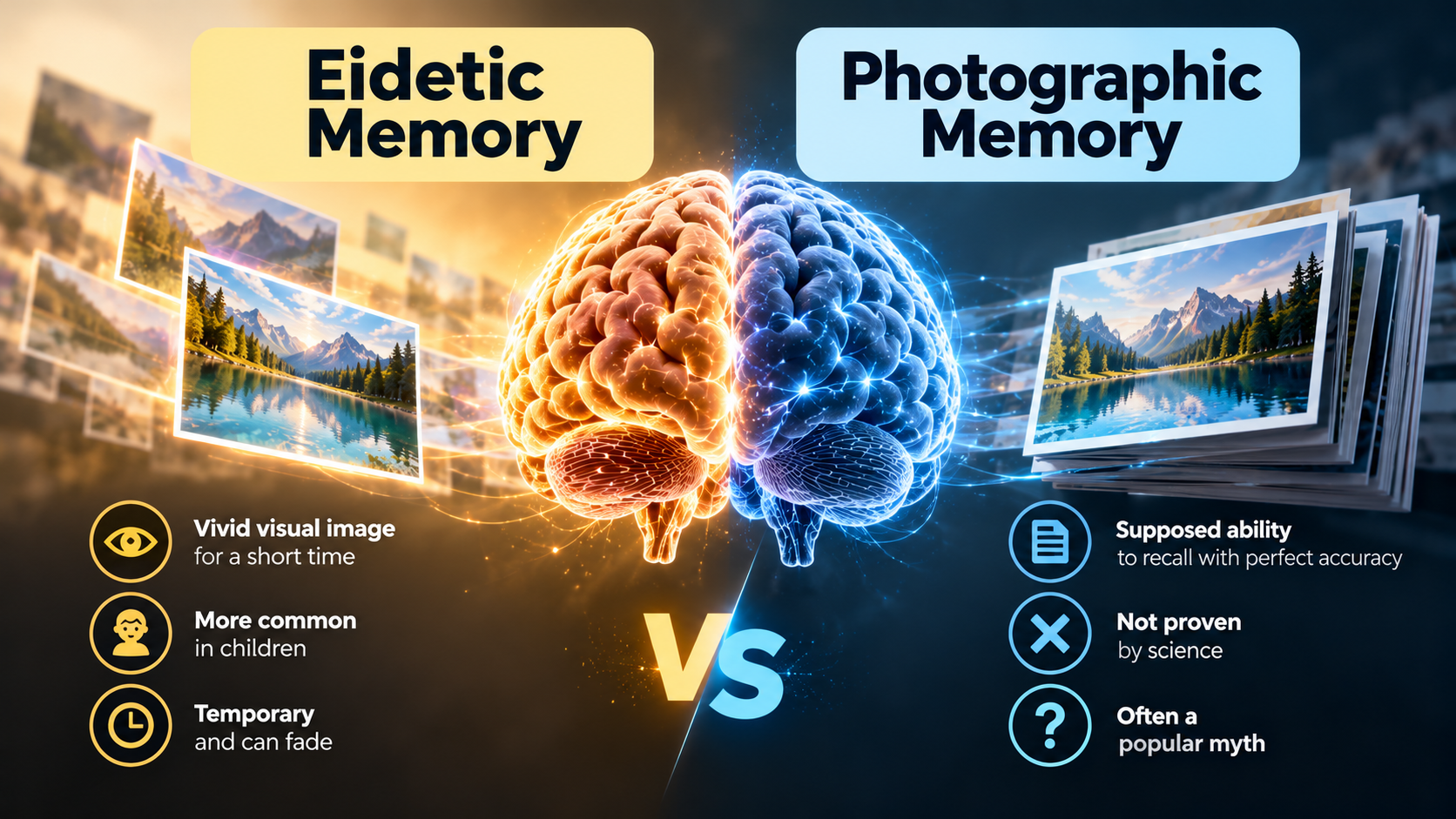
Eidetic imagery refers to the ability to retain a vivid mental image briefly after viewing something. Photographic memory, by contrast, describes the supposed ability to reproduce information with exceptional accuracy. Despite its popularity, photographic memory has not been established as a distinct scientific ability. The American Psychological Association’s Dictionary of Psychology provides further information about eidetic imagery.
Understanding these differences helps separate psychological evidence from popular myths. It also explains why exceptional memory does not necessarily indicate superior intelligence. In this guide, we explore the definitions, scientific evidence, and practical distinctions behind these memory types. We also examine famous fictional examples, rare memory conditions, and the different systems that help the brain store and retrieve information.

Which is better, eidetic memory or photographic memory?
Neither eidetic memory nor photographic memory can be considered inherently better. Their usefulness depends on the type of information someone needs to remember. Eidetic imagery involves retaining a vivid visual representation for a short period after seeing an image. Researchers have documented this phenomenon primarily in children, and it remains relatively uncommon.
Photographic memory describes the supposed ability to reproduce images, pages, or other information with exceptional accuracy. However, scientists have not established photographic memory as a distinct human ability. Understanding eidetic memory vs photographic memory helps separate documented experiences from claims about perfect recall.
In practical terms, strong memory depends on more than visual recall. People benefit from understanding information, recognizing patterns, and retrieving knowledge when needed. These skills often matter more than briefly retaining a mental image.
Therefore, the more useful question is which memory skills support a particular goal. For students, professionals, and researchers, understanding and retrieval generally provide more practical benefits than relying on vivid mental imagery alone.
Scientific Reality Versus Popular Myth
The scientific distinction between eidetic imagery and photographic memory matters when evaluating extraordinary recall claims. Researchers have documented eidetic imagery in some individuals, particularly children. These individuals may report seeing a vivid mental image after the original stimulus disappears. However, this experience does not guarantee perfect accuracy. Details can change, fade, or become distorted during recall.
Photographic memory supposedly allows someone to reproduce information exactly as originally encountered. Despite extensive interest in exceptional memory, scientists have not established this ability as a distinct, reliable human phenomenon.
Memory champions sometimes demonstrate remarkable recall, but they often use deliberate techniques, including visualization, association, and structured mental organization. These methods improve retrieval without requiring a photographic memory.
Understanding this distinction helps separate documented psychological experiences from exaggerated claims. Vivid imagery is not the same as a flawless mental recording, and impressive recall does not prove that someone remembers every detail perfectly.
What memory does Sheldon Cooper have?
Sheldon Cooper, the fictional physicist from The Big Bang Theory, is frequently portrayed as having an extraordinary memory. He often recalls specific facts, conversations, and personal experiences with remarkable detail. His character is sometimes associated with eidetic memory, although the series does not consistently distinguish this ability from other forms of exceptional recall.
In real psychology, eidetic imagery describes a vivid visual experience that can briefly persist after someone stops looking at an image. It does not automatically allow a person to remember every conversation, reproduce entire books, or recall every event from childhood. These abilities involve different aspects of memory.
Sheldon’s portrayal combines impressive factual knowledge, strong recall, and comedic exaggeration. His ability to remember details serves the show’s storytelling rather than providing a scientifically precise example of human memory.
The character therefore illustrates how television can blur the differences between memory, intelligence, and fictional superhuman abilities. While someone may develop excellent recall through learning and practice, there is no evidence that Sheldon’s complete range of abilities represents a single documented memory condition.
What is the rarest type of memory?
There is no universally accepted ranking that identifies one memory type as the rarest. However, highly superior autobiographical memory (HSAM) is an exceptionally uncommon and well-documented condition that attracts considerable scientific interest.
People with HSAM can recall many details about their personal lives and often connect specific dates with events they experienced. For example, they might remember what happened on a particular day years earlier, including associated personal experiences. Their recall can be remarkably detailed, although it is not necessarily perfect across every event or subject.
HSAM differs from eidetic imagery because it primarily concerns autobiographical experiences rather than vivid visual representations. It also differs from photographic memory, which is commonly described as the ability to reproduce information exactly as originally seen.
Researchers study HSAM to understand how personal experiences are encoded, organized, and retrieved. However, this condition does not automatically produce exceptional academic performance, superior reasoning, or comprehensive knowledge. It demonstrates that human memory varies considerably between individuals, while also showing that exceptional recall can have specific characteristics and limitations.
What is a didactic memory?
Didactic memory is not a widely recognized technical category in mainstream cognitive psychology. The word didactic generally refers to teaching, instruction, or educational activities. Some writers use the phrase informally to describe how people remember information they learn through education. However, avoid presenting it as an established memory type without a reliable supporting source.
In education, several factors influence memory, including how people present, understand, practice, and retrieve information. Students may remember material more effectively when they connect new concepts with existing knowledge. Active recall, spaced repetition, and explaining ideas in their own words can also support long-term retention. Students preparing for exams can also explore top memory improvement techniques for exams to strengthen their recall.
These approaches are learning strategies rather than separate neurological abilities. They help learners strengthen their understanding and retrieve information when needed. Learning also involves adapting to mistakes, and understanding how failure can improve learning can help students develop more effective study habits.
If you encounter the term didactic memory in an article or online discussion, examine how the author defines it. The phrase may refer to educational retention rather than a recognized psychological condition. For accurate comparisons, it is better to use established terms such as working memory, semantic memory, episodic memory, and long-term memory.
Is a photographic memory high IQ?
Having an exceptional memory does not automatically mean someone has a high intelligence quotient (IQ). Memory and intelligence are related but distinct cognitive abilities. Memory helps people encode, retain, and retrieve information. Intelligence involves reasoning, problem-solving, pattern recognition, and learning from experience.
Someone may remember large amounts of information yet struggle with unfamiliar problems. Another person may remember fewer facts but excel at analyzing complex situations. These differences show why memory alone cannot measure overall intellectual ability.
People can improve recall through mnemonic techniques, visualization, and structured practice. Memory competitions demonstrate how these methods support impressive results without proving unusually high general intelligence.
IQ tests measure selected cognitive abilities under standardized conditions. They do not simply measure how many facts someone remembers or how vividly someone pictures an image.
Understanding eidetic memory vs photographic memory also helps clarify this distinction. Neither ability, by itself, establishes a person’s IQ. Evaluating intelligence requires broader evidence than exceptional recall alone.
The Difference Between Memorization and Critical Thinking
Memorization and critical thinking serve different purposes, although both contribute to effective learning. Memorization involves retaining information for later recall. Critical thinking involves evaluating evidence, identifying assumptions, comparing explanations, and reaching reasoned conclusions.
For example, a student might memorize scientific definitions accurately but struggle to apply them to an unfamiliar problem. Another student might remember fewer details yet understand the underlying principles well enough to solve new questions.
Both abilities have value. Memorized knowledge provides information for informed decisions. Critical thinking helps people determine how that information applies in different situations.
Effective learning combines both skills. Students can strengthen recall through practice and improve reasoning by explaining concepts, examining evidence, and solving unfamiliar problems.
This distinction explains why exceptional memory does not guarantee exceptional intelligence. Remembering information accurately matters, but understanding its meaning and applying it appropriately matter just as much. Strong recall supports knowledge; critical thinking turns knowledge into useful decisions.
What are the 7 types of memory?
Cognitive psychology describes several memory systems that work together to support learning, everyday activities, and personal experiences. Researchers use several categories to explain how memory works. Seven useful categories include sensory memory, short-term memory, working memory, episodic memory, semantic memory, procedural memory, and autobiographical memory. Psychologists do not universally agree on a list of exactly seven types.
- Sensory memory: Briefly retains incoming sensory information, such as sights and sounds.
- Short-term memory: Holds a limited amount of information for a short period.
- Working memory: Maintains and manipulates information while performing a task, such as mental arithmetic.
- Episodic memory: Stores experiences associated with particular events and contexts.
- Semantic memory: Holds general knowledge, facts, concepts, and word meanings.
- Procedural memory: Supports learned skills and actions, such as riding a bicycle.
- Autobiographical memory: Involves memories of personal experiences and life events.
These categories overlap rather than operating as completely separate systems. For example, remembering a childhood birthday may involve both episodic and autobiographical memory. Understanding how these systems interact provides a more accurate picture of human memory than assuming everyone uses one universal memory ability. Language learning offers another practical example of memory in action; the importance of learning different languages highlights the value of learning and retaining new vocabulary.
FAQ SECTION
Can you train your brain to have an eidetic memory?
No, adults cannot train themselves to develop true eidetic memory because it is primarily a developmental trait seen in children. While adults can improve their general recall using mnemonics and memory palaces, these techniques rely on cognitive strategies rather than innate visual projection. Eidetic imagery naturally disappears as the brain matures, meaning adults must focus on practical memory improvement methods instead of attempting to recreate childhood visual persistence.
Does memory decline naturally as people get older?
Yes, mild memory decline is a normal part of the natural aging process as neural processing speeds slow down. However, significant cognitive decline is not inevitable, and many older adults maintain sharp minds by staying mentally active. Engaging in lifelong learning, solving puzzles, and maintaining social connections help protect brain health over time. Adopting healthy lifestyle habits early in life provides the best defense against age-related memory loss.
Are mnemonics effective for improving everyday recall?
Yes, mnemonic devices are highly effective tools for boosting everyday recall and organizing complex information. By associating new facts with familiar images, acronyms, or structured locations, your brain encodes data much more efficiently. Students and professionals frequently use these techniques to memorize lists, foreign languages, and technical terminology. Consistent practice with mnemonic strategies transforms abstract data into easily retrievable mental packets.
What lifestyle habits support healthy brain function?
Regular physical exercise, balanced nutrition, and adequate sleep are foundational lifestyle habits that directly support healthy brain function. Aerobic exercise increases blood flow to the brain, promoting the growth of new neural connections. Additionally, quality sleep allows the brain to clear metabolic waste and consolidate daily learning experiences. Combining these physical wellness practices with mental stimulation ensures optimal long-term cognitive longevity.
Conclusion
Understanding eidetic memory vs photographic memory helps separate scientific facts from popular myths. Although fictional characters often display extraordinary recall, human memory relies on different systems, including working memory and autobiographical memory.
Photographic memory remains scientifically unproven as a distinct ability. Instead of chasing unrealistic expectations, focus on practical ways to improve learning. Techniques such as mnemonic devices, adequate sleep, and regular practice can support memory and information retention.
Understanding how memory works helps you make informed decisions about personal growth. Use evidence-based learning strategies to strengthen recall, improve understanding, and support long-term learning.