
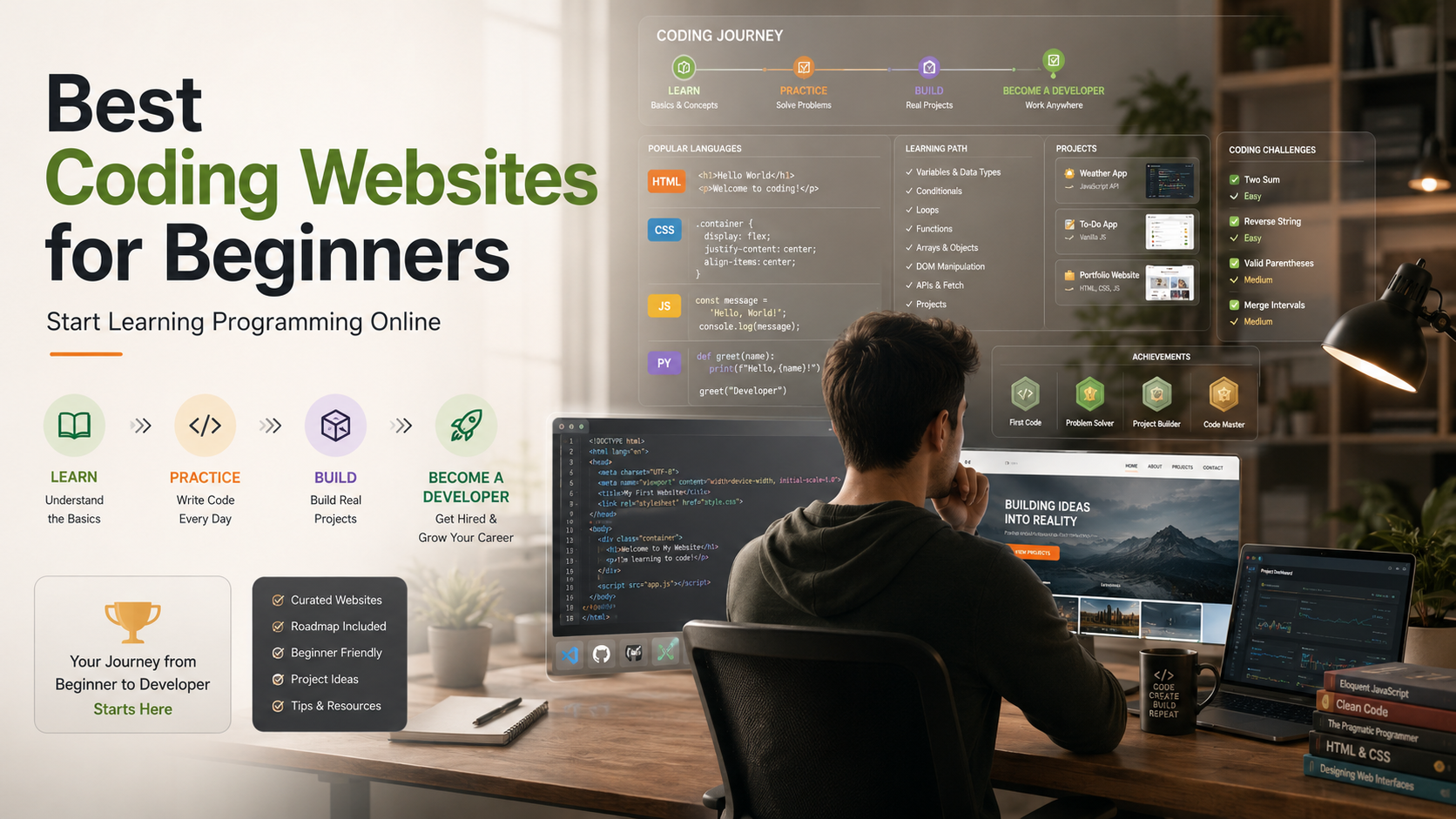
The Best Coding Websites for Beginners: Your Ultimate Guide to Learning Programming Online
Finding the best coding websites for beginners is an important first step for anyone who wants to start learning programming online. Learning how to code may feel challenging at the beginning because programming languages, tools, and technical concepts can seem unfamiliar. However, with the right coding websites for beginners, learners can gradually develop essential skills, understand programming logic, and build confidence through regular practice.
Today, many online coding websites for beginners offer different learning methods, including interactive lessons, video courses, coding challenges, and real-world projects. Therefore, choosing the right platform depends on your goals, learning style, and experience level. Some coding websites focus on teaching basic concepts, while others help learners create professional projects and prepare for technology careers.
Moreover, beginner-friendly coding websites make programming easier by providing structured lessons, practice exercises, and supportive communities. In this guide, we will explore the top coding websites for beginners, compare their features, and explain how each platform can help you start your journey from writing your first line of code to building useful applications.
Top Coding Websites for Beginners
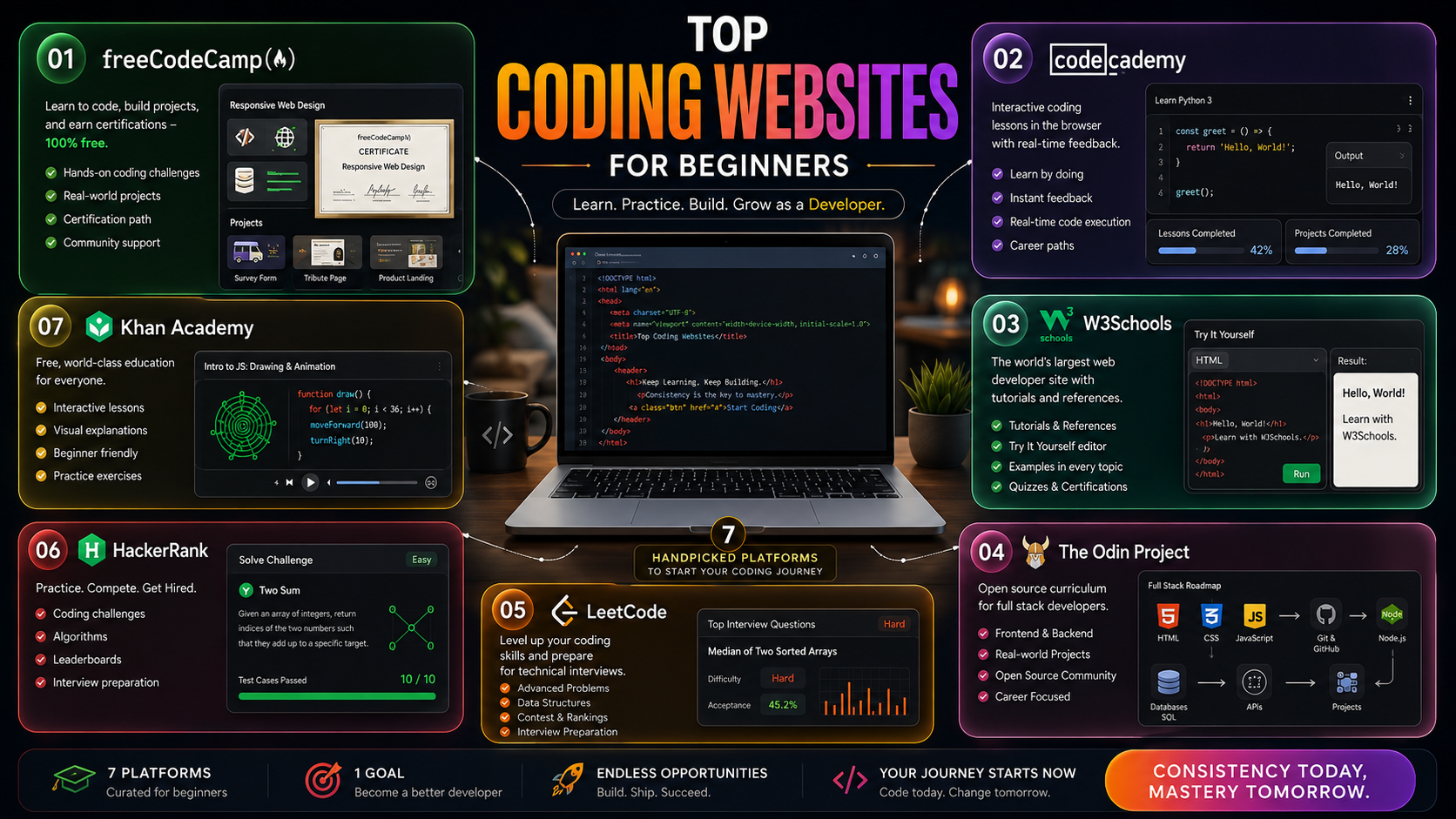
1. FreeCodeCamp — Best for Project-Based Learning
freeCodeCamp is one of the most popular free coding platforms for beginners who want to learn programming through practical experience. Instead of only reading tutorials, students complete coding exercises and build real-world projects that help them understand how software is created. The platform covers important technologies such as HTML, CSS, JavaScript, Python, databases, APIs, and machine learning basics. It also provides certifications after completing different learning paths, which can help learners create a professional portfolio. freeCodeCamp is especially useful for self-taught developers because it provides a complete roadmap from beginner level to advanced topics. The lessons are organized clearly, making it easier for new programmers to follow without feeling overwhelmed.
Why it’s best:
- Completely free learning platform
- Real projects for practical skills
- Certifications for portfolio building
- Covers many programming technologies
- Helpful community support
2. Codecademy — Best for Interactive Learning
Codecademy is a beginner-friendly coding website that teaches programming through interactive lessons directly inside the browser. Users can read explanations, write code, and immediately see the results without installing complicated software. This makes it an excellent choice for people who are starting programming for the first time. Codecademy offers courses in web development, Python, Java, JavaScript, SQL, data science, and many other technical areas. The platform breaks large topics into smaller lessons, helping learners understand programming concepts step by step. Beginners can practice coding regularly and build confidence before moving into more advanced projects. It also offers career-focused paths that guide students toward specific goals such as becoming a web developer or data analyst.
Why it’s best:
- Easy-to-use coding environment
- Interactive exercises
- Beginner-friendly courses
- Career learning paths
- Immediate practice and feedback
3. W3Schools — Best for Quick Learning and Reference
W3Schools is a simple and widely used learning website for beginners who want quick explanations of programming concepts. It provides tutorials and examples for HTML, CSS, JavaScript, Python, SQL, Java, PHP, and many other technologies. The website is designed with simplicity in mind, making it easy for new learners to understand coding basics without complicated theory. One of its strongest features is the “Try It Yourself” editor, where users can test code directly in their browser. Many developers use W3Schools as a reference tool while working on projects because it provides quick syntax examples and explanations. It is especially useful when you forget a command or need a simple explanation of a programming concept.
Why it’s best:
- Very simple explanations
- Large collection of tutorials
- Built-in code testing
- Great for beginners
- Useful as a coding reference
4. The Odin Project — Best for Becoming a Web Developer
The Odin Project is a free learning platform designed to help beginners become professional web developers. It provides a complete curriculum that teaches both frontend and backend development skills. Instead of focusing only on theory, the platform encourages students to build real websites and applications. Learners study important tools such as HTML, CSS, JavaScript, Git, databases, and server-side programming. The course structure follows a clear roadmap, allowing beginners to progress from basic concepts to advanced development topics. The Odin Project is especially valuable because it teaches practical skills that developers use in real jobs. Students also learn how to research problems, read documentation, and work like professional programmers.
Why it’s best:
- Free full-stack curriculum
- Real-world projects
- Professional development approach
- Teaches modern developer tools
- Strong learning community
5. HackerRank — Best for Coding Practice
HackerRank is a platform focused on improving programming skills through coding challenges and problem-solving exercises. It helps beginners develop logical thinking and understand how programmers approach technical problems. The website includes challenges related to algorithms, data structures, Python, Java, SQL, and other programming languages. Users can practice problems at different difficulty levels, starting from simple exercises and gradually moving to advanced challenges. HackerRank is also commonly used by companies during technical hiring tests, making it useful for students preparing for programming interviews. Regular practice on this platform helps learners become faster and more confident at writing code.
Why it’s best:
- Improves problem-solving skills
- Coding practice for many languages
- Useful for interviews
- Different difficulty levels
- Competitive programming experience
6. LeetCode — Best for Interview Preparation
LeetCode is one of the most popular coding practice websites used by programmers around the world. It provides thousands of programming problems that focus on algorithms and data structures. Although many experienced developers use it for technical interviews, beginners can also start with easier problems to improve their coding logic. The platform helps learners understand how to write efficient and optimized solutions. Practicing on LeetCode teaches important concepts such as arrays, strings, searching, sorting, recursion, and problem-solving techniques. It is especially helpful for students who want to prepare for software engineering jobs at technology companies.
Why it’s best:
- Large problem collection
- Builds strong coding logic
- Interview preparation
- Improves algorithm knowledge
- Used by professional developers
7. Khan Academy — Best for Visual Learning
Khan Academy is a free educational platform that teaches programming through simple explanations and interactive lessons. It is ideal for beginners who prefer learning concepts visually instead of reading only technical documentation. The platform provides courses in HTML, CSS, JavaScript, and computer science fundamentals. Students can practice coding through interactive exercises and understand how programming works step by step. Khan Academy focuses on making difficult topics easier by explaining them in a beginner-friendly way. It is a good starting point for students who want to build a strong foundation before moving to more advanced programming platforms.
Why it’s best:
- Free educational content
- Visual explanations
- Beginner-friendly approach
- Interactive coding exercises
- Strong foundation building
Key Features to Look For in a Beginner Programming Platform
Choosing the right beginner programming platform is an important step because the learning environment can strongly affect your progress. A good coding website should not only teach programming concepts but also make learning simple, practical, and enjoyable. Therefore, beginners should look for platforms that provide useful tools, clear guidance, and strong support while learning how to code.
1. An Intuitive Code Editor
One of the most important features of a beginner-friendly coding platform is an easy-to-use code editor. When starting programming, setting up tools like code editors, Git, command-line terminals, and development environments can feel confusing. As a result, many beginners lose focus before they even start writing code. A good platform removes this difficulty by allowing users to write, run, and test code directly in the browser. Furthermore, a simple code editor helps learners focus on understanding programming logic instead of dealing with technical setup problems. Features such as automatic suggestions, error messages, and instant results can make the learning process smoother. Therefore, an intuitive code editor helps beginners build confidence and learn faster.
2. Active Community Forums and Support
Learning to code involves making mistakes, facing errors, and solving difficult problems. In fact, every developer experiences challenges while programming. Therefore, having access to an active community is extremely valuable for beginners. Good coding platforms often provide discussion forums, chat groups, or community spaces where learners can ask questions and share solutions. Additionally, these communities allow beginners to search previous discussions and find answers to common problems. Support from other learners and experienced programmers can make difficult topics easier to understand. Moreover, being part of a coding community keeps learners motivated and prevents them from feeling stuck during their journey.
3. Clear Progress Tracking and Flexible Learning Paths
A strong beginner programming platform should provide clear progress tracking features. When learners can see their achievements, completed lessons, and upcoming goals, they are more likely to stay motivated. For example, progress bars, achievement badges, and structured courses help users understand how far they have advanced. However, a good platform should also provide flexibility instead of forcing every learner to follow the exact same path. Beginners often need to review older topics or explore different subjects based on their interests. Therefore, platforms with flexible learning paths allow students to learn at their own speed. This approach creates a more comfortable and effective learning experience.
4. Practical Projects and Real-World Practice
Another essential feature of a good coding platform is the ability to work on practical projects. Learning programming only through theory is not enough because developers need hands-on experience. Therefore, beginner platforms should include exercises and projects that simulate real-world tasks. Building websites, applications, or small programs helps learners understand how coding is used outside tutorials. Additionally, completed projects can become part of a portfolio that demonstrates skills to employers. As a result, project-based learning prepares beginners for future development work.
5. Beginner-Friendly Explanations
Finally, a quality programming platform should explain concepts clearly and avoid unnecessary complexity. Beginners need simple examples, step-by-step instructions, and understandable explanations before moving to advanced topics. Furthermore, good platforms introduce difficult ideas gradually so learners do not feel overwhelmed. A supportive learning environment helps students develop confidence and continue improving over time.
By choosing a platform with these important features, beginners can create a strong foundation and make their programming journey more successful.
Frequently Asked Questions About Coding Websites for Beginners
What are the best coding websites for beginners?
The best coding websites for beginners depend on your learning style, goals, and the type of programming skills you want to develop. Generally, platforms like FreeCodeCamp, Codecademy, W3Schools, Coursera, and The Odin Project are considered excellent choices for new learners. For example, FreeCodeCamp is perfect for students who prefer learning through real projects, while Codecademy provides interactive lessons that allow beginners to practice coding directly in their browser. Similarly, W3Schools works well as a quick reference guide because it explains programming concepts in a simple way. Additionally, Coursera and edX are useful for learners who want structured courses from universities. Therefore, beginners should choose a platform that matches their preferred learning method. Most importantly, practicing consistently and building small projects will help you improve faster than only watching tutorials.
Can I learn coding for free online?
Yes, you can learn coding completely free online by using many high-quality educational platforms available today. In fact, thousands of beginners start their programming journey without spending money on expensive courses. Websites such as FreeCodeCamp, W3Schools, Khan Academy, and The Odin Project provide free lessons, exercises, and project-based learning materials. Furthermore, many experienced developers have successfully learned programming through self-study using online resources. Free coding websites allow learners to study important technologies such as HTML, CSS, JavaScript, Python, databases, and web development. However, while free resources are enough to build strong skills, paid courses may offer additional benefits like mentorship, certificates, or career guidance. Therefore, the key to success is not the price of the course but your dedication, practice routine, and willingness to solve real programming problems.
Which programming language should a beginner learn first?
Choosing the first programming language depends on your goals, but Python and JavaScript are commonly recommended for beginners. Python is often considered one of the easiest languages because its syntax is simple, clean, and close to everyday English. As a result, beginners can focus on understanding programming logic instead of struggling with complicated code structures. Python is widely used in areas such as automation, artificial intelligence, data science, and software development. On the other hand, JavaScript is an excellent choice for anyone interested in web development because it helps create interactive websites and applications. Additionally, JavaScript works together with HTML and CSS to build modern websites. Therefore, both languages provide strong foundations. After learning one programming language, moving to others becomes much easier because many core concepts remain the same.
How long does it take to learn coding?
The time required to learn coding depends on your learning speed, practice schedule, and the level of programming knowledge you want to achieve. Generally, beginners can understand basic coding concepts within three to six months if they practice regularly. During this period, students can learn programming fundamentals, create simple projects, and understand how websites or applications work. However, becoming job-ready usually requires more time because professional development involves advanced topics, debugging, teamwork, and real-world experience. Furthermore, consistent daily practice is usually more effective than studying for many hours occasionally. For example, spending one hour coding every day can create better progress than studying only once a week. Therefore, beginners should focus on steady improvement, building projects, and solving programming challenges instead of rushing through lessons.
Do I need a powerful computer to learn how to code?
No, beginners do not need an expensive or powerful computer to start learning programming. In fact, many coding websites allow students to write and test code directly in a web browser, which means a basic laptop or desktop computer is usually enough. Platforms such as freeCodeCamp, Codecademy, and W3Schools provide online coding environments where beginners can practice without installing complicated software. Additionally, many programming tasks such as web development, basic Python projects, and coding exercises require very little computer power. However, if you later move into advanced fields like game development, video processing, or machine learning, a stronger computer may become useful. Therefore, beginners should focus more on learning skills and practicing regularly rather than worrying about having expensive equipment at the start of their coding journey.
Are coding websites enough to become a professional developer?
Yes, coding websites can provide a strong foundation for becoming a professional developer, especially when combined with consistent practice and real-world projects. These platforms teach important programming concepts, problem-solving skills, and development techniques that beginners need to start their journey. For example, websites like freeCodeCamp, The Odin Project, and Codecademy help learners understand web development, programming languages, and software tools step by step. However, learning from websites alone may not be enough if you do not practice outside the lessons. Therefore, beginners should also create personal projects, contribute to open-source work, and build a portfolio to demonstrate their abilities. Additionally, learning how to read documentation, debug errors, and search for solutions is essential because professional developers use these skills every day. In conclusion, coding websites are valuable learning resources, but your progress depends on how consistently you apply what you learn.
Conclusion
Choosing the right coding websites for beginners is one of the most important decisions when starting a programming journey. The right platform can make learning easier, more enjoyable, and more organized by providing clear lessons, practical exercises, and helpful resources. Furthermore, beginners should remember that programming is a skill developed through regular practice rather than something learned overnight. Platforms such as freeCodeCamp, Codecademy, W3Schools, Coursera, and The Odin Project each offer unique advantages for different types of learners.
Moreover, the best way to improve is to combine learning with action. Instead of only watching tutorials, beginners should write code, complete challenges, and build small projects regularly. Over time, these activities improve confidence, problem-solving ability, and technical knowledge. Additionally, learning programming requires patience because mistakes and errors are a normal part of the process. Therefore, choose a platform that matches your goals, stay consistent, and continue practicing. With dedication and the right resources, anyone can develop coding skills and move toward becoming a successful developer.
With dedication and the right resources, anyone can develop coding skills and move toward becoming a successful developer. If you want to continue your journey and learn more about building a career in web development, check out our detailed guide on how to become a web developer in 2026.