

Career Options After High School: A Complete Beginner’s Guide
Finishing your secondary education is a massive milestone, but it often brings a wave of anxiety about the future. You stand at a major crossroads, facing a dizzying array of paths, choices, and opinions. Exploring the best career options after high school allows you to align your personal passions with sustainable economic opportunities. Data published by the U.S. Bureau of Labor Statistics highlights that mapping out your post-graduation strategy early drastically improves your long-term earning potential. Whether you want to jump straight into the workforce or pursue higher education, understanding your choices ensures you make an informed decision.
This guide explains the main paths available to recent graduates. We will explore university degrees, skilled trades, gap years, and direct entry into the workforce. Each option has its own benefits and drawbacks. If you are considering higher education, our guide on top courses for science students can help you explore popular academic options and career opportunities.
By comparing these routes, you can identify the path that best matches your lifestyle, strengths, and financial goals. Careful planning now can help you avoid costly mistakes later. It also provides a stronger foundation for adulthood.
Exploring Traditional Higher Education
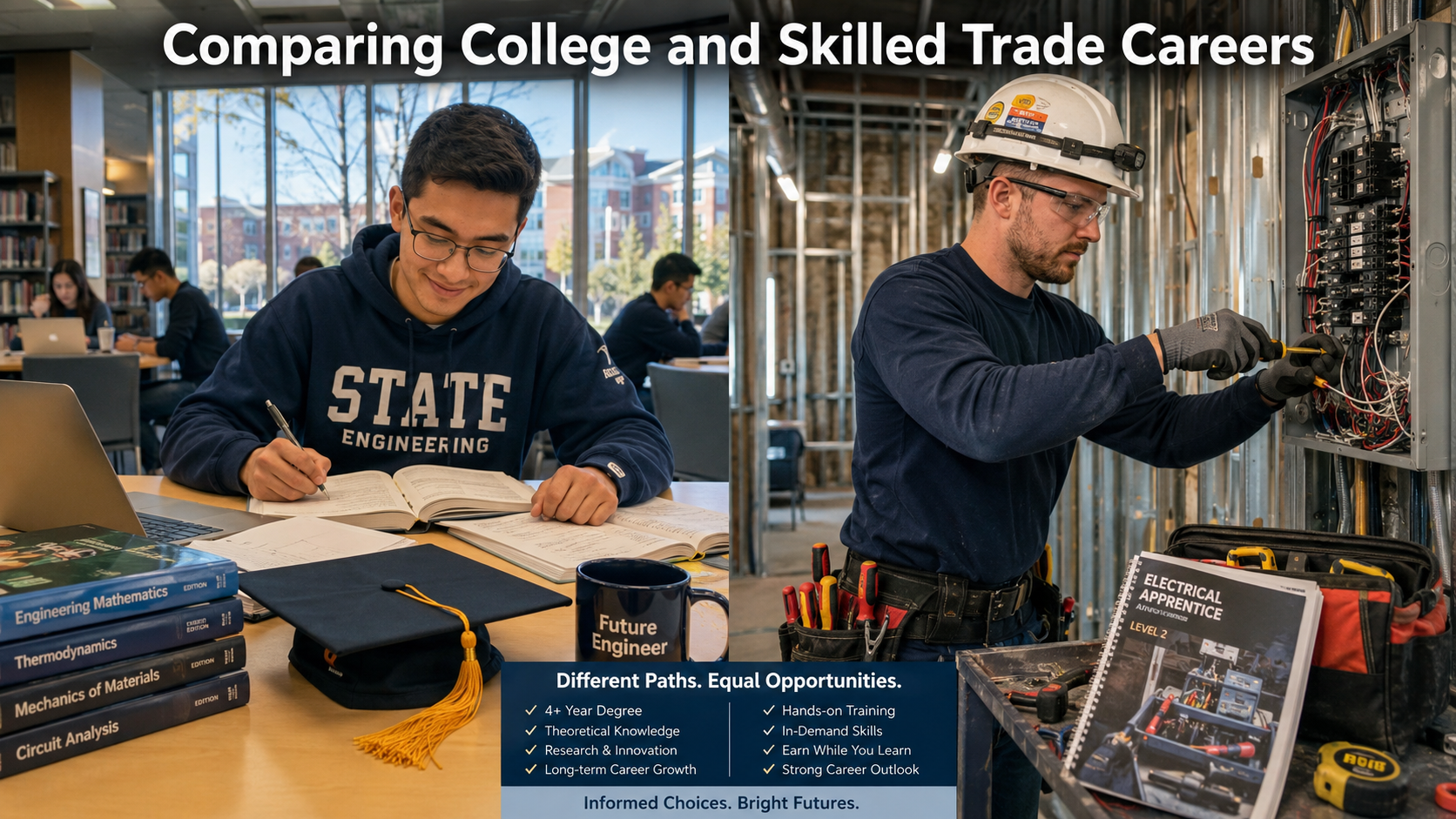
For decades, attending a four-year college or university has been the standard recommendation for high school graduates. This path remains highly relevant today, especially for fields that require specialized academic credentials. Higher education offers a structured environment where you can develop critical thinking skills, expand your worldview, and build a powerful professional network that will serve you throughout your working life. While alternative paths are growing in popularity, earning a college degree still commands a significant wage premium in many highly competitive industries.
Pursuing a Four-Year Bachelor’s Degree
A bachelor’s degree opens doors to professions in corporate business, engineering, healthcare, and technology. Beyond the classroom, universities offer networking opportunities, internships, and campus resources that help shape your career. However, tuition costs have risen significantly, making it vital to calculate your potential return on investment (ROI) before committing to student loans. You must carefully research the job placement rates and average starting salaries for your chosen major. Many students find that fields like computer science or nursing offer an immediate financial return that justifies the initial debt. Ultimately, a four-year degree requires a major investment of time and money, but it remains a primary gateway to upper-management roles and specialized professional sectors worldwide.
Benefits of a Community College or Associate Degree
If you want to save money while keeping your academic options open, community colleges are an excellent alternative. An associate degree takes only two years to complete and prepares you for specialized roles like dental hygienist, web developer, or paralegal. These positions often offer excellent starting salaries without the burden of heavy student debt. Additionally, many community colleges maintain articulation agreements with four-year universities, allowing you to transfer your credits seamlessly later on. This “two-plus-two” strategy lets you graduate with a traditional bachelor’s degree at a fraction of the total cost. It provides a flexible safety net for students who need more time to decide on a specific major while steadily earning college credits.
The Rise of Skilled Trades and Vocational Training
Not every lucrative career requires a traditional degree. Vocational schools and trade programs offer a faster, more affordable path to stable employment. These programs focus entirely on hands-on technical skills, allowing you to bypass general education requirements like art history or literature. As the current workforce ages, a massive wave of retirements is creating an urgent need for younger, qualified technicians across the country.
High-Paying Alternatives to a College Degree
Skilled trades are currently facing a massive labor shortage, which drives up wages for qualified individuals. Programs in these fields focus purely on practical, hands-on training, allowing you to skip general education classes. Because these jobs cannot be outsourced or easily automated, they offer incredible long-term job security. Many specialized technicians eventually transition into business ownership, launching their own successful contracting companies and boosting their earnings even further.
-
Electricians: Install, maintain, and repair electrical systems in residential, commercial, and industrial buildings safely.
-
HVAC Technicians: Fix heating, ventilation, and cooling systems, a vital service that remains in high demand across all climates.
-
Plumbers: Install and repair water supply lines, drainage systems, and waste disposal units in various properties.
The Benefits of Registered Apprenticeships
Apprenticeships offer a unique “earn while you learn” model that completely eliminates the need for student loans. Instead of paying tuition, you receive a paycheck from day one while working under the supervision of an experienced mentor. The Organisation for Economic Co-operation and Development (OECD) notes that countries utilizing robust apprenticeship systems experience significantly lower youth unemployment rates. As you master new skills and hit training milestones, your hourly wages automatically increase according to a structured schedule. By the time your peers graduate from a four-year university with thousands of dollars in debt, you could be a fully licensed journeyman with years of paid work experience and zero academic liability.
Entering the Workforce Directly
If you are eager to start earning money immediately and want to avoid student debt entirely, entering the job market right after graduation is a highly practical choice. This pathway allows you to achieve financial independence quickly and start building a real-world resume.
Entry-Level Jobs with Growth Potential
Many industries value work ethic, reliability, and on-the-job performance far more than formal degrees. Starting at the bottom allows you to learn how a business operates from the ground up, creating a natural pathway for internal promotions. Companies frequently promote dedicated entry-level workers into supervisory and managerial positions because they already understand the daily operations.
Career Growth Examples Across Different Industries
- Tech and Sales: Many professionals start as Customer Success Representatives. With experience and strong performance, they can advance to roles such as Account Executive.
- Logistics: A common entry point is working as a Warehouse Associate. Over time, employees can move into leadership positions, including Operations Manager.
- Hospitality: Entry-level workers often begin as Front Desk Agents. With industry knowledge and management experience, they may eventually become Hotel General Managers.
Building Essential Skills on the Job
Direct work experience teaches you critical transferable skills, such as time management, teamwork, project coordination, and conflict resolution. Employers highly prize these capabilities across all sectors, making you incredibly marketable as your career progresses. Furthermore, many modern companies offer tuition reimbursement programs, meaning they will pay for your college degree or certifications while you work for them. This corporate benefit allows you to gain a debt-free education while keeping a steady stream of income. Entering the workforce immediately does not close the door on education; instead, it often provides a more practical, employer-funded path toward it.
Venturing into Entrepreneurship and the Gig Economy
The modern digital landscape has made it easier than ever for young adults to launch their own businesses or work independently. The traditional nine-to-five corporate model is no longer the only way to build a stable, prosperous career.
Starting a Digital Business
If you possess digital skills like graphic design, video editing, social media management, or coding, you can start freelancing immediately. Platforms like Upwork and Fiverr allow you to connect with global clients right from your bedroom without any upfront capital. While building a business requires immense self-discipline and carries financial risk, it provides unmatched freedom and unlimited earning potential. You act as your own boss, set your own working hours, and directly reap the financial rewards of your hard work. Success in the gig economy depends on your ability to market your services, deliver high-quality work on time, and communicate professionally with clients.
Obtaining Professional Certifications
Short-term professional certificates are rapidly reshaping the job market by offering direct pathways into highly technical roles. Tech giants like Google, Microsoft, and AWS offer specialized training programs in data analytics, cybersecurity, and cloud computing. These certifications take only a few months to complete and can quickly qualify you for entry-level tech roles that pay competitive salaries. Employers increasingly favor skills-based hiring over traditional degrees, making these certificates highly valuable on a resume. By focusing your energy on a specific, high-demand digital skill, you can bypass years of generalized schooling and jump straight into a lucrative modern career track.
FAQs
What are the highest-paying career options after high school without a degree?
The highest-paying options usually lie within the skilled trades, commercial transportation, and specialized services. Air traffic controllers, commercial pilots, and nuclear medicine technologists can earn impressive salaries without a traditional four-year degree, though they do require specific technical certifications or licenses. Additionally, elevator mechanics, web developers, and experienced sales representatives frequently earn wages well above the national median.
Success in these fields depends heavily on technical expertise, spatial awareness, and strong communication skills, proving that specialized knowledge is highly rewarded in the modern economy. For example, elevator mechanics undergo rigorous technical apprenticeships to manage complex vertical transport systems, commanding top-tier blue-collar salaries. Web developers can showcase mastery through complex coding portfolios rather than academic credentials, landing high-paying software roles. Sales professionals with high emotional intelligence can quickly out-earn university graduates through performance-based commission structures. Ultimately, shifting focus toward niche trade certifications or industry-recognized licenses allows you to build an affluent lifestyle straight out of secondary school while preserving your financial freedom.
How do I choose the right path if I am completely undecided?
If you feel overwhelmed by the many career options after high school, start with a self-assessment. Consider your strengths, interests, and values. Think about activities you enjoy and subjects that hold your attention.
Next, explore different career options after high school by speaking with professionals. Informational interviews can provide valuable insights. You can also shadow someone at work or apply for an internship. These experiences help you understand whether a career matches your expectations.
Career assessments can also help narrow down your choices. Many tools connect your skills and personality traits to suitable career options after high school. While no test can make the decision for you, the results may highlight paths you had not considered. Do not pressure yourself to choose a lifelong career immediately. Instead, test different career options after high school through short courses, volunteer work, or part-time jobs. Real-world experience often provides better answers than endless research. The best way to evaluate career options after high school is through action. Each experience teaches you what you enjoy and what you want to avoid. Over time, these lessons will help you make a confident and informed decision.
Are trade schools objectively better than traditional colleges?
Neither option is inherently superior; the best choice depends entirely on your unique career goals, learning style, and financial situation. Trade schools offer accelerated, highly focused programs that lead directly to specific, stable jobs with minimal debt. On the other hand, traditional universities provide a broader education, foster critical thinking skills, and are mandatory for professions like law, medicine, and corporate management. If you prefer hands-on, practical work and want to enter the workforce quickly, a trade school is excellent. If you enjoy academic research and want a traditional campus experience, college is ideal.
Furthermore, trade programs take anywhere from six months to two years, meaning you begin generating income much faster than university students. This drastically cuts down on accrued interest from student loans and positions you favorably within local labor markets facing critical service shortages. However, universities provide a broader liberal arts foundation that simplifies pivoting into executive management later in life. Weigh your current patience for lecture-based learning against your desire for tactile training to determine your perfect choice.
Can I change my career path later if I make the wrong choice now?
Absolutely. Your first decision after high school does not lock you into a specific career for life. The modern job market is flexible. Thousands of adults successfully switch to new industries every year.
The skills you develop in your first jobs can transfer to many other careers. These skills include problem-solving, digital literacy, project coordination, and leadership. Think of your early twenties as a period of learning and exploration. It is a time to gain experience, not make a permanent commitment.
Online learning has made career changes easier than ever. Professional certificates and short courses allow people to build new skills while working full-time. For example, an automotive mechanic can study data analytics in the evenings. Later, they may move into an operations role in a logistics company.
Career paths are rarely fixed. Choosing one direction now does not stop you from exploring different opportunities later. As your interests change, your career can change too.
What is a gap year, and should I consider taking one?
A gap year is a structured break taken between graduating high school and entering college or the workforce. During this time, individuals focus on personal growth, travel, volunteer work, or temporary employment. A gap year is highly beneficial if you feel burned out from academic pressure or need time to figure out your goals. However, a gap year must be carefully planned and purposeful rather than just an excuse to do nothing. Using this time to volunteer abroad or complete a short internship can greatly enhance your resume and give you a clearer perspective.
Moreover, many elite universities and modern employers look incredibly favorably upon candidates who have successfully completed a structured gap year. This intentional pause demonstrates emotional maturity, independence, and a proactive approach to self-discovery. You can spend the year testing out various entry-level freelance gigs, learning a foreign language, or saving capital through local retail work. If approached with strict discipline and clear milestones, this experience provides immense mental clarity, allowing you to return to your chosen professional track with renewed drive and sharp direction.
Conclusion
Choosing among the various career options after high school is a personal journey that requires balancing your passions with economic realities. There is no single “correct” path to long-term professional success. Whether you choose the academic rigor of a university, the practical security of a skilled trade, or the immediate independence of the workforce, your dedication determines your outcome. Focus on building transferable skills, cultivating a professional network, and remaining adaptable to changing industry trends.
Take the time to research your choices, trust your instincts, and confidently step into the next exciting chapter of your life. Remember that your career path is a marathon, not a sprint, and every experience helps you grow. By remaining open to learning and adapting to new opportunities, you will naturally build a rewarding and financially stable life.