
Build Your Child’s Vocabulary Naturally: 5 Easy Routines
Every parent wants to give their child a strong start in communication. You can build your child’s vocabulary naturally without flashcards, stressful drills, or rigid study schedules. Language develops through ordinary, enjoyable moments at home. Research from the National Institute on Deafness and Other Communication Disorders highlights the importance of early language exposure and responsive communication.
When you talk during everyday activities, children learn words through meaningful context. They connect new vocabulary with familiar people, objects, actions, sounds, and experiences. This makes language easier to understand and remember.
This guide explores simple ways to support early vocabulary development at home. You will learn how to introduce useful words during daily routines, expand your child’s vocabulary, and use a simple framework for language learning.
You will also discover practical ways to support language processing and long-term word retention. Small changes during meals, playtime, morning routines, and bedtime reading can create valuable learning opportunities.
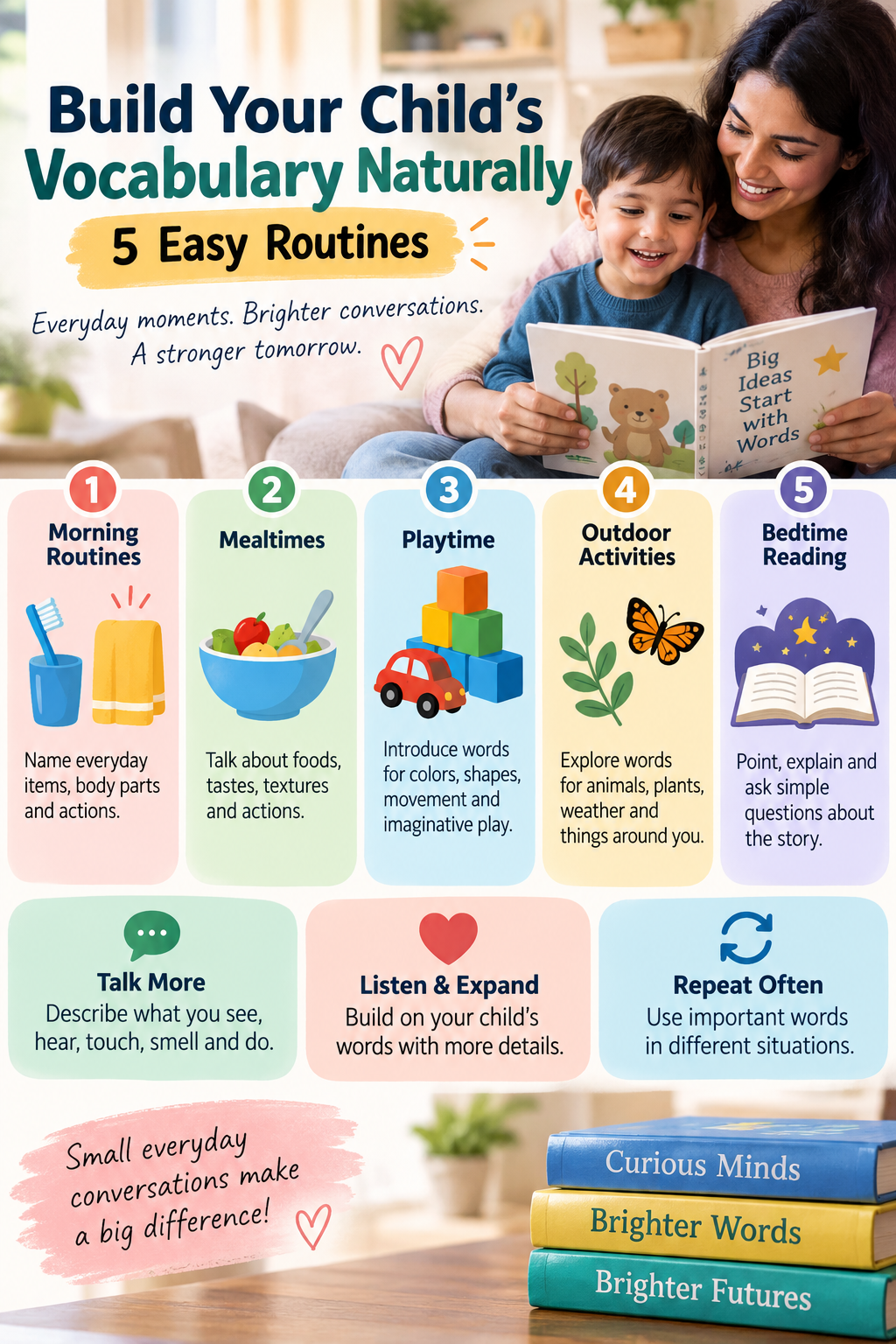
Try using these routines throughout the day:
- Morning routines: Name clothing, body parts, actions, and household objects.
- Mealtimes: Describe foods, textures, tastes, sizes, and actions such as pour, cut, and eat.
- Playtime: Introduce words that describe movement, colors, shapes, sounds, and pretend-play actions.
- Outdoor activities: Talk about animals, plants, weather, vehicles, and things your child notices.
- Bedtime reading: Point to pictures, explain unfamiliar words, and ask simple questions about the story.
Repeat important words in different situations. This helps children understand that words can describe many related experiences. You can also make bedtime routines a consistent opportunity for language learning through conversation and reading.
Most importantly, follow your child’s interests. When a child is engaged, natural conversation becomes easier and more meaningful. You do not need to turn every interaction into a lesson. Consistent, responsive conversation can make vocabulary growth part of normal family life.
How to build a child’s vocabulary?
To build your child’s vocabulary naturally, weave rich language into everyday activities. Talk about your surroundings and describe what you are doing. Ask open-ended questions that encourage more than one-word answers. You can also use fun English games at home to encourage children to practice new words naturally. Instead of using only simple terms, introduce advanced words alongside familiar ones.
For example, describe objects with precise words while cooking, cleaning, or getting dressed. Explain what you see, hear, touch, smell, and feel. This helps children connect new vocabulary with real experiences.
Practice active listening by responding to your child’s ideas. Expand their short phrases into complete sentences. If your child says, “Big dog,” you might say, “Yes, that is a large, fluffy dog.”
Read different picture books together every day. Pause to discuss unfamiliar words, characters, and ideas. Ask your child to predict what might happen next. Encouraging independent learning habits can also help children become more confident in exploring words and ideas on their own.
Children develop vocabulary best through meaningful, repeated conversations. Daily interaction and shared reading make new words easier to understand and remember.
Use the Narrative Expansion Strategy
The narrative expansion strategy helps children learn new words through natural conversation. Start with something your child says, then expand it with descriptive language.
If your child points to a truck, respond with, “Yes, that is a large yellow bulldozer clearing heavy rubble.” Your response introduces adjectives, action verbs, and sentence patterns without turning the moment into a formal lesson.
You can use this strategy during play, outdoor walks, meals, or household activities. Listen carefully to what your child says. Then add one or two useful details to their statement.
For example, if your child says, “Bird flying,” you could respond, “The small blue bird is flying across the bright morning sky.”
This approach exposes children to new vocabulary in meaningful contexts. They hear how words fit naturally into complete sentences.
Avoid correcting every mistake. Instead, model the correct form naturally and keep the conversation moving.
What are some examples of daily routine vocabulary for kids?
Daily routines provide countless opportunities to teach useful vocabulary. Children encounter the same objects, actions, and sequences repeatedly. This repetition makes everyday activities ideal for building vocabulary naturally. A calm home environment can make these everyday conversations more comfortable and consistent.
Morning routines can introduce action verbs such as stretch, rinse, scrub, button, and comb. Household nouns can include towel, toothbrush, wardrobe, mirror, and slippers.
Mealtimes provide opportunities to describe food, textures, temperatures, and actions. Try words such as crunchy, steaming, lukewarm, swallow, sprinkle, and utensils.
Transition periods can introduce sequence words. Use terms such as first, next, afterward, meanwhile, and finally. Bedtime can reinforce words like dim, snuggle, whisper, cozy, and drowsy.
Whenever possible, connect words with real actions. Let your child see, touch, hear, or perform what you are describing.
Repeating vocabulary during familiar routines strengthens comprehension. Children gradually begin using these words independently as they hear them in meaningful situations.
Anchor Sequence Words During Transitions
Sequence words help children understand order and develop stronger language skills. Use them during transitions between familiar activities.
Words such as initially, next, afterward, and eventually help children understand when things happen. These terms also prepare children for more complex storytelling and explanations.
For example, say, “First we wash our hands, next we prepare the plates, and finally we eat.” Repeat similar patterns throughout the day.
You can also encourage your child to describe the sequence. Ask, “What do we do first?” Then follow with, “What happens next?” These simple questions encourage active vocabulary use.
Use sequence words while getting ready for school, preparing meals, cleaning toys, or following a bedtime routine. Repeated exposure makes abstract concepts easier to understand.
The key is consistency. Children learn these terms more effectively when they hear them during real situations.
Over time, your child may begin using sequence words while explaining events. This supports vocabulary development, comprehension, and early storytelling skills.
What are 20 vocabulary words?
Here are 20 practical vocabulary words grouped into four everyday categories:
- Emotions: furious, anxious, delighted, exhausted, sympathetic
- Sensory details: fragrant, prickly, scorching, lukewarm, vibrant
- Actions: investigate, scatter, scamper, hesitate, assemble
- Descriptive adjectives: gigantic, fragile, ancient, peculiar, sturdy
These words can help expand your child’s vocabulary beyond basic terms. Instead of always saying “happy,” your child can learn to describe feeling delighted. Instead of “hot,” they can understand words such as scorching or lukewarm.
Introduce these terms through real experiences. Use “fragrant” while smelling flowers or food. Try “prickly” when describing a safe plant or textured object. Use “fragile” when handling something that can break.
Do not expect your child to remember every word immediately. Repeated exposure matters more than memorizing long lists.
Use new vocabulary during conversations, stories, games, and outdoor activities. Encourage your child to describe what they notice.
Precise words help children communicate feelings, observations, and experiences more clearly. They can also reduce frustration when basic words do not fully express an idea.
What are the 7 steps of vocabulary strategy?
A seven-step vocabulary strategy gives children a simple framework for learning new words. It combines explanation, visual support, active use, and repeated review.
- Introduce the word clearly within a natural sentence or situation.
- Explain its meaning using simple, child-friendly language.
- Create a visual connection with a picture, object, demonstration, or gesture.
- Encourage thinking by asking questions about the word and its meaning.
- Have your child say the word aloud to practice pronunciation.
- Encourage personal use by asking your child to create a sentence.
- Review the word repeatedly through conversation, stories, games, and daily activities.
For example, when teaching “fragile,” show your child a safe breakable object. Explain that fragile means something can break easily. Ask what other objects might be fragile.
Then encourage your child to use the word in a sentence. Revisit it later during another activity.
This process turns vocabulary learning into active language practice rather than simple memorization.
What are four types of vocabulary?
The four main types of vocabulary are listening, speaking, reading, and writing vocabulary. Each type describes how children understand or use words in different language situations.
Listening vocabulary includes words a child understands when hearing other people speak. This area often develops early through everyday conversations, stories, and instructions.
Speaking vocabulary includes words a child can actively use during conversations. Children usually understand more words than they can comfortably say.
Reading vocabulary includes words children recognize and understand when they encounter printed text. It becomes increasingly important as children develop reading skills.
Writing vocabulary includes words children can retrieve and use when expressing ideas in written form. It also involves spelling and selecting appropriate words.
These vocabulary types develop together but do not always grow at the same speed. A child may understand a word long before using it independently.
Frequent exposure helps move words from recognition toward active use. Talking, reading, listening, and writing all provide valuable opportunities for vocabulary growth.
Parents can support this development by creating regular language-rich experiences at home.
What is the best way to teach vocabulary?
The best way to teach vocabulary is through interactive conversation and shared reading. Dialogic reading turns story time into an active exchange instead of passive listening. Activities such as English games for kids at home can provide another opportunity for children to practice vocabulary through active participation.
While reading together, pause to discuss illustrations, characters, actions, and unfamiliar words. Ask questions that encourage your child to explain, predict, compare, or describe.
For example, instead of simply defining “enormous,” connect the word to the story. Ask, “Which character looks enormous?” Then compare the character with something your child knows.
Connect new vocabulary to your child’s experiences whenever possible. A word becomes easier to understand when children can relate it to something familiar.
Encourage your child to use new words without making mistakes feel stressful. If they use a word incorrectly, model the correct usage naturally.
Repetition also matters. Revisit important words across different books, conversations, games, and activities.
This approach provides context, meaningful repetition, and active participation. Those elements help children understand new vocabulary and gradually use it with confidence.
Frequently Asked Questions
At what age do children learn vocabulary fastest?
Children experience their most rapid vocabulary expansion between eighteen months and four years old. During this toddler stage, their brains develop thousands of neural connections every second. Often called the language explosion phase, toddlers transition from single words to multi-sentence expressions by absorbing phrases directly from everyday conversations and storytelling. Parents can build your child’s vocabulary naturally during this stage by using everyday conversations, reading, and storytelling to introduce new words.
How many words should a child know by age three?
Most three-year-old children maintain an active speaking vocabulary of roughly 200 to 500 distinct words. However, their listening comprehension is much broader, often exceeding 1,000 words. If a child understands complex directions and communicates needs clearly, their developmental progress is typically right on schedule.
Can educational videos help my child’s vocabulary?
Passive screen viewing provides minimal benefits for early vocabulary acquisition compared to human interaction. Young children need interactive conversational feedback, eye contact, and emotional cues to master spoken language. Real-life conversations, outdoor exploration, and shared reading remain significantly more effective than any educational application or television program.
What should I do if my child struggles with speech?
If your child struggles to produce words, misinterprets simple instructions, or shows intense frustration when speaking, consult a licensed pediatric speech-language pathologist. Early evaluations provide specialized strategies, rule out hearing difficulties, and ensure your child receives constructive, personalized communication support during their formative development window.
Conclusion
Language development is a marathon built upon small, ordinary interactions. You do not need expensive curriculums, digital software, or artificial flashcard sessions to give your child an exceptional linguistic start. When you build your child’s vocabulary naturally, you turn everyday routines—like sorting laundry, preparing lunch, and taking neighborhood walks—into rich communication opportunities. A calm home environment can further support these consistent, language-rich interactions.
Sorting laundry, preparing lunch, and taking neighborhood walks can all become valuable language-learning moments. These simple activities help children connect new words with familiar experiences and understand how language works in everyday life.
Consistency matters far more than intense study sessions. Focus on asking engaging questions, narrating daily tasks, and exploring diverse storybooks together. As you introduce new vocabulary, apply strategic language-building steps, and support different types of language, your child’s confidence can grow naturally.
Celebrate their curiosity whenever they question a word’s meaning, and patiently model richer sentences in response. By creating a home atmosphere filled with conversation, responsive listening, and shared reading, you can build your child’s vocabulary naturally while supporting clearer communication, stronger learning skills, and social confidence.