All posts by Vikas Chaudhary

Christianity and colonization: Discover the important Aspects

Christianity and colonization: Discover the important Aspects

Christianity served as the official religion of the historical European colonial powers, which were also heavily Christian.  Therefore, Christianity and colonialism are frequently associated in different denominations (e.g., Protestant, Catholic, and Orthodox). Christian missionaries served as a “religious weapon” for European colonial nations through a variety of means.

Almost all of the colonists were compelled to convert to Christianity and were turned away from their native religion. It served as a justification for colonists to kill adherents of other religions.  Also to enslave indigenous people, and exploit the land and the oceans.

Discover what is the relationship between Christianity and Colonialization. Christianity has been used as a valid excuse and reason for colonialism. Know more about its politics in this article.

Looking at history of Christianity

Image Credits: Unsplash.com

Because religious teachings were used to justify colonial acts, critics of colonialism have criticized Christianity. Some missionaries, according to Toyin Farora, thought that “the aims of colonialism in Africa were similar to those of Christianity.” Farora stated, “Colonialism is a form of imperialism based on a divine mission to share the blessings of a Christ-inspired civilization.

Through People and Western nations affected by a confluence of political, economic, and religious forces. These work together under a regime that seeks the interests of both rulers and ruled. And suffers from satanic oppression, ignorance, and disease, it seeks to bring about spiritual, cultural, economic, and political emancipation.

Church historians and Christianity

The earliest church historians who documented mission history did so with hagiographic tales of their tribulations, victories, and occasionally martyrdom. In a sea of perpetual savagery, the missionaries were thus seeming saints and models of perfect piety. But missionaries were viewed entirely differently in the middle of the 20th century. During a period characterized by growing secularization, anti-colonialism, and civil rights movements.

The missionaries pushed Christianity, an aggressive and monolithic force, on the disobedient locals; it was not a saving grace.

Age of discovery

Image Credits: Unsplash.com

The Catholic Church launched a significant campaign to convert. This included Native Americans and other indigenous peoples to Christianity during the Age of Discovery. A significant component of the justification for the colonial endeavors of European countries like Spain, France, and Portugal was missionary activity.

European Christians’ religious beliefs and the settlement of new lands were methods of proselytizing indigenous peoples. The ideas of European exploration and the spread of Christianity were identical.

Monastic organizations including the Augustinian, Franciscan, Jesuit, and Dominican orders managed the majority of missions in the Americas and other colonies in Asia and Africa. Religion was an essential component of state life in both Portugal and Spain. And Christianization was viewed as having both material and spiritual advantages.

The concept of exploring new lands was put out to the religious leaders by Portuguese explorers. They claimed that “honor and glory would fall not only on the whole of Christendom. But also on this holiest Peter’s See.” approved based on careful consideration. The missionaries quickly follow these powers wherever they aim to increase their dominion and influence.

Conversion in India and Christianity

When Afonso de Albuquerque and other Portuguese explorers arrived in Goa in 1510, native Goan women married to Portuguese men became the first Christians in the region. From Portugal, Goa received missionaries from a number of orders, including Franciscan, Dominican, Jesuit, Augustinian, and others.

 True Christianity?

Image Credits: Unsplash.com

False Christianity has led to many individuals being misled. Numerous organizations are accused of incorporating concepts and doctrines that contradict the Bible yet are nonetheless considered Christian(s). Since they are all called Christians, it can be confusing, but any kind of Christianity that is not in line with the Bible and the message of Jesus Christ is false. Numerous individuals have attempted to weaken Christianity by not adhering to all of the Bible’s requirements. The term “Christian” refers to following Christ and becoming like Christ; selective Christianity is not what constitutes Christianity.

Human vs God

People may behave independently of God while believing they are carrying out God’s plan. It is crucial to both have a solid understanding of God’s word and submit to the Spirit of God’s direction. Since human beings are prone to making mistakes, we should always exercise caution and ensure that our actions are in line with God’s will rather than our own self-serving goals. The hunger and appetite of man will always lead him wrong.

Since Jesus is indeed our only hope, if others who attempt to follow Him are failing. Then you should follow Him correctly and make an effort to be a success as well. Instead of using the lost souls as a justification to join the losing team, provide an example for them. Make it real that your connection with God and your Christianity are personal matters.

Word of God: Christianity

Image Credits: Pexels.com

The foundation of true Christianity is found in the Word of God; Christ led an unselfish and faultless life. Christians attempt to follow him. Despite the fact that the majority of them delude themselves by practicing a form of Christianity whose tenets are not even present in the Bible.

I’m not trying to upset anyone; I’m just trying to be blunt. Christians should concentrate on improving themselves because Christ will never change. And any other gospel that deviates from the word’s teachings is wholly false—even if it goes by the name of Christianity.

The Bible states that “in everything you do, gain understanding,” because although the colonists succeeded in converting people, they lacked wisdom. The Jesus of the Bible does not coerce people to follow Him; if He so desired, He is not the kind of God who would do such a thing. God wants us to acknowledge His unwavering love for us and voluntarily give ourselves to Him.


LINKS YOU MUST VISIT:

For more information about Christianity, visit this site
The role of symbolism in the religion. See how important symbols are in any religion
For an evolutionary perspective of religion, click here 

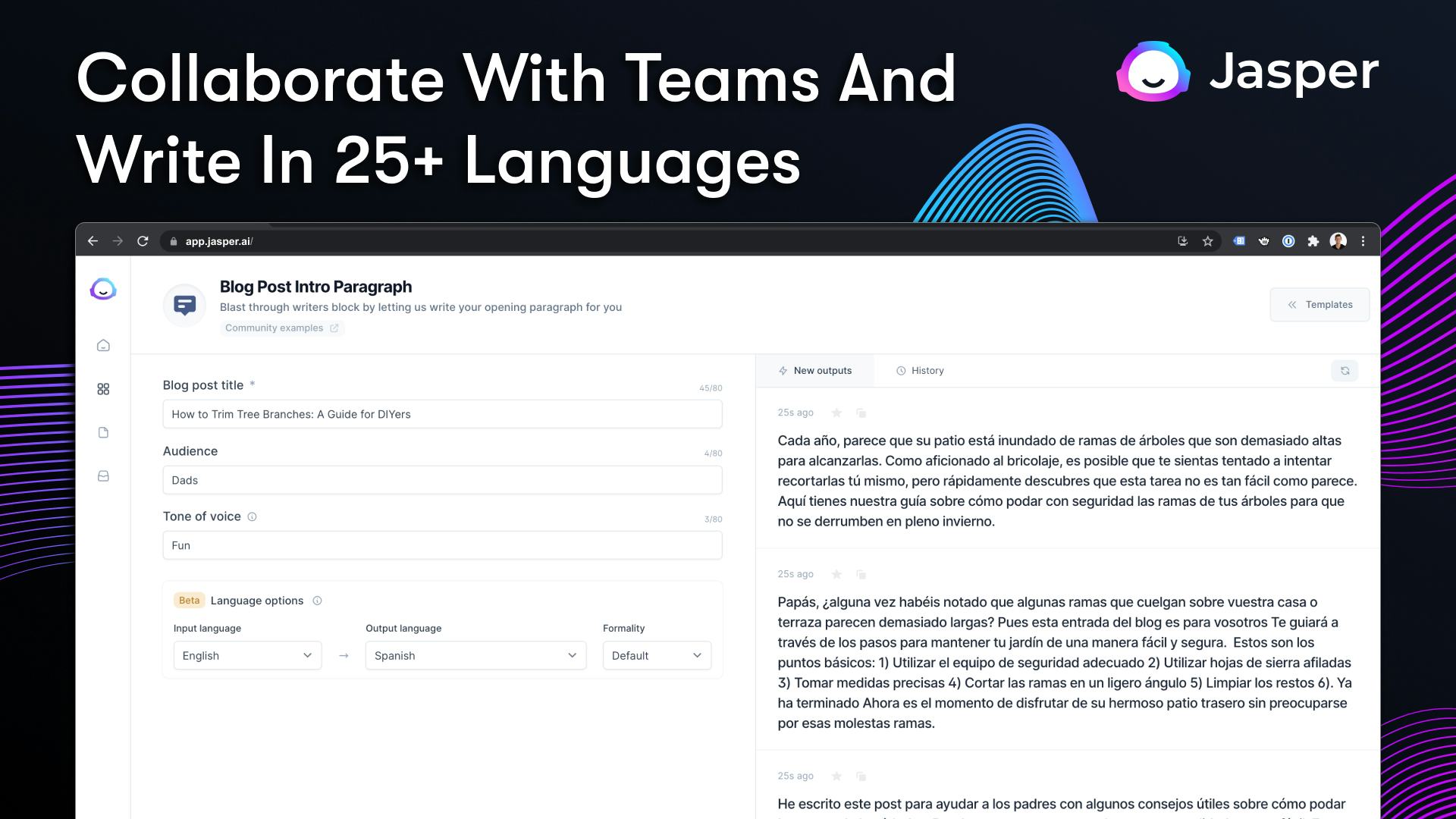
Jasper AI commands: Starting from the Start

Jasper AI commands: Starting from the Start

Using any of its various templates, Jasper may generate blog headlines, video script hooks, and even absurd marketing concepts. However, the document editor is where the application truly excels. There, you can use inputs known as commands or prompts to tell Jasper to generate any type of content asset.

The caliber of the outputs produced by generative AI technologies such as Jasper is contingent upon the quality of the inputs fed into them. But there’s a learning curve with AI prodding. As a result, we have created a set of Jasper prompt templates that address various marketing scenarios.

Prompt tips

Image via Capterra.com

Before we get started, keep in mind that these prompts still need to be adjusted to fit your unique requirements. As you modify the prompts to suit your needs, bear the following points in mind.

Clarity is essential: Make sure you know exactly what kind of information you want to find. Give the AI instructions using verbs (action words), then specify a structure and give it guidance so the tool can generate useful outputs.

Always add context. You can give the AI examples of the kind of content output you want, as well as positive and negative examples to avoid. The more context you can give, the better the results you’ll get.

Be patient: Jasper might take a few tries to get the desired outcome. Evaluate its output, make adjustments to your inputs, and rerun the prompts until you get the best outcome.

Email-Marketing and Jasper

It might be tedious to create content for email marketing campaigns. Jasper is able to generate fresh concepts and create compelling subject lines, calls to action, and messaging. With the right input—such as the desired tone of voice, target audience, and copy goal—the tool can quickly generate suitable content outputs for you.

Jasper prompts for advertising

Image via B12websitebuilder.com

Jasper can assist with brainstorming and producing ad copy (as well as graphics) for various media. It can even examine past winning advertising campaigns to learn what worked and what still needs to be improved. It will then utilize those findings to develop fresh advertising material for you. Right present, this is the method of creating affiliate product advertising using Jasper that is most popular.

Japer AI prompts and Social Media Strategy

It takes more than 280 characters to write a compelling social media post. Things get time-consuming, especially when you’re trying to customize each article for the several platforms where your audience spends their time.

Jasper can assist you with your social media marketing by creating content strategy and channel-specific post optimizations. It can even make execution plans and content calendars, freeing up more time for you to work on higher-value tasks.

Start by providing Jasper with essential corporate information, such as target customers, rivals, and product details, along with your brand’s tone of voice. Next, make advantage of these brainstorming ideas to organize your process.

PR Outreach

Image via SheKnowsSEO.com

There are many moving components in communications-related job, from data analysis and pitching to media monitoring and research. AI text generators can assist with writing so you can focus on other human-intensive tasks. You may improve your outreach campaigns by using Jasper AI to create compelling press releases, email templates, and pitches.

Jasper AI commands for creating Blogs

Jasper is an effective writing aid for long-form content. It performs an excellent job of stimulating original thought and increasing productivity, regardless of whether you’re producing brand-new content or trying to breathe fresh life into existing articles.

Two considerations for blog articles are as follows:

Jasper needs a lot of guidance while creating long-form content. The blog post prompts you use will mostly depend on your workflow, but we’ve discovered that asking it to write in chunks rather than producing an entire piece at once improves performance.

When you activate the Google Search option, the search engine will provide you with facts and statistics.

Some additional Tips: Cherry on the Cake

Image via TravelPayOuts.com

While the vast majority of Jasper users adore the program, some could argue that Jasper writes a lot of junk. The truth is, Jasper’s output when you press the compose button is entirely dependent on the data you provide him. Help Jasper with the writing you need him to do.

Jasper.ai is not a robot; it’s a helper! Consider Jasper as your copywriting assistant rather than your senior copywriter. One of the best things about “Boss Mode” is that it can comprehend simple human commands.

Check facts before publishing

Jasper can write on nearly any subject, and the quality of his work will rely on your involvement. On the other hand, there are instances where Jasper is likely to provide inaccurate information. Jasper is not so much a factual writing tool as it is a creative one. It’s possible that you will need to manually verify the information before publishing it on your blog.

Jasper will examine the data that has been provided to him, search for trends, and utilize those findings to create content. It’s not always clear-cut, though; occasionally, depending on your inputs, he may return with rather accurate information; other times, random data and figures will be entered.

Blog outlines

Before you start writing, blog outlines are a terrific method to arrange your ideas and thoughts.  You can either utilize the pre-existing ones or make your own blog outlines using outlines. Jasper will find it easier to grasp what kind of content you need him to write about if all of your ideas are in one location.

Pro Tip: Jasper has a variety of templates, and the “Blog Post Outline” template might assist you in creating a blog outline.

Use Templates, Always

Image via ElegantThemes.com

Although the long-form template is our personal favorite, we discovered that experimenting with alternative templates produced greater outcomes. You’ll be shocked at how adaptable these templates are for your copywriting and content requirements.

For example, we enjoy creating interesting blog post openings with the “Quora Answers” template. Don’t get me wrong, I think the blog post introduction template is fairly nice on its own, but Quora Answers is my first choice when it comes to “technical” topics.

USEFUL LINKS:

To explore more, visit this site
Increase Your Blog Traffic by Following These Tips 

Chess: A Guide to the Game of Mind 

Chess: A Guide to the Game of Mind

You’ve come to the perfect site if you want to learn how to play chess or if you just want advice on how to teach a child the game! Even the world’s smartest individuals still find this age-old board game challenging. It has been around for millennia.

In addition, learning the fundamentals is quite simple and you may start playing right away. Continue reading to find out how to move the pieces and build up the board, as well as some initial tactics that might have you saying “checkmate.”

Setting the chess board

Image via Unsplash.com

Place a white square in the lower right corner of the chess board. To help you remember this, try using the expression “white to the right.” The line (“rank”) with a 1 next to it goes on the side where you’ll align the white pieces if your board has numbers down the side.

Arranging pieces: playing chess

With all of the pieces facing each other in the back two rows of each side, begin the game. Place the pawns ahead of the other pieces and arrange them in a symmetrical formation with the king and queen at the center.

The king is the most significant piece since its capture brings the game to an end.

Know the movement of pieces

Image via Unsplash.com

16 pieces total—8 pawns, 2 bishops, 2 knights (little horse heads), 2 rooks (small castle towers), 1 king, and 1 queen—are in each player’s possession. Every kind has a unique strategy for advancing around the board and possibly capturing pieces belonging to your opponent.

  • Pawns can advance one square every turn, with the exception of their initial turn, when they can advance two squares. Pawns advance diagonally forward one square and capture other pieces in a diagonal manner. They are unable to go backward.
  • Rooks: Move as many squares in a horizontal or vertical direction as you can. At the square immediately before, the rook must stop if one of your pieces is in the path. If a piece belonging to your opponent gets in the path, use your rook to capture it and end the move there.
  • Knights: Take two squares in any direction, then move one square to the left or right of the second square. Knights are the only pieces that can leap over other pieces, and they can only capture a piece belonging to an opponent if it lands on the move’s last square.
  • Bishops: Move as many squares diagonally as you can. They must stop at the square directly in front of one of your pieces, just like the rook does, or they must capture an opponent’s piece and stop there.
  • King: Go any direction in a square. The king cannot be moved into a position from which one of your opponent’s pieces could capture it.
  • Go as many tiles in whatever direction as you can, Queen. The queen must either capture an opponent’s piece and stop there, just like the rooks and bishops, or stop immediately before one of your own pieces.

Special moves of pawns, rooks and king: playing chess

For the first few games, you don’t really need to worry about these moves, but it’s still good to be aware of them. You’ll discover that you use them more and more as the play progresses and you settle in.

  • Pawns: You can capture a pawn with your pawn on your next move, but only if your opponent moves a pawn two spaces on its first move, placing it directly adjacent to one of your pawns. En passant is the term for this unique skill (French for “in passing”).
  • Pawns: A pawn is promoted when it reaches the rear row of the opposing side of the board. This implies that you can transform the pawn into any kind of piece except a king. As the most potent piece, the queen, most players promote a pawn to a queen.
  • Kings and rooks: You can move your king two spaces in the direction of your rook if there are no pieces in the back row between them. Then, without delay, advance your rook to the opposite side of your king. We refer to this as casting.

Whites attack first

Image via Unsplash.com

The player with the white pieces in chess always takes the initiative. Although they do have a small advantage, you and your opponent might prefer to toss a coin to see who receives the white pieces (primarily, that with white you get to attack first)

Take turn to make move: playing chess

Chess operates similarly to other turn-based board games in that each player gets one move in before the action shifts back to their opponent. Think about the various moves that each piece on the board is capable of making while deciding what move you wish to make.

In chess, there is no such thing as a “pass”—you always have to move during your turn.

Block, Evade, and Capture

Eventually, as the game goes on, your opponent will probably check your king (or maybe you will check their king). This simply indicates that your opponent would capture your king on their next move if nothing else changed. When your opponent declares, “check,” you have to take action to avoid being in check. You have three primary choices:

Block: Place a piece between your king and the attacking piece.

Evade: Move your king one square to the other side of the assaulting piece’s attack line.

Capture: To stop your opponent from assaulting with a piece, use another piece to capture it. Threat removed, whoa!

Continue Playing: playing chess

Image via Pexels.com

It is also the game! In order to prevent your opponent from checkmating you, your objective is to checkmate them while defending your king. Sounds easy enough? However, with so many moving parts, planning and strategy can get very intricate. You’ll succeed if you concentrate on always defending your king because you’re only getting started.

When neither player has any further valid movements, you might sometimes play to a stalemate, which is similar to the opposite of checkmate. This typically occurs after the majority of the pieces are caught.

USEFUL LINKS:

Click here to know more about chess
Improve your dribbling skills in Basketball 


Snooker: Know its Rules and Art of Scoring 

Snooker: Know its Rules and Art of Scoring

Snooker is a fantastic game to try out if you enjoy pool or billiards but want something a little more difficult. In snooker, players take turns hitting balls of various colors with a cue ball in order to sink them.

However, the points awarded for each color vary. Snooker appears to be a conventional pool game, but its rules differ in a number of ways. For all the information you need to start playing snooker and learn how to improve as a player, keep reading.

Earning points: learning snooker

In snooker, players hit the red or colored balls into the pockets on the sides and corners of the snooker table by striking a white cue ball. With every shot, players have to switch between hitting the red balls and the different colored balls. Each ball color has a point value that goes towards their score. The player with the most points at the conclusion of the game, when every ball has been pocketed, wins.

Snooker differs slightly from pool and billiards, while having a similar appearance. Compared to a regular pool table, a snooker table is bigger, but the balls and pockets are smaller, making the game slightly harder.

Placing colored balls on matching spots: learning snooker

Snooker tables are marked with particular beginning positions for each of the six colored balls. And they are marginally larger than regular pool tables. Put the black ball on the area a few inches behind the red balls that have been racked. Then place the pink ball on the pink spot right in front of them. Place the blue ball in the middle of the table. Next, arrange the green, brown, and yellow balls on the corresponding positions on the other end of the table’s baulk line.

Snooker tables have somewhat bigger pockets than standard pool tables, but they also have smaller pockets, making it harder to sink a ball.

Shooting from inside the D

On the snooker table, the semi-circular area behind the baulk line is known as the D. To set up their initial shot, the starting player may position the white cue ball wherever inside or along the D’s lines. After that, the player lines up the shot to strike one of the red balls using their cue. The player’s turn continues if they sink a red ball on their opening shot.

The stroke is ruled foul if the cue ball makes contact with a colored ball before a red one.

Players must strike the cue ball from wherever it lands on the table following their initial turn.

Alternate shooting: learning snooker

During a turn, switch between shooting colored and red balls.

The red balls are regarded as “on” on the first shot of a turn. And in order to shoot the cue ball into a pocket, a player must strike one of them. They select any colored ball as the next ‘on’ to aim at for their next shot if they sink (or ‘pot’) a red ball, leaving the cue ball where it came to rest. A player keeps playing as long as they pocket the right color ball with every shot.

A player’s turn ends if they miss their shot or strike a ball color that is not “on.”

Replacing balls after they’ve potted

A red ball that has been potted remains off the table for the remainder of the round. A colored ball is replaced on its corresponding spot on the table whenever it enters the pocket, regardless of whether it was hit “on” or accidentally as a foul.

Place the colored ball on the colored spot of the next greatest point value if another ball is in the way or already on that spot. Put the green ball on the brown location instead of the green one. For instance, if it was potted but another ball was knocked onto the green area.

Simply place the ball as near to its initial location as you can if every spot is taken.

Sinking balls in point order: learning snooker

Players end the game by successively sinking the remaining colored balls in the order of their point values. From lowest to highest, once all of the red balls have been pocketed. At this stage of the game, colored balls are potted; they are not returned to their starting places. The game is over when every ball has been potted.

At the conclusion of the game, the colored balls should be spotted in the following order: yellow, green, brown, blue, pink, and black.

Proper grip and stance

Using your dominant hand, hold the cue close to the bottom of the thick, weighted end. To increase your control and shot extension, bring your hand closer to the grip’s end. To support the front of your cue, place your non-shooting hand on the table and utilize it as a bridge. When you make a shot, keep your dominant leg straight and bend forward so that the cue is parallel to the table.

There are two common cue-resting techniques. The “open bridge,” which involves placing the cue in the thumb joint’s groove. And the “closed bridge,” which involves drawing a circle with your thumb and pointer finger and placing the cue inside.

Aim for clear shots: learning snooker

Check the colored balls that are close by and have an open shot after you sink a red ball. If at all possible, select a ball with a larger point value to increase your score. Keep in mind that after being pocketed, the colored balls are re-spotted on the table, allowing you to score them more than once.

No matter where the cue ball is on the table, you should always have a clear shot at one because of the colored balls’ permanent position.

Target for red ball

Look for a red ball that will give you a second chance at one of the colored balls as you evaluate the table for your shot. Remember the worth of each ball and, whenever possible, aim for the one that will score the most points for you.

USEFUL LINKS:

Check out more tips on Snooker 
Avoid injuries in Basketball with these tips 


Past and future of Islam: Seeing What Was and What Will be

Past and future of Islam: Seeing What Was and What Will be

Islam is a huge religion with millions of followers. It has a presence in many parts of the world, and a 130-year history. The one transcendent, immanent God of pristine uniqueness is shared by all Muslims. Its Past and Future are a topic of debate.

According to them, the Qur’an is the authentic word of God, existing eternally with God. And being revealed to all the prophets, starting with Adam, but only to Muhammad, the Seal of the Prophets, in its purest, most unadulterated form. Islam was disseminated via the sword, evangelization, spiritual leadership, and financial inducement.

Islam saw numerous invasions, conquests, and civil wars during its first six centuries. Islamic civilization was likewise at its height throughout those early years. As evidenced by its universities, philosophy, law, science, literature, and art. Creativity was not hindered by political uncertainty.

For the most of its second six centuries, the Ottoman and Mughal empires ruled over most of Islam. They were extremely militarized and centralized. Generally speaking, under those two empires, learning decreased, tribalism grew. And a corrupt privileged and quasi-feudal elite structure retained itself in power—though there were undoubtedly exceptions. Stultification and political stability coexisted throughout that time.

Islam: into the Past

Image Credits: Pexels.com

Islamic tradition holds that Muhammad was called “to recite” sometime around 610 A.D. He declared that Allah, a god who was once worshipped as a composite of several pagan gods, was indeed the One and only God. Muhammad was a member of the prominent tribe in Mecca, and his preaching caused them to become hostile.

He went to Medina in 622 after accepting an invitation from several of his converts, where he led the Meccans and other tribes in battle. He was eventually invited back to Mecca, where his preaching had a profound effect on the entire city. After then, Islam swiftly expanded throughout Arabia. Islam passed away in 632.

There was instant competition over who should succeed him. This was the major civil conflict that finally caused the Sunnis and Shi’ites to split off from Islam.

What followed Next

The competition persisted in one form or another over the following three centuries. However, as Muslims argued over the central tenets of their faith, an ideological competition also emerged alongside the political struggle. The great achievements of Islamic civilization, such as institutional tolerance for other religions, especially Christianity and Judaism, emerged in the midst of this conflict. There are five noteworthy ideological streams of Islam in this age.

The Mutazilites were one tradition and theological school that placed a strong emphasis on reason and rigorous argument. The Mutazilites resembled the Scholastics of mediaeval Europe and were readers of Greek philosophy. They held that reason might assist one in gaining substantial understanding about what was desirable, offering a certain means of achieving connection and nearness to God, even though reason’s fallibility necessitated the Qur’an.

They claimed that the Qur’an was a creation of God and refuted the notion that it has existed from all eternity.

The decline of Islam: Past and Future of Islam

Image Credits: Pexels.com

Calling the period of the Ottoman Empire, when its soldiers reached the gates of Vienna or when the Mughals ruled the vast subcontinent of India, the age of Islam in decline may seem odd. However, after the catastrophic Mongol destruction of the thirteenth century, the Ottomans brought much of Islam back together. But Islamic culture as a whole died out, especially when compared to the high Middle Ages and the Renaissance in the West. The ulema, or legal and religious academics, emerged as the dominant intellectual group in Islam and eventually became the imperial court party. The self-sustaining ulema comprised a group of supporters of an inflexible interpretation of Shari’a.

Adherence to Sufi orders and practices expanded across the Muslim world. However, this was also the time of military elites, strict legalism. And forced conversions, a thriving slave trade, political oppression, and tribalism.

The late 18th century

Reactions to the corruption and, eventually, the fall of the Islamic empires accelerated starting in the late eighteenth century. There were two Muslim responses that contended that the Islamic world had become disconnected from its roots. A faction held the opinion that the empire had been overly tolerant of Sufi mysticism. They believed that the empire had not been strict enough with its laws.

This group aimed to enforce the Shari’a in all its strictness, as it had been codified several centuries before. They were the ones who are nowadays quite rightly called extremists. Muhammad ibn ‘Abd al-Wahhab, a prominent early fundamentalist who denounced Sufi devotions, was one of the most significant among them. Wahhabism ultimately established one of the strictest and most intolerable forms of fundamentalist Islam, allied with the Saud faction.

Into the tomorrow: Past and Future of Islam

Image Credits: Pexels.com

Liberty is the only thing that can allow religion to fully develop. The fight against terrorism today is also a fight to rescue Islamic civilization from the evil deeds of extremists. And to grant that region of the world the opportunity to experience liberty.

Liberty was able to vanquish even more dangerous ideologies than modern Muslim extremism: Nazism and Communism. In one way or another, Eastern Europe, Latin America, Japan, Germany, and Russia now all support liberty. The Muslim world is a natural ally of liberty. We see it in writers in Egypt who risk an autocratic state and deadly extremists, in young men of Kabul who shaved their beards to defy the Taliban. And in women who dared to reveal their unique looks.

This guide traces the past and future of Islam. And it has been substituted with references which are beneficial for you. Discover the extensive account on what was and what will be.

LINKS YOU MUST VISIT:

For a detailed discussion oh past and future of Islam, visit this site
The Role of Religion in the history of education and science 
The Political Causes of Terrorism: Explaining the Complex Web 

Islamic civilizations: A Historical Account 

Islamic civilizations: A Historical Account

The Islamic Civilization, spans nations and polities from Central Asia to sub-Saharan Africa. And from North Africa to the western edge of the Pacific Ocean, is an amalgam of many different cultures both now and in the past.

During the seventh and eighth century CE, the broad and encompassing Islamic Empire was established. It united  through a series of conquests with its neighbors. That first unity broke up in the ninth and tenth centuries. But it continued to exist and thrive for over a millennium after that.

Over the time: Islamic civilizations

Image via Unsplash.com

Islamic states developed and collapsed during this time, embracing and integrating various cultures and peoples, creating and sustaining enormous trading networks, and erecting magnificent cities. Great developments in philosophy, science, law, medicine, art, architecture, engineering, and technology were also brought about by the empire.

The Islamic faith is a fundamental component of the Islamic empire. Today’s Islamic branches and sects all support monotheism, despite differences in doctrine and politics. One could consider Islam to be a reform movement that emerged from monotheistic Judaism and Christianity in certain ways. That rich blending is reflected in the Islamic empire.

Into the history: Islamic civilizations

Under the leadership of the Byzantine emperor Heraclius (d. 641), the Byzantine Empire began to spread out of Constantinople, or modern-day Istanbul, in 622 CE. Heraclius waged multiple operations against the Sasanians, who had been controlling large portions of the Middle East, including Jerusalem and Damascus, for almost ten years. The goal of Heraclius’ war, which was really a crusade, was to expel the Sasanians and establish Christian dominion over the Holy Land.

A man by the name of Muhammad bin ‘Abd Allah (c. 570–632) was beginning to preach in west Arabia a different, more radical form of monotheism during Heraclius’s ascent to power in Constantinople: Islam, which means literally “submission to the will of God.”

Muhammad: Founder of Islam

Image via Unsplash.com

According to tradition, Muhammad was given the first verses of the Quran by Allah through the angel Gabriel around 610 CE. In 615, a group of his devotees had settled in Mecca, Saudi Arabia, the site of his birth.

Muhammad belonged to a middle clan in the prestigious Quraysh tribe in Western Arabia, but his family was one of his biggest rivals and opponents, viewing him as little more than a sorcerer or fortune teller.

Muhammad’s hegira (return journey) to Medina, located in Saudi Arabia, began in 622 after he was driven from Mecca. He bought a piece of land, constructed a modest mosque with flats next to it, and was welcomed by the local followers.

As Muhammad gained more political and religious influence, the mosque became the first location of the Islamic government. He also created trade networks and drew up a constitution, setting himself distinct from his Quraysh relatives.

Umayyad Dynasty

Following ‘Ali’s death in 661, the Umayyads took over Islam and ruled it for the ensuing many centuries. Mu’awiya was the first person in queue. He ruled for ninety years, followed by his heirs. Among their many notable distinctions from the Rashidun was their belief that they were the supreme authorities of Islam, answering solely to God. They referred to themselves as Amir al-Mu’minin, or Commander of the Faithful, and God’s Caliph.

When the Arab Muslims began to conquer the old Sasanid and Byzantine lands, Islam became the dominant religion and culture of the area, and the Umayyads came to power. The new society combined Arabic and Islamic identities, and its capital was shifted from Mecca to Damascus in Syria. Despite the Umayyads’ desire to isolate the Arabs as the superior ruling class, this dual identity emerged.

Abbasid revolt: Islamic civilizations

Image via Pexels.com

The ‘Abbasids called their overthrow of the Umayyads in 750 “a revolution” (dawla). Perceiving the Umayyads as an exclusive Arab dynasty, the ‘Abbasids aimed to take the Islamic community back to the Rashidun era. Their aspiration to establish universal governance as emblems of a single Sunni community.

They accomplished this by emphasizing their ancestry from Muhammad’s family rather than that of his Qurayshite forebears. They moved the caliphate’s center to Mesopotamia, establishing Baghdad as the new capital under the caliph ‘Abbasid Al-Mansur (r. 754–775).

Mongol invasion: Islamic civilizations

Depleting resources and internal pressure from newly independent dynasties in formerly ‘Abbasid areas meant that by the early 10th century, the ‘Abbasids were already in difficulty and the empire was collapsing. Ayyubids (1169–1280) and Fatimids (909–1171) in Egypt, the Buyids (945–1055) in Iraq and Iran, and the Samanids (819–1005) in eastern Iran were some of these dynasties.

The Seljuks, a dynasty of Turkish Sunni Muslims, governed the empire from 1055 until 1194, when it was reverted to ‘Abbasid power. The Seljuks had overthrown the Buyid caliph al-Mustakfi in 945. The ‘Abbasids’ were driven out of the realm in 1258 when the Mongols stormed Baghdad.

Mamluk sultanate

Image via Pexels.com

The Mamluk Sultanate of Egypt and Syria came next. This family’s origins were in the Ayyubid confederation, which Saladin established in 1169. The first Mamluk ruler of the Islamic empire, Baybars (1260–1277), killed the Mamluk Sultan Qutuz after he fought the Mongols in 1260.

Baybars proclaimed himself sultan and governed the Islamic empire’s eastern Mediterranean region. Long-lasting conflicts with the Mongols persisted until the middle of the 14th century. But under the Mamluks, Cairo and Damascus rose to prominence as academic and commercial capitals for global trade. In 1517, the Ottomans, in turn, overthrew the Mamluks.

Ottoman empire

About 1300 CE, a small principality on ancient Byzantine territory gave rise to the Ottoman Empire. During the next two centuries, the Ottoman empire expanded, bearing the name of the first emperor, Osman I (1300–1324). After defeating the Mamluks in 1516–1517, Ottoman emperor Selim I added Mecca and Medina to his kingdom, effectively tripling its size. As the world grew closer and more modern, the Ottoman Empire started to lose ground. When World War I ended, it was declared to be over.

USEFUL LINKS:

Click here to know more about the Islamic civilization 
 Know about the creation, evolution and origin of religion here 
Should the Government control the Internet? 


Towards Islam and World Politics: Exploring their Relationship 

Towards Islam and World Politics: Exploring their Relationship

Politics and religion are not exclusively influenced by one another in the Islamic world. Nonetheless, no political thinker could overlook the significance of Islam in Muslims’ public lives. Because of the population’s great propensity towards religion and the loud voice they give it, Islam has a significant impact on the politics of Muslim nations. Let us try and move towards the Islam and world politics.

The relationship between any Religion and politics is complex. To understand it we need to take into account many factors. In this article we have presented a discussion covering some of the important aspects. Read below to know more about this relationship.

 Islamic government: Towards Islam & Politics

Image Credits: Unsplash.com

The creation of a genuinely Islamic society is the main goal of an Islamic government. Islam does not view society as nothing more than a group of people. Instead, it holds that the social structure in which these people live. As well as their interpersonal ties make up society.

These are arguably the most defining characteristics of a civilization. Based on their social structures and legal and moral frameworks, societies are classified as either just or unjust, developed or underdeveloped, complicated or simple.

The intricate network of social ties that makes up society includes social advantages, financial resources. And the design of the current political system.

An Islamic government is one that acknowledges and submits to Islam’s supreme authority. It aspires to execute Shari’ah and create an Islamic social structure in accordance with the teachings of Islam. All the while trying to align its public policies and political choices with the principles and goals of Islam.

Against Islamic government: Towards Islam & Politics

The opposition to Islamic governance can be broadly classified into two groups. The first group is that of secularists, who maintain that religion and worldly matters should be kept entirely apart. They consider the idea of a religious state to be antiquated and out of date. They contend that this political system model must be limited to an era. A model in which people relied on religion to establish their legal, economic, and cultural interactions. Because they lacked the knowledge or expertise to organize their social structure.

Secularism, however, is not a philosophy that just discusses how religion and politics interact. It is essentially a radical perspective on how revelation and religion shape human knowing. According to secular reason, knowledge can be formed by the human brain without the aid of revelation. This suggests that reason is independent and self-sufficient in and of itself. Therefore, without the assistance of God or religion, mankind is capable of creating the natural and human sciences, philosophy, law, and ethics.

Towards a Islamic society

Image Credits: Unsplash.com

Important side effects of such a revolution are its moral and cultural implications. Maximizing the importance of moral characteristics, Islamic principles, and genuine compassion in social connections is vital for an Islamic governance. Supporters of the Islamic state think that moral attributes and true humanity, which are the foundation of religion goals and values. Because it can elevate human civilization to a higher plane of existence.

To show that the Islamic legal system is unable to adapt to social changes, the argument that rejects the possibility of harmonizing social order. This is according to Islamic laws and principles typically tries to limit the conversation to a solely legal one.

The aspect of flexibility: Towards Islam & Politics

When we limit our analysis to the legal side of things, the precise complaint levelled by this argument against the idea of a “Islamic state”. It is that the Islamic legal system is unable to adapt to social changes. Therefore, it cannot possible satisfy the legal obligations of human society. Because it is rigid and unable to adapt to new conditions.

Every legal system needs adaptable components in its foundations and procedures. Because it effectively handle the diverse societal ties it will unavoidably confront. Even if the Islamic legal system lacks these elements, it is important to recognize that it does have certain characteristics that enable it to satisfy all of the legal demands. All the demands made by the two categories of social change stated above.

The efficiency of Management

Image Credits: Unsplash.com

Two opposing groups have arisen as a result of misconceptions regarding the application of Shari’ah. And the function of fiqh (Islamic jurisprudence) in governing a state and its society. These groups mistakenly conclude that the Islamic approach to governance is incompatible with “rational management.”  It is the norm in the majority of modern states. This group can be split into two groups. The first group maintains that Muslims in the modern world should organize their social, political, economic, and cultural issues through technological and logical administration. In this regulatory framework, religion is kept apart from worldly affairs while the human mind, technology, and sciences hold authority.

A misunderstanding of the terms “religious state” and “religious social order” leads to this false conception of the function of Islamic law in social management.  And it affects the formulation of political or economic policies. This false impression of a religious society and state gives adversaries a platform from which to paint the Islamic state as outdated and unresponsive to modern demands. As well as Islam as a system that rejects reason, advancement, and human understanding.

Objectivity of Islamic state

Image Credits: Unsplash.com

Any political system must have ideological goals and purposes in order to set itself apart from competing ideologies. Goals like establishing a welfare state, expanding access to education, fostering wealth, and protecting national boundaries are universal to all political system models. Consequently, it is imperative that we clarify the distinct goals of a religious administration. And talk about how they distinguish it from other forms of governance.

USEFUL LINKS:

For an extensive discussion on Islam and the world politics, see this article 
To know the role of United Nations in the world Politics, click here
Political Cause of Terrorism: Explaining the Complex Web 

Women in Islam: Knowing their Role and Status

Women in Islam: Knowing their Role and Status

“Oppression,” “inferiority,” and “unequal” are among terms that frequently spring to mind when discussing women in Islam. These terms are frequently used to mix up the Islamic faith with cultural customs and beliefs.

It is crucial to keep in mind that Islam sees women as equal to men and has given them the most progressive rights since the 7th century. The Quran really dedicates a whole chapter to women and makes constant mention of them.

Women and Islam

Image via Unsplash.com

The Prophet Muhammad (peace be upon him) instructed, back in the 7th century, that all Muslims, male and female, seek mandatory education. Muhammad’s wife Aisha was among the most prominent scholars. Both sexes would journey to her to benefit from her immense reservoir of wisdom.

It has become customary to urge women to actively participate in enhancing and leading various elements of their communities because of the long history of women’s participation in government, public affairs, education, and scholarship in Islam. In order to maintain balance, it is common practice to seek out the viewpoint and voice of women in various areas, as Allah acknowledges in the Quran the distinct distinctions between men and women.

Decoding the status of women

The Quran explicitly states that a woman’s primary job in life is motherhood, even if it also encourages women to work, pursue education, own land, and engage in other activities. The Quran urges others to respect this function, and it is one that is highly esteemed.

The practice of female infanticide, which was all too widespread before to the establishment of Islam, was abolished by the Quran. The book goes on to criticize parents’ judgmental attitudes when they learn their child is pregnant.

The teachings of Muhammad and the Quran obligate parents to provide their daughters with kindness, support, and safety throughout their lives. This involves supporting and facilitating her academic endeavors.

Though it is practiced by some Muslims and Christians in some parts of Africa, female circumcision is solely a cultural practice and is not required nor encouraged by Islam.

Islam established marriage as a union of peace and understanding; a woman is entitled to a divorce, to reject marriage proposals, and to be treated equally in all relationships. Additionally, after her husband files for divorce, she is permitted to retain her assets—something that was not customary in Arabia prior to Islam.

Representatives of Islam

Image via Unsplash.com

It is important to keep in mind that not every Muslim is an ambassador for Islam and that they are free to rely more on their own cultural and societal norms than the teachings of the Quran. By doing this, they may be disenfranchising women and also explicitly violating the explicit rules of Islam on how women should be treated.

Rights of women

Politics and Social Services: During the early Islamic era, women actively participated in the day-to-day operations of society. Islam grants women the freedom to freely voice their thoughts and believes that it is important to actively seek out their counsel. During wars, women not only provided medical attention to the injured but also occasionally fought alongside men.

inheritance: Prior to the arrival of Islam in the seventh century, women were denied the right to inherit and were viewed as men’s property. Islam gave women the freedom to inherit from their ancestors and to buy and sell property. She inherits a portion of the deceased relative’s belongings regardless of whether she is a wife, sister, or daughter. Their personal relationship and the number of heirs she has generated will determine her share.

Financial Responsibilities: In Islam, it is the job of men to earn and spend money on things like housing, food, and other essentials. Women are not required to do either of these things. A woman is free to earn and spend money anyway she pleases; she is not required to provide it to her family if she does not want to.

A woman who marries has the legal right to a dowry from her spouse. This is her property and cannot be shared or given to anyone else. She is entitled to retain everything she acquired throughout the marriage and everything she held before to the divorce. This guarantees her ability to maintain her standard of living following the separation.

Marriage and protection

Image via Unsplash.com

Marriage: In Islam, a woman has the freedom to accept or reject marriage proposals. Her consent is also needed to finalize the marriage contract. It is against Islamic law for women to be forced to marry against her will. If she is, it may be due to cultural obligations. If the woman is unhappy, she also has the option to file for divorce.

Dignity and Protection: Islam forbids any kind of psychological, emotional, or physical abuse. This principle does not apply to mistreating women. When taken into consideration in its whole, no teaching in Islam supports domestic abuse of any kind.

Modesty: Despite the misconception that Islamic women are oppressed because of their modest clothing. The intention is to release them from the unachievable beauty standards that permeate their environment. A modest look is thought to draw attention to a person’s personality and mentality more than outward appearance. It leads to a greater appreciation of the person behind the appearance.

Know some revered Muslim Women

Image via Unsplash.com

Aisha bint Abu Bakr

Following the passing of Khadijah, Muhammad had several wives, among them Aisha bint Abu Bakr. Aisha was a learned woman who imparted knowledge by telling tales about her husband’s personal life. And discussing topics like inheritance, pilgrimage, and other related topics. Her extraordinary knowledge, which included everything from poetry to medicine, was well known. It is reported that before to her demise in 678 AD, she founded and instructed at numerous institutions.

Fatimah

The only child of Muhammad and Khadijah to live to adulthood was Fatimah. At an early age, she converted to Islam. And her father and her faith were compared to Mary, the mother of Jesus (peace be upon him). Fatimah is revered and loved by Muslims, but the Shiites place the greatest value on her. Ali, her spouse, is regarded by Shi’a Muslims as the legitimate heir to the first Imam (spiritual guide).

USEFUL LINKS:

Click here to know more 
See the role of United Nations in the world politics 


Civil Islamic practices: Knowing an Ancient Religion 

Civil Islamic practices: Knowing an Ancient Religion

The Middle East is a small region that gave rise to the world’s three monotheistic religions: Islam, Christianity, and Judaism. Abraham was born around 1900 years before Jesus was born at Bethlehem, Palestine, in the city of Ur in Mesopotamia (Iraq). Muhammad was born in 570 A.D. at Mecca, Saudi Arabia. Jesus spent a brief time in Egypt, as did Moses, and Muhammad journeyed across the Arabian Peninsula. Do you want to know Civil Islamic practices?

The words “Islam” and “salaam,” which mean “peace” and “the condition of peace,” are derived from the same root. Islam signifies peacefully giving up oneself. Therefore, a Muslim is someone who, in peace, gives himself over to God. Islam is a free acceptance of the religion with the heart, mind, and soul. Thus, to surrender to Islam is to embrace the principles of faith without reservation and to adhere to the text as well as the spirit of the Qur’anic teachings.

Shariah: Civil Islamic Law

Image credits: Unsplash.com

The primary source of Islamic law, or Sharia, is the Qur’an. It lays the foundation for relationships between Muslims and non-Muslims, as well as between people and creation. The Sharia offers the framework for organizing and governing Muslim societies as well as a mechanism of resolving disputes between people and the state.

Complementary to the Qur’an, the Hadith and Sunna contain the sayings and narratives of the Prophet’s deeds.

Quran and the Civil Law

Image credits: Unsplash.com

The field of interpretation science (ilm usul aI-fiqh) includes these and other regulations. For instance, one is required under these principles to first make reference to a specific provision before moving on to a broader provision that addresses that particular scenario.

Clear language and simplicity are always preferable. Likewise, divergent interpretations cannot change the unambiguous spirit of some mandates. As with the theory of ijtihad (progressive reasoning by analogy), a policy-oriented interpretation is acceptable and even encouraged within the bounds of jurisprudential norms.

A Universal law?

Image credits: Unsplash.com

Muslim academics view Islam as a timeless religion and legal system rather than as a religion that is always changing. Therefore, the application is the one that can change. Indeed, Islam can, as intended, offer the solution to today’s social issues through the disciplined reading of the Qur’anic verses, in conjunction with the Hadith, Sunna, and other sources of interpretation.

Islam was a revolution in law, society, and spirituality fourteen centuries ago. For the most part, this is what enlightened fundamentalist Muslims believe. Thus, Islamic fundamentalism does not represent a retrograde understanding of the past or the present. Islam was neither authoritarian nor regressive during the height of its civilization, which occurred between the seventh and the eleventh century. It was a force for justice and reform that was progressive, humanistic, and juridical.

Various of thoughts on Islam: Civil Islamic Law

The development of Islamic jurisprudence spans fourteen centuries. Many schools of law have developed over that time, each with its own interpretation and application of the Sharia. Numerous schools continued to divide, forming new institutions that used various applications and interpretive philosophies.

The thriving diversity of opinions and ideas demonstrates the depth and scope of Islamic jurisprudence. Nothing, however, stops a state from codifying Sharia in order to increase legal certainty and promote uniformity and clarity in its application. Many Muslim states have followed suit; Egypt is the most developed, with centuries of legal tradition and the thousand-year-old Al-Azhar University (which was once dedicated only to Islamic studies but now encompasses all disciplines) combining to make Islamic law a model for the Muslim world at large.

The Sunni and Shia

Image credits: Unsplash.com

Shia tradition, which is practiced by the majority of Muslims worldwide, is distinct from Sunni tradition, which is currently practiced by 85–90% of all Muslims. The two traditions’ main differences stem from their divergent approaches to governance.

The Sunni hold that the Muslim people should be governed by consensus (ijma) under democratic principles by means of an elected head of state, the khalifa, based on certain verses of the Qur’an and the Sunna. On the other hand, the Shia hold that the imam, or head of Islam, has to be a direct descendant of the Prophet; they call him the imam instead of the khalifa. The Shia tradition’s hereditary hierarchy is based on this idea.

The interpretation of the Qur’an is the most significant area of disagreement between Sunni and Shia. The Qur’an’s letter is more important to Sunnis than its spirit is to Shia.

Social system and morality: Civil Islamic Law

Image credits: Pexels.com

One of the Prophet’s most significant hadiths (sayings) is that religion is not about formal, ceremonial practices, but about how one treats other people. Thus, being pious alone is insufficient if one does not carry out acts that reflect their convictions.

Islam is one the ancient religions in the world. However due to some unfortunate like 9/11 Islam had to face lot of criticism. This criticism tainted its image. And it resulted even in questioning its tenants and philosophy. Our attempt to rediscover its inherent humanitarian ideology and bursting many conceptions about Islam.

This guide has covered many aspects on Islam. The underlying thought is to familiarize you about an antique religion. It should be kept in mind that every religion is humane. There exists no religion which promotes violence or genocide. It is our ethical and moral duty to present before others a better picture of world. The future is in our hands. We should build our critical ability so that we are aware what is being presented before us. The propagandistic ideology will surely harm us. Seedtimes the  loss is so intense that it nearly irrecoverable. We should come together to paint a peaceful future. Because we are the change.

USEFUL LINKS:

If you want want deep insight into the philosophy of Islam, then this is a must visit site 
This article traces the evolution and origin of religion, click here to know more about Religion

Islam: prejudices and misunderstandings

Islam: prejudices and misunderstandings

According to Muslims, Islam is the oldest religion. Because it has been predetermined from the beginning of time and inscribed on Lawh-e-Mahfuz. In terms of history, Islam dates back more than a thousand years.  Currently, about two billion people worldwide identify as Muslims.

Islam holds the distinction of being one of the world’s religions with the quickest rate of growth. Its unique features have drawn criticism or caused disputes with some parts of Islam. These could be related to the apprehension, biases, and animosity arising from the historical account of Islam’s swift ascent to prominence as a political force as well as a religion.

Islamophobia

Image via Unsplash.com

It is imperative, therefore, to differentiate between valid critiques or disapprovals of specific facets of Islam or its customs and extrapolating them into what is currently termed as Islamophobia. It is essential to foster an atmosphere that respects religious liberty and fosters compassion, understanding, and acceptance for all person, regardless of their religious convictions.

Understanding Islam

It takes a lot of effort and time to understand Islam. The majority of its verses are clear-cut, uncomplicated, and simple to comprehend. Others might call for a careful and nuanced study of other important sources of Islamic knowledge and doctrine, such as “Hadith” (the prophets’ recorded words, deeds, and actions) and “Fiqh” (Islamic jurisprudence). The majority of the Quran’s teachings are timeless and global. However, some are contextual as well.

It is written with the assumption that most misconceptions about Islam and Muslims result from a lack of knowledge or acquaintance with the fundamental ideas, practices, doctrines,. This endeavor would have enormous benefits for a vast segment of the national and international society. If nothing else, the book would offer a trustworthy and genuine foundation for polite discussion and comprehension.

The idea of Middle East

Image via Unsplash.com

One billion Muslims, the majority, reside in Asia, mostly in south and southeast Asia. Sub-Saharan Africa is home to more than 300 million Muslims as well.

With over 100 million Muslims living in each of Indonesia, Pakistan, India, and Bangladesh, these four countries have the biggest Muslim populations.

The phrase “Middle East” is imprecise and frequently derogatory, misrepresenting the region in which Muslims reside.

Though they make up only 20% of all Muslims, the bulk of people who live in north Africa, the Arabian Peninsula, and southwest Asia are Muslims.

Does Muslim worship Moon?

Certain Christian organizations teach that Allah is the moon god’s idol. Because Islam utilizes the crescent moon as a symbol, some people interpret the Arabic word Allah as referring to a “moon god.” Muslims find this accusation to be extremely hurtful.

The Hebrew word El and the Aramaic word Elah are remarkably similar to the Arabic word for God, Allah. Islam’s central tenet is the worship of the one real God. Christians and Jews who speak Arabic also refer to God by the Arabic term Allah, as do all Arabic Bible translations. In Arabic, there isn’t another term for God.

Oppression of women: Misconceptions on Islam

Image via Unsplash.com

Local norms and traditions are typically to blame for the majority of the heavily publicized persecution of women by Islam and Muslims. Muslim women have held positions as prime ministers and presidents. Islam forbids forcing women to do anything against their will or using violence against them.

One of Islam’s greatest commandments is to take care of widows, orphans, and the impoverished. There is no difference in the prevalence of female maltreatment between Muslims and non-Muslims.

Value of education

With Master’s and PhD degrees, a large number of Muslims have advanced degrees. Numerous Muslims are multilingual. Islamic universities led the world in math, medicine, science, law, architecture, and many other academic subjects up to the industrial revolution. The scientific method originated with scientific advancements made by Muslims. Muslims use the Qur’an as inspiration to learn more about the world they live in. While many Muslims attend our colleges nevertheless the majority of Muslims today live in poverty and have limited access to higher education.

Founder of Islam

Image via Unsplash.com

Muslims hold that Muhammad conveyed the last revelation from God so was his prophet. Adam is regarded by Muslims as the first Muslim. Muhammad is regarded as the quintessential Muslim role model. Although he is highly respected so he should not be worshipped.  Worship is only designated for God. Muslims commemorate Muhammad’s birthday in a similar manner to how we observe Columbus Day or Martin Luther King Jr.

How peaceful is Islam?

The majority of Muslims are peaceful, devout, moderate individuals who want to live lives that glorify God. According to Muslim academics who study the Qur’an the majority of Muslims also view Islam as a religion of peace and they prefer to let others live as they choose. The media has sensationalized the opinions of a small number of violent extremists, portraying them as the true representation of Islam as a community that seeks to impose its will on the world.

Terrorism: Misconceptions on Islam

Image via Pexels.com

Prominent Muslim organizations and academics consistently condemn the radical viewpoints of violent Muslims while opposing and disproving radical doctrines. If you search for “Muslims against terrorism,” this will come up.

Most of the misconceptions are a resultant of biased society. Moreover it also a society marked by division. We need to understand the politics. Because the problem calls for a solution. There are many aspects we have to take into account. We should be aware that the generalized opinions can be hazardous for a community. And it can be said without any hesitation that the Islam and Muslim have fallen victim to this generalization.

We should avoid judging a community on the basis of few. It is the need of the hour. It is only with sensitivity and mutual understanding that we can find solution. Otherwise the endless chain of hatred will never end.

USEFUL LINKS:

Read more about the common misconception on Islam here
For a wonderful explanation on Islam, click on this link 
Role of religion in the history of education and Science 

World without Islam? Dealing with Troubling Questions 

World without Islam? Dealing with Troubling Questions

If you will, try to picture a world without Islam, which is obviously unthinkable given how frequently Islam is mentioned in the headlines of our daily newspapers.

Suicide attacks, vehicle bombings, military occupations, resistance movements, riots, fatwas, jihads, guerrilla warfare, menacing films, and 9/11 itself all appear to have its roots in Islam.

Answering the “whys”? Islam and world

Image via Unsplash.com

Why are these events occurring? “Islam” appears to provide a quick and simple analytical touchstone that helps us make sense of the turbulent environment we live in today. As a matter of fact, some neoconservatives believe that “Islamofascism” is our ordained enemy in an impending “World War III.”

Understanding the real causes of past crises is crucial, especially in light of the current heightened attention on war, terrorism, and widespread anti-Americanism—some of the most sensitive international topics of our day.

Does Islam itself tend to be the root of the issue, or are there other, more subtle, variables at play? Imagine, for the purpose of argument and historical imagination, a Middle East before Islam ever existed.

Would many of the difficulties we face now then be avoided? Would there be greater peace in the Middle East? To what extent could the nature of East-West interactions differ? The current state of the international system would undoubtedly be significantly different from what it is without Islam. Is that right?

Can Islam be replaced?

Image via Unsplash.com

Islam appears to have influenced the cultural standards and even political inclinations of its adherents since the early Middle East. Then, how can we keep Islam and the Middle East apart? It turns out that imagining it is not that difficult.

First, let’s discuss ethnicity. The region’s face would still be complicated and divided without Islam. Politics would continue to be dominated by the primary ethnic groups of the Middle East, including Jews, Turks, Kurds, Arabs, Persians, and even Berbers and Pashtuns. Consider the Persians. Long before Islam, Anatolian rulers faced constant competition from the powerful Persian dynasties that advanced to the gates of Athens. The Semitic peoples engaged in combat with the Persians not just in Iraq but also across the Fertile Crescent.

Then, prior to Islam, there were the strong forces of many Arab tribes and traders who expanded and migrated into other Semitic regions of the Middle East. In the thirteenth century, the Mongols would still have conquered and destroyed the civilizations of Central Asia and much of the Middle East. The majority of the Middle East, Anatolia, and the Balkans up to Vienna would still have been under Turkish rule. These conflicts over dominance, trade, territory, and influence predated the arrival of Islam.

Islam and the world

Image via Unsplash.com

Naturally, the claim that Islam’s presence has had no independent influence on the Middle East or East-West ties is ludicrous. Islam has served as a powerful factor for regional unification. As a worldwide, universal religion, it has spawned a vast civilization with deeply ingrained high culture, sharing many common ideas about philosophy, the arts, and society as well as a moral outlook, justice, law, and good governance.

Islam, as a moral and cultural force, has assisted in bridging ethnic divides among various Muslim populations and fostering a sense of unity within the larger Muslim civilizational endeavor.

All Muslims could look to Islamic civilization for a shared ideal in the name of struggle against Western expansion. Even if the plea was ineffective in stopping the Western imperial tide, it did leave a lasting cultural sense of a fate that was shared by all.

 Western imperialism: Islam and world

Western imperialism would have had a far easier time partitioning, conquering, and ruling the Middle East and Asia if there had been no Islam. A widespread, shared cultural experience of humiliation and failure would not have survived. This is a major factor in why the US is currently having difficulty navigating the Muslim world. Global intercommunications and shared satellite imagery of today have made Muslims acutely aware of their own culture and of a wider Western imperial onslaught against a shared Islamic one. This siege is not about modernity; rather, it is about the relentless Western effort to establish a “pro-American” Middle East by seizing control of the crucial region, its resources, and even its culture.

Terrorism: A burning topic

Image via Unsplash.com

However, what about terrorism, which is currently the most pressing issue that the West most closely links to Islam? To put it simply, without Islam, would there have been a 9/11? Would things have been really different if the Middle East’s complaints, which stem from years of political and emotional resentment towards U.S. policies and deeds, had been united under a different banner?

Once more, it’s crucial to keep in mind how quickly religion can be brought up even when there are other, more persistent issues at hand. The events of September 11, 2001, did not start the history. Islam served as a magnifying glass in the sun for the al Qaeda hijackers, gathering all of these widely held frustrations and concentrating them into a single, powerful beam.

Imagining the what ifs: Islam and world

Image via Pexels.com

However, the question still stands: Would there be greater peace in the world if Islam didn’t exist? Islam surely adds yet another emotive component to the East-West tensions, adding another level of complexity to the problem-solving process. Such issues are not related to Islam.

It would appear intelligent to look for verses in the Koran that appear to clarify “why they hate us.” However, such obligingly ignores the essence of the phenomenon. It’s much easier to label Islam as the cause of “the problem” than to examine the effects of the world’s only superpower’s extensive global reach.

Of course, history would not have transpired in precisely the same way as it has. However, the fundamental causes of the East-West conflict are still the great historical and geographical concerns of human history.

USEFUL LINKS:

Check out this well researched article dealing with questions on Islam
Role of Religion in the history pf education and science 

Formation of Islamic image in the West

Formation of Islamic image in the West

Even though Islam and the West have a long history together, their connection has been tainted by rivalries and disputes. The predominantly Christian societies of Western Europe and North America have been wary and afraid of Muslims. How does the formation of Islamic image occurs in the West?

On the other hand, Muslim followers of Islam find that many Western social norms and customs are incompatible with their culture.

The information age’s technological advancements and the clash of cultures are the main causes of the fast-changing field of conflict between these societies. Geographical borders are insufficient to distinguish different cultures nowadays.

Through satellite TV, Western values are pushed into the Islamic countries of North Africa, Asia, and the Middle East. Muslims living abroad are simultaneously establishing religious and cultural communities through conventional routes, Arabsat, and the Internet.

Tracing recent trends: formation of Islamic image

Image via Unsplash.com

The challenge of finding their true voice in popular Western culture must be weighed against the anxieties of cultural assimilation and identity loss that recent Islamic migrants to Western countries experience.

In comparison to other religious or ethnic minorities, such as Jews or African Americans, Muslims have not been as successful in providing “a window on the multidimensionality of what can be called cultural ecology”. They are interested in learning how to integrate into Western society while maintaining firmly held religious convictions and customs.

Given the stark differences in worldviews, navigating the cultural disputes between Islam and the West is no easy task; the two fields of knowledge are ill-suited. Islam presents a comprehensive worldview that covers all areas of social, political, and economic interaction within the community.

The West enshrines the individual and separates the domains of knowledge and action. They are extrinsically secular, despite Western societies’ connotations of “civic religion”; traditional Muslims openly embrace the sacred as the foundation of family and community life.

Rise of the clash

Conflicting worldviews can lead to conflict that damages people emotionally and psychologically. Many Muslims who have recently immigrated to Europe and North America share the irritation and dismay of American Islam.  Nevertheless, despite these unsettling interactions, Islam and Western culture are managing to adjust. If not fully, to one another’s worldviews and morals.

The struggle is real: formation of Islamic image

Image via Unsplash.com

Muslims’ cultural compatibility with Western principles raises a larger issue.  It is an issue of how they have historically adapted to the environments in each of their home countries. The Islamic world faces the difficulty of bringing disparate country cultures together because of its different ethnic, cultural, and geographic populations.

With a combined population of around 900 million, there are thirty nations. Mostly in Asia and Africa, where Muslims make up the majority of the population; several more have sizeable Muslim minorities. Approximately 1.5 billion Muslims worldwide make up one-fourth of the global population.

Over the previous 20 years, there has been a sharp increase in the Muslim population in North America and Europe. Though mainly centered in a dozen big cities, there is a rising Islamic presence in the United States. There were over 35 million Muslims in North America and Europe towards the end of the 20th century. And there were about 1,250 mosques and Islamic center in the US.

Strangers on a land

Some Muslims are starting to assert a certain level of cultural ownership in America, no longer content to be outsiders in a foreign place. They cite the example of Black African slaves who, even in the early 1900s, continued to practice Islam.

Melungeon migration to North America occurred earlier, before the 1600s. According to academics, Muslim communities may have existed on the coastlines of the “new world” before Virginia and Plymouth Plantation.  The 1870s and 1880s saw the first waves of Arabic immigration from Syria and Lebanon.

Within the larger Muslim community (umma), Muslims may adhere to different religious traditions (such as Sunni and Shi’ite). But they also share many religious beliefs based on the Koran and fundamental obligations expressed in the five pillars of Islam.  These are prayer, fasting, almsgiving, pilgrimage, and profession of faith.

Islam is fundamentally the religion of balance and tolerance, according to traditional Muslims and Pakistani anthropologist Akbar S. Ahmed, one of the most important interpreters of Islamic principles for Western audiences. This belief suggests a wide range of perspectives, global positions, and the fulfilment of human destiny in the universe.

Islamic universalism: formation of Islamic image

Image via Unsplash.com

Edward Said claimed more than 20 years ago that Arabs traded their oil in the free international market for a foreign and hostile Western culture. It was the strange twist of global consumerism that allowed Western values to dominate the Arab and Islamic cultures. “In terms of the production of [global] culture, knowledge, and scholarship, the Arab and Islamic world remains a second-order power,” Said contended.

Regarding the ability of Western principles to secularize Islamic culture, Muslims differ. Traditionalists support either the globalization of Islamic ideals or the breakup of Islamic countries from Western systems.

The term “Islamic new intellectuals” (lumpen intelligentsia) refers to this new class of Muslim neo-fundamentalists. They make a deliberate effort to refute Western science and ideology.

The reluctant West

Image via Amazon.com

Muslims who live in or close to the “cultural center” have not always been welcomed by the West. The unequal treatment of strangers (dhimmi) in mixed populations where Islam has historically predominated is cited by those who doubt Islam’s collective intentions. There have been times of intense animosity and outright conflict throughout the history of Muslim-Christian discourse. As well as times of uneasy toleration, peaceful coexistence, and even collaboration towards common goals. However, a rising body of evidence indicates that the expanding information society may be contributing to Islamic-Western tensions.

The West has seems to be self-centric. It undoubtedly posits many problems to ‘others’. It is interesting to note that everything which is not West, for it becomes the ‘Other’. So, the debate of ‘Self vs Other’ has always been predominant. This binary opposition is problematic. It can be argued that due to this binary opposition arises many superstitions, prejudices and beliefs among the West about the ‘other’. Hence, the result of the formation of Islamic image is distortion.

USEFUL LINKS:

For a scientific approach, check this out 
Know the origins and evolution of Religion 


Filling up your social media content within 90 minutes

Filling up your social media content within 90 minutes

Your social media posts have the power to transform your followers into fans and your brand into a household name. You can only achieve this kind of impact with a strong social media content strategy for filling it.

The greatest method to be noticed on social media is to have clear objectives. Write insightful posts that support them, and share the appropriate content on the appropriate channels.

No one social media tactic, no matter how generic, can ensure success. Your approach will change over time based on your audience, industry, and performance. Nonetheless, there are particular approaches to developing a long-term strategy that expands your company and brand.

What is your aim? filling social media content

Image via Unsplash.com

Establishing your content goals is the first step towards a long-term social media plan. Setting objectives will assist you in organizing the kind of content you should produce.

This method entails studying your audience and delving deeply into your brand principles.

To begin with, clearly define your overarching marketing objectives. And the ways in which your social media content strategy will contribute to them. You will be able to better adapt your social media material to fit your marketing objectives if you are more explicit about them.

Get to know your audience

Without understanding who it’s for, it’s impossible to produce excellent social media content. Your social media content strategy will be aided by having buyer personas for social media, which are made-up depictions of your ideal clients.

Begin by utilizing your data to provide basic demographic details such as location and age. Gathering information on the conversations your prospective clients have about your company, sector, and offerings will help you get a more accurate understanding of who they are, what matters to them, and what kinds of material they would be interested in from you.

Who are your competitors? filling social media content

Image via Unsplash.com

You must go outside your own data to see how well your social media content strategy is working. A competitive analysis (i.e., what are they doing that you can do better?) might assist generate ideas for your content. What formats do they use?) and improve the objectives and benchmarks for your plan.

The correct tool will automate the process of obtaining competitive information at scale, such as average engagements, growth rate, and top content. All of which assist you in developing data-driven objectives and tactics for producing better content.

Your current content

It’s time to perform a social media content audit on the content you’ve already produced once you’ve established your target audience and goals.

One of the greatest methods to figure out how to develop a social media content strategy that works for your brand is to do a content audit. This will give you quantitative data that demonstrates how each article performs, allowing you to support your conclusions about what you believe is effective.

Examine your postings on each platform, noting which ones went well and which ones didn’t. The audit’s requirements ought to be in line with your content objectives. Take a look at your follower count, impressions, and reach on each network if increasing brand awareness is one of your objectives.

Your content types: filling social media content

Image via Unsplash.com

This is where data-driven creativity can be fun. As we’ve already established, short-form video is very popular. However, when creating your social media content strategy, keep in mind the social buyer personas you created and the forms they are most likely watching.

Examining your data is the greatest approach to determine what kinds and forms of material will be most effective for you. Taking a look at your most popular pieces will assist you in choosing what to write.

A content calendar is must

Create a social media content calendar when you’ve determined what works best and what your main objectives are. Using a calendar will enable you to approach your social media content strategy from a broad perspective. It will assist you in organizing and visualizing your thoughts, which will facilitate the execution of your plan. Everything you post will be centered around your content schedule.

To make the most of your content, don’t be scared to reuse it and schedule it for many channels. Based on your audit, take into account what material performs well on that platform when choosing where to post it.

Promoting and distributing: filling social media content

Image via Unsplash.com

There is more to your social media strategy than just what you share on your networks. To optimize brand awareness, a sound plan looks for ways to actively distribute your content.

Reaching a wider audience can be achieved by identifying your audience’s peak activity periods and providing content at those times. You’re losing out on a huge chance to maximize your reach if you simply publish on social media the moment material goes live.

Encourage others to share posts

Another great source of social proof is other individuals sharing your material. Retweeting or answering users who share your content is an important part of any social media content strategy. By posing a question and inviting readers to respond on social media or in a blog post’s comments section, you can get your audience interested in your content.

Collab with creators

Making connections with bloggers and content producers in your niche is another effective distribution tactic. If you develop a relationship with other brands, they are more likely to reciprocate by sharing your material with their audience. Always keep in mind that the content you provide with your audience should still be relevant to your company and beneficial to them.

Utilize features on platform: filling social media content

Image via Pexels.com

There are strategies to optimize reach on specific social media networks as well. Using hashtags is a terrific method to expand the reach of your content on social media sites like Instagram and Twitter. Using hashtags, you can connect with others who are interested in the same things as you or who follow a particular trend. Join industry-related groups on LinkedIn and Facebook, and provide content when it fits the topic of discussion.

USEFUL LINKS:

Click here to know more 
Increase your blog traffic by following these simple steps 


Future of content writing in the face of AI

Future of content writing in the face of AI

Content writing is changing in tandem with the ongoing changes in the digital world. The development of natural language processing (NLP) and artificial intelligence (AI) has opened up previously unimaginable new opportunities for content writers. So, what does the future hold?

The way we produce and consume content is evolving. As a result of the increasing sophistication and availability of AI-powered writing tools. Undoubtedly, artificial intelligence (AI) is expanding the possibilities for both content authors and viewers. However potential apprehensions over its involvement in the writing process.

The intriguing possibilities of AI-powered content writing will be discussed in this essay. Along with potential implications for the industry’s future.

What AI writing tools can do? Future of writing

Image via Unsplash.com

Software programs that combine artificial intelligence (AI) and natural language processing (NLP) to help writers produce material are known as AI-powered writing tools. These tools, which are growing in sophistication and popularity, have a number of features that enable writers to produce excellent material more quickly. Writing tools with AI features include the following:

Grammar and spelling checks: AI-powered writing tools enable authors to produce error-free content by automatically identifying and fixing grammar and spelling errors in real time.

Content creation and suggestion: These technologies can generate ideas for subjects or titles by analyzing the content’s intended audience and subject matter. Based on a set of conditions, they can even produce content on their own.

Analysis of existing content’s style and tone using AI-powered writing tools might recommend modifications to align the content’s voice, style, and desired tone with the brand.

Material optimization: AI-driven writing tools may evaluate material to find places where readability, SEO, and engagement can be enhanced.

AI and content creation: Future of writing

Content creators’ writing processes are evolving in a number of ways thanks to AI. Writers are increasingly depending on artificial intelligence (AI)-driven writing tools to help them with a variety of content creation tasks, such as content development and suggestion as well as grammar and spelling checks. This has made it easier for authors to produce work more quickly, freeing up time for more creative endeavors and lowering the possibility of mistakes in their writing.

The ability for content producers to evaluate enormous volumes of data and utilize that information to inform their work is one of the most important ways artificial intelligence is transforming the writing process.

AI-powered technologies can help authors produce material that appeals to their target audience by analyzing user data to spot trends and patterns. This makes it possible for content producers to adopt a more data-driven strategy for producing interesting and relevant content.

Revolutionizing the writing process

Image via Unsplash.com

By allowing content producers to alter and personalize their work, AI is also revolutionizing the writing process. By using AI tools for content production, authors can produce content that is customized to each user’s unique interests and preferences, which increases the chance that the user will interact with the piece. This is especially crucial in sectors like marketing and advertising, where creating individualized content is crucial to boosting sales and fostering customer loyalty.

AI, SEO and Rankings: Future of writing

Content produced by AI has the power to drastically affect search engine optimization and rankings. When deciding search ranks, search engines like Google give preference to relevant, interesting, and high-quality material. AI-generated content can assist content providers in meeting these requirements more quickly.

Writing content that is optimized for particular keywords and phrases is one way that AI-generated content might have an impact on SEO. Writing tools with artificial intelligence (AI) capabilities can examine a piece of material’s keyword density and related term usage. And then recommend ways to make the content more search engine friendly. This may enhance the content’s relevancy and visibility in search results.

AI-generated content can also assist content producers in producing more shareable and interesting material, which raises search engine results. Writing tools with AI capabilities can examine data to spot patterns and trends in user behavior. It also recommend content categories or subjects that are likely to increase interaction. Increased social shares, backlinks, and other signals may result from this. And search engines will utilize these signals to assess the value and relevancy of the material.

The ethical concern

Image via Unsplash.com

There are several ethical issues surrounding the use of AI in content creation that should be properly thought through. Content creators can reap numerous advantages from utilizing AI-powered writing tools. But it is imperative to acknowledge the possible hazards and limitations associated with this approach.

The possibility of bias is one of the key ethical issues concerning AI’s usage in content creation. AI-powered systems have the ability to learn from the data they are trained on; biased data may lead to biased content in the output. This may result in unfair or biased material that reinforces preconceived notions or stereotypes already in place.

The possibility of plagiarism or copyright infringement is another ethical factor. Writing tools with AI capabilities have the potential to produce content that is identical to already published works or even straight copies of other sources. This begs the questions of whose rights to the content belong. And who is in charge of making sure it is unique and doesn’t violate anyone else’s rights.

Can AI improve content quality? Future of writing

Image via Pexels.com

The quality and engagement of material could be significantly increased by including AI into the development process. Content creators can benefit from AI-powered writing tools in many ways. That is from making recommendations for subjects, titles to evaluating the language of already published content.

Using data analysis, artificial intelligence (AI) can help content makers by offering recommendations and insights. AI-driven writing tools, for instance, may examine vast volumes of data to spot trends, hot subjects, and user behavior patterns. This can assist content producers in producing more interesting and audience-relevant material.

By aiding in the dissemination of material, AI can also increase user engagement with content. AI-powered solutions can determine the most effective channels. Its also has approaches for addressing a specific audience by analyzing data on user behavior and preferences.

This can assist content producers in expanding the audience and impact of their work, which will boost reader loyalty and engagement.

USEFUL LINKS:

See this extensive article on AI and the future of writing 
Learn the fundamentals of SEO here 

Google and its policy to penalize sites using AI content? What is it?

Google and its policy to penalize sites using AI content? What is it?

Artificial intelligence (AI) has completely changed the way that we produce and use content, especially on Google. We can now produce vast amounts of text in a matter of minutes thanks to artificial intelligence.

However, many people have concerns about the implications of using AI for content creation. Using AI-generated content and Google penalties is one of the most often asked questions.

What does Google Has to say?

Image via Unsplash.com

Google has long made a strong case for original, high-quality content. The goal of the massive search engine is to deliver the most useful and pertinent stuff to its consumers. Google’s policies regarding AI-generated content are not clear-cut, yet. Google says that employing AI to create content is permissible.

“Our focus on the quality of content, rather than how content is produced, is a useful guide that has helped us deliver reliable, high-quality results to users for years”, says Danny Sullivan and Chris Nelson of the Google Search Quality team.

Google continued by describing how you may produce useful and interesting content using AI and automation:

“Automation has long been used to generate helpful content, such as sports scores, weather forecasts, and transcripts.”

Guidelines from Google

Automatically generated content is deemed low quality and is to be avoided, according to Google’s Quality Rater Guidelines. The standards do not, however, specifically forbid the use of AI in content development.

Google highlights that the value of content to users is the most important component in establishing its quality. Google is unlikely to penalize content that is both valuable and relevant.

It’s crucial to remember that artificial intelligence-generated content has its uses. News organizations, for instance, may swiftly produce pieces on breaking news stories using AI.

When there is a lot of demand for information and journalists have to keep up with the news cycle, this can be quite useful. Furthermore, product descriptions for e-commerce websites can be produced by AI-generated content, freeing up human writers to concentrate on more imaginative projects.

AI and Search Engine Optimization (SEO)

Image via Unsplash.com

A vital component of creating content for the internet is SEO. High search engine ranking websites, like Google, have higher traffic and conversion rates.

However, a website’s SEO is not immediately impacted by using AI-generated content. Websites that use AI content are not penalized by Google’s algorithms.

Rather, the content’s position on search engine results pages (SERPs) is determined by its quality and relevancy.

However, it’s crucial to keep in mind that creating original, high-quality content is still the greatest approach to raise a website’s search engine ranking. Artificial intelligence (AI)-generated content is useful, but it shouldn’t be the main technique used to create content.

Websites that depend too much on content created by AI risk having their rankings decline. In the end, artificial intelligence-generated content is a technology that can support human content creation.

Material creators are responsible for deciding when and how to use AI-generated material to produce valuable, high-quality content for their audience.

Does AI content impact websites rankings?

The way we generate and consume content has been completely transformed by artificial intelligence (AI).

Businesses can create content with AI more quickly and effectively than ever before. Even while AI-generated content offers advantages, you should be aware of how it may affect your website’s placement on search engine results pages (SERPs).

Relevance and Quality’s Place in AI-Generated Content

Image via Unsplash.com

Delivering valuable, pertinent, and high-quality content to its users is Google’s main objective. Content produced by AI is not an exception.

AI can speed up and streamline the creation of content, but relevance and quality must always come first. Low-quality material that doesn’t benefit users will probably have a poor SERP ranking.

The demands and interests of your target audience must be taken into account while producing AI-generated content. You may produce content that connects with and benefits your audience by learning about their preferences and problem concerns.

AI algorithms and Google

AI algorithms are able to examine user behavior and enjoy creating customized content that meets the requirements of each individual user.

Byword, for instance, is an AI-driven article creation platform that produces vast amounts of excellent, search engine optimized material.

Issue of duplicity and Google

Image via Unsplash.com

The possibility of duplicate content is one of the biggest problems with AI-generated content. AI algorithms have the potential to produce language that is identical or similar on several websites, leading to plagiarism or duplicate content.

This may cause Google to penalize your website or reduce its SERP ranking. To prevent problems with duplicate material, AI-generated content must be original and distinct.

AI systems that create content according to the voice and tone of your brand are available for usage.

Using AI content without being penalized by Google

Byword gives you the ability to create content that eludes the majority of AI content detectors by enabling its AI Detector Evasion on any page where articles are generated. Byword will write much more intricately when this function is enabled, making it harder for detectors to detect.

AI content with human editing and Google

Image via Pexels.com

AI-generated content that has been edited by humans can provide better, more relevant content that connects with your audience. Even though AI algorithms have advanced significantly in recent years, context and subtlety perception remains a human strength.

Additionally, human editors can guarantee that the content adheres to your brand’s values and voice. You can produce content that is both educational and interesting by combining the advantages of AI and human editors.

Original and unique content

Making sure AI-generated content is original and unique is a crucial factor to take into account. Avoiding duplicate content as much as possible is crucial because it can negatively affect your website’s rating.

Making changes to your AI algorithms and using plagiarism detectors can assist make sure that your content stands out from other content on the internet.

USEFUL LINKS:

To know more about AI content and the penalizing issue, visit this site
Increasing your blog traffic by following these simple tips 


AI writing tools: Because it’s time to do some Smart Work

AI writing tools: Because it’s time to do some Smart Work

There is disagreement in the public on the usage of AI writers. These tools can help you produce more content and optimize your operations, but they are noticeably lacking in the human element. More importantly, we don’t know how Google feels about this kind of information or if using it could result in penalties.

Any writer, from content marketers to students to renowned authors, can make use of these immensely potent tools.

Wordtune: AI Writing Tools

Image via Wordtune.com

If you’re stuck as a content writer, Wordtune is a simple sentence rewriter. All you need to do is select the top six ideas that the AI-powered writing assistant generates in a matter of seconds.

You can utilize the fantastic free version on a daily basis, albeit the quantity of rewrites is limited. The AI-powered writing tool may also lengthen, shorten, or make your work more official. Paying plans start at only $9.99 a month.

Quillbot

A content writer with artificial intelligence, Quillbot is like a Swiss army knife of tools. A few clever tools on the site assist content authors with rephrasing text, checking grammar and plagiarism, summarizing, and co-writing. In essence, you may use it to polish your posts so that each one is distinct and adheres to search engine best practices.

I adore Quillbot because it can be used for so many different kinds of content, such as blog entries, product descriptions, sales emails, and social media postings. Put differently, the software is ideal for marketing writers who work on a variety of projects during the day.

Sudowrite: AI Writing Tools

Image via Sudowrite.com

As far as editing original text goes, this writing platform is unmatched. When it comes writing long-form content, Sudowriter is just incredible; it produces the greatest outcomes for novels and ebooks.

It uses natural language processing, just like the other platforms on the list, to offer style recommendations. Feedback, one of its main functions, lets you adjust problematic regions, and Twist can offer your compositions a fresh perspective. All things considered, Sudowrite is among the greatest copywriting tools I’ve ever used, and it will undoubtedly help you produce excellent content for your visitors.

Grammarly

The original sophisticated editor tool, Grammarly, is compatible with almost any writing process and may be used by users of any writing ability. Actually, Grammarly serves as both a content editor and a teaching tool in my opinion. Using this application, I have, for once, greatly improved my workflow.

This important tool not only fixes grammar errors but also enhances the readability and style of your work. The business recently added an AI tool that can greatly simplify your marketing procedures.

Longshot: AI Writing Tools

Image via Longshotai.com

Longshot is the ideal complement to your content process because it offers a feature-rich long-form editor and bulk content creation. The platform holds your hand—or rather, your keyword—as you work through the many stages of creating content.

The platform interface will generate a piece based on your specifications once you supply the fundamental data.

WordAi

WordAi is ideal for creating infinite amounts of material. This platform focuses on rewriting rather than creating material from start like other software solutions do. In particular, bulk rewrites work well for major marketing initiatives where updating previously published blog content is required.

The platform can repurpose user-generated material, short-form content, and high-performing cold emails in addition to lengthy pieces.

Describely: AI Writing Tools

Image via descirbelyai.com

This platform stands out from the competition because of its eCommerce-focused features. Describely allows you to move whole categories, which makes managing your web-shop a breeze. It is compatible with major platforms such as Amazon and Shopify.

Describely is ideal for search engine optimization because it allows you to improve the performance of your content by adding important keywords and information.

Closercopy

The fact that this program is designed for sales teams is obvious to even the most unsophisticated user. Conversions are the primary objective of the platform, which employs proprietary technology.

Software developers can brag about their additional SEO features in addition to their eye-catching language. With the platform’s keyword optimization feature, you may cover the most pertinent keywords. Additionally, the program excels at coming up with original concepts for your company. Thus, when you buy this program, you’re not just getting an AI writer; you’re also getting a whole content management system.

INK: AI Writing Tools

Image via Pexels.com

INK is a feature-rich suite made up of many minor features and handy tools. The designers made the decision to develop certain features in accordance with particular content formats. Thus, you can experiment with tools like a YouTube idea generator, creative tale writer, and cold email generator.

Naturally, the primary focus of INK is material that is optimized for search engines. Its robust keyword capability will guarantee that you’re focusing on the most appropriate keywords for your company. Its clustering functionality, which can help you when constructing funnels and a sales pipeline, particularly astounded me.

Fraser

It’s unlikely that a marketer hasn’t used Frase at least once. The platform is regarded as one of the best online tools for text optimization for search engines. Once you enter the main keyword, Frase will provide you with a list of suggested keywords to use in the article.

Above all, the product can assist you in assessing whether your efforts were in vain. The upper right corner of your item displays a score that indicates how well-optimized it is. It is important to consider this minor feature before releasing a piece because it is ideal for benchmarking.

GrowthBar: AI Writing Tools

Image via TrendingAITools.com

GrowthBar handles all facets of content optimization, serving as a one-stop shop. The SaaS will display search traffic along with the difficulty score once you enter your target keyword.

You can review the headlines and if you incorporated pertinent terms after creating a piece. GrowthBar’s collaborative features make it ideal for larger teams, and you’ll love all the extra integrations that make your process for content creation even more efficient.

USEFUL LINKS:

Explore more AI writing tools here 
Check out Zoom meeting tutorials 


Blogging and AI: What does the Future hold? 

Blogging and AI: What does the Future hold?

Artificial intelligence (AI) has revolutionized the blogging industry by making it easier for content creators to engage with readers and optimize their posts.

Without spending endless hours researching or creating text, bloggers may develop more effective pieces that are targeted to their target audiences by utilizing AI. AI can assist bloggers in spotting any SEO problems and guaranteeing the best possible quality for their material.

By teaching an algorithm to produce blog entries on a specific subject, artificial intelligence (AI) can also be utilized to produce dynamic content. This can save up a lot of time and energy for bloggers, enabling them to concentrate on other blog-related tasks. To get the best results, it’s crucial to understand when and how to apply AI for blogging.

AI and blogging

Image via Unsplash.com

It’s important to know when to employ AI for blogging. Although it is not a universally applicable solution, it can be a highly effective tool. Before choosing to use AI, bloggers should think about their objectives, target market, and the kind of material they want to produce.

Bloggers should also make sure that the AI technologies they employ are dependable and generate excellent content that is consistent with their brand voice and core values.

Role of AI in blogging

Blog post optimization for search engines is another area where AI might be very useful. Tools with artificial intelligence (AI) capabilities can evaluate data and offer suggestions on how to increase blog post visibility in search engine results pages (SERPs).

Analyzing blog reader data is another method artificial intelligence (AI) can be applied to blogging. Bloggers can use this information to better understand their audience and produce material that appeals to them. AI can also be used to spot new trends and assess how effective a piece of content is.

Although AI can be a helpful tool for bloggers, it’s crucial to use it wisely to get the most out of it. Bloggers should begin by learning the fundamentals of artificial intelligence and how it affects the sector. To increase productivity and writing quality, they could also think about utilizing AI-powered writing tools.

What are benefits of AI in blogging?

Image via Unsplash.com

There are a number of advantages to using AI as a blogger. These can raise audience engagement, expedite workflows, and increase material quality, including:

Time-saving: By automating jobs like article creation, proofreading, and social media administration, artificial intelligence (AI) solutions free up bloggers’ time to concentrate on other facets of their business.

Enhanced creativity: AI may help bloggers stay creative. And keep a steady flow of content by coming up with ideas for new articles, creating article outlines. Also coming up with attention-grabbing titles.

Better content quality: Grammar and spell checkers driven by AI can help find and fix mistakes. It makes blog articles look polished and professional. Additionally, AI technology can enhance SEO and readability, which enhances the information’s discoverability and usability.

Data-driven insights: By utilizing AI to examine reader behavior, preferences, and sentiment, bloggers may produce more individualized and focused material. This effectively connects with their readership.

Enhanced productivity: AI solutions can help bloggers work more productively. And create better material in less time by automating chores and offering insights.

Covering large audience

Global reach: By translating information into several languages, AI-driven translation systems can assist bloggers in reaching a larger audience. And boosting accessibility and readership.

Increased audience engagement: Chatbots driven by AI and tailored content recommendations can make the user experience more dynamic and interesting. It helps in enticing readers to stay on the site longer and forward information to others.

Improved content promotion: AI may assist with social media account management and posting schedule recommendations. It makes sure that content is shared with the appropriate audience at the correct moment for optimal visibility.

Trend prediction: AI is able to recognize patterns and forecast what will be popular in the future. It enables bloggers to provide timely, topical content that engages readers.

Competitive edge: By utilizing AI technologies, bloggers may maintain an advantage over their rivals by generating better content. It may help in streamlining their processes, and enhancing user engagement.

But how to use AI in blogging?

Image via Pexels.com

Like most things, you shouldn’t jump to employ AI blogging tools on your content sites just because they’re available.

When AI technology first started to be released, bloggers’ biggest fear was that Google would try to penalize content created by AI.

Digital publishers, who were already weary of the seemingly never-ending barrage of Google algorithm changes in 2022, were deeply alarmed and paranoid as a result.

Content generation: A stalemate

This is most likely the most common (but riskiest) application of AI solutions for creators looking to grow their enterprises. Writing assistants driven by artificial intelligence (AI) can save bloggers time by generating fresh content ideas. And assisting with article drafting, outlining, and headline suggestions.

They are also capable of producing lengthy passages of text or whole articles. This application of AI tools could put your entire website at risk, as will be detailed later, if not applied carefully!

Proofreading and Editing

Image via Pexels.com

This use of AI techniques is rather secure. By spotting and fixing mistakes, AI-powered grammar and spell checkers may raise the caliber of blog entries. And guarantee polished, expert writing.

It’s likely that you’ve already used programs like Grammarly, Autocomplete, and Spell Check.

This does not, however, mean that using these technologies is entirely risk-free, particularly when handling large amounts of content. It is undoubtedly feasible to heavily alter human-written content. Because this either make it sound artificial or to make it worse.

AI and keyword research

In order to increase SEO and draw in the correct audience, bloggers can use AI to find suitable keywords and phrases for their niche.

The use of AI writing tools to generate subject clusters is among the most evident instances of this.

Translation and AI

Image via Pexels.com

By translating their content into other languages, AI-driven translation technologies can assist bloggers in reaching a worldwide readership and improving accessibility.

USEFUL LINKS:

Explore more about AI and Blogging here 
Know and about computers and software 

AI writing tools You Must Try Today 

AI writing tools You Must Try Today

AI writing tools have been the talk of the town ever since ChatGPT made its debut last year. They may not be taking over the world just yet, but they are developing quickly and can now be quite helpful, given the correct conditions.

When used properly, these AI text generators can make your job easier and faster while producing professional, consistent copy.

Naturally, for any AI writing program to function at its best, human oversight is required. Even though it may seem like something a human authored, when left to its own devices, it usually generates content that is pretty general and typically wrong.

Since AI tools are becoming more widely used, people also seem to know what bland content created by AI looks like and can probably recognize it, or at the very least, they should be wary of stuff that seems to be missing something. Explore more here.

Jasper: AI writing tools

Image via Jasper.com

One of the most feature-rich and potent AI content creators is Jasper (previously Jarvis). It feels like a more sophisticated tool than most of the other apps because it was one of the initial waves of programs created on top of GPT and because of its relative duration. It has persisted in expanding and changing.

Jasper ought to be one of the first apps you test if you own a business and money, isn’t your main focus. It used to produce only generic AI content, but now it focuses mostly on marketing campaigns. Plans now start at $125/month for teams and $49/month for individual producers, which isn’t a bad thing.

Copy.ai

Copy.ai can accomplish almost anything Jasper can. It lacks a browser extension but contains team features, chatbots, Infobase, and brand voices. Think of it as the McDonald’s to Jasper’s Burger King.

Additionally, Copy.ai caters to slightly varied tastes, just as the Home of the Whopper.  Copy.ai slows things down a bit and invites you to work with its chatbot or utilize a template that poses some thoughtful, pointed questions, whereas Jasper allows you and the AI go at it loose.

The price difference is significant. Copy.ai offers limitless brand voices and five user seats for $49 a month, while both offer plans for the same price. For a small staff managing several brands, this can be far less expensive. Also, Copy.ai provides a free plan with 2,000 words per month if you’re searching for a free AI writing generator.

Anyword: AI writing tools

Image via aitools.fyi.com

None of the apps on this list make it as simple as Anyword, even though you may instruct the AI to highlight particular facts and give precise details for each app. More than any other, this AI doesn’t feel like a beast you have to tame with obscure instructions; instead, it feels like an enthusiastic and somewhat skilled underling that needs some micromanaging (and can also try to emulate your writing style and brand voice).

Consider the Blog Wizard, one of its primary content-generating tools. Similar to Copy.ai, you must enter any SEO keywords you wish to target and explain the blog post you want the AI to write during the setup process. After that, Anyword provides you with a selection of titles and an estimated engagement score.

Sudowrite

Because Sudowrite is specifically designed for fiction authors, it is a very different tool from everything else on this list. And a great deal of controversy follows with it. Many writers on Very Online have referred to Sudowrite as “an insult to writers everywhere” and have largely written it off as a hacker’s tool. Although it can’t truly replace a human author, it’s still enjoyable, practical, and can really help with creating fiction.

The best part is that using Sudowrite is quite simple. Other developers might take note from the app’s onboarding, tool tips, and overall helpful attitude.

Writer: AI writing tools

Image via Unsplash.com

GPT has a significant amount of baggage. around the specific data that went into making the several iterations of GPT-3 and GPT-4, OpenAI has been less than forthcoming, and it is currently embroiled in a number of legal disputes around the usage of protected content in its training dataset.

For the majority of people, this is a hazy situation with plenty of exceptions and grey areas.

For companies, however, who wish to use AI writing tools without the controversy, GPT is not and will not be an option for some time to come.

Writersonic

Although practically every program on this list makes use of GPT, the majority are very evasive regarding which specific version they are using at any one time.

This is significant because the GPT-3.5 Turbo API has three different pricing models: GPT-4 starts at $0.06/1K tokens, the most powerful version costs $0.12/1K tokens, and the entry-level version is $0.002/1K tokens (around 750 words).

All of this shows that most apps probably rely on one of the more moderate (though still excellent) GPT-3 models for most text production, and may not use GPT-4 in all situations.

Rytr: AI writing tools


Image via TrendingAITools.com

Most of the apps on this list are meant for professionals, businesses, and other folks on a tight budget. That’s not exactly a hobbyist-friendly amount of money, so check out Rytr if you’d like to experiment with AI text generators without going over budget.

There is a free plan that allows you to write 10,000 characters (or around 2,500 words) per month and has many of the features, including some AI-generated pictures and a plagiarism checker. With the $9/month Saver plan, you can produce 100,000 characters, or roughly 25,000 words, each month. Additionally, you can create up to 20 photos per month with that plan—a feature that many other applications charge extra for. (There is an unlimited plan available for $29/month as well, but Writesonic offers greater value at that point.)

USEFUL LINKS:

This is an extensive guide on some of the best AI writing tools 
iPhone and Android apps to help you manage your everyday life 

Myth vs Reality: Will AI writers replace human writers?

Myth vs Reality: Will AI writers replace human writers?

Artificial intelligence (AI) tools are starting to penetrate many industries and are changing the way we operate in a world where technology is developing at a rate never seen before.  Therefore a myth rises.

One ability that has traditionally been valued as being uniquely human is writing, and this revolutionary wave also affects other endeavors.

A concern that both seasoned wordsmiths and aspiring authors wonder about as artificial intelligence permeates every aspect of our lives is whether or not these advanced AI tools will eventually replace human writers entirely. Come along on a voyage to discover the future of writing and the complex interplay between artificial intelligence and human creativity in this exciting field.

Artificial intelligence and writing industry: Myth vs Reality

Image via Unsplash.com

AI has revolutionized the writing profession by making substantial advancements in content production. These resources provide precise and timely grammar, tone, and style recommendations.

Writing assistants with AI capabilities may also create text based on given keywords or prompts, which saves authors time and effort. These developments enable authors to create high-caliber content, increase productivity, and enhance their writing abilities.

Benefits of Artificial intelligence

AI writing tools with improved accuracy and grammatical checking are a key feature. It aids writers in removing mistakes, honing their work, and improving quality all around. By pointing out errors in grammar, making correction suggestions, and providing substitute words, these tools enhance the text’s precision and legibility.

They can highlight typographical flaws, punctuation issues, and linguistic irregularities, for instance. In the end, this saves time and effort because authors can concentrate on the content instead of worrying about technological issues. Even non-native English speakers can generate excellent work with the help of AI.

And its limitations: Myth vs Reality

Image via Unsplash.com

The lack of originality and inventiveness that AI writing tools frequently exhibit is one of the main issues with them. Even though they could be excellent at producing content fast and effectively, they frequently struggle to come up with original and creative ideas. These tools can’t think creatively or provide novel insights because they generate language based on pre-existing facts and patterns.

Because of this, writing generated by AI algorithms may come across as generic and devoid of the real human touch that readers want. In order to get over this restriction and produce unique, captivating work, artificial intelligence techniques must be used with human creativity and critical thinking.

AI falls short of emotional intelligence

Artificial intelligence (AI) writing tools may not work as well if emotional intelligence is low. While these technologies could be excellent at sentence construction and grammar check, they frequently have trouble picking up on the subtleties of human emotions.

They might so create content that is impersonal or doesn’t resonate with the target audience. Emails using AI but without emotional intelligence, for example, may come across as mechanistic and frigid, alienating the recipient. In order to get over this restriction and enable more genuine and captivating writing, developers should concentrate on improving AI’s capacity to identify and react to emotional cues.

Job market is changing: Myth vs Reality

Image via Unsplash.com

The duties and job market for authors are changing significantly in an increasingly AI-driven society. The conventional duties of writers are changing as artificial intelligence (AI) writing tools become more prevalent. It is now possible to automate tasks like coming up with ideas for material, editing, and even composing draughts. This frees up writers to concentrate more on more advanced jobs like ideation and content planning.

AI is also having an impact on the labor market, as employers are looking for writers who can work well with AI systems to generate excellent content quickly.

Can AI and humans collaborate?

AI and human cooperation in writing tools has enormous potential to boost output and creativity. AI is capable of helping with a variety of functions, including idea generation, improvement suggestions, and grammar and spelling correction. Contrarily, human input provides the context, feeling, and critical thinking that artificial intelligence is missing. Together, writers may take advantage of AI’s speed and precision while maintaining their individuality in terms of originality and judgement.

AI and personal growth: Myth vs Reality

Image via Unsplash.com

Making the most of AI tools can have a big impact on human development. These tools offer clever methods to boost creativity, increase productivity, and improve writing abilities. Writers can quickly find and fix mistakes with AI-powered grammar and spell checkers, which enhances the quality of their work. AI writing assistants help people improve their writing style by providing recommendations for improving tone, coherence, and clarity.

Furthermore, by offering capabilities like task management and automated scheduling, AI technologies can help with time management. These resources not only make writing easier, but they also offer insightful criticism and direction, enabling users to improve and refine their writing abilities over time.

AI content and accountability

Concerns about accountability and responsibility for content produced by AI are urgent. Ensuring that the author bears some responsibility for the content generated. Rather than the AI alone is essential as AI tools find their way into writing. AI-generated content should be thoroughly reviewed and edited by writers to prevent biased storylines or inaccurate information.

Quality and standards

Writing standards and quality have been greatly changed by AI writing tools. By offering instantaneous grammar and spelling corrections, these tools raise the content’s overall accuracy.

They also provide readability analysis, which aids authors in creating compositions that are more logical and simpler to comprehend. Consistent style and tone can be ensured throughout a manuscript with the help of AI tools. This is particularly helpful for huge projects or collaborative writing. They can also spark original thoughts, which helps writers avoid writer’s block and produces more interesting work. But writers need to be in charge and know when to employ AI-generated suggestions wisely. Else, their uniqueness and authenticity could be compromised.

Future of writing: Myth vs Reality

Image via Medium.com

Writing’s future depends on emphasizing human ingenuity and emotional connection. Although AI writing tools can produce content quickly, they frequently lack the ability to add personality and emotionally connect with readers. In order to get noticed in a crowded digital space, writers need to put their storytelling abilities and distinct viewpoint first.

USEFUL LINKS:

Click here to know more 
AI for SEO: The guide to optimize your website 

GPT-3: Towards its definition, uses and inherent Risks 

GPT-3: Towards its definition, uses and inherent Risks

GPT-3, or the third-generation Generative Pre-trained Transformer, is a neural network machine learning model that was trained using internet data to generate any type of text. The advancement of OpenAI has made it possible to produce large amounts of relevant and intelligent machine-generated text from very little text input.

GPT-3 is the biggest neural network ever created as of early 2021. Consequently, GPT-3 outperforms all previous models in generating language that is compelling enough to pass for human-written.

You can discover everything about GPT-3 here in this article. It is a one stop to answer all your questions.

Functions of GPT-3

Image via Unsplash.com

GPT-3 performs a range of natural language tasks by processing text input. To comprehend and produce natural human language text, it makes use of both natural language processing and natural language creation.

It has always been difficult for robots to create information that people can understand since they are not aware of the subtleties and intricacies of language. GPT-3 can generate enormous volumes of copy from a tiny amount of input text.

Some models of GPT-3

A prominent illustration of GPT-3’s application is the ChatGPT language model. As a human-dialogue-optimized version of the GPT-3 model, ChatGPT may challenge false premises, offer follow-up questions, and acknowledge mistakes.

To gather user feedback, ChatGPT was made available to the general public for free during its research preview. One of the main goals of ChatGPT’s design was to lower the likelihood of negative or dishonest comments.

Dall-E is yet another well-known instance. An artificial intelligence image-generating neural network called Dall-E is based on a GPT-3 version with 12 billion parameters. OpenAI was responsible for creating ChatGPT and Dall-E.

The healthcare industry is another application for GPT-3. A study conducted in 2022 investigated the potential of GPT-3 to assist in the diagnosis of neurodegenerative disorders, such as dementia, by identifying common symptoms, such as speech impairment in patients.

Potential of GTP-3

Image via Unsplash.com

  • produce advertising text, comic strips, quizzes, recipes, memes, and blog articles;
  • compose jokes, music, and social media postings;
  • automate conversational duties by providing fresh, contextually-relevant text in response to any text that a user types into the computer;
  • convert text to commands in programming; convert commands in programming to text;
  • conduct contract information extraction; conduct sentiment analysis;
  • create a color in hexadecimal based on a description in text;
  • construct boilerplate code; identify errors in already written code;
  • mock up a webpage
  • undertake hostile prompt engineering and phishing assaults; translate across programming languages; and create condensed summaries of material.

How does it actually work?

A language prediction model is called GPT-3. This indicates that it is equipped with a neural network machine learning model that can interpret text input and convert it into what it believes to be the best beneficial outcome.

A supervised testing phase and a subsequent reinforcement phase are used to train GPT-3. A group of trainers poses a query to the language model during ChatGPT training, keeping in mind the desired result. The trainers modify the model to teach it the proper response if it provides an incorrect response. Additionally, the model may provide many responses, which trainers rate from best to worst.

GPT-3 is substantially larger than its predecessors, the previous large language models, like Turing NLG and Bidirectional Encoder Representations from Transformers (BERT), with over 175 billion machine learning parameters.

A large language model’s parameters specify its capabilities for tasks like text generation. The performance of large language models often increases with the number of parameters and data added to the model.

Benefits of GTP-3

Image via Unsplash.com

GPT-3 offers a useful option whenever a machine is required to generate a significant amount of text from a little bit of text input. Given enough training instances, large language models such as GPT-3 can produce reasonable results.

There are numerous artificial intelligence applications for GPT-3. Because it is task-agnostic, it can do a broad range of jobs without requiring fine-tuning.

Like any automation, GPT-3 would be able to perform fast, repetitive jobs, freeing up humans to work on more difficult, critically thinking-intensive activities.

For instance, sales teams can utilize GPT-3 to engage with new clients, while customer care centers can use it to respond to inquiries from consumers and assist chatbots.

The risks you need to know

Image via  Pexels.com

  • The GPT-3 does not learn continuously. It doesn’t have an ongoing long-term memory that picks up new information with every interaction because it has already been pre-trained.
  • Limited size of input: A user cannot supply a large amount of text for the output, which may restrict the use of some programs. The prompt limit for GPT-3 is approximately 2,048 tokens.
  • Slow rate of inference: GPT-3 experiences a delayed inference time as well because the model takes a while to produce findings.
  • Because language models like GPT-3 are getting more and more accurate, it might get harder to tell machine-generated text from human-written information. This could lead to some problems with plagiarism and copyright.
  • Though GPT-3 is good at mimicking the style of human-generated text, it lacks factual accuracy in a lot of scenarios.

There lies no doubt that Artificial Intelligence is our Future. Perhaps we are thriving towards a better one too. However, we need to remain conscious to the fact that the usage of Artificial intelligence can lead to various unwelcomed risks. If this is acknowledged, then half of our is done.

Moreover, the need of the hour is to engage yourself in constructive and enlightening debates around Artificial Intelligence. We need to explore more about it rather than mindlessly naming it as a cause of deteriorating humanity. As it is important to note that we, the human community, occupy the driving seat and not the other way around. The future lies in our hands.

USEFUL LINKS:

Explore this wonderful guide on GPT-3 and have all your doubts cleared
Building a computer with our beginner friendly Guide. See everything here 
All about social media: Its evolution, future and Impact


Natural Language Processing: Dwell Deep into AI

Natural Language Processing: Dwell Deep into AI

Artificial intelligence (AI)’s Natural Language Processing (NLP) discipline makes it possible for computers to interpret and analyze spoken and written human language. In place of programming or artificial languages like Java or C, it was designed to create software that generates and comprehends natural languages, enabling users to conduct natural conversations with computers.

While simpler speech-to-text software can translate our spoken words into written words, it cannot incorporate computational linguistics and natural language processing (NLP).

 An overview of Natural Language Processing

Image credits: Unsplash.com

Artificial intelligence and computer algorithms are used in natural language processing, or NLP, to make computers recognize and react to human speech.

Although there are many different NLP techniques, most of them entail segmenting voice or text into distinct subunits and then matching these to a database that has information about how these units fit together based on prior experience.

Over the past several years, text-to-speech apps—which are now available on the majority of iOS and Android platforms—as well as smart speakers like Google Home and the Amazon Echo (Alexa) have become commonplace instances of natural language processing (NLP).

Towards a simple life

The goal of the technology industry is to employ artificial intelligence (AI) to make life easier, and natural language processing (NLP) is one step towards this goal. Many businesses have found that the digital world has changed the game as more and more tech-savvy people discover new methods to communicate with businesses and with one other online.

Social media has changed what it means to be a community; cryptocurrencies have altered the accepted practices for digital payments; e-commerce has given the word convenience a new meaning; and cloud storage has made data preservation accessible to a wider audience.

World of possibilities

Image credits: Unsplash.com

AI-enabled disciplines like deep learning and machine learning are unleashing limitless potential. Data analytics is using machine learning more and more to interpret large amounts of data.  However, without the innovation of Natural Language Processing (NLP), these forward-thinking machine learning applications would not be feasible.

Stages of Natural Language Processing

To process voice and human or natural languages, NLP blends artificial intelligence (AI) with computer science and computational linguistics. There are three components to the process.  The computer performs a speech recognition procedure that translates natural English into a programming language using an integrated statistical model. It accomplishes this by dissecting a recent speech it hears into tiny units and contrasting them with earlier units from an earlier speech.

Speech-to-text process

Image credits: Unsplash.com

The text formatted output or result uses statistical analysis to identify the words and sentences that were most likely spoken. We refer to this initial effort as the speech-to-text process.

Part-of-Speech Task: Natural Language Processing

The next job is known as word-category disambiguation, or part-of-speech (POS) tagging. This method uses a set of lexicon rules that are encoded into the computer to identify words in their grammatical forms like nouns, verbs, adjectives, past tenses, etc. Following these two procedures, the computer most likely now comprehends the meaning of the spoken word.

Text-to-speech conversion

Text-to-speech conversion is an NLP’s third action. At this point, the user can access the computer programming language in an audio or textual manner. When a financial news chatbot receives a question such as “How is Google doing today?,” it will probably search online finance sites for Google shares and may choose to respond with solely price and volume statistics.

Exceptional contributions into Natural Language Processing

Image credits: Unsplash.com

NLP uses the illusion of human-computer interaction to try and imbue machines with intelligence. A computer is considered fully intelligent if it can think and communicate like a human without the human being aware that they are actually speaking with a machine, according to Alan Turing’s 1950 Turing test.

A chatbot in 2014 that assumed the identity of a thirteen-year-old kid was able to pass the exam with convincing ease.

This does not imply that it is impossible to create an intelligent machine. But it does highlight the challenges involved in getting a computer to think or speak like a human.

Why is NLP important?

Unstructured text is where you’ll get about 95% of customer data. Like emails, survey responses written down, Twitter posts, online reviews, forum comments, and more.

It is practically difficult to read through this entire material. Even if the average human could comprehend 50 items of unstructured data in an hour, it would take them about seven years to go through a million things. How then can you make sense of and absorb all of this feedback?

Natural language processing uses advanced speech recognition and human language algorithms to automate text reading. NLP engines can recognize words and grammar to extract meaning from vast volumes of text. They are quick, reliable, and programmable.

Benefits of Natural Language Processing

Image credits: Unsplash.com

In a fraction of the time, it would take a human, computational linguistics and natural language processing can arrange an input of data from a vast array of sources into actionable knowledge. For example, in only one hour, Qualtrics XM Discover can transcribe up to 1,000 audio hours of speech.

Smarter chatbots

When possible, chatbots are a terrific way to let customers help themselves. However, if the bot is unable to follow the conversation, you will simply have irate customers.

Bots can become vastly more intelligent with the use of natural language processing and computational linguistics. This will enable them to respond correctly to positive or negative sentiment. Also to communicate in any language with human-level comprehension, and even interpret emojis.

Enhanced customer service

Image credits Pexels.com

Conversations with customers don’t always center on one subject. Fortunately, natural language processing (NLP) is capable of identifying every topic and subtopic in a single contact. And it can also do actionable “root cause” analysis. The same holds true for various clientele channels.

USEFUL LINKS:

Dwell deep into the world of artificial intelligence
The benefits and drawbacks of various computers 
All about social media: Its Evolution, Impact and Future

Archery: Shooting at Your Aim Perfectly 

Archery: Shooting at Your Aim Perfectly

Since ancient times, archery has been used for both hunting and recreation, and it is still widely used today. Although it is not too difficult to start, it involves more than just sports like basketball or soccer.

The ideal approach to learn is to locate a club where you can have one-on-one instruction from a live instructor. After that, you can select the appropriate safety gear and locate a bow that suits you perfectly. In addition, you should learn the fundamentals, experiment with various target kinds and angles, and practice as much as you can when you first start out.

Archery club

Image via Pexels.com

It is not advisable for you to attempt to take up archery on your own. Find an archery club nearby on the internet and pay it a visit. Tell the employees you’re new to archery and would appreciate some tips on how to get started when you meet them.

If you’re enrolled in college or a school, your institution might offer an archery club or program. Starting with school programs is a terrific idea.

You can come across competitive archery organizations during your study. Additionally, there are likely to be shops and shooting ranges that provide equipment sales, instruction, and shooting facilities.

Live lessons

Nothing compares to learning from a seasoned archer, even though you can watch videos and read about the right tactics. They may assist you with correct form alignment, positioning, and adjustment advice.

Speak with a friend or relative who has been shooting for some time to see if they may offer you some introductory instruction.

The best method to learn if you have no prior experience is to enroll in one of the basic programs offered by archery clubs.

A course to get started

Image via Unsplash.com

One advantage of this is that an introductory lesson tailored to those with no prior archery experience will be offered. Common terminology used in archery, proper bow grip and standing technique, and shooting safety measures are all covered.

There are several techniques in archery, such as the proper foot placement, the amount of draw back on the string, and how to aim. You can learn these and have the opportunity to concentrate on them in a supportive environment by enrolling in a course.

Look for another club, even if it’s a bit further away, where you could enroll in a course if the one close to you doesn’t. After mastering the fundamentals, you could practice in your club.

Eye dominance test for archery

Your dominant eye will influence how you see the shot and, consequently, how you aim, even though your dominant hand may appear more significant. One way to determine which side of your body to hold the bow on is to test your eye dominance.

Put your thumbs and forefingers together to form a triangle. Place an object in the center of the triangle at a distance of approximately fifteen feet. Shut your left eye and see if the object remains in the center or moves. Additionally, test with your right eye.

Equipment needed

Image via Unsplash.com

Since archery equipment is expensive, you should wait to invest in it until you are certain you want to remain with it. Numerous archery clubs allow you to rent or borrow equipment.

Additionally, you might be able to locate a friend or acquaintance who will allow you to use their tools while you study.

If the clubs in your area don’t have any rental choices, ask about their return policy in case you decide after using the equipment for a while that archery isn’t for you.

Choosing bow for archery

The term “poundage,” which is often used to refer to draw weight, describes the amount of weight required to draw back the bow string. The weight that will work best for you depends on your size and strength. One thing an archery club expert may assist you with is this.

A child just beginning out, for instance, would want a draw weight of 10–20 lbs., depending on their size. A big man would prefer 35 pounds at the most.

Selecting a draw weight that is too high for you will not only make shooting too challenging but also put strain on your arms as you try to draw the string back.

Perfect the fundamentals

Image via Pexels.com

There are many different uses for archery, from hunting to mounted target practice. You must refine your stance, gain familiarity with grasping and drawing the bow, and improve your aim accuracy before moving on to more advanced shooting. Learning to account for wind and other weather conditions is another useful ability.

Steady breath while shooting

One common mistake that novice shooters do is to hold their breath during a shot. This lowers the amount of oxygen that reaches your brain and may have an impact on your vision. Breathe normally and slowly to maintain your composure without depriving yourself of oxygen.

Keeping your breathing steady during the shot can help you stay composed because archery is a tranquil sport.

Practicing arena for archery

It’s acceptable to practice in your backyard or in the nearby woods as long as you are aware of any local regulations and take precautions. Make sure no one else is nearby, or make sure you give them advance notice before firing.

Never aim a gun at your home or any other place where people might be present.

It could be a good idea to see if any of your life or house insurance policies have any restrictions on shooting.

Consistent practice

Image via Pexels.com

It’s okay to start archery as a side pastime that you occasionally engage in, but don’t anticipate making significant progress. It needs constant practice to become a skilled archer. Make it a goal to practice a couple times a week if you are unable to practice every day.

Ensure you don’t overdo it because the new strain of archery might cause your muscles to become sore, especially in the beginning. Make sure you take breaks between shooting sessions.

USEFUL LINKS:

See another helpful guide on Archery 
Tips to Improve your running form with step-by-step guide 

Equestrian Sports: How to Ride a Horse 

Equestrian Sports: How to Ride a Horse

Equestrian sport has the potential to be enjoyable. However, learning to ride a horse correctly requires a lot of expertise and instruction. Make sure you understand the correct ways to saddle, direct, and signal for your horse to move.

Prior to riding, you must also be proficient in groundwork and horse training! The most crucial aspect of horseback riding is preparation, which you should always complete before mounting your mount. Before you get on your horse, groundwork helps soothe them and establishes your authority over them.

Mounting the horse: equestrian sports

Image via Unspalsh.com

When riding a horse, you should start by laying some groundwork. It’s simply a small amount of groundwork, but it won’t require you to exert yourself and wear out your horse! The next thing you should do is carefully mount your horse! The thought of mounting a horse scares a lot of people, but if you remain composed, it should be enjoyable and simple.

Using a mounting block is a good idea if you’re a novice rider. This is a little wooden stand that you can use to get yourself up onto the horse.  As you mount, you should also ask someone to support the horse’s head.

If you’re a novice, choose a horse that is well-trained. Younger or less experienced horses may wiggle and shift when being mounted. Pick an elderly equine that has a track record of being quiet and obedient during rides.

You should grip the reins firmly in your left hand if someone isn’t holding the horse’s head as you mount, but not so tightly that the animal pulls away from the strain.

Balance yourself: equestrian sports

After getting into the saddle, pause to check that your posture is optimal for balance. Maintain a straight back. Remember that you should be able to draw a straight line between your heel, hip, shoulder and ear when riding a horse. Maintain erect and even shoulders as well, with the majority of your weight supported by your buttocks’ seat bones.

Position your legs

Image via Unspalsh.com

After you have a stable balance, arrange your legs correctly. Beginner riders may find this especially challenging, so take your time and make sure your legs are in the right positions. Maintain your heels directly beneath your hips.

Fold your legs inside out. As it can feel more natural, many beginner riders have their legs turned outward, with their knees protruding. Recall that your legs are forming a type of hug with the horse. With your legs bent inward towards the horse, you should not squeeze it too hard.

Style to move your horse: equestrian sports

There are several techniques to cue your horse to move when riding English style.

To begin, softly squeeze your legs against your horse’s side. This ought should tell your horse to start walking.

Your horse might require further prodding if he doesn’t react to this. You can give your horse a soft heel kick. But don’t kick too forcefully. Despite having thick hides, horses can get hurt if you kick them too hard. Usually, all it takes to induce a horse to walk is a light touch.

Moving along horses’ head

Image via Unspalsh.com

A horse’s head moves in unison with his body when he walks, canters, or gallops. Give your hands permission to bob in time with the horse’s head. The horse may become harmed if you don’t observe its actions. The horse stretches out its neck when cantering, so give him plenty of rein when you start the canter.

Learn how to steer: equestrian sports

It’s critical that you develop your horsemanship skills. English-style steering is generally self-explanatory.

When you ride English, you make greater contact with the horse’s mouth. Use your right hand to very gently pull back to signal the horse to turn right. Pull back very gently with your left hand to tell the horse to turn left. You can progressively start tugging somewhat harder until the horse responds if the lighter pulling is ineffective.

A horse should be signaled to move by your body and legs as well. It is helpful to look in the direction you want to go. Your seat bones are movable to horses. To instruct a horse to change direction, you should also lightly pinch your legs. If you want your horse to turn right, for instance, squeeze your left leg; the animal will seek to escape the strain.

Learn to trot

Image via Unspalsh.com

When the horse is comfortable walking, urge him to trot by softly pressing your legs into his sides. Maintain touch with your legs while sitting firmly on the saddle. Take care not to jerk on your horse’s mouth by maintaining a relaxed elbow position.

A “posting trot” is what some riders like over a sitting trot. Given that a trot is a bouncy gait, this may be more pleasant. Simply rise when the horse’s outside shoulder pushes forward and then softly settle back down in the saddle to prevent throwing the horse off-balance. This is how a “posting trot” is performed.

Practice advanced riding

Learning English-style dressage maneuvers, such as galloping and leaping, is enjoyable. But you ought to wait till you’ve gotten the hang of things. Before attempting anything new, practice the aforementioned methods for a few months at the very least. Inexperienced people should be extra cautious when galloping and jumping.

Grooming: equestrian sports

Image via Pexels.com

The type of grooming required for horses varies based on whether they are kept indoors or outdoors. Always follow the directions and instructions provided by the horse’s owner. But there are some broad guidelines. Typically, a horse should be groomed before being ridden.

To get rid of sweat, loose hair, and dust from the horse’s coat, use a body brush to brush the animal’s fur all over its body. Apply the mane-and-tail comb correctly to the mane and tail.

After that, brush the horse’s body and legs with a dandy brush to get rid of any perspiration and muck. The horse’s face, mane, or tail should not be brushed with this brush due to its firmer bristles.

USEFUL LINKS:

Click here for a complete information about horse riding 
How to increase your footspeed in Football 

Hiking: It’s Never Late to Fulfill a Dream

Hiking: It’s Never Late to Fulfill a Dream

Hiking in the vast outdoors is among the most enjoyable activities. Trails can be a true paradise, with the sun warming your shoulders, the natural world all around you, and an amazing vista in front of you.

But if done incorrectly, hiking can also be dangerous. Planning ahead for a hiking excursion and being aware of what to do once on the path are crucial.

Local guidebook: hiking tips

Image via Unsplash.com

When trying to choose the ideal hike for you, hiking guidebooks are a must. Local guidebooks will also tell you everything there is to know about the surrounding natural environment, from the kinds of birds soaring overhead to the wildflowers you will encounter when trekking in different seasons. A local hiking guide should be available for purchase at the visitor center of your regional park, your neighborhood bookstore, or outdoor adventure stores. You can buy them online as well.

Online searches are another way to find local treks. Even if you live in the middle of a big city like San Francisco, there’s a good chance you will find a tone of websites listing some amazing hikes that are very near your house.

Begin at a small scale: hiking tips

If this is your first time hiking, pick a trail that is not too difficult. Seek for short day hikes that correspond to your ability level. You may want to stay with a flat one or two mile track if you are not a frequent outdoors person. It actually depends on you, but for those who work out frequently, a simple walk of five miles round trip would be more to your liking. But on your first outing, try not to push yourself too hard.

Carry lots of water

Image via Unsplash.com

Bringing the appropriate amount of water is one of the most crucial things to remember when learning how to walk safely. It’s crucial to stay hydrated, so before you embark on your hike, make sure you consume enough of water. It’s best to have more water than you anticipate needing because it prevents dehydration from occurring. For every two hours of hiking, it’s a good idea to pack at least one liter of water per person. If the walk is especially hot or difficult, bring even extra.

Packing Bag-pack: hiking tips

Depending on how far you plan to hike, you might want to bring different items. A torch, matches or a lighter, a map, an energy-boosting snack, an extra layer of clothes in case the weather unexpectedly changes, a knife of some type (Swiss Army knives are excellent), and snacks should all be carried at all times.

You might also think about bringing binoculars, a first aid kit, etc. Just keep in mind that you don’t want to overburden yourself with stuff. But always carry an ample supply of water.

During the coronavirus pandemic, if you want to go hiking, remember to pack a face mask and wear it whenever you are in close proximity to other trail users.

Protection against sun

Image via Unsplash.com

You’ll need to carry goods to shield yourself from the sun in your backpack in addition to anything else you need. This includes wearing sunglasses, a hat, and sunscreen. Take all reasonable precautions to shield yourself from the sun’s harmful rays because developing skin cancer or sun poisoning is not something to joke about.

Wear right shoes: hiking tips

It’s crucial to wear footwear that will facilitate your trailblazing. Instead of wearing flip-flops, choose lace-up shoes with supportive arches. The ideal footwear for navigating across rugged terrain is hiking boots or trail shoes, if you can wear them. Combat boots are particularly fantastic; they are comfortable enough to be worn on tough terrain for extended periods of time. Put your pant legs into your socks if tick season is among us; you don’t want to be bitten and have an infection from a tick transfer to you.

It is advisable to break in new shoes that you haven’t worn before starting your walk. You risk getting painful blisters on your feet if you don’t.

Hiking with friends and family

Image via Unsplash.com

Before heading out on the trek alone, novice hikers should form a group or accompany more seasoned hikers. This is due to the fact that if something were to happen to you while hiking alone, it would be considerably harder to get assistance. In addition to asking your friends to join you for the adventure, consider hiking as a safety measure.

If you do choose to walk alone, be sure to notify someone else of your intended destination and return time. Inform them that you will get in touch with them once your walk is over. Remember to get in touch with them in person; else, they might contact emergency services.

Be ready for emergency

Even while it is most probable that your walk will go without a hitch, you should always be ready for the unexpected. Bring your phone and a first aid kit with you at all times. But be aware that in the woods, reception could be spotty at best.

Begin at trailhead

Every trail starts at a trailhead, which is a marker that usually indicates the name of the path and the length of the loop (or distance to the end). Other trailheads, such as those found in national parks, will feature a map showing all the other trails to which your trail connects, along with various hiking hazards to be aware of.

You might not be at the correct place if you are unable to locate a trailhead. Seek guidance from an individual. Some trails may not have a trailhead; your trail guide will make this information clear.

Trail markers while hiking

Image via Pexels.com

A fork in the road is something you will unavoidably encounter when trekking. Pay attention to the signage bearing the name of your trail. In the unlikely event that there are no markers accessible, search for cairns on your map. Rangers build cairns, or heaps of rocks, to indicate to hikers the proper route to follow.

USEFUL LINKS:

Check out more tips about Hiking 
Perfect Your Swing in Golf with these tips


White Water Rafting: Guide for a Safe Adventure 

White Water Rafting: Guide for a Safe Adventure

White water rafting can be the ideal pastime for you if you’re searching for an exhilarating pastime that incorporates rivers and the outdoors. It is an excellent group activity for older kids and adults.

It involves utilizing an inflatable raft to travel through harsh seas. At lower difficulty levels, white water rafting is actually rather safe, despite its daunting initial reputation. You can enjoy this outdoor sport in safety if you prepare yourself with rafting expertise, pay attention to your guide, and carefully plan your trip.

Sitting on outer rim of raft: white water rafting

Image via Unsplash.com

Although your first instinct might be to sit inside the raft, doing so will actually make you more likely to be flung overboard. Rather, take a seat on the outside edge of the raft and place your feet inside using the foot cones or cross tubes. Place your foot closest to the inside of the raft under any foot cones if your raft has them. You can put one foot under the cross tubes on your raft, also known as a thwart, if they are there to help stabilize you. For stability, place your other foot under the outer tube.

You can reduce your risk of being thrown overboard by sitting in the middle.

Correct hand position: white water rafting

If you hold the paddle incorrectly while your raft is moving downstream, it could endanger the safety of people nearby. Ensure that one hand is securely gripping the paddle’s shaft and the other is covering the “T” grip at the end.

If the “T” grip escapes your hand, it could hurt other rowers’ bodies and faces.

Try alternating between the two hands to find the most comfortable position for you.

Learn pedaling

Image via Unsplash.com

You’ll become tired of using your arms alone very quickly. Lean into the stroke as you paddle and use your entire weight to lean back, rather than relying just on your arms. You can control your raft more effectively if you paddle in unison with several people. When you execute a backstroke, you should also lean into the stroke. Lean forward, drag your paddle backward, and use your leg as an anchor to execute a backstroke.

To keep your raft stable as you go down the rapids, paddle aggressively.

Those in the raft ought to make an effort to paddle in unison with those at the front.

Bracing over the bump: white water rafting

A knowledgeable white water rafter or instructor will frequently shout “bump” as your raft is about to pass over a rock or other rough surface. In this situation, you should lean in towards the center of the raft and remove your paddle from the water.

As you cross the rocky area, keep your grip on your paddle by placing it in the “T” grip on the ground.

Safety equipment

Image via Unsplash.com

A helmet, a personal flotation device, the appropriate size paddles, a throw bag or rope, and a first aid pack are necessities when riding the rapids. Obtaining these necessities is advised by most guides and instructors and can help ensure your safety during your expedition.

Listen to your guide

You will probably have an instructor if this is your first time white water rafting, who can provide you with the basic safety instructions. More significantly, as your raft is down the rapids, they will probably call out directions and determine the pace. Try not to panic if the going gets rough and adhere to the raft instructor’s instructions exactly as they are laid out.

Frequently, the instructor will gesture in the direction they want the raft to go. We refer to this as “positive pointing.”

Avoid rafting in the dark alone: white water rafting

Rafting should never be done in the dark or by yourself since it might be quite dangerous. Experienced rafters can assist you and answer your questions if this is your first time white water rafting. White water rafting in the dark is extremely risky. Since you cannot see potential obstacles, such as distant rocks, or where someone may end up if they are tossed overboard.

Do not panic

Image via Unsplash.com

Shock and panic are your body’s first reactions when you’re flung overboard from your raft and find yourself submerged in frigid water. This can make it more difficult to climb back into your raft. Since it throws off your breathing pattern and impairs your judgement. Try to reach the water’s surface while remaining calm. After you’ve done that, you’ll be in a better position to decide how to proceed and avoid danger.

In order to focus on the task at hand rather than the fact that you were tossed overboard, try to control your breathing.

Moving towards the raft: white water rafting

As soon as you are able to breathe and reach the water’s surface. Take a moment to collect yourself and locate the raft. If you are tossed overboard, it’s common to land right next to the raft. You can try to convince someone else to pull you closer to the boat if you are farther away from the raft by extending your paddle towards it.

Make sure you give the person pulling you in the “T” grip when you extend your paddle.

Grab onto the safety line

Image via Pexels.com

To stabilize yourself, hold onto the line that is fastened to the raft’s edge. Give your paddle to someone inside the raft if you still have it so you can use both hands to grip onto it. Await being pulled in by someone by hanging onto the raft’s side.

Planning a budgeted trip: white water rafting

Reduce the number of vacations you are considering and pick one that you can afford. Visit their website to find out when white water rafting is offered. Furthermore, you should confirm that it works with your timetable. It’s wise to set aside a whole day for white water rafting. As it might take anywhere from three to six hours.

A one-day guided white water rafting trip typically costs between $25 to $115 per person.

USEFUL LINKS:

Click here to know more tips on White Water Rafting 
Improve Your Stroke in Swimming 


Abseiling: Rock-Climbing Tips to Start With

Abseiling: Rock-Climbing Tips to Start With

Climbing natural or artificial rock structures, such as walls, is the sport of abseiling. It puts a climber’s strength, endurance, agility, and balance to the test and is psychologically and physically taxing. In spite of this, anyone can begin rock climbing regardless of prior experience.

Visit a Bouldering gym: abseiling tips

Image via Unsplash.com

Visit a rock or bouldering gym to acquire fundamental skills and safety in a safe manner. You can boulder outside as well, but before you step onto a rock, you should research safe, well-known bouldering locations. Furthermore, outdoor locations are typically more challenging, requiring guidance and a greater understanding of rock formations. Rock gyms are well-designed, secure areas that cater to a range of skill levels. They frequently offer personnel and classes to aid in learning.

Bouldering routes are quick rock-climbing challenges without the need for ropes or harnesses. They’re an excellent method to develop your climbing abilities safely without having to learn complicated belaying or equipment techniques. Certain limitations associated with roped climbing are circumvented because these challenges don’t require ropes. Bouldering routes are enjoyable and an excellent method to learn to climb, but they don’t offer the same level of safety as roped routes.

Snug shoes and chalk bag: abseiling tips

Snug shoes are essential for rock climbing in order to feel the precise edges of the rock. Since the toes are frequently pointed to help you stay on little chips and edges, they could feel awkward at first, but you’ll get used to them quickly. Just watch out that they don’t stop the flow of blood.

Wearing shoes, a size smaller than your typical shoe size is usual. Though they are not required, chalk bags are meant to keep your hands dry, which is important for gripping the rock as you become tired. To lightly dust your hands with chalk, just dip your fingers into the material and clap them together.

Climb to the top of ball

Image via Unsplash.com

Routes, or distinct groups of rocks that you must follow to reach the top, are typically used to identify walls. Even if these are more difficult and enjoyable for specialists, you must first become accustomed to the height, the grips, and the whole experience of climbing. Ignore the tape marks and focus on your form fundamentals as you make your way up the wall. When you feel confident enough to climb, you can begin taking on some beginner routes.

For top-roping, start by looking for routes with the good beginner ratings of 5.4 or 5.5, or for bouldering, V0 or V1. Fontainebleau grades are widely used in Europe. These grades begin at 2a and increase by one number for every “c” grade.)

Pushing your legs: abseiling tips

The most important and challenging rule for excellent climbing is this one. Your fingers feel more securely latched onto the holds, so it feels natural to move your body up the wall. However, your legs are made of considerably stronger muscle, thus attempting ten pull-ups in a row will wear you out halfway up the wall. Here are a few tried-and-true methods to help you become used to using your legs:

Hold out your arms. Lean your knees for strength and let your weight hang low while holding onto the handholds alone for balance.

Planning your moves and position

Image via Unsplash.com

You don’t have to transform into Mr. Fantastic to grasp a handhold if you’re having trouble reaching it with your left hand. To extend your left side and facilitate the reach, you must raise your left foot. Gaining momentum up a wall by force is not a good strategy for climbing, which is a deliberate and thoughtful activity. Take a moment to consider the best path up a route or consult with more seasoned climbers.

It’s never too early to start honing the crucial ability of reading a route from the ground up, which involves anticipating where your hands and feet will go.

You’ll get more exhausted the longer you clutch the wall, not knowing where to go.

Resting points to relax: abseiling tips

There are one or two places along most routes where you can take a breather and relax your muscles. Anywhere you can stand comfortably and support the majority of your weight on your feet is a wonderful place to relax. To obtain chalk and stretch, you should be able to remove one arm off the wall without discomfort. While you’re sleeping, make plans for your future steps. Make a mental note of the footholds that are approaching and decide which limb to use. Seek guidance from someone at the bottom if necessary.

Chalk your hands again. On rocks, chalk wears off, so grab some extra.

Moving up the wall

Image via Unsplash.com

These are sophisticated moves for later in your career that call for quick reflexes, quick speed, and even tiny leaps (called “dynos”). Right now, you should concentrate on fluid mobility. Moving your body after concentrating on each limb is the optimal method for achieving this. Often referred to as “static climbing technique,” you shift your body into the new position after moving each limb to get set. Imagine yourself climbing the wall like a slinky, coiling and uncoiling.

Building climbing muscles: abseiling tips

The fact that novice climbers become weak after just one or two runs is one of their largest obstacles. You won’t feel like you can even hold on to the wall because your forearms and fingers will be blistering and aching. But this makes sense—you don’t normally use your forearms to this extent in daily life. But you’ll rapidly get over this hump and be able to concentrate on your climbing technique rather than how sore your arms are if you climb a few routes two or three times a week.

Learning to tie and belay

Image via Unsplash.com

Although belaying is not a tough procedure, it is necessary if you take climbing seriously. To belay someone, you must typically pass a supervised test at most climbing gyms. Typically, they provide short, free courses in addition to classes. Always get belaying practice from a qualified professional. Regardless of your level of experience, you should know how to tie into your rope even if belaying requires in-person instruction.

USEFUL LINKS:

See more tips on rock-climbing 
Improve Your Jump Shot in Basketball

Mountain climbing: Small Steps to Reach Heights 

Mountain climbing: Small Steps to Reach Heights

Until you’ve seen the sun from the summit of a mountain, you haven’t truly lived! When you reach the summit, you get an amazing sense of accomplishment. It is not an issue if you are a novice mountain climber. Contrary to popular belief, it’s really simple to enter into.

In little time at all, you’ll be climbing a mountaintop with the appropriate equipment and strategy. We’ve created a helpful list that you can utilize to reach the top in order to assist you in doing so.

Starting from the start: mountain climbing

Image via Unsplash.com

Seek out and enroll in any introductory courses that are offered in your region. If none are available, try searching online for virtual classes. They will provide you with some of the basic equipment and information required for a safe and effective mountain climb.

A course can also help you master the many various phrases and lingo used in mountaineering.

You can take crash courses in mountain climbing offered by the American Alpine Club at several locations across the United States.

Meet other climbers: mountain climbing

Beginners are very welcome at many clubs and regional chapters of national organizations like the American Alpine Club. To find out how to join a club in your region, search online for one. Attend meetings and group events to connect with other climbers who can offer advice and guidance when you’re getting started.

Additionally, you can search for online communities that you can join to communicate with other climbers on platforms like social media.

Work out months before

Image via Unsplash.com

Because mountain climbing requires a lot of physical exertion, increasing your strength and conditioning is an excellent method to get ready for a climb. Start your training at least a year in advance if you haven’t worked out in a long time. It might just take three to six months of training if you’re already quite active. Aim for both strength and aerobic capability, and use exercises specifically designed for climbing to replicate the types of motions you’ll encounter on the mountain.

Try running, cycling, or high-intensity interval training (HIIT) as aerobic activities. Strengthening yourself with weightlifting is a terrific idea, but if you’re not competent, train with an experienced partner to avoid injury.

Simulate mountain climbing

Put on a rucksack that is filled with weights or equipment. To improve your physical fitness and climbing muscles and to better prepare yourself for mountaineering, walk uphill while wearing a pack. To improve your alpine climbing skills, try hiking through the snow if you live somewhere with a lot of snowfall.

Find some hiking routes that you can explore in your neighborhood. It’s a fantastic way to take in the scenery while getting ready for your mountain climbing excursion.

To shake things up, incorporate hiking with a weighted pack into your overall training regimen.

Carry all the necessities while climbing mountain

Image via Unsplash.com

Look into a local mountaineering supplies store. To discover a pair of hiking boots or shoes you like, try on a few different pairs. Make sure you have a harness that fits you perfectly if you intend to climb parts of a mountain. To utilize them, you’ll also need some strong climbing ropes. Crampons are spikes that connect to your boots to increase their grip in snowy circumstances. You should also buy an ice axe.

Verify that the boots are a comfortable fit! You don’t want your feet to feel squeezed or constricted because you’ll be wearing shoes for a long period.

A waterproof membrane, synthetic material, or leather can be used to make hiking boots and shoes. While synthetic materials are lighter but may degrade more quickly, leather is more resilient and can be heavier; waterproof membranes are made to withstand water. Select the material that best meets your requirements.

Utilize rope that is graded and intended for climbing mountains. When things count most, you want to be able to rely on it.

Check route difficulty rating

The National Climbing Classification System (NCCS) and the Yosemite Decimal System (YDS) are the two primary classification systems used in North America. A “class” system is used by the YDS, with Class 1 being the easiest and Class 5 being the most challenging. The NCCS employs a “grade” system and bases it on the anticipated length of a climb. While Grade VII is the hardest and requires scaling massive alpine walls, Grade I is the easiest and should take less than half a day to complete. Select a route based on the level of experience you have.

For example, if mountain climbing is new to you, stick to Class 1 or Grade I route.

Areas with special permission

Image via Unsplash.com

To find out what licenses and costs are necessary, get in touch with the park ranger’s office or visit their website. To enable you to concentrate on climbing when you get to the mountain, make sure you pay the price and obtain the permit beforehand.

Most parks take online payments.

Save your receipt in case you ever need to prove to someone that you were the recipient of the needed payment.

Camping at mountain

Contact the park ranger’s office or check their website to see what fees and licenses are required. Make sure you pay the fee and get the permit in advance so that you can focus on climbing when you arrive at the peak.

Most parks accept payments online.

Keep your receipt handy in case you ever need to provide evidence to someone that you received the required payment.

Learn as much as you can

Image via Pexels.com

If you can, ask to climb with other, more seasoned climbers. They may help you make sure you’re doing things correctly, respond to inquiries, and offer advice on how to get better at climbing. Benefit from their expertise! Observe their actions, probe with inquiries, and take in as much information as you can.

Ask an experienced climber why they seem to be moving more slowly than you anticipate, for example. They might be taking it slow to conserve energy.

USEFUL LINKS:

Check out more information on mountain climbing 
Increase Your Power in Surfing with these tips 

Motor Racing: Right Way To Fulfill Your Passion

Motor Racing: Right Way To Fulfill Your Passion

If you’ve ever dreamed of motor racing cars, it’s possible that fast cars make your heart race. Even though a lot of people begin racing at an early age, you can still start when you’re a little older.

Nevertheless, before you compete in a race, you must master driving and maintain good physical health.

Try go-kart driving for motor racing

Image via Unsplash.com

Go-kart tracks are where many race car drivers learn the fundamentals of driving, despite the fact that they may seem like kid’s toys.

Even go-kart races, which are essentially miniature versions of race car races, are open to competitors.

In actuality, a lot of elite race car drivers start out as “go-karters”. Sponsors will take attention if you can win races when you’re young, and you might be able to pursue a career as a race car driver.

Qualify for full driving school

You might be able to go into driving school if you improve your kart driving. A few of these schools accept adults as well as teenagers as young as 13 and 14 for their 3-day sessions. They give you a crash course in race car driving fundamentals.

You will learn how to take corners, approach your visual field, brake and accelerate correctly on a racecourse and the fundamentals of passing in driving school.

You should be able to get some notion of when you’re prepared for the track from your instructor. You might require additional time in school if you’re not learning the fundamentals.

Learn seating positions of motor racing

Image via Unsplash.com

Although the majority of novice drivers don’t give it much thought, posture matters. The seat supports you when driving and helps you endure the forces of the vehicle in an accident.

Align your torso with the seat. In other words, avoid bending or twisting in any direction. Ensure that your shoulders, head, and legs—as well as the rest of your body—are in contact with the seat.

Make sure your arms are properly positioned in relation to the driving wheel. Your wrists should be resting on top of the wheel as your shoulders are pushed back into the seat. You can make turns with this additional room without having to turn away from your seat.

Learn steering

Put your hands in positions 9 and 3. In other words, if you imagine the steering wheel to be a clock, position your hands between 9:00 and 3:00 to offer yourself the most control over the wheel.

Ascend into the curves. Use the hand away from the turn to push the wheel rather than pulling with it. To add more control, use your other hand.

Pushing instead of pulling allows for smoother steering, which increases speed and gives you greater control over the vehicle.

Basics of shifting for motor racing

Image via Unsplash.com

When shifting, only place your hand on the shifter. You lose 50% of your steering skill if you don’t. Additionally, only use as much force as is necessary when shifting. You will slow down if you are forcing the shifter too much.

Learn to use pedals

The accelerator, brake, clutch, and rest pedals are the four pedals found on most race cars. When applying pressure to the pedal, use the ball of your foot and press it smoothly in one motion.

The rest pedal is on the left, much like in a standard car. You can rest your leg there, away from the clutch.

The rest pedal is to the right of the clutch. On a racecourse, you must heel-toe downshift in order to turn a corner. You use your right hand to downshift and your left foot to apply the clutch as you break into the bend.

The car has been losing speed, so you also need to crank the engine. You place the ball of your right foot back on the brake and use the heel of your right foot to lightly press the accelerator. You shift your right foot to the accelerator as you come out of the corner after fully putting your foot back on the brake and releasing the clutch.

The clutch is on the right side of the brake. First, apply a steady, smooth pressure before applying the brakes. After then, use the brakes until you feel a vibration that indicates they are about to lock. Release the brakes progressively as you slow down to enable you to make a pit stop.

Know how to take corners while racing

Image via Unsplash.com

Drawing the simplest possible path from the input point to the exit point is the best technique to cut corners. The farthest point inside the turn is known as the apex.

Approach the bend on the outside of the track as fast as you can to take the corner. Proceed to the outside of the track after cutting across the inside of the bend.

It is essentially the same as making an arching cut on a piece of paper to remove the corner.

When you are taking a corner, use a reference point. When practicing runs, pick a reference point for the apex and departure, as well as for when to turn. You’ll remain steady if you do this throughout the race.

Finding money

You’ll need money to race because entries to races are expensive. If you’re talented enough, you might be able to get sponsors. If a team sees your potential and pays your entry cost, they may also be eligible to enter alongside you. But, in order to pursue either of those alternatives, you must already have proven yourself as a talented racing car driver.

Local races, however, are far less expensive. At a local racecourse, for example, you might get away with a few hundred bucks a day.

Be ready to train for motor racing

Image via Pexels.com

Just like in any sport, you need to put in a lot of practice. Some drivers work on their skills seven days a week.

In addition to spending several hours on the racecourse, race car drivers practice with simulators. In order to achieve optimal physical condition, you should also anticipate engaging in some physical training, such as swimming, weightlifting, or running.

USEFUL LINKS:

See more useful link about motor racing 
Best Car Rental Companies In India 

Surfing Like a Pro: A guide Like Never Before

Surfing Like a Pro: A guide Like Never Before

Surfing is currently a popular sport practically any place in the world where waves break, despite once being exclusive to Hawaiian nobility. Some people say that learning to ride a wave and get across the lake can change your life.

If you want to learn how to surf, make sure you have the necessary equipment, practice your surfing techniques, and get ready to catch your first waves.

Rent your surfboard: surfing tips

Image via Unsplash.com

If you have never surfed before, do not purchase a surfboard. Rental sites are typically accessible near the shore in surfable beaches, with hourly or daily rental rates that are fairly priced.

Typically, your options will be fiberglass surfboards and soft surfboards, also referred to as “soft tops” or “foam.” Soft surfboards are significantly less expensive and lighter than epoxy or fiberglass models. Soft boards are a fantastic option for novices because of their exceptional buoyancy and durability.

It depends depend on your weight and size which kind of board is best for you to learn on.  The larger the board volume required, the heavier you are.

Try a longboard for surfing

The longest and most traditional kind of surfboard that is readily accessible are longboards, which have a length of 8 to 12 feet (2.4 to 3.7 meters). Longboards are frequently suggested for novices due to their ease of use, even though they’re not quite as adaptable or maneuverable as other types of boards.

A longboard is simpler to balance and paddle into waves if it has more volume. For the majority of learners, this results in more enjoyable experiences.

A funboard is a better option if you’ve tried a longboard and want something a little nimbler. Funboards are hybrid boards that are usually 7–8.5 feet (2.1–2.6 meters) shorter than longboards. Funboards blend some of the agility of a shortboard with the stability and smoothness of a longboard.

Then try a shortboard

Image via Unsplash.com

Shortboards have several fins and a pointed nose. They are shorter than seven feet. Though some elite surfers use longboards as well, shortboards are thought to be the ultimate high-performance board for pros. Mastering a shortboard requires more practice than a longer surfboard.

Fish boards are significantly wider and even shorter than shortboards. The fish board’s compact profile and flat surface make it perfect for riding small waves that other boards can find challenging. For intermediate and experienced surfers, this is an excellent board.

Another more sophisticated board is The Gun. These are expert-level surfboards, made of thin material with extremely narrow noses for surfing the largest waves. It can easily manage fast speeds and steep drops.

Get a wetsuit for surfing

In many locations, having a wetsuit is almost as important to having fun surfing as the board itself. In chilly water, the wetsuit helps keep your body warm and helps stave off chills and hypothermia. Get fitted and buy or rent a wetsuit before heading to the beach if the neighborhood surf shop suggests one. It does depend on your location, though, as wetsuits can limit your range of motion and should only be worn in extremely cold water. If the water is too warm, you risk overheating.

Surfboard wax

Image via Unsplash.com

An essential and reasonably priced product is surfboard wax, which is applied to the top of a surfboard to improve foot grip and balance in the water. Find out from your surf store which kind is suitable for the water temperature where you plan to surf.

Take care not to get any sand in the wax! This can cause stomach pain and makes it extremely abrasive.

Leash for your board: surfing tips

In the water, a leash prevents you and your board from getting separated. You don’t want to be left in the pounding surf without a board if you wipe out. Additionally, you don’t want your board to crash into other surfers or the rocks. Anyone in the water could be seriously hurt by a runaway board, not to mention the financial risk.

Additionally, make sure you have a leash line that attaches your leash to the plug at the board’s tail.

Practice on ground

Image via Unsplash.com

After fastening the leash to both your rear foot and the board’s tail, lay down on the board with your body parallel to the center of the board. To gain an understanding of the muscles you will be using, practice your paddling action with both arms while in this position.

Your back foot is often your right foot if you are right-handed. It is known as the “regular” stance. The “goofy” stance is what you do when you place the leash on your left foot. When in doubt, follow your gut instinct.

When you’re first beginning to surf, don’t just dive in; you’ll rapidly lose patience. Spend some time honing your skills in the sand.

Practice getting up: surfing tips

It takes some getting used to “taking off” (or “popping up”) on the wave and getting to the board. Raise your hands from paddle to place them below your chest, palms down on the board’s flat surface and fingers curled over the surfboard’s sides, while you lie on the board.

Tuck your feet under you and raise your body up with your arms in one swift motion. Put one foot in the spot where your hands came up and the other at least shoulder-width apart behind.

It could be simpler for you to start by rising to your knees and then raise each foot one at a time until you are standing.

Learn to stand on surfboard

Image via Pexels.com

After you lift off, maintain your feet firmly planted on the board, your arms outstretched and loose, your knees bent, and your torso pushed forward to reduce your center of gravity.

You’ll either be a “regular foot” or a “goofy foot” depending on which foot is naturally in front. When you have a regular foot, your left foot leads, whereas a goofy foot indicates your right foot leads.

When they are first starting out, they often take a squat posture. From the bow to the stern of their boards, their feet are widely spaced apart. Although this may feel cozy, it really becomes more difficult to manage

USEFUL LINKS:

Learn more surfing tips here 
Exercise to improve upper body strength  


Wakeboarding Made Easy: Tips to Remember

Wakeboarding Made Easy: Tips to Remember

Wakeboarding is a quick-to-learn, thrilling, and enjoyable water sport. For beginners, this is wonderful news because it means you can quickly get up on your board and begin gliding across the wake.

All you need to do before you start flipping and executing tricks in the air is have the proper equipment and learn a few wakeboarding fundamentals.

Owing a wakeboard

Image via Unsplash.com

Select a wakeboard that is longer than you are; these boards land softly and are easier to handle. Your weight will also determine the board’s size. Your wakeboard should be longer the heavier you are.

For a more comfortable and easier ride, get a board with continuous rocker. If the contour of the object is one continuous curve from tip to tail when viewed from the side, it has a continuous rocker.

Wakeboarding boats

Wakeboarding boots, sometimes referred to as bindings, fit over your feet and fasten onto your wakeboard to keep you stable while you ride. For your first pair of boots, look for something stiffer and less flexible. Keeping your ankles firmly in position will make it easier to steer and maintain balance on the board.

Your wakeboard has tiny holes that your boots will screw into. Before attempting to attach your boots to your board, make sure you follow the directions that came with them. Not all bindings attach to a board in the same way.

Talk to a boat driver before wakeboarding

Image via Unsplash.com

Assure them of your status as a novice and request that they proceed cautiously with you. Never speed with a novice wakeboarder when operating a boat. In order to avoid getting caught in any choppy waves, urge the driver to slow down before turning around to come get you, as you will probably fall multiple times during your first few attempts.

Finalize your stopper: wakeboarding tips

The person on the boat who acts as the spotter when you are wakeboarding is someone other than the driver. When there are boats or other objects nearby, or if they witness you falling while being towed, the spotter is supposed to notify the driver.

Decide your forward foot

In other board sports like snowboarding and surfing, your wakeboarding skills will likely be similar to those of a regular or foolish person. If you’re unsure, consider the foot you often use to kick a ball and position that foot behind you. Your non-dominant foot should be pointed forward. Make sure your left foot should be facing forward on the board if you are a normal footer.

Your right foot should face forward on the board if you have flat feet.

Do drills on land: wakeboarding tips

Image via Unsplash.com

With your feet flat on the ground in front of you, take a seat on the ground with your knees bent. As though you were grasping a tow rope, extend your arms straight ahead, putting your legs in between. Assume that you are being pulled up onto your board by a boat using the tow line, and have someone grasp your hands and bring you to a standing position.

Being able to relax when being hauled up to a standing position is essential for the land drills. Don’t try to resist the pull or get up on your own. Leave all the labor to the person who is hoisting you up.

Try it on water

Slide your feet into your boots and take a seat on the swim platform of the boat. Put your board in the water after you’re strapped in, then carefully glide off the swim platform’s edge until you’re off the boat. The front edge of your board should be in the water as it floats on its side. Stretch your arms out in front of you as though you’re grasping a tow rope handle, and bend your knees until they touch your chest.

Practice drills on water: wakeboarding tips

Image via Unsplash.com

Practice in the water with someone you trained with on land, but with your board strapped into you this time. Ask someone to stand on the boat’s swim platform while you both grasp onto opposing ends of a tow rope. Ask them to use the tow line to bring you as near to the swim platform as they can, then pull you up onto it so you can stand on your board.

Have the person on the swim platform release you back into the water if you tense up or resist the pull. Repeat the drill until you can come to terms with it and allow yourself to be hauled up onto the platform without resistance.

Some useful steps:

  • When the driver tosses the tow rope into the water, grab hold of the handle. While you wait for the driver to maneuver the boat into place, try to relax.
  • Maintain a bent kneeling position and extend your arms in front of you. Your knees ought to be in contact with your chest or very near it. Verify that your body is at ease. The wakeboard’s front edge need to be slightly above the water’s surface and perpendicular to the tow rope.
  • When signaling the driver, the majority of seasoned wakeboarders will raise their hands; but, if you’re a novice, you run the risk of losing your hold if you release the tow rope with just one hand. Instead, when you’re ready to start, raise the tow rope handle into the air while holding onto it with both hands.
  • Like in your practice drills, let yourself to be drawn up onto your board as soon as the boat starts to move ahead and you feel the tow line starting to tug. Remain calm and bend your knees. Take your time getting up. You risk losing your equilibrium if you move too quickly.

Raising gradually

Image via Pexels.com

Keep in mind that the boat is moving faster, therefore you should position yourself to maintain a steady, balanced stance. Don’t lock your knees; instead, keep them slightly bent. You should continue to hold your arms out in front of you. If you are having difficulty standing up onto the board, you might lock your elbows around your knees.

USEFUL LINKS:

Click here to know more tips 
Increase your endurance in swimming