

What are the environmental impacts of commercial flights?
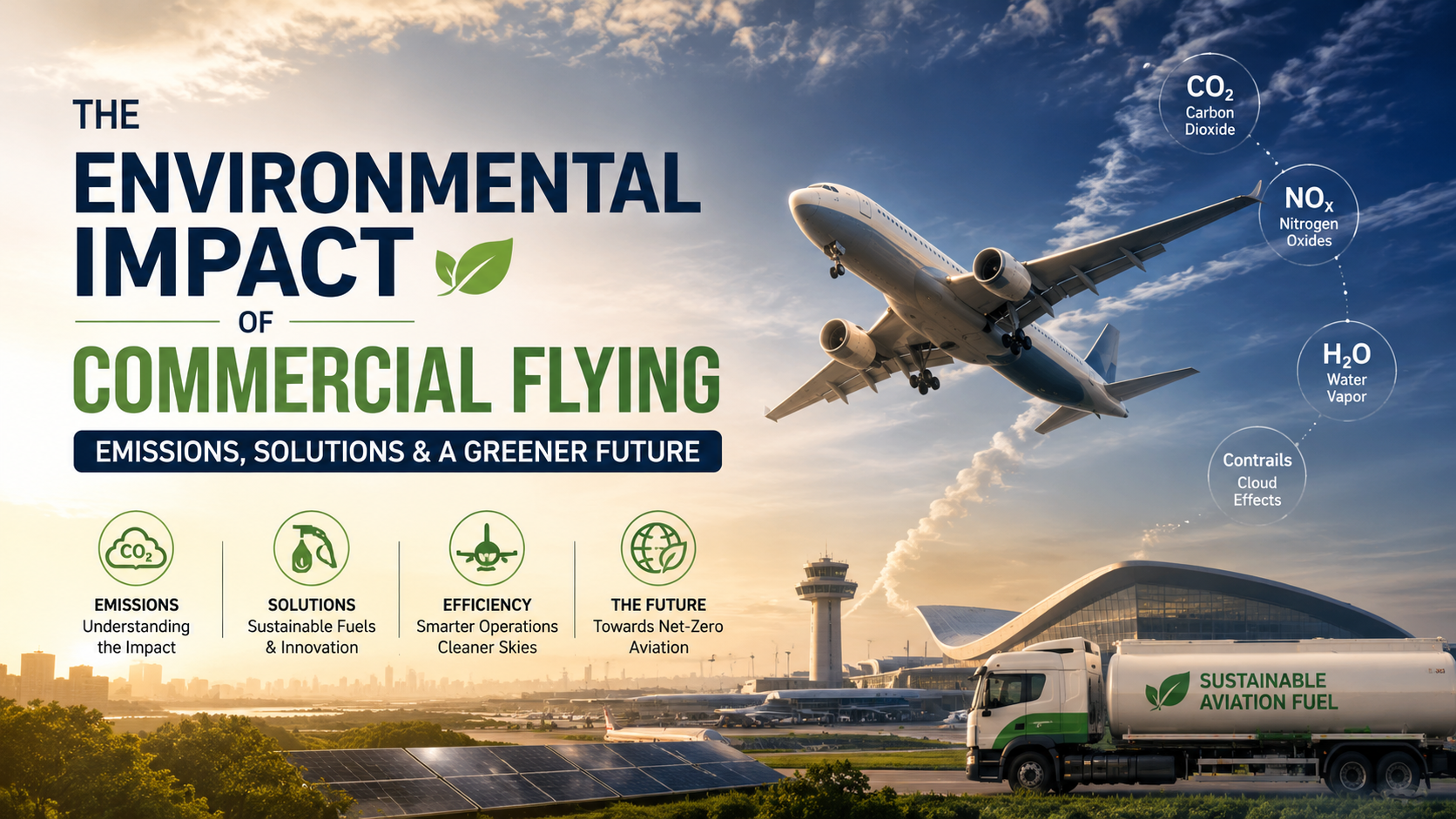
Commercial aircraft mainly create environmental impacts by burning aviation fuel. Jet fuel combustion releases carbon dioxide, water vapor, nitrogen oxides, and particulate matter into the atmosphere. Because these emissions occur at cruising altitude, their climate effects can differ from emissions released near the ground. Understanding how to lessen pollutants in the air can provide broader context on strategies for reducing harmful emissions.
Carbon dioxide remains a major long-term contributor to aviation’s climate impact. However, aviation also produces important non-CO₂ effects. These include nitrogen oxide chemistry, water vapor, soot particles, and persistent contrails. Under suitable atmospheric conditions, contrails can develop into cirrus clouds that influence how much heat remains within the Earth system.
Aircraft efficiency has improved substantially over time. New engines, lighter materials, better aerodynamics, and improved flight operations can reduce fuel consumption per passenger. However, rising demand for air travel can offset some efficiency gains.
Several measures can reduce the environmental impact of commercial flying, including:
- Greater use of sustainable aviation fuel.
- More efficient aircraft and engines.
- Better air traffic management and flight routing.
- Reduced congestion and unnecessary airborne holding.
- Development of hydrogen, electric, and hybrid propulsion.
SAF is particularly important because it can work as a drop-in fuel within existing aviation systems.
The Role of Non-CO2 Warming Effects
Non-CO₂ emissions make aviation’s climate impact more complex than simply measuring carbon dioxide. Aircraft release water vapor, nitrogen oxides, and soot at high altitudes. Under cold and humid conditions, soot can help form ice crystals that create condensation trails, commonly called contrails.
Some contrails disappear quickly. Others can persist and spread into larger areas of ice clouds. These clouds can alter the balance between incoming sunlight and outgoing heat. The resulting warming effect depends strongly on atmospheric conditions and the location and timing of the flight. Learn more about why white trails behind planes aren’t chemicals and what actually causes them.
Reducing these effects is therefore an important part of aviation climate research. Airlines and researchers can examine atmospheric conditions before and during flights. Aircraft may then adjust routes or altitudes when suitable alternatives are available.
However, avoiding contrails must also consider fuel consumption. A route change that reduces contrail formation could sometimes require additional fuel. Effective climate strategies must therefore evaluate CO₂ and non-CO₂ effects together, rather than treating either one in isolation.
What is the 80/20 rule in aviation?
The 80/20 rule in aviation is commonly used as a shorthand for the Pareto principle. It suggests that a relatively small group can account for a disproportionately large share of activity. In discussions about aviation emissions, this idea is sometimes applied to frequent flyers and long-distance travel.
However, the 80/20 ratio should not be treated as a universal aviation law. The exact distribution varies by country, income group, travel purpose, route, and dataset. Some frequent travelers generate much larger aviation footprints because they fly often or take long-haul journeys.
Long-distance flights can consume substantial amounts of fuel because aircraft must carry fuel, passengers, cargo, and equipment over thousands of kilometers. Premium cabins can also produce higher emissions per passenger because they use more cabin space.
The concept is still useful when discussing targeted climate policies. Policymakers can examine where the greatest emissions occur instead of applying identical measures to every traveler.
Potential approaches include:
- Improving aircraft efficiency on high-demand routes.
- Encouraging lower-carbon travel alternatives where practical.
- Applying effective carbon pricing.
- Supporting sustainable aviation fuel deployment.
- Improving emissions reporting for frequent and long-distance travel.
The key point is that the 80/20 rule should be presented as a general distribution concept, not as a fixed statistic for all aviation emissions.
Targeting Frequent Flyers and Long-Haul Corridors
Frequent flyers and long-haul passengers can have relatively large individual aviation footprints. This makes them important groups when policymakers evaluate demand-management strategies. However, policies must distinguish between essential travel and discretionary travel.
Long-haul routes also deserve attention because they involve large fuel requirements. Improving aircraft efficiency can therefore produce meaningful savings across high-volume international corridors.
Premium cabins create another consideration. Business and first-class seating generally uses more aircraft floor space per passenger. When emissions are allocated by passenger rather than by aircraft, this can increase the associated individual footprint.
Possible measures include better emissions information, carbon pricing, and incentives for lower-emission travel choices. Airlines can also improve efficiency through modern aircraft, optimized flight planning, and improved load management.
The objective should not simply be to reduce the number of flights. A more effective approach combines demand management with technological and operational improvements. This allows essential connectivity to continue while addressing areas where emissions reductions may be easier to achieve.
Why do pilots say “heavy”?
Pilots use the word “heavy” in radio communications to identify aircraft that fall into a specific wake turbulence category. In U.S. air traffic control procedures, the designation applies to aircraft capable of a takeoff weight of 300,000 pounds or more. The classification relates to wake turbulence rather than an aircraft’s environmental performance.
Large aircraft create strong wingtip vortices as they generate lift. These rotating air masses can remain behind the aircraft and create dangerous conditions for following aircraft. Controllers therefore use aircraft weight categories when determining appropriate separation.
The term is especially important during takeoff and landing. Controllers may provide additional spacing between aircraft based on their wake turbulence categories. This helps reduce the risk of a following aircraft encountering hazardous wake.
The environmental connection is indirect. Larger aircraft can burn more fuel during a flight, but aircraft size alone does not determine emissions per passenger. A newer, larger aircraft operating with a high passenger load can sometimes perform efficiently on a per-passenger basis.
It is therefore important to distinguish aviation safety terminology from environmental terminology. “Heavy” primarily describes wake turbulence requirements. It should not be interpreted as a direct measurement of an aircraft’s carbon footprint.
Wake Turbulence and Air Traffic Separation
Wake turbulence consists of rotating vortices produced behind an aircraft’s wings. These vortices can remain strong enough to affect another aircraft following too closely. The risk is particularly important when a lighter aircraft follows a heavier one.
Air traffic controllers use established separation procedures to reduce this risk. Aircraft weight categories help determine the required spacing under applicable procedures. The FAA defines heavy aircraft for wake turbulence purposes based on a takeoff weight threshold of 300,000 pounds or greater.
Wake management also has an indirect connection to aviation efficiency. Airports handle large numbers of departures and arrivals within limited runway capacity. Poor sequencing can create delays, holding patterns, and extended taxi times.
Reducing unnecessary waiting can lower fuel consumption and associated emissions. Modern air traffic management therefore aims to improve both safety and operational efficiency.
However, safety remains the primary consideration. Controllers cannot reduce required separation simply to save fuel. Environmental improvements must operate within established safety limits and procedures.
What will flying be like in 2050?
Flying in 2050 could look significantly different from today, but the exact aircraft technologies remain uncertain. The aviation industry is pursuing a combination of sustainable aviation fuel, improved aircraft efficiency, hydrogen, electric propulsion, and better operations.
SAF is expected to play a major role because it can be used in existing aircraft and airport fuel systems. Depending on the production pathway, SAF can significantly reduce lifecycle greenhouse gas emissions compared with conventional jet fuel. IATA currently identifies SAF as the largest potential contributor to aviation’s net-zero transition.
Electric and hybrid-electric aircraft are more likely to serve shorter routes because batteries have lower energy density than aviation fuel. Hydrogen could eventually support some regional or larger aircraft designs, but it requires major changes to aircraft and airport infrastructure.
Future aircraft may also use more efficient engines, advanced aerodynamics, lighter structures, and improved flight-control systems. Air traffic management could reduce unnecessary routing, congestion, and airborne delays.
However, 2050 should not be presented as a guaranteed technological outcome. Costs, infrastructure, certification, energy availability, and aircraft development timelines will determine which technologies become commercially viable.
Hydrogen and Electric Propulsion Breakthroughs
Hydrogen and electric propulsion could reduce aviation’s dependence on conventional jet fuel, particularly on shorter routes. However, neither technology can currently replace conventional propulsion across the entire commercial aviation network.
Battery-electric aircraft face a major energy-density challenge. Batteries are much heavier for the amount of usable energy they store compared with aviation fuel. This limits the practical range and size of battery-powered aircraft.
Hydrogen presents a different opportunity. Hydrogen can contain substantial energy by mass, but storing it requires specialized tanks and aircraft designs. Airports would also need new systems for hydrogen production, transportation, storage, and refueling.
Hydrogen-powered aircraft could potentially eliminate direct carbon dioxide emissions during flight. Their overall climate benefit would still depend on how the hydrogen is produced.
Hybrid-electric systems may provide another pathway. They could combine electric motors with conventional or alternative energy sources to improve efficiency on suitable routes.
Industry roadmaps continue to study battery, hybrid, hydrogen, and SAF-powered aircraft as complementary technologies.
Environmental impact of airports
The environmental impact of commercial flying does not end when aircraft land. Airports create their own environmental footprint through energy use, ground transportation, construction, waste, noise, and local air pollution.
Large airports require extensive infrastructure. Runways, terminals, parking areas, access roads, and maintenance facilities can alter surrounding land and habitats. Construction can also increase resource consumption and create temporary environmental impacts. Choosing sustainable construction materials can help reduce some of the environmental impacts associated with infrastructure development.
Airport operations can affect nearby communities through aircraft noise. Ground vehicles and equipment can also release nitrogen oxides and particulate matter. Road traffic around busy terminals can add further local air pollution.
Water and soil can face risks from fuel handling, maintenance activities, and chemicals used during aircraft operations. Deicing fluids are particularly important at airports that experience freezing conditions.
Airports are therefore investing in measures that reduce their operational footprint. These can include renewable electricity, electric ground-support equipment, fixed electrical ground power, energy-efficient buildings, and public transportation connections. Renewable sources such as offshore wind farms can also contribute to broader efforts to expand low-carbon electricity generation.
Improving airport infrastructure can reduce emissions even when aircraft technology remains unchanged. Better ground operations can also reduce aircraft fuel burn by limiting unnecessary engine use, taxiing, and delays.
Managing Noise Pollution and Local Air Quality
Aircraft noise remains one of the most visible local environmental effects of airport operations. Repeated aircraft movements can affect communities near busy airports, particularly during nighttime hours. Airports and aviation authorities therefore use measures such as noise restrictions, operating procedures, and optimized flight paths. Understanding how noise cancellation works also provides useful context for the broader science of managing unwanted sound.
Local air quality is another concern. Aircraft engines emit nitrogen oxides and particulate matter during takeoff, landing, taxiing, and other phases of operation. Ground equipment and road vehicles around terminals can add further emissions.
One useful measure is fixed electrical ground power. It allows aircraft to use electricity from airport systems while parked instead of relying as heavily on onboard auxiliary power units. Electric ground-support equipment can provide additional reductions in local emissions.
Public transportation can also reduce the environmental footprint of airport access. Rail links, buses, and other shared transport options can reduce the number of private vehicles traveling to terminals.
Effective airport sustainability therefore requires more than quieter aircraft. It involves coordinated improvements in aircraft operations, ground equipment, energy systems, transportation access, and land-use planning.
FAQ SECTION
How much do non-CO2 emissions contribute to aviation warming?
Non-CO₂ effects make up a substantial share of the environmental impact of commercial flying. Contrail cirrus and nitrogen oxide effects can increase aviation’s overall warming impact beyond carbon dioxide alone. Their influence depends on altitude, location, weather, and atmospheric conditions. Researchers are studying route and altitude changes that could reduce persistent contrails. These measures could lower aviation’s overall climate impact while maintaining safe and efficient flight operations.
What are Sustainable Aviation Fuels (SAF)?
Sustainable Aviation Fuels (SAF) are alternative fuels designed to reduce aviation’s lifecycle greenhouse gas emissions. They can be produced from sources such as used cooking oils, agricultural residues, municipal waste, and other eligible feedstocks. Some emerging pathways also use captured carbon and renewable energy. SAF can be blended with conventional jet fuel under approved standards. Expanding SAF production and supply is considered an important part of reducing the environmental impact of commercial flying. However, limited supply, production costs, and feedstock availability remain major challenges.
Do carbon offset programs actually reduce flight emissions?
Carbon offsets do not directly reduce emissions produced by the aircraft during a flight. Instead, they fund projects intended to compensate for emissions elsewhere. These projects can include forest protection, reforestation, methane capture, or renewable energy initiatives. Their effectiveness depends on additionality, accurate measurement, permanence, and credible verification. Some offset projects may deliver weaker climate benefits than claimed. Therefore, offsets should not replace direct reductions in aviation fuel use and emissions. They are better viewed as a supplementary measure within broader strategies addressing the environmental impact of commercial flying.
Can electric planes replace commercial airliners?
Electric aircraft could reduce the environmental impact of commercial flying on suitable short routes, but current battery technology limits their size and range. Batteries store less usable energy per kilogram than aviation fuel, creating major weight challenges for larger aircraft. As battery technology improves, electric propulsion may become practical for more regional routes. Hybrid-electric systems could also extend aircraft capabilities. However, large long-haul airliners will likely require energy-dense solutions such as sustainable aviation fuels or potentially hydrogen-based propulsion for many years.
Conclusion
Understanding the environmental impact of commercial flying reveals the complex challenge of balancing global connectivity with urgent climate action. From managing high-altitude contrails and understanding operational rules like the 80/20 principle to redesigning sustainable airport infrastructure, the aviation sector faces a critical transformation. Achieving a greener future requires a combination of revolutionary propulsion technologies, widespread adoption of sustainable aviation fuels, and conscious travel habits. By supporting ongoing industry innovations and adopting efficient routing practices, the global community can work toward a truly sustainable future for air travel by 2050.