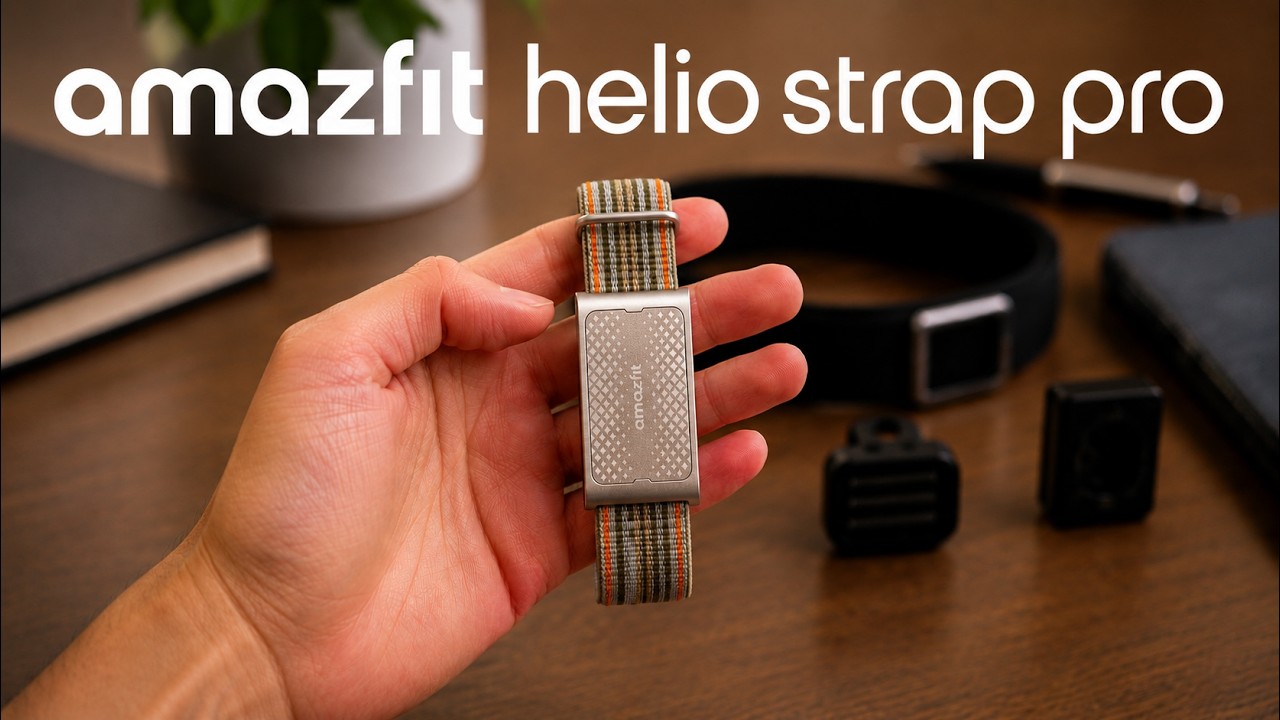
Amazfit Helio Strap Pro: The Ultimate Hybrid Training Guide
The Amazfit Helio Strap Pro represents a new direction in fitness tracking technology from Amazfit. Modern athletes no longer want simple step counters. Instead, they demand accurate performance metrics, deeper recovery insights, and detailed movement analysis.
As a result, a new category of wearable technology has emerged. Rather than focusing only on general wellness, manufacturers are now creating devices specifically for serious athletes, hybrid competitors, and functional fitness enthusiasts.
Launched in June 2026 at the HYROX World Championship in Stockholm, the Amazfit Helio Strap Pro is one of the most ambitious products in this category. Specifically, it targets athletes who need accurate biometric data during demanding workouts and high-intensity training sessions.
However, traditional smartwatches often struggle during complex movements. For example, heart-rate sensors can lose accuracy during exercises involving heavy gripping, rapid wrist movement, or loaded carries. Consequently, these limitations can reduce the reliability of workout data.
The Amazfit Helio Strap Pro solves this problem with a dual-sensor system. Instead of relying on a single wrist-based sensor, it tracks both physiological performance and body movement. As a result, athletes receive a more complete picture of training intensity, fatigue, and efficiency.
In this guide, we will explore how the Amazfit Helio Strap Pro works, what makes it different from competing wearables, and whether it deserves a place in your training setup.
What Is the Amazfit Helio Strap Pro?
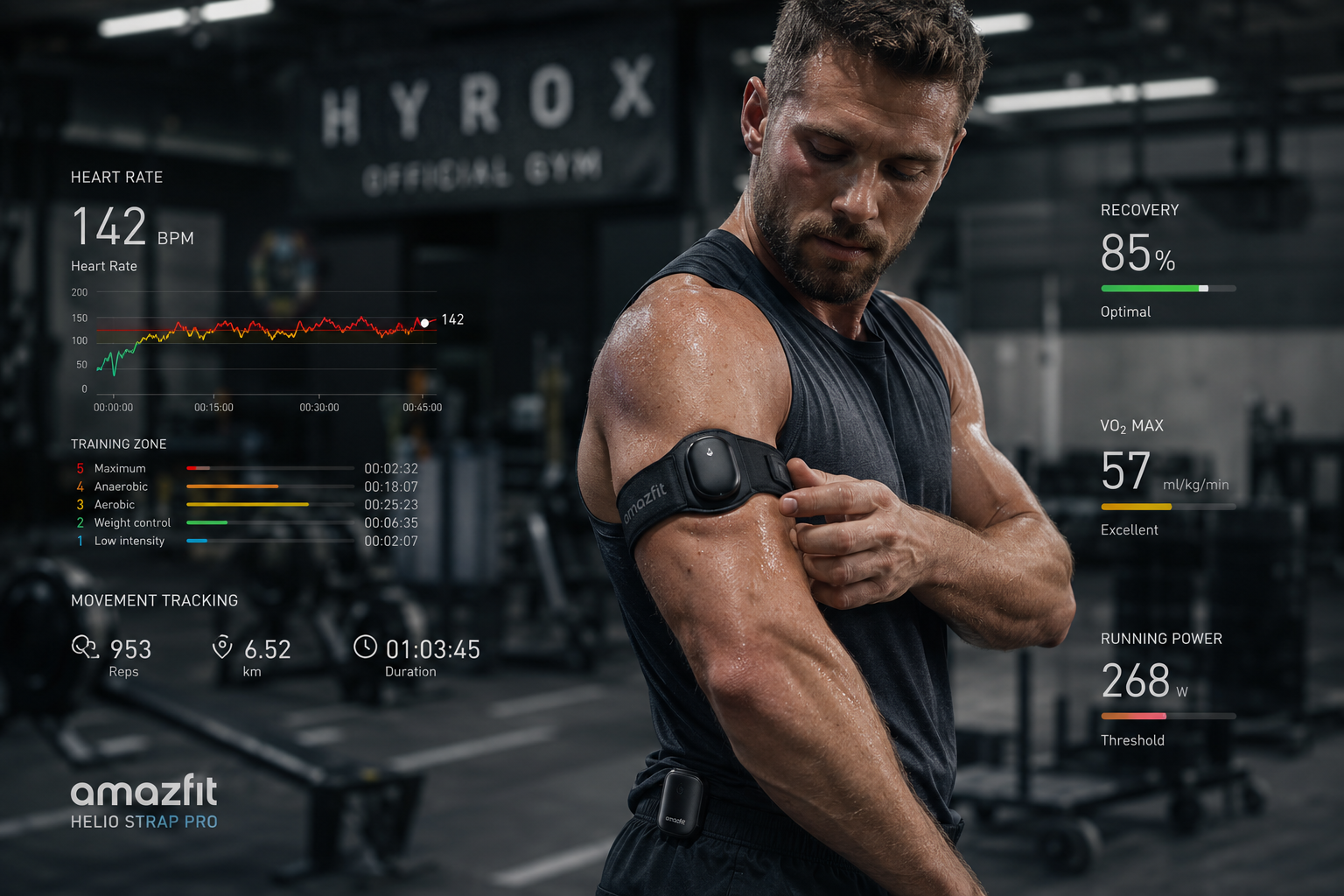
The Amazfit Helio Strap Pro is a premium dual-sensor sports tracking platform designed for functional fitness, hybrid racing, and high-intensity training environments.
Unlike traditional smartwatches, the device does not include a display. Instead, the Amazfit Helio Strap Pro focuses entirely on collecting accurate biometric and movement data. Therefore, athletes can train without distractions while still capturing detailed performance information.
The system includes two separate hardware components:
- Helio Core Motion HR
- Helio Core Motion Waist
First, athletes can wear the Core Motion HR sensor on either the wrist or upper arm. This module contains the upgraded BioTracker 6.0 optical sensor. Furthermore, it uses five photodiodes and two LEDs to monitor heart rate and blood oxygen levels with improved precision.
Meanwhile, the second component attaches to the athlete’s waist. This lightweight tracking pod measures movement patterns, posture, and stability metrics that wrist devices often miss.
Together, these sensors create a more complete performance profile. While one sensor measures physiological stress, the other tracks movement quality and structural efficiency.
Because of this dual-sensor design, athletes can understand not only how hard they are training but also how effectively they are moving. Ultimately, this deeper analysis helps identify performance limitations and improve future workouts.
Amazfit Helio Strap Pro Dual-Sensor Architecture Explained
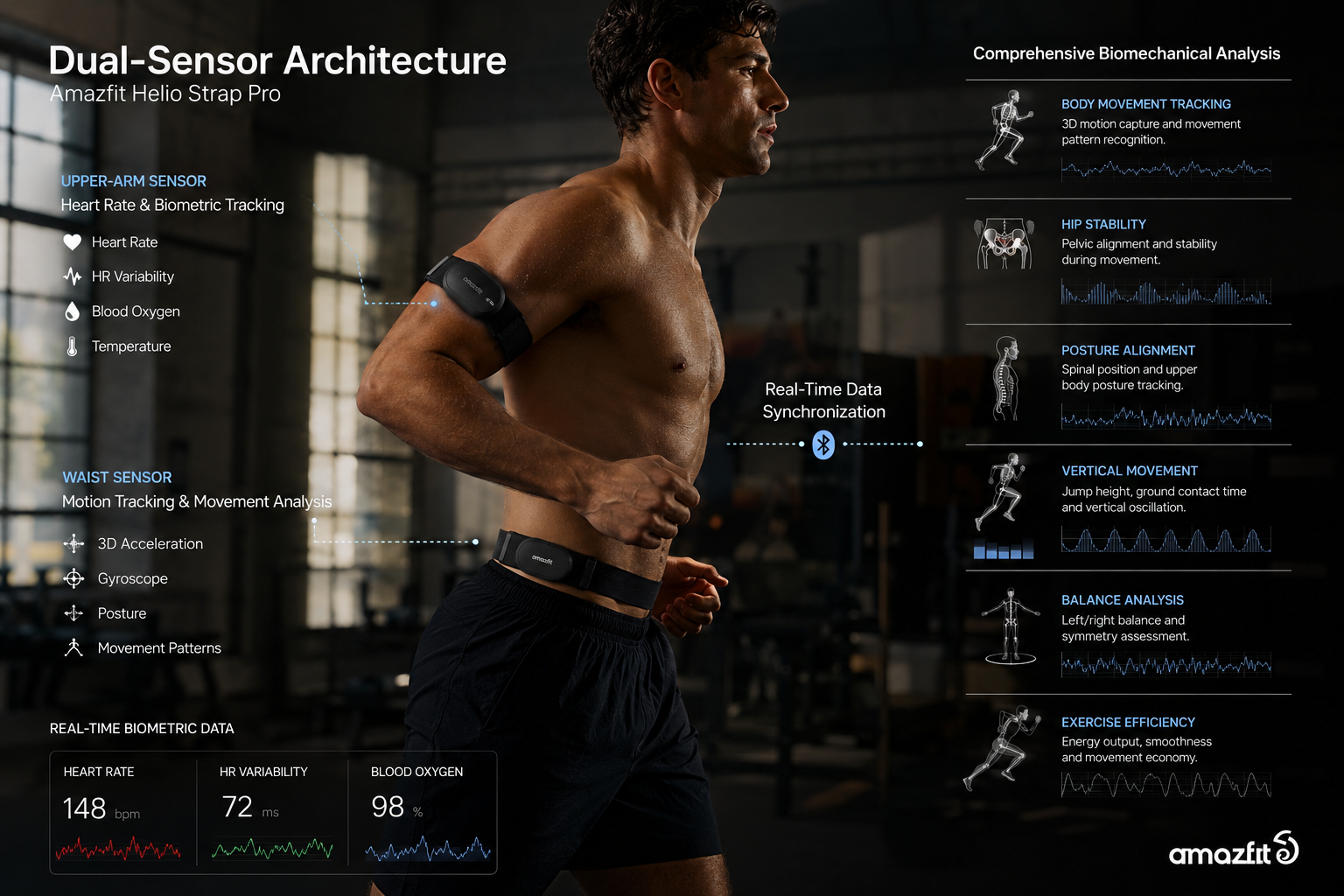
The Amazfit Helio Strap Pro stands out because of its unique hardware design.
The upper-arm sensor contains a 9-axis inertial measurement unit. This system combines:
- A three-axis accelerometer
- A three-axis gyroscope
- A geomagnetic sensor
These components help identify movement patterns, exercise types, and body positioning with impressive accuracy.
Despite its advanced capabilities, the module weighs only 11.4 grams. Therefore, most athletes will barely notice it during intense training sessions.
The waist-mounted pod serves a different purpose. Instead, it acts as a central reference point for movement tracking.
When attached to a waistband or lifting belt, it measures:
- Vertical oscillation
- Pelvic stability
- Lateral movement
- Hip extension power
- Core positioning
As a result, the Amazfit Helio Strap Pro captures movement information that traditional wrist trackers cannot provide.
During explosive exercises such as burpee broad jumps, sled pushes, and Olympic lifts, the sensor records how efficiently the body generates and transfers force.
The software then combines data from both sensors. For example, an athlete may show an increasing heart rate while movement efficiency declines. In this situation, the system can identify fatigue rather than simply detecting reduced effort.
This distinction helps athletes make smarter training decisions and reduce the risk of overtraining.
Amazfit Helio Strap Pro Performance Metrics for Hybrid Athletes
Hybrid sports place unique demands on the body.
Athletes must transition quickly between strength movements and cardiovascular efforts. For example, a HYROX competitor may move from sled pushes to rowing intervals and then immediately perform lunges or wall balls.
Traditional fitness trackers often struggle to analyze these rapid changes.
However, the Amazfit Helio Strap Pro addresses this challenge with activity-specific performance analysis.
The platform supports detailed tracking for:
- SkiErg sessions
- Rowing intervals
- Sled pushes
- Sled pulls
- Farmer’s carries
- Sandbag lunges
- Burpee broad jumps
- Wall balls
- Plyometric exercises
Instead of treating the workout as one continuous effort, the system evaluates each movement category separately.
During a farmer’s carry, for example, the upper-arm sensor measures cardiovascular strain. At the same time, the waist sensor tracks body sway and core stability.
Therefore, athletes can see exactly when fatigue begins to affect technique and performance.
After training, users can review detailed muscle load and movement efficiency reports inside the Zepp app.
These insights make it easier to identify weaknesses, adjust training plans, and improve future performance.
The Zepp App Experience
The hardware is only one part of the ecosystem.
The Zepp App acts as the platform’s analytical hub. It collects data from training sessions, sleep tracking, daily activity, and recovery monitoring.
The app organizes this information into clear dashboards and performance reports.
Bluetooth 5.2 connectivity ensures stable communication between the sensors, smartphone, and compatible Amazfit smartwatch.
One of the platform’s most interesting features is HybridCharge Energy Intelligence.
This recovery framework combines multiple factors to estimate readiness and recovery status.
BioCharge
BioCharge analyzes physiological recovery.
It focuses on:
- Heart rate variability (HRV)
- Resting heart rate
- Recovery trends
These metrics help athletes understand how well their nervous system has recovered.
Training Load
Training Load measures accumulated exercise stress.
The platform compares recent workload against long-term training history.
This comparison helps athletes avoid sudden spikes that increase injury risk.
LifeLoad
LifeLoad evaluates factors outside the gym.
It includes:
- Sleep quality
- Daily movement
- Stress levels
- General activity
This category recognizes that recovery depends on more than training alone.
Together, these three pillars provide a comprehensive readiness score.
Third-Party Integrations
Many athletes use multiple fitness platforms.
Amazfit addresses this need through broad integration support.
Users can sync workout data with:
- Strava
- TrainingPeaks
- Apple Health
These integrations make it easier to share performance data with coaches, training partners, and healthcare professionals.
The open ecosystem also reduces the risk of getting locked into a single platform.
Pricing and Availability
The Amazfit Helio Strap Pro launched with a retail price of $199.99 in the United States.
The package includes:
- Core Motion HR sensor
- Core Motion Waist sensor
- Performance bands
- Waist clip
- Magnetic charging cradle
For serious athletes, this pricing places the device in direct competition with premium fitness wearables.
Smartwatch Compatibility
At launch, the Helio Strap Pro requires a compatible Amazfit smartwatch to unlock its full range of features. Without a supported watch, athletes can still track basic biometric data. However, they won’t have access to the platform’s most advanced movement analytics.
Currently, the system supports the following smartwatch models:
- Amazfit Balance 3
- Amazfit Balance Ultra
These watches serve as processing hubs during workouts. In other words, they collect, synchronize, and process data from both tracking sensors in real time.
As a result, athletes receive a more detailed view of their physiological and biomechanical performance. Furthermore, the smartwatch helps combine heart-rate data with movement metrics to create a complete training profile.
The standalone sensors can still function independently for everyday tracking. However, advanced features such as dual-sensor movement analysis, exercise-specific insights, and detailed performance breakdowns require the full Amazfit ecosystem.
Therefore, athletes who want to take advantage of the platform’s complete capabilities should pair the Helio Strap Pro with a compatible Amazfit smartwatch.
Technical Specifications
| Category | Details |
|---|---|
| Compatible Watches | Amazfit Balance 3, Balance Ultra |
| Smartphone Support | Android 8.0+ and iOS 17+ |
| Data Platform | Zepp App |
| Core Metrics Subscription | Free |
| Third-Party Integrations | Strava, Apple Health, TrainingPeaks |
A Subscription-Free Advantage
Many competing fitness platforms rely on subscription revenue.
Athletes often pay monthly fees to access recovery scores, sleep analysis, and historical performance data.
Amazfit takes a different approach.
The company provides access to core biometric metrics without a recurring subscription.
For long-term users, this policy can result in significant savings over several years.
That advantage strengthens the overall value proposition of the Helio Strap Pro.
Frequently Asked Questions
Is the Helio Strap Pro Better Than Whoop?
The Helio Strap Pro compares favorably with Whoop for many hybrid athletes. While both devices focus on recovery and performance tracking, they take different approaches to data collection.
Whoop primarily relies on a single sensor location. As a result, signal quality can vary depending on sensor placement and exercise type. During certain functional fitness movements, this may affect data consistency.
In contrast, the Helio Strap Pro uses a dual-sensor architecture. Alongside its biometric sensor, it includes a dedicated motion sensor that tracks movement mechanics. Consequently, athletes gain deeper insights into posture, stability, and structural fatigue throughout a workout.
Furthermore, the additional movement data helps identify performance breakdowns that a single-sensor system may overlook. This can be particularly valuable for HYROX competitors and functional fitness athletes.
Another major advantage is pricing. Unlike Whoop, which requires an ongoing subscription, the Helio Strap Pro provides access to core metrics without recurring fees. Therefore, it may offer better long-term value for budget-conscious athletes.
Is the Helio Strap Pro Worth Buying?
For HYROX athletes, functional fitness enthusiasts, and competitive cross-trainers, the answer is likely yes. The platform delivers performance insights that most traditional wearables cannot provide.
In particular, its movement analysis features help athletes understand how fatigue influences technique, posture, and overall efficiency. As a result, users can make more informed training decisions and target specific weaknesses.
Additionally, the dual-sensor system offers a deeper understanding of both physiological strain and movement quality. This combination makes the platform especially useful for athletes who regularly perform complex, high-intensity workouts.
However, not every athlete needs this level of analysis. If your training mainly consists of walking, running, cycling, or basic gym sessions, many of the advanced features may go unused.
In that case, a traditional multisport smartwatch could provide better overall value. Ultimately, the Helio Strap Pro makes the most sense for athletes who want detailed biomechanical insights and are committed to optimizing every aspect of their performance.
Does the Helio Strap Pro Measure Blood Oxygen?
Yes, the Helio Strap Pro can monitor blood oxygen levels through its BioTracker 6.0 sensor system.
The sensor tracks blood oxygen saturation (SpO₂) alongside heart rate and recovery metrics. As a result, athletes can gain a broader understanding of their body’s response to different training conditions.
Furthermore, SpO₂ data can help users evaluate how their bodies adapt to exercise intensity, recovery demands, and environmental changes. For example, athletes may use these insights to better understand recovery patterns after demanding workouts.
However, blood oxygen measurements represent only one part of the overall performance picture. When combined with heart-rate trends, movement data, and recovery analysis, the Helio Strap Pro provides a more complete view of training readiness.
Conclusion
The Amazfit Helio Strap Pro represents a significant milestone in specialized wearable fitness tech by moving past the limitations of traditional single-device wrist trackers. By separating data collection across an upper-arm biometric sensor and a waist-mounted motion pod, this innovative system provides cross-trainers and hybrid athletes with an incredibly accurate view of physical strain and biomechanical form. It eliminates the data interference caused by heavy gripping movements, delivering clean heart rate data alongside deep structural stability analysis. Combined with the subscription-free analytical power of the Zepp App dashboard, it stands out as an exceptional tool for anyone serious about optimizing their functional movement and athletic longevity.
If you want to take your hybrid training and recovery metrics to elite levels, investing in this multi-sensor tracking platform is a smart, forward-thinking move. Before making your decision, you may also want to explore how modern fitness tracking technologies compare in our comprehensive guide to Google Fitbit Air Fitness Tracker features and benefits. To get started, evaluate your current hardware setup to ensure compatibility with an Amazfit hub watch like the Balance 3 series, allowing you to seamlessly integrate dual-sensor movement intelligence into your next training block.