
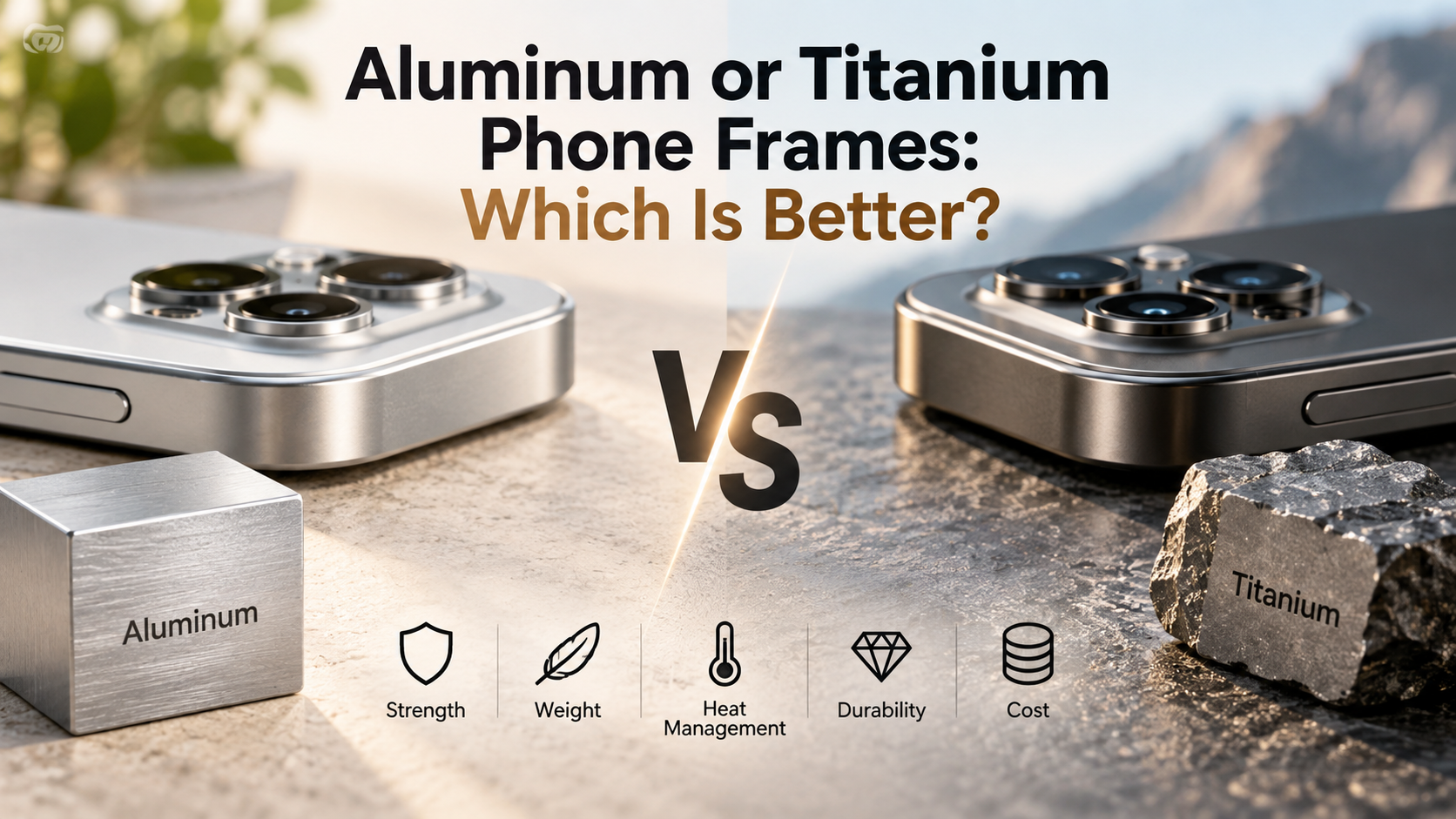
Is Aluminum or Titanium Better for Phone Frames?
Modern smartphones face drops, scratches, heat, and constant handling. That makes the material around the edges important for everyday durability. When comparing aluminum or titanium phone frames, you are balancing strength, weight, thermal performance, and manufacturing cost.
Materials engineering organizations such as ASM International explain how alloy composition affects properties such as strength, hardness, and ductility. However, a phone frame is only one part of a device’s durability. The glass, internal structure, adhesives, and frame design also affect how a phone survives impacts.
Aluminum and titanium also behave differently around heat. Aluminum conducts heat much more effectively, while titanium offers higher strength and hardness at comparable dimensions. Weight also matters because the frame contributes to the phone’s overall feel in your hand.
This guide compares aluminum vs. titanium phone frames across strength, heat management, weight, durability, and practical use. It also looks at Apple’s recent material choices and the frame material used in the iPhone 17 lineup. Understanding these differences can help you choose a phone based on how you actually use it.

Is a titanium or aluminum phone better?
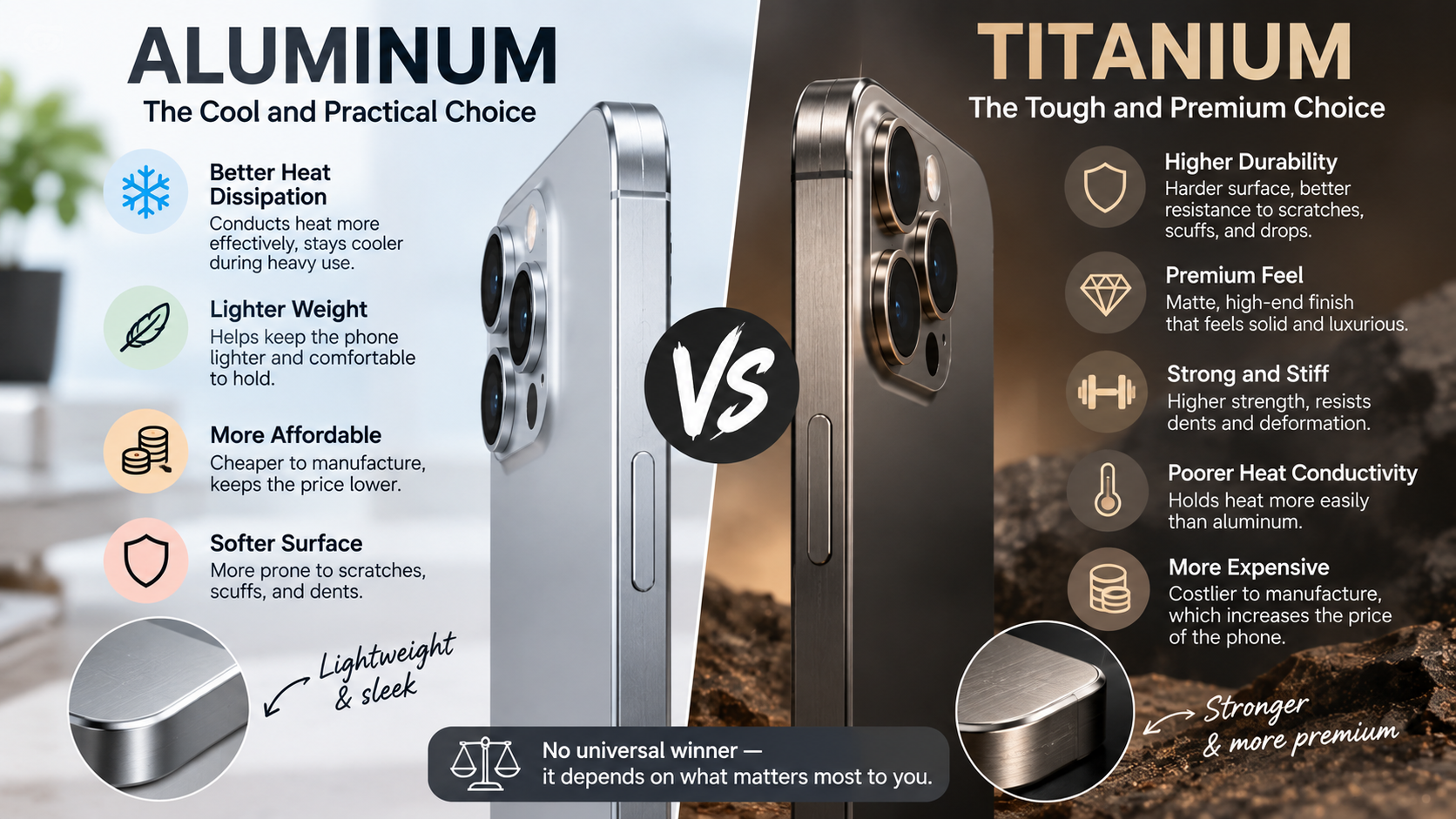
There is no universal winner between a titanium and aluminum phone. The better option depends on which characteristics matter most to you. Titanium offers higher strength and hardness, while aluminum generally provides better thermal conductivity and lower material and manufacturing costs.
Titanium can provide a premium feel and strong resistance to dents and surface wear. It also has an excellent strength-to-weight ratio. However, titanium is not automatically more durable in every real-world situation. The phone’s glass, internal structure, frame thickness, and overall construction still play major roles.
Aluminum has several practical advantages for everyday smartphones. It is lightweight, relatively easy to machine, and highly conductive. Those characteristics make it useful for managing heat generated by processors, batteries, and charging systems. Avoiding smartphone mistakes that reduce battery life can also help maintain long-term device performance.
For buyers comparing aluminum or titanium phone frames, consider these factors:
- Titanium: higher strength, hardness, and premium construction.
- Aluminum: lighter manufacturing, better thermal conductivity, and lower cost.
- Both: can provide excellent durability when properly engineered.
- Overall durability: depends on the complete phone design, not the frame material alone.
Thermal Dissipation Versus Premium Surface Feel
Thermal performance is one of the biggest differences between aluminum and titanium. Aluminum conducts heat far more effectively than titanium. Pure aluminum has thermal conductivity around 235 W/m·K, while titanium alloys are typically around 6–7 W/m·K.
That difference does not mean an aluminum phone will always feel cooler. Manufacturers use internal graphite, copper, vapor chambers, thermal pads, and other components. These systems can have a greater effect on sustained temperatures than the outer frame alone.
Titanium can still provide a premium surface finish and strong resistance to dents. However, surface durability also depends on the coating and finishing process. A titanium frame is not automatically scratch-proof.
For demanding activities such as gaming or long video recording, thermal design matters more than the frame material alone. Look at the complete cooling system rather than assuming the metal determines performance. Proper charging habits also matter, so understanding common phone charging myths can help protect battery performance.
In practical terms:
- Aluminum: excellent thermal conductivity and lightweight construction.
- Titanium: high strength with relatively low weight.
- Cooling: depends on the entire thermal architecture.
- Surface durability: depends on the alloy and finish.
Is an aluminum frame better than a titanium frame?
An aluminum frame can be better than titanium when you prioritize low weight, thermal conductivity, and manufacturing efficiency. Aluminum is widely used in consumer electronics because it combines relatively low density with useful strength and excellent machinability.
Aluminum alloys can also absorb some impact energy through controlled deformation. However, this does not mean aluminum automatically protects a phone better during a drop. The frame’s geometry and the surrounding glass structure are equally important.
Titanium offers greater strength and hardness in many commonly used alloys. That can help reduce dents and deformation under certain loads. It also allows manufacturers to achieve high structural strength without adding excessive weight.
The practical difference therefore depends on the phone’s complete construction. A well-designed aluminum phone can be extremely durable. A titanium phone can also suffer serious damage if its glass or internal components take the impact.
For everyday buyers, the main differences are:
- Aluminum: lightweight, thermally conductive, and easier to manufacture.
- Titanium: stronger and harder in many applications.
- Drop protection: depends on the complete chassis and glass design.
- Repair costs: depend more on the manufacturer’s construction and parts availability.
Impact Absorption and Component Safety
Aluminum and titanium respond differently when subjected to mechanical forces. Aluminum alloys generally have good ductility, which allows them to deform before failure. Titanium alloys can provide higher strength while also maintaining useful ductility. This difference is also relevant when comparing why Samsung stopped using titanium on flagships.
However, it is inaccurate to say that aluminum always protects internal components better. During a phone drop, energy travels through the frame, glass, adhesives, and internal structure. The direction and location of the impact also affect the result.
A slightly deformed frame can sometimes absorb energy. Yet excessive deformation can also create problems for the display, back glass, buttons, or internal components. Titanium’s greater strength can reduce deformation, but that does not mean it simply transfers destructive energy into the glass. Protecting these components also matters because smartphone camera technology continues to become more sophisticated.
Manufacturers therefore optimize the complete structure rather than selecting a metal based on strength alone. Important design considerations include:
- Frame geometry: determines how forces move through the chassis.
- Material thickness: affects stiffness and deformation.
- Glass design: strongly influences drop survival.
- Internal supports: help protect sensitive components.
- Adhesives: can influence how impact forces are distributed.
This makes overall construction more important than the metal name alone.
Is titanium stronger than aluminum?
Titanium is generally stronger than aluminum by weight and volume, although the exact difference depends on the alloys being compared. Grade 5 titanium, for example, has a tensile strength commonly around 900 MPa. Some high-strength 7000-series aluminum alloys can exceed 500 MPa.
Strength is only one measurement, though. Titanium also has a higher density than aluminum. That means an equally sized titanium frame will generally weigh more. Aluminum therefore remains attractive when manufacturers need low weight and sufficient structural strength.
Titanium also has a higher elastic modulus than aluminum. This means it is stiffer under the same dimensions and loading conditions. However, phone manufacturers can change frame thickness and geometry to achieve their desired stiffness.
It is also important to separate strength from scratch resistance. Titanium itself is not immune to scratches. Surface treatments, coatings, and finishes can significantly influence how a phone looks after prolonged use.
When comparing phone frames, consider:
- Strength: titanium is generally stronger.
- Stiffness: titanium has a higher elastic modulus.
- Weight: aluminum is significantly lighter.
- Scratch resistance: depends heavily on surface treatment.
- Real-world durability: depends on the complete phone design.
Tensile Yield and Structural Rigidity Limits
Yield strength describes the stress at which a material begins to deform permanently. Titanium alloys generally provide higher strength than many common aluminum alloys. Their higher elastic modulus also makes titanium stiffer when comparing identical dimensions.
However, phone frames are not simple laboratory test bars. Manufacturers adjust the thickness, shape, corners, openings, and internal supports to achieve the required structural performance. Because of this, comparing raw material strength alone does not reveal how two finished smartphones will behave.
A thicker aluminum frame can provide substantial stiffness while remaining lightweight. A titanium frame can achieve high strength with less material, but titanium itself is denser and more difficult to machine.
This distinction matters when evaluating smartphone durability. A titanium phone is not automatically twice as resistant to bending as an aluminum phone. The exact result depends on alloy selection, frame dimensions, and structural design.
Key factors include:
- Yield strength: resistance to permanent deformation.
- Elastic modulus: resistance to elastic bending.
- Frame geometry: strongly affects stiffness.
- Material thickness: changes structural performance.
- Phone construction: determines how laboratory properties translate into real use.
Therefore, material specifications should be viewed alongside the phone’s complete engineering design.
Why did Apple stop using titanium?
Apple has not simply abandoned titanium across its smartphone lineup. Instead, its material choices have changed between different iPhone models and generations. Titanium was introduced with the iPhone 15 Pro and iPhone 15 Pro Max, replacing the stainless-steel frame used on previous Pro models.
For the iPhone 16 Pro generation, Apple continued using titanium. The company then changed the Pro models’ frame construction for the iPhone 17 generation, moving to an aluminum unibody design.
The change reflects several engineering considerations. Aluminum is lighter than titanium and has much higher thermal conductivity. It is also easier to machine and widely established in high-volume electronics manufacturing.
However, it would be misleading to claim that Apple changed materials because titanium simply trapped processor heat. Smartphone thermal management involves multiple layers, including vapor chambers, graphite, heat spreaders, internal frames, and software controls. These factors can also influence why a phone slows down over time.
Apple’s material decisions can therefore reflect several factors at once. These may include weight, thermal management, structural requirements, manufacturing processes, cost, and industrial design.
Thermal Conductivity Bottlenecks and Manufacturing Costs
Titanium has much lower thermal conductivity than aluminum. This makes aluminum more effective at spreading heat when the metal itself forms part of the thermal path. However, the outer frame is only one component in a modern smartphone’s cooling system.
Phones typically rely on dedicated thermal materials and structures. These can include copper, graphite, vapor chambers, thermal interface materials, and internal heat spreaders. Their arrangement determines how processor heat moves through the device. Battery usage also matters, making ways to improve iPhone battery life relevant to overall phone efficiency.
Manufacturing is another important consideration. Titanium is generally harder to machine than aluminum. That can increase machining complexity and affect production requirements. Aluminum is widely used because it offers a useful combination of low density, machinability, strength, and thermal conductivity.
Still, the choice cannot be reduced to cost alone. Manufacturers balance several competing requirements when designing a phone chassis.
Important considerations include:
- Thermal conductivity: aluminum has a major advantage.
- Machining: aluminum is generally easier to process.
- Strength: titanium offers higher strength in many alloys.
- Weight: aluminum is lighter.
- Production: manufacturing complexity varies by design and process.
The frame material is therefore one part of a much larger engineering decision.
What material is the iPhone 17 frame made of?
The iPhone 17 lineup also uses different construction approaches between models. Therefore, it is important not to describe the entire lineup as having one identical chassis design. These differences become especially relevant when comparing the iPhone 18 Pro and iPhone 18 Pro Max.
The move to aluminum gives Apple a lighter and more thermally conductive structural material. However, the exact alloy specification should not be described as a confirmed 7000-series alloy unless Apple officially provides that detail. Apple often describes its materials and manufacturing processes without publishing every alloy composition.
The iPhone 17 lineup also uses different construction approaches between models. Therefore, it is important not to describe the entire lineup as having one identical chassis design.
For buyers comparing aluminum or titanium phone frames, the iPhone 17 family provides a useful example. Material choice is not simply about which metal is stronger. Apple also has to balance weight, stiffness, heat management, manufacturing, appearance, and overall device architecture.
The key points are:
- iPhone 17: aluminum frame.
- iPhone 17 Pro models: aluminum unibody construction.
- Previous Pro generation: titanium frame.
- Exact alloy composition: not fully specified by Apple.
- Material choice: reflects several engineering requirements.
Advanced 7000-Series Alloy Engineering
It is tempting to describe the iPhone 17’s aluminum as a confirmed 7000-series alloy. However, that level of specificity should be avoided unless Apple or another reliable technical source confirms it.
Aluminum smartphone frames can use different alloy compositions and surface treatments. Manufacturers may also use machining, anodizing, blasting, polishing, or other finishing techniques to achieve the desired appearance and durability.
Surface treatment can improve resistance to everyday wear. However, it does not make an aluminum frame completely scratch-proof. The final result depends on the alloy, finish, coating, and how the phone is used.
The broader engineering goal is to balance several properties. These include low weight, structural strength, thermal performance, manufacturability, and appearance.
For the iPhone 17 generation, Apple’s move toward aluminum should therefore be viewed as a broader chassis redesign. It is not proof that aluminum is universally superior to titanium.
When comparing the two materials, remember:
- Aluminum: lighter and more thermally conductive.
- Titanium: stronger and stiffer in many comparable applications.
- Surface finish: affects scratch and wear resistance.
- Phone design: determines real-world durability.
The best choice ultimately depends on how the manufacturer uses the material, not just the material itself.
Conclusion
Choosing between aluminum or titanium phone frames requires balancing raw structural toughness against practical everyday ergonomics. Titanium offers undeniable prestige, unmatched tensile yield strength, and robust resistance to deep structural dents. It shields internal hardware from bending forces, making it an exceptional outer shield for demanding operating environments.
Conversely, aluminum stands out as an engineering marvel for daily usability. Its superior thermal conductivity keeps modern mobile processors cool, preventing performance throttling during intense gaming, video rendering, and high-wattage charging. Aluminum is also noticeably lighter, reducing muscle strain during prolonged single-handed use, and its lower production cost makes repair and replacement far more accessible.
If your routine exposes your device to rugged worksites, sharp abrasives, and severe drops, a titanium chassis provides valuable defensive insurance. However, if you spend most of your day gaming, streaming, or running resource-heavy applications, an aluminum frame delivers cooler operational temperatures and lightweight comfort. Assess your daily habits, thermal demands, and handling preferences to choose the frame material that best protects your mobile investment.