Gurukul Education System in Ancient India: History, Subjects, and Methods
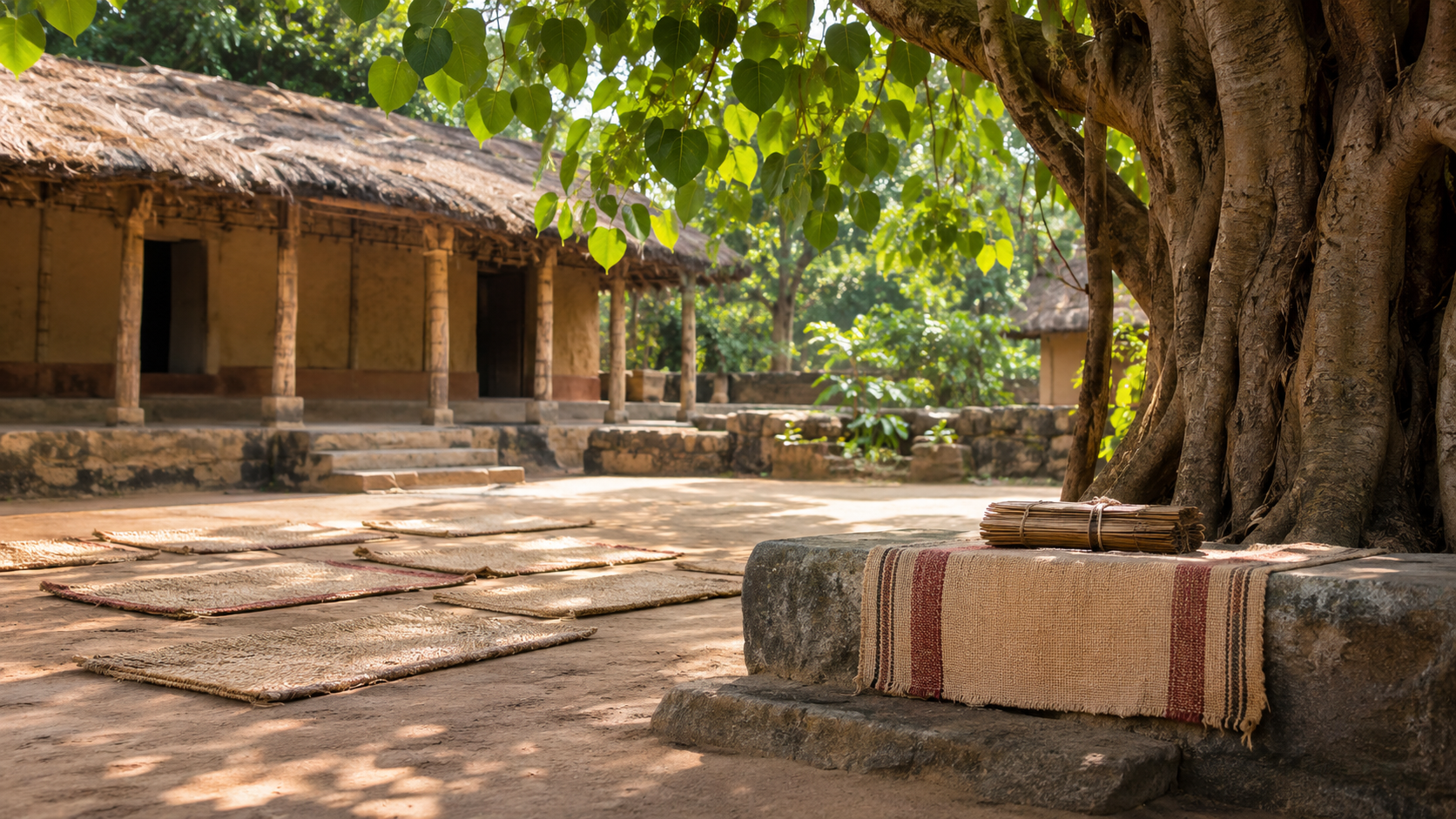
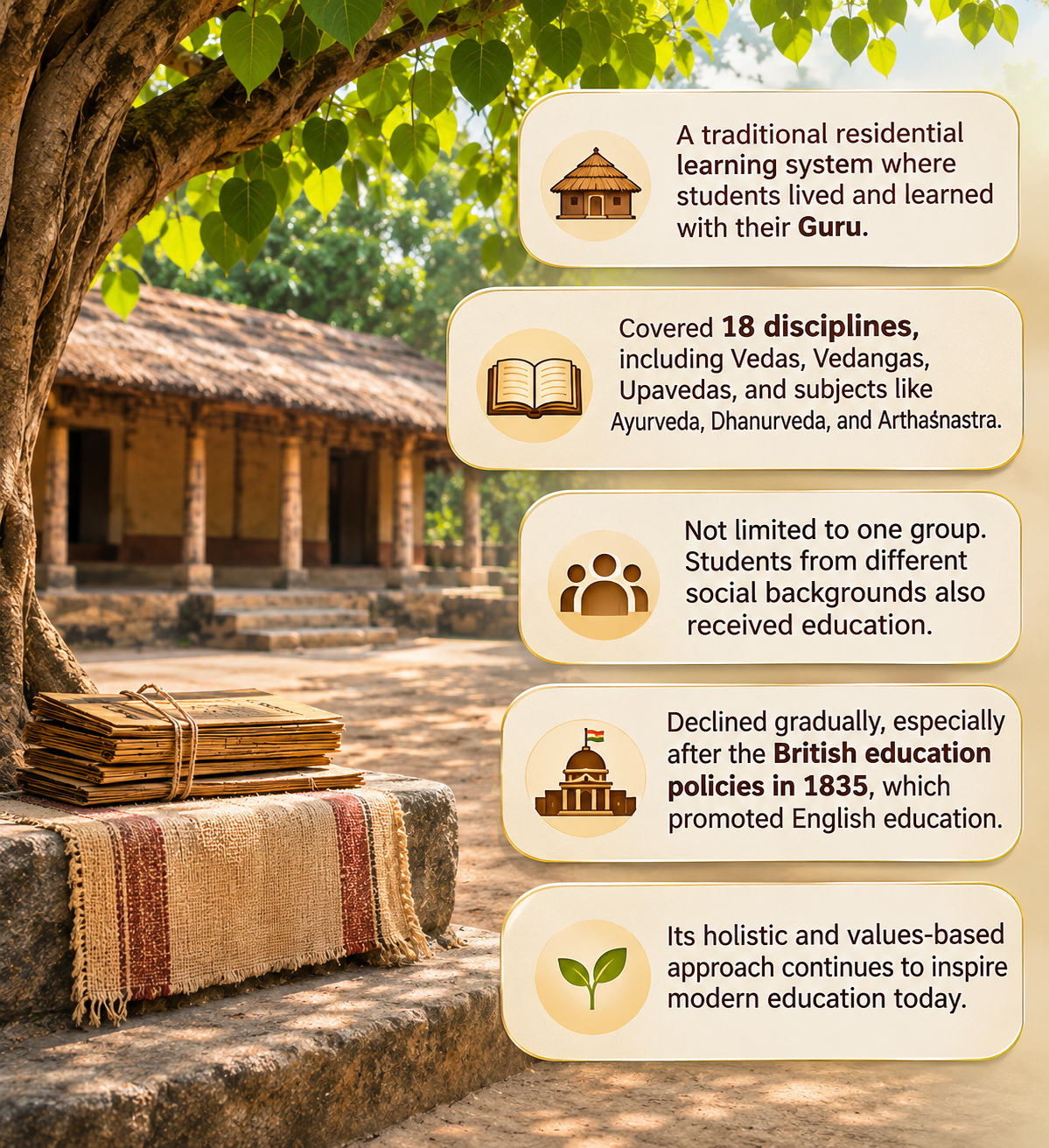
The Gurukul System in Ancient India shaped scholars, leaders, and thinkers through a traditional residential education model. Students lived with their teacher, known as a Guru, and learned through daily interactions. This relationship encouraged discipline, responsibility, respect, and intellectual development. Ancient Indian education combined academic knowledge with practical and moral learning.
Understanding this educational heritage matters because modern educators still explore holistic teaching methods. The National Curriculum Framework for Foundational Stage (NCF), published by India’s Ministry of Education, discusses the traditional Gurukul approach and its emphasis on teacher-student relationships and holistic development.
In this guide, we explore the history and structure of the ancient Gurukul education system. You will discover its traditional 18 disciplines, student admission ages, and teaching methods. We also examine educational opportunities across different social groups. Additionally, we discuss famous learning centres, colonial education policies, and modern revival movements. For further historical context, explore UNESCO’s documentation of Nalanda Mahavihara, an important residential and educational institution in ancient India.
What are the 18 subjects of Gurukul in ancient India?
The traditional curriculum included 18 branches of knowledge, commonly called Ashtadasha Vidyas. These disciplines combined religious learning, philosophy, language, science, and practical skills. They were divided into four Vedas, six Vedangas, and four additional disciplines. The remaining four were traditionally known as Upavedas.
The four Vedas included:
- Rigveda: Hymns, prayers, and religious knowledge.
- Yajurveda: Rituals and sacrificial procedures.
- Samaveda: Musical chants and melodies.
- Atharvaveda: Everyday life, healing traditions, and philosophical ideas.
The six Vedangas covered phonetics, rituals, grammar, etymology, poetic metre, and astronomy. The four Upavedas included Ayurveda and the history of medicine (medicine), Dhanurveda (military knowledge), Gandharvaveda (music and performing arts), and Arthashastra (economics and governance).
The remaining disciplines were Purana, Nyaya, Mimamsa, and Dharmashastra. Together, these subjects formed a broad intellectual framework. However, individual Gurukuls did not necessarily teach every discipline. Their curriculum depended on the teacher, institution, and historical period.
Who removed Gurukul in India?
There was no single person or government order that completely removed the Gurukul system from India. Its decline happened gradually through several political, economic, and educational changes. British colonial policies played an important role in transforming India’s traditional education structure.
One significant development was Thomas Babington Macaulay’s Minute on Indian Education in 1835. It supported greater government funding for English-language education and European literature and science. Governor-General Lord William Bentinck subsequently issued an education resolution on March 7, 1835. This shifted official priorities towards English education.
However, traditional education did not disappear immediately. Indigenous schools, Sanskrit institutions, and Persian learning centres continued operating in different regions. Their financial support and institutional importance changed over time.
The decline also reflected changing employment opportunities and government recognition of English-based qualifications. Therefore, attributing the disappearance of Gurukuls entirely to Macaulay would oversimplify a much longer historical process.
Impact of the English Education Act of 1835
The education reforms of 1835 significantly changed the direction of colonial education in India. Macaulay supported using public funds to promote English education and European knowledge. His recommendations influenced government priorities and reduced the importance of traditional Sanskrit and Arabic learning within official educational policy.
The changes had several long-term consequences:
- Language shift: English gradually became more important for higher education and administration.
- Employment changes: English education provided access to new government and professional opportunities.
- Institutional pressure: Traditional learning centres faced difficulties competing for financial support and recognition.
- Curriculum changes: Western literature, science, and administrative subjects gained greater importance.
However, the 1835 resolution did not immediately abolish every indigenous school. Some traditional institutions continued receiving support or operating through community funding.
Later developments, including Wood’s Despatch of 1854, further expanded colonial educational administration. These policies gradually reshaped India’s education system and influenced the future of traditional learning institutions.
Were gurukuls only for Brahmins?
No, it would be historically inaccurate to claim that every Gurukul admitted only Brahmin students. Educational access varied across historical periods, geographical regions, institutions, and social groups. Some early Vedic traditions describe students from different backgrounds receiving instruction from teachers.
Brahmins generally had an important role in preserving and teaching Vedic knowledge. Kshatriyas also received education related to warfare, administration, and political responsibilities. Vaishyas learned subjects connected with agriculture, trade, and economic activities.
However, access was not equal for everyone. Later religious and social regulations restricted certain forms of Vedic education, particularly for Shudras and women. These restrictions became more established in some later periods.
Historical records also reveal a wider picture of indigenous education. William Adam’s nineteenth-century surveys documented students from several lower-caste communities attending traditional schools in Bengal and Bihar. These findings concern regional village schools, not every residential Gurukul. Therefore, educational access should be understood through historical and regional differences rather than one general rule.
What is the oldest system of education in India?
The Vedic tradition is among the oldest documented foundations of formal education in India. Its early development is generally associated with the second millennium BCE, although its exact origins remain difficult to establish. Knowledge initially passed between generations through oral teaching, recitation, and memorization.
Teachers transmitted religious hymns, philosophical ideas, language, and cultural traditions. Students learned directly from experienced teachers rather than depending on printed textbooks. Over time, residential learning arrangements became an important feature of many Vedic educational traditions.
The Gurukul model connected education with everyday life. Students followed disciplined routines and participated in household responsibilities. Their education could include physical training, ethical discussions, religious studies, and practical knowledge.
Later Buddhist monasteries and Jain learning centres developed their own educational traditions. Institutions such as Nalanda and Takshashila became important centres of advanced learning. Although these institutions were not identical to Vedic Gurukuls, they shared certain features of residential study, teacher guidance, and scholarly discussion. Together, these traditions shaped India’s long educational history.
What is the history of the Gurukul system in India?
The history of the Gurukul System in Ancient India spans several historical periods, beginning with Vedic traditions and evolving through different educational institutions. Its early foundations emerged from oral instruction, where teachers transmitted knowledge to students. Students gradually began living with teachers to receive more intensive education and guidance.
During the later Vedic period, educational traditions became more structured. Students studied religious texts, philosophy, grammar, and other disciplines. Different teachers and learning centres developed specialized areas of instruction.
During the ancient and early medieval periods, India also became home to major residential learning institutions. Takshashila, Nalanda, Vikramashila, and other centres attracted scholars from different regions. These institutions were not all traditional Gurukuls. Many developed through Buddhist monasteries and other educational traditions. Students interested in exploring these institutions further can learn about ancient Indian universities and their historical contributions.
During medieval and colonial periods, political changes affected different educational institutions. Local schools, religious centres, and traditional teachers continued providing education in several regions. British educational policies later changed institutional funding and official priorities. Despite these changes, traditional learning practices survived through different reform movements and educational communities.
Revival Movements in Modern India
During the nineteenth and twentieth centuries, several Indian reformers attempted to revive traditional educational values. They believed education should develop character, discipline, cultural awareness, and intellectual ability alongside academic knowledge.
Swami Dayananda Saraswati promoted Vedic learning and educational reform through the Arya Samaj movement. His ideas later influenced the Dayanand Anglo-Vedic (DAV) educational network, which combined traditional values with modern subjects.
Swami Shraddhanand established Gurukul Kangri near Haridwar in 1902. The institution promoted Vedic education, residential learning, and Indian cultural traditions. It also incorporated subjects relevant to contemporary education.
Rabindranath Tagore developed another influential educational approach at Shantiniketan. He encouraged learning through nature, creativity, literature, music, and international cultural exchange.
These movements did not simply recreate ancient Gurukuls. Instead, they adapted selected traditional principles to changing educational needs. Their efforts helped preserve interest in Indian educational heritage while introducing new approaches to teaching and learning.
Which is the most famous Gurukul in India?
Several ancient Indian institutions earned recognition for their contributions to education, philosophy, and scholarship. The Gurukul System in Ancient India influenced traditional learning practices, while Takshashila and Nalanda became renowned centres of higher education. However, these institutions differed from the smaller residential hermitages traditionally associated with Gurukuls.
Takshashila, also known as Taxila, developed into an important centre of higher learning in ancient Gandhara. Students studied subjects such as medicine, grammar, philosophy, politics, and military knowledge. It attracted learners from different regions and became associated with several renowned scholars.
Nalanda Mahavihara later emerged as a major Buddhist residential learning institution in present-day Bihar. It flourished from approximately the fifth century CE. Historical accounts describe its international student community, experienced teachers, extensive libraries, and advanced studies.
In modern India, Gurukul Kangri Vishwavidyalaya in Haridwar is a prominent institution inspired by traditional Vedic education. Swami Shraddhanand founded it in 1902. The university combines traditional educational values with contemporary academic subjects. These institutions represent different stages of India’s rich educational history.
At what age did children go to Gurukul?
Children traditionally entered a Gurukul after completing an initiation ceremony called Upanayana. This ceremony marked the beginning of formal student life, known as Brahmacharya. The exact admission age varied according to religious traditions, family circumstances, and historical periods.
Some traditional texts prescribed different initiation ages for different social groups. Brahmin boys were generally associated with the eighth year, Kshatriyas with the eleventh, and Vaishyas with the twelfth. These ages reflected prescribed religious practices rather than a universal admission rule followed by every Gurukul.
After entering student life, learners followed a disciplined daily routine. They studied under their Guru, participated in household responsibilities, and practised self-control. Their education could continue for several years, depending on their subjects and learning goals.
Some students completed their studies after approximately twelve years. However, there was no single duration followed by every institution. The length of education depended on the teacher, curriculum, and individual progress.
What teaching method was used in the gurukuls in ancient India?
Gurukuls used teaching methods that combined listening, discussion, observation, memorization, and practical experience. The Guru guided students according to their abilities and educational progress. Unlike modern classroom systems, learning often took place within the teacher’s household or residential learning environment. Students today can also explore effective ways to study ancient history to develop better learning habits.
The teaching approach of the Gurukul System in Ancient India focused on understanding, practical experience, discipline, and individual guidance. Students actively participated in lessons rather than simply listening to lectures.
A traditional learning approach involved three important stages:
- Shravana: Students listened carefully to the teacher and received new knowledge.
- Manana: They reflected on the lessons, questioned ideas, and developed understanding.
- Nididhyasana: They contemplated the knowledge and applied its principles through deeper understanding.
Oral recitation played an important role in preserving religious and philosophical texts. Teachers also encouraged questions and discussions to strengthen comprehension. Students could participate in activities involving agriculture, physical training, household work, and other practical responsibilities.
These experiences connected theoretical knowledge with everyday life. However, teaching methods differed between institutions and subjects. Not every Gurukul followed an identical curriculum or learning routine. The central principle was the teacher’s guidance and the student’s active participation in learning.
Role of Shastrartha (Scholarly Debate)
Shastrartha was an important method of intellectual discussion in ancient Indian scholarly traditions. It involved structured debates in which scholars examined philosophical ideas, religious interpretations, and logical arguments. Students could participate in discussions under the guidance of experienced teachers.
During these debates, participants presented arguments and responded to questions from others. They needed to explain their reasoning clearly and support their positions with relevant knowledge. This encouraged careful thinking rather than accepting every statement without examination.
Shastrartha also helped students develop communication skills. They learned to listen, identify weaknesses in arguments, and defend their ideas logically. Discussions sometimes involved visiting scholars and teachers from other learning centres.
Unlike modern written examinations, scholarly debates provided an opportunity to demonstrate understanding through discussion. However, ancient educational institutions used different assessment practices. Shastrartha was one important approach, not a universal replacement for every form of evaluation. Its emphasis on reasoning and respectful intellectual disagreement remains relevant to education today.
Conclusion
The Gurukul Education System in Ancient India offered far more than academic instruction; it built resilient, ethical, and self-reliant human beings. By combining eighteen diverse subjects with personalized mentorship, hands-on chores, and rigorous debate, ancient teachers nurtured both intellect and character. Although nineteenth-century colonial policies dismantled most traditional academies, their core educational philosophies remain deeply relevant today.
Modern schools increasingly recognize the value of experiential learning, small class sizes, and emotional intelligence—principles that defined Indian hermitages thousands of years ago. Whether you are a parent, teacher, or lifelong learner, you can apply these timeless lessons right now. Encourage curiosity over rote memorization, connect theory to real-world practice, and value mentorship as much as textbooks. Exploring how ancient India educated its youth gives us practical tools to build a wiser, more balanced future for education today.