Understanding Crop Rotation Strategies for Healthy Farmland
Healthy, productive soil is the foundation of every successful agricultural operation. Implementing deliberate crop rotation strategies helps farmers move beyond monoculture and improve the long-term health of their farmland. By planting different crop families in planned sequences, growers can support soil fertility, reduce pest pressure, and maintain better growing conditions.
Research from the USDA Natural Resources Conservation Service highlights the importance of diverse cropping systems and conservation practices. These approaches can improve soil structure, increase organic matter, and support biological activity.
Modern farming faces several challenges, including persistent weeds, nutrient depletion, soil erosion, and changing weather conditions. Relying entirely on synthetic fertilizers and chemical treatments does not address every underlying problem. Alternating crops with different root structures and nutrient requirements offers a more balanced approach to climate-smart agriculture.
This guide explores the benefits of crop rotation, practical rotation examples, and the importance of diversifying agricultural fields. It also explains how farmers can protect soil health, improve moisture retention, and maintain productive farmland over multiple growing seasons.
What are the benefits of crop rotation?
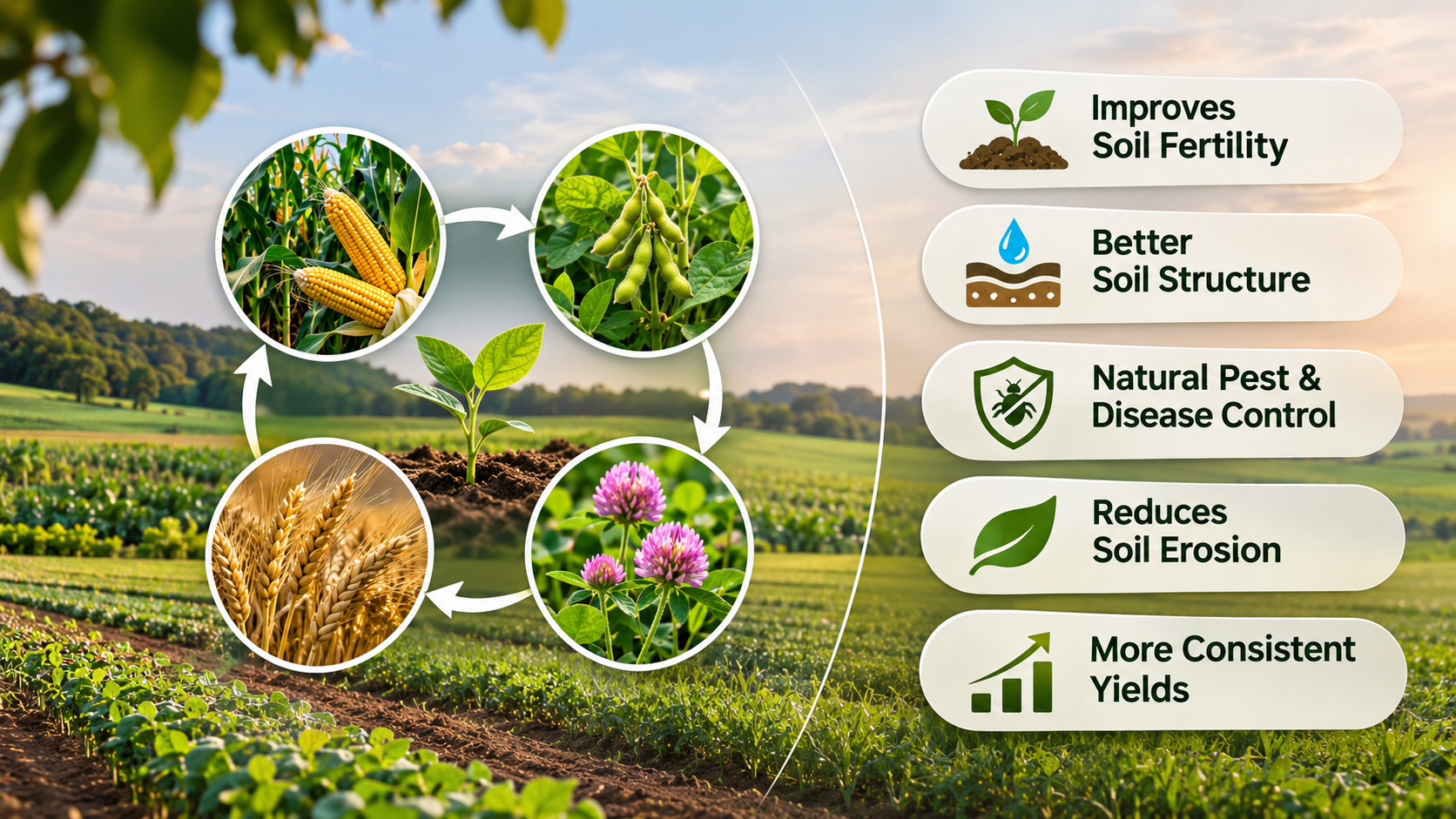
Implementing planned crop rotation strategies provides several agricultural benefits. One major advantage is improved soil fertility. Different crops require different nutrients, so alternating plant families can help balance nutrient removal across growing seasons. Understanding the three main nutrients in commercial fertilizers can also help farmers make informed nutrient management decisions. Including legumes can support natural nitrogen fixation through their relationship with beneficial soil bacteria.
Crop rotation also improves soil structure. Deep-rooted crops can access nutrients from lower soil layers, while fibrous-rooted plants help create a stable soil structure. These differences support better water infiltration and reduce surface runoff.
Another important benefit is natural pest and disease management. Many insects, weeds, and soil-borne pathogens depend on specific crop hosts. Changing the planted crop can interrupt their life cycles and reduce their ability to multiply.
Additional benefits include:
- Improved soil organic matter: Diverse crop residues contribute organic material to the soil.
- Better weed management: Different planting and harvesting schedules disrupt weed growth.
- Reduced erosion: Cover crops protect exposed soil from wind and rainfall.
- Greater farm resilience: Diversified production reduces dependence on a single crop.
Over time, these improvements can support more consistent yields and reduce certain production costs.
Can you give me an example of a crop rotation?
A traditional four-year crop rotation combines corn, soybeans, winter wheat, and red clover. This sequence introduces different plant families and growing characteristics across successive seasons. It also demonstrates how farmers can balance grain production with soil improvement practices.
Here is how the rotation works:
- Year 1 – Corn: Corn serves as a major cash crop and requires substantial nutrients, particularly nitrogen. Farmers can support its growth through appropriate soil testing and fertility management.
- Year 2 – Soybeans: Soybeans are legumes that form relationships with nitrogen-fixing bacteria. They can contribute nitrogen to the farming system, although the amount remaining depends on crop yield and residue management.
- Year 3 – Winter Wheat: Wheat provides valuable ground cover and helps capture nutrients. Its fibrous root system also supports soil structure and reduces erosion.
- Year 4 – Red Clover: Red clover acts as a forage crop and green manure. Its roots contribute organic matter, while its nitrogen-fixing activity supports future crops.
After four years, farmers can return to corn and repeat the sequence. The exact schedule should reflect local climate, soil conditions, and market requirements.
Why is it important to rotate crops?
Growing the same crop repeatedly in one field can create serious agricultural problems. Continuous monoculture removes similar nutrients, encourages specific weeds, and provides suitable conditions for certain pests and diseases. Over time, these pressures can reduce soil productivity and increase production expenses.
Crop rotation helps prevent these problems by introducing different plant species across growing seasons. Each crop interacts with the soil differently. Some have deep roots, while others develop dense root systems near the surface. This variation supports better soil structure and nutrient cycling.
Another important advantage involves breaking pest and disease cycles. Many harmful organisms depend on particular host plants to survive and reproduce. Planting a different crop can interrupt their development and reduce their populations.
Crop rotation also supports more effective water management. Different root structures improve soil porosity and water infiltration. When combined with cover crops and residue management, these practices help protect agricultural land from erosion.
For farmers, rotating crops is not simply a planting preference. It is a practical way to maintain soil productivity, manage agricultural risks, and support sustainable farming over the long term.
Preserving Topsoil Integrity Against Erosion
Topsoil contains essential nutrients, organic matter, and biological organisms that support healthy plant growth. However, exposed agricultural fields can lose valuable topsoil through heavy rainfall and strong winds. This loss reduces soil fertility and can affect long-term crop productivity.
Including small grains, cover crops, and other fibrous-rooted plants in a rotation helps protect vulnerable soil surfaces. Their roots hold soil particles together and reduce the movement of sediment during rainfall. Aboveground vegetation also slows wind movement and reduces the direct impact of raindrops.
Farmers can strengthen these protective benefits through practices such as:
- Planting cover crops: Establish living vegetation between main growing seasons.
- Maintaining crop residues: Leave suitable plant material on the soil surface after harvesting.
- Using reduced tillage: Minimize unnecessary soil disturbance.
- Managing field drainage: Reduce concentrated water flow across agricultural land.
These practices work together to limit erosion and maintain soil structure. They also help reduce nutrient runoff into nearby rivers and waterways, addressing some of the major current environmental problems associated with unsustainable land management. Over multiple growing seasons, protecting topsoil supports healthier farmland and more reliable agricultural production.
How can crop rotation help?
Systematic crop rotation strategies can help farmers manage production costs while improving the long-term condition of their fields. Different crops contribute to soil health in different ways. For example, legumes support biological nitrogen fixation, while deep-rooted plants help access nutrients from lower soil layers.
These natural processes can reduce the need for certain fertilizer applications. However, farmers should still conduct regular soil testing and apply nutrients according to crop requirements. Rotation alone cannot replace every soil fertility input.
Crop diversification also supports better pest and weed management. Changing crop families and planting schedules makes it harder for certain pests and weeds to establish permanent populations. This can reduce dependence on repeated chemical treatments.
Another advantage is greater financial flexibility. Growing different crops provides additional marketing opportunities and spreads production risks. If unfavorable weather damages one crop, another crop may still generate income during the same agricultural cycle.
Crop rotation can also improve soil moisture management and reduce erosion. When combined with appropriate conservation practices, it helps farms remain productive under changing environmental conditions.
Enhancing Soil Moisture Storage Capacity
Soil moisture plays an important role in plant development, nutrient availability, and agricultural productivity. Fields with poor soil structure often struggle to absorb and retain sufficient water. This becomes particularly challenging during periods of limited rainfall and high temperatures.
Crop rotation can improve moisture management by introducing plants with different root structures and residue characteristics. Cover crops and small grains provide additional surface protection. Their residues help reduce direct sunlight exposure and slow moisture evaporation.
Increasing soil organic matter is another important factor. Organic matter improves soil aggregation and supports the formation of spaces that hold and transmit water. Well-structured soils can absorb rainfall more effectively and make stored moisture available to plant roots.
Farmers can further improve water retention through practices such as:
- Growing cover crops between main growing seasons.
- Maintaining suitable crop residues after harvesting.
- Including deep-rooted crops in rotation plans.
- Reducing unnecessary tillage and soil disturbance.
These combined practices improve the soil’s ability to manage rainfall. They can also help crops withstand short periods of dry weather, although results depend on soil type, climate, and field management. Such measures are increasingly important for addressing climate change impacts on food security.
Who is the father of crop rotation?
British agricultural pioneer Charles Townshend, popularly known as Turnip Townshend, is widely recognized for popularizing modern crop rotation during the eighteenth century. He played an important role in the British Agricultural Revolution through his promotion of the Norfolk Four-Course System.
Before these developments, many European farmers followed a traditional three-field system. This approach divided farmland into three sections, with one section left fallow each year. Although fallowing allowed the soil to recover, it also meant that part of the available farmland remained unproductive.
Townshend promoted a different approach by introducing a planned sequence of four crops:
- Wheat: Provided an important grain crop for food production.
- Turnips: Supplied livestock feed and helped improve soil management.
- Barley: Provided another valuable cereal crop.
- Clover: Supported livestock feeding and improved soil nitrogen through biological fixation.
This system reduced the need for traditional fallowing and supported more continuous agricultural production. It also strengthened the relationship between crop cultivation and livestock farming.
Townshend’s contributions helped popularize systematic crop rotation and influenced agricultural practices across Britain and beyond.
What is the most important rotation crop?
Legumes are among the most valuable crop groups in effective crop rotation strategies. They include plants such as alfalfa, crimson clover, field peas, hairy vetch, and soybeans. These crops offer an important advantage because many legumes form beneficial relationships with nitrogen-fixing bacteria.
These bacteria, commonly belonging to the Rhizobium group, live in specialized structures called root nodules. They convert atmospheric nitrogen into forms that plants can use. This natural process is known as biological nitrogen fixation.
When farmers incorporate legume residues into the soil, decomposing plant material releases nutrients. Subsequent crops can benefit from some of this nitrogen, depending on biomass production, harvesting practices, and residue management.
Legumes also provide several agricultural benefits:
- Improved soil fertility: Nitrogen fixation supports natural nutrient management.
- Better soil structure: Their roots contribute organic material and improve soil aggregation.
- Livestock feed: Several legume varieties provide nutritious forage.
- Pollinator support: Flowering legumes provide valuable resources for beneficial insects.
- Ground protection: Certain varieties cover exposed soil and help reduce erosion.
However, legumes do not automatically replace all nitrogen fertilizer requirements. Their contribution depends on crop establishment, growing conditions, and how much plant material remains in the field.
Including suitable legumes in crop rotation strategies can improve soil management, support nutrient cycling, and encourage more sustainable agricultural production.
Conclusion
Building resilient, high-yielding farmland requires moving away from continuous single-crop production in favor of balanced ecological stewardship. Adopting intentional crop rotation strategies provides a clear, science-backed roadmap for revitalizing depleted acreage. By alternating botanically diverse plant families with varied root depths, growers systematically break destructive pest lifecycles, enhance water infiltration, and minimize topsoil erosion.
Furthermore, integrating powerful nitrogen-fixing legumes and fibrous small grains naturally rebuilds organic matter while reducing costly synthetic fertilizer dependency. The proven agronomic principles first demonstrated by agricultural pioneers like Charles Townshend remain just as critical in modern production agriculture as they were centuries ago.
Start evaluating your current field acreage today. Examine historical soil test records, identify recurring weed and disease pressures, and introduce a complementary small grain, legume, or cover crop into your upcoming seasonal rotation. Making deliberate, incremental shifts toward plant diversity will protect your natural resources, strengthen crop resilience against unpredictable weather, and secure sustainable profitability for your farm for generations to come.