
Can We Make Learning as Addictive as TikTok?
Can we make learning as addictive as TikTok? Modern digital platforms capture our attention through personalized algorithms, variable rewards, and endless scrolling. Educators and technology developers are exploring whether these same engagement techniques can make education more interesting and enjoyable. Understanding this possibility requires examining how technology influences attention, motivation, and reward pathways in the human brain. Research from the American Psychological Association explores how digital media influences attention, behavior, and psychological well-being.
Traditional classrooms often rely on delayed rewards, such as examination results and future career opportunities. Social media, however, provides frequent feedback through likes, notifications, and entertaining content. This difference raises an important question: Can educational platforms create similarly engaging experiences without encouraging unhealthy screen habits? The World Health Organization also provides useful information about digital technology and health.
This article explores how dopamine, microlearning, gamification, and personalized recommendations influence learning motivation. We also examine TikTok addiction risks, healthy study habits, and practical ways to make learning more engaging.
Can learning become addictive?
Learning can become highly engaging when it combines continuous feedback, progressive challenges, and intellectual curiosity. Discovering new information and solving problems can activate the brain’s reward systems. These experiences encourage people to continue exploring subjects and developing new skills.
However, enjoying learning is not the same as experiencing addiction. Clinical addiction involves persistent behavior despite harmful consequences. Healthy learning generally improves knowledge, confidence, independence, and practical abilities. It should not interfere with sleep, relationships, or everyday responsibilities.
The distinction matters when designing educational platforms. Developers should encourage curiosity rather than create compulsive usage patterns. Progress tracking, achievable goals, and meaningful rewards can make studying enjoyable. However, users should remain in control of their learning habits. The objective should be to build sustainable motivation, not endless screen time. When education supports personal growth without creating dependency, it becomes a valuable lifelong habit.
Dopamine and the Intellectual Reward Loop
Dopamine plays an important role in motivation, learning, and reward processing. When you solve a challenging puzzle or discover something interesting, your brain processes the experience through interconnected reward pathways. Dopamine helps reinforce behaviors associated with rewarding outcomes.
This process can encourage curiosity and repeated learning. For example, understanding a difficult mathematical concept can create a sense of achievement. That experience motivates learners to tackle another challenge.
However, dopamine is not simply a pleasure chemical. It also influences anticipation, motivation, and how the brain responds to expected rewards. Educational platforms can use this understanding to support healthy learning habits.
Consider these practical approaches:
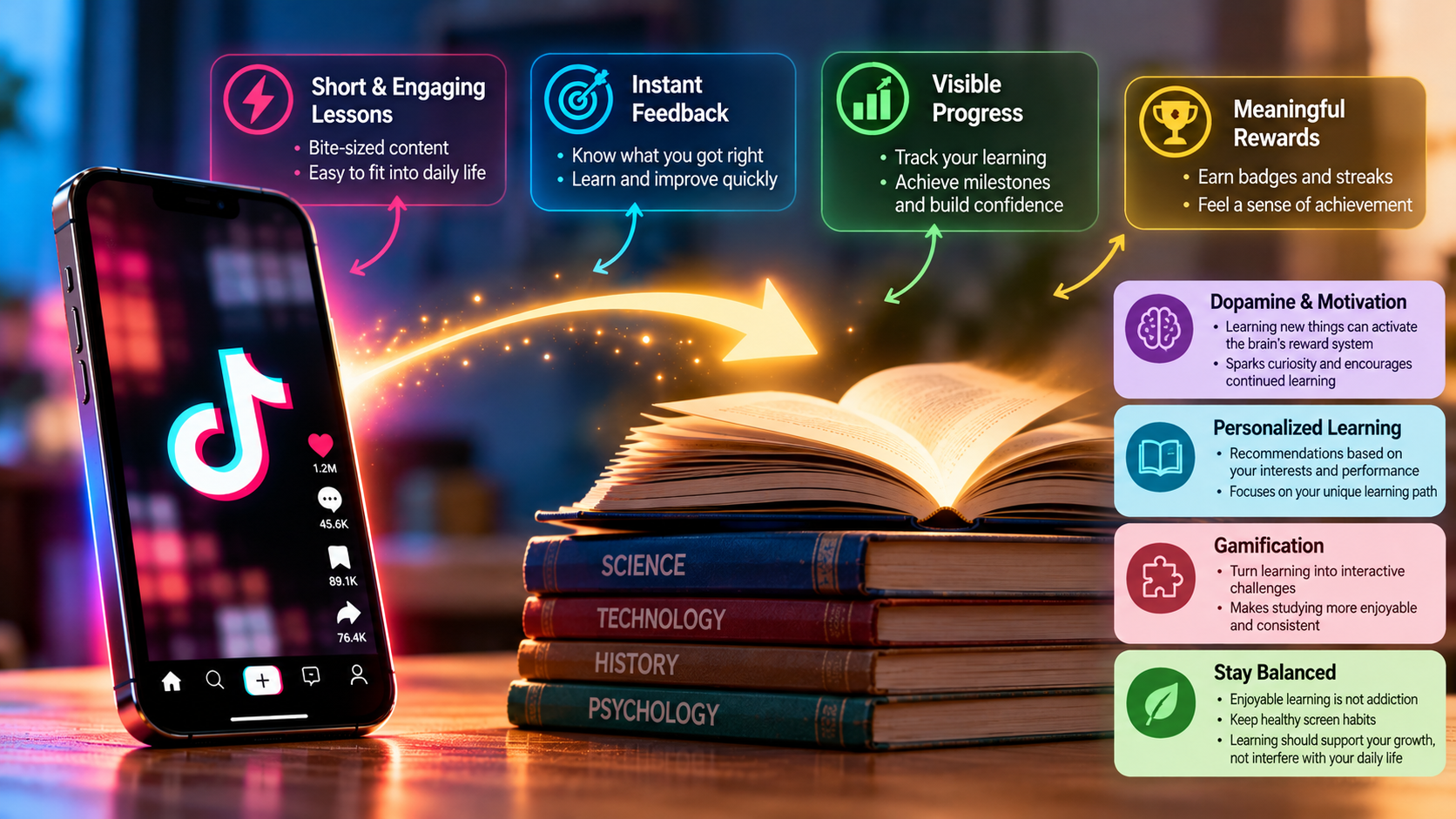
- Immediate feedback: Show learners where they succeeded or need improvement.
- Progressive challenges: Introduce increasingly difficult concepts.
- Visible progress: Display completed lessons and achieved milestones.
- Meaningful rewards: Recognize genuine improvements in knowledge and skills.
These techniques can make intellectual progress more satisfying without relying on compulsive engagement.
How to make learning addictive as social media?
To make learning as addictive as TikTok, educational designers can borrow certain engagement techniques from social media. However, the goal should be meaningful engagement rather than psychological dependency. Platforms such as TikTok succeed through accessible content, personalized recommendations, and frequent interactions. Educational platforms can adapt these principles to improve student motivation.
Microlearning, immediate feedback, and personalized learning paths provide useful starting points. Instead of presenting lengthy lectures, platforms can divide complicated subjects into short, interactive lessons. Progress trackers, achievement badges, and learning streaks can encourage consistency. Adaptive algorithms can also recommend lessons based on individual performance and knowledge gaps.
For example, someone learning programming could complete a short coding challenge during a break. After receiving feedback, they could immediately attempt another exercise. This approach reduces learning friction and makes education easier to incorporate into everyday routines. The focus should remain on knowledge retention and practical understanding.
Leveraging the Power of Microlearning Modules
Microlearning divides complex subjects into smaller, manageable learning activities. Instead of studying an entire chapter in one sitting, learners focus on individual concepts. This approach makes educational content easier to approach, especially for people with limited study time.
Short lessons can include interactive quizzes, visual explanations, flashcards, and practical exercises. Each activity should have a clear learning objective. Completing these activities provides a sense of progress without overwhelming learners.
Educational platforms can also introduce microlearning through:
- Daily challenges: Encourage learners to practice one concept every day.
- Interactive quizzes: Test understanding immediately after each lesson.
- Short tutorials: Explain individual topics through concise videos.
- Practical exercises: Help learners apply newly acquired knowledge.
- Progress tracking: Show improvements across completed activities.
However, shorter lessons do not automatically produce better learning outcomes. Learners still need repetition, deeper explanations, and opportunities to apply their knowledge. Combining microlearning with active recall and spaced repetition can create more effective learning routines.
Is it possible to be addicted to TikTok?
Yes, some people develop problematic patterns of TikTok use that interfere with their everyday lives. Although excessive use does not automatically qualify as a clinical addiction, it can create significant difficulties with attention, sleep, and productivity.
TikTok uses a personalized recommendation system to deliver videos based on users’ interactions and viewing preferences. Its continuous video feed makes discovering new content effortless. Users can keep scrolling because another entertaining or interesting video is always available.
This experience can encourage prolonged usage, particularly when users struggle to control their screen time. Frequent notifications and personalized recommendations may further reinforce checking habits.
Potential warning signs include:
- Spending significantly more time watching videos than intended.
- Neglecting work, education, or personal responsibilities.
- Experiencing difficulty stopping despite repeated attempts.
- Losing sleep because of extended scrolling sessions.
- Feeling distressed when unable to access the platform.
The important distinction is functional impairment. When digital habits consistently harm someone’s well-being or responsibilities, reducing usage and seeking appropriate support may become necessary.
Is TikTok good or bad for learning?
TikTok offers both educational opportunities and potential learning disadvantages. Its short videos allow creators to explain scientific concepts, historical events, language skills, and technology topics. Visual demonstrations can make unfamiliar subjects easier to understand. Educational creators can also introduce viewers to topics they might never explore independently.
However, short-form content has limitations. Videos sometimes simplify complicated subjects or present information without sufficient context. Misinformation can spread when viewers accept claims without checking reliable sources. Rapidly switching between unrelated videos can also interrupt concentration while studying and make sustained learning more difficult.
Another important limitation involves passive consumption. Watching an educational video does not necessarily mean someone understands or remembers its content. Effective learning requires active participation, repetition, and practical application.
A balanced approach involves using TikTok as a starting point rather than a complete learning resource. Viewers can discover interesting topics through short videos, then explore textbooks, educational websites, and detailed tutorials. Combining engaging content with deeper study creates a more reliable learning experience.
What are the top 3 worst addictions?
There is no universally accepted ranking of the world’s worst addictions. However, alcohol, opioids, and tobacco are associated with substantial health risks and public health consequences. Their effects vary depending on consumption patterns, individual circumstances, and access to treatment.
Alcohol addiction can damage the liver, heart, and nervous system. Long-term dependence may also affect relationships, employment, and mental well-being. Severe withdrawal can become medically dangerous without appropriate supervision.
Opioid addiction presents particularly serious risks because these substances can suppress breathing. Overdose can cause fatal respiratory failure. Fentanyl and other potent synthetic opioids have increased concerns surrounding opioid-related deaths.
Tobacco addiction primarily involves dependence on nicotine. Long-term tobacco use increases the risk of lung cancer, cardiovascular disease, and chronic respiratory conditions.
These examples demonstrate why addiction requires serious attention. Behavioral problems involving gaming, gambling, or social media can also disrupt everyday life. However, their clinical characteristics and health consequences differ from substance use disorders. Early recognition, professional support, and appropriate treatment can help people manage addiction.
What is hypersexuality?
Hypersexuality describes patterns of excessive sexual thoughts, urges, or behaviors that become difficult to control. However, having a high sex drive does not automatically indicate a psychological or behavioral disorder.
The World Health Organization recognizes compulsive sexual behaviour disorder (CSBD) in the ICD-11 classification. It involves persistent difficulty controlling intense, repetitive sexual impulses or behaviors. Individuals may continue these behaviors despite negative consequences or repeated attempts to reduce them.
Possible signs include:
- Repeated unsuccessful attempts to control sexual behaviors.
- Neglecting personal, professional, or family responsibilities.
- Continuing behaviors despite relationship difficulties.
- Experiencing significant distress related to these patterns.
The condition differs from simply having frequent sexual thoughts or a strong libido. Diagnosis requires considering the individual’s circumstances, distress, and functional difficulties.
Treatment may involve psychotherapy, particularly approaches that address behavioral patterns and emotional regulation. Cognitive behavioral therapy can help individuals develop healthier coping strategies. Professional assessment is important because underlying circumstances and treatment needs vary between individuals.
Who is the founder of Duolingo?
Duolingo was co-founded by Luis von Ahn and Severin Hacker in Pittsburgh, Pennsylvania. The language-learning platform officially launched in 2012. Its founders wanted to make language education accessible to people regardless of their financial circumstances.
Luis von Ahn is a Guatemalan computer scientist and professor at Carnegie Mellon University. Before founding Duolingo, he became widely recognized for developing CAPTCHA and reCAPTCHA technologies. Severin Hacker, his former graduate student, joined him in building the platform.
Their approach combined language education with gamification. Instead of relying entirely on traditional lessons, Duolingo introduced features designed to encourage consistent participation.
Some of its notable engagement features include:
- Learning streaks: Encourage users to practice regularly.
- Experience points (XP): Reward completed learning activities.
- Achievement badges: Recognize progress and accomplishments.
- Leagues: Introduce friendly competition between learners.
- Personalized lessons: Adapt learning activities to individual progress.
These features help make language practice more interactive and accessible. However, maintaining a streak alone does not guarantee language proficiency. Meaningful progress still requires understanding vocabulary, practicing grammar, and developing speaking and listening skills.
Duolingo demonstrates how gamification can support educational engagement when combined with structured learning activities.
FREQUENTLY ASKED QUESTIONS
Can gamification techniques replace traditional classroom teaching?
Gamification techniques cannot fully replace traditional classroom teaching, but they can make learning more engaging and interactive. Educators can use points, challenges, rewards, and progress tracking to make learning as addictive as TikTok while reinforcing important concepts. However, teachers remain essential for personalized guidance, critical thinking, meaningful discussions, and developing deeper understanding. Gamification works best when combined with structured classroom instruction.
What psychological mechanism makes social media scrolling feel addictive?
Social media scrolling feels addictive because platforms use intermittent reinforcement and variable reward systems. Users never know when they will discover something interesting, entertaining, or emotionally stimulating. This unpredictability encourages repeated scrolling and releases dopamine during anticipation. Educators can understand these mechanisms to make learning as addictive as TikTok by introducing unexpected rewards, interactive challenges, and engaging learning experiences.
How can learners design their own habit-forming study routines?
Learners can develop sustainable study routines by establishing clear goals, consistent schedules, and small daily commitments. Starting with ten minutes of focused study reduces procrastination and makes learning manageable. Using progress trackers, achievement badges, and small rewards can make learning as addictive as TikTok by creating a sense of accomplishment. Over time, consistent repetition turns studying into a natural daily habit.
What are the main hazards of learning exclusively through short-form videos?
Learning exclusively through short-form videos can create fragmented knowledge, reduced attention spans, and superficial understanding. Short videos often simplify complex subjects and leave out important explanations. Although engaging content can make learning as addictive as TikTok, entertainment does not guarantee meaningful learning. Students should combine educational videos with reading, note-taking, active recall, discussions, and practical exercises to develop deeper knowledge and long-term retention.
CONCLUSION
Building educational platforms that captivate our curiosity represents one of the most promising frontiers in educational technology. Digital entertainment networks have revealed how behavioral loops, immediate feedback, and personalization hold human attention across diverse demographics. While compulsive short-form video consumption introduces real challenges regarding fragmented focus and behavioral dependency, adopting these dynamic design principles can revitalize outdated instructional models.
Transforming study habits requires educators and developers to borrow engagement mechanics responsibly. By deploying microlearning modules, gamified milestones, and responsive assessments, learning platforms can make learning as addictive as TikTok in a constructive, empowering manner. Rather than fostering passive consumption, optimized educational tools build intrinsic curiosity, confidence, and self-directed mastery.
Success ultimately hinges on aligning algorithmic innovation with sound pedagogical foundations. Integrating regular practice alongside meaningful contextual study ensures knowledge endures. As instructional tools evolve, learners must cultivate intentional digital habits, utilizing technological convenience to deepen intellect rather than scatter attention. Emphasizing active retrieval and structured goals allows us to transform screen time into a lifetime of intellectual growth.