
Solar vs Wind Energy Costs: Which Renewable Energy Is More Affordable?
Choosing between renewable power options often comes down to upfront investment, energy output, and long-term operating costs. When comparing solar vs wind energy costs, both technologies offer alternatives to fossil fuels, but their economics vary by location and project size.
According to the International Renewable Energy Agency (IRENA), renewable energy costs have fallen sharply over the past decade. In 2024, new utility-scale onshore wind had a lower global weighted-average levelized cost of electricity (LCOE) than solar PV. However, that does not mean wind is cheaper for every customer or project.
For homeowners, rooftop solar is usually easier to install and integrate into existing properties. Wind projects need suitable wind resources, towers, foundations, and more specialized equipment.
Businesses and utility developers face different economics. They must consider land, financing, grid access, capacity factors, maintenance, and project scale. This guide compares the practical costs of solar and wind energy. It also examines residential economics, wind turbine pricing in India, and the main disadvantages of wind power.
Which is cheaper, solar energy or wind energy?
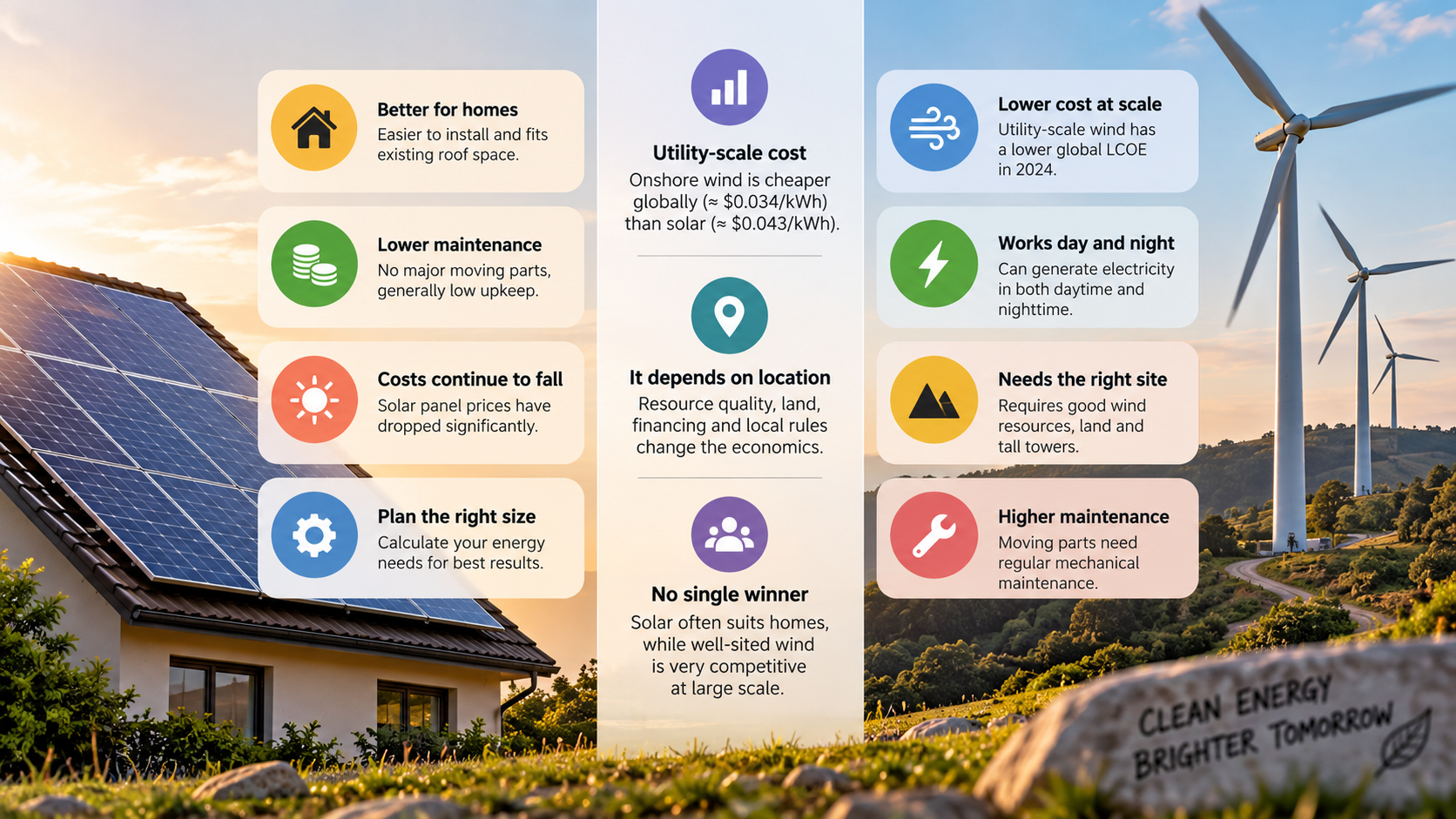
The answer depends on the project scale, location, resource quality, and installation requirements. At the residential level, solar is generally more practical and often more affordable than small wind systems. Rooftop panels can use existing roof space without requiring a tall tower or large foundation. Homeowners can also learn how to calculate their home’s solar energy needs before estimating the right system size.
Small wind turbines face different challenges. They need adequate wind speeds, suitable tower locations, structural support, and regular mechanical maintenance. These requirements can increase the total cost of ownership.
At utility scale, the comparison changes. IRENA reported a global weighted-average 2024 LCOE of about $0.034 per kWh for new onshore wind and $0.043 per kWh for new solar PV.
Therefore, there is no universal winner. Solar vs wind costs depend strongly on application. Solar often suits homes and distributed generation, while well-sited onshore wind can produce very competitive electricity at utility scale.
The Impact of Residential Scale Economics
Residential economics strongly favor technologies that are simple to install and maintain. Solar panels benefit from straightforward mounting systems and have no major moving mechanical components. A typical rooftop array can also use space that would otherwise remain unused.
Small wind systems face more site-specific requirements. A turbine needs enough clearance above nearby buildings, trees, and other obstacles. The property must also have a strong and consistent wind resource.
Tower construction can add significantly to installation costs. Foundations, wiring, inverters, transportation, and specialized installation work can further increase the project budget.
Maintenance is another consideration. Solar systems generally require limited routine maintenance, although panels and electrical equipment still need periodic inspection. Wind turbines contain moving components that experience mechanical stress.
For these reasons, homeowners should compare total installed cost, expected electricity production, maintenance, and payback period rather than equipment prices alone. A cheaper turbine does not automatically produce cheaper electricity if the site has weak wind resources.
What is the cheapest form of energy?
There is no single cheapest energy source for every country, project, or operating condition. The answer depends on how costs are measured. Levelized cost of electricity (LCOE) is commonly used to compare the lifetime cost of generating electricity from different technologies.
For 2024 projects, IRENA reported that new utility-scale onshore wind had the lowest global weighted-average LCOE among the renewable technologies it assessed, at about $0.034 per kWh. Solar PV followed at approximately $0.043 per kWh.
This comparison applies to newly commissioned utility-scale projects. It should not be interpreted as proof that wind is cheaper for every household or business.
Solar remains highly competitive because manufacturing costs have fallen dramatically. IRENA also reported particularly low solar LCOE values in markets such as India and China.
Ultimately, the cheapest option depends on resource availability, financing, land, grid connection, capacity factor, and local regulations. These factors can change the economics substantially from one project to another.
Is wind energy better than solar energy?
Wind energy is not universally better than solar energy. Each technology has strengths that become more valuable under different conditions. Wind turbines can generate electricity during both daytime and nighttime when sufficient wind is available. Solar panels, by contrast, produce electricity only when sunlight reaches the modules. For a broader comparison of renewable technologies, wave vs tidal power offers another example of how resource conditions affect energy generation.
Wind can therefore achieve higher capacity factors at excellent sites. IRENA reported a global weighted-average capacity factor of around 17.4% for new utility-scale solar PV in 2024, while wind performance varies considerably by project and location.
Solar has different advantages. Rooftop systems can use existing buildings and avoid dedicated generation sites. They also have fewer moving parts and relatively simple maintenance requirements.
Wind projects can produce large amounts of electricity from a relatively compact turbine footprint, but they require carefully selected locations. Poor wind resources can reduce output and weaken project economics.
The better option therefore depends on site conditions, electricity demand, available land, installation scale, and grid requirements. Comparing technologies without considering these factors can produce misleading conclusions.
How much does wind energy cost?
Wind energy costs vary significantly according to project size, turbine technology, location, financing, and whether the project is onshore or offshore. Utility-scale onshore wind is generally far less expensive than offshore wind because offshore projects require specialized foundations, subsea cables, marine construction, and more complex maintenance. These challenges are also relevant to why we don’t put more turbines underwater, where installation and maintenance can be significantly more complex.
IRENA reported a global weighted-average total installed cost of approximately $1,041 per kW for onshore wind projects commissioned in 2024. Offshore wind was substantially higher, at about $2,852 per kW.
Residential wind systems have different economics. Small turbines can have higher costs per unit of installed capacity because towers, foundations, inverters, transportation, and installation are spread across a much smaller project.
The actual electricity cost also depends on how much electricity the turbine produces. A high-priced turbine at a strong wind site may outperform a cheaper turbine at a poor site.
Therefore, buyers should compare installed cost, expected annual generation, maintenance, financing, and equipment lifespan rather than focusing only on the turbine’s purchase price.
How much does a 3kW wind turbine cost in India?
The cost of a 3kW wind turbine system in India can vary substantially depending on the turbine model, tower height, foundation, inverter, battery requirements, installation location, and supplier. A single nationwide price should therefore be treated cautiously.
Small wind systems can become expensive because the turbine is only one part of the installation. Buyers may also need a tower, foundation, electrical equipment, transportation, installation labor, wiring, and grid-connection components.
A 3kW rooftop solar system can often be simpler to install because solar panels can use an existing roof structure. However, the final price depends on the panel technology, inverter, mounting system, installation quality, and applicable subsidy or incentive. Before choosing a system, homeowners can calculate their home’s solar energy needs to better understand the capacity required.
IRENA’s 2024 data shows that India had a highly competitive utility-scale solar LCOE of about $0.038 per kWh.
For Indian homeowners, the right comparison is therefore not simply 3kW wind versus 3kW solar. The systems should be compared by expected annual generation, installed cost, maintenance, available space, and payback period.
What are 5 disadvantages of wind power?
Wind power offers low-carbon electricity and can provide highly competitive generation at suitable sites. However, it also has several disadvantages that should be considered before installation. These disadvantages become especially important for small residential projects.
1. High site and installation requirements: Wind turbines need suitable wind resources and structural support. Towers and foundations can increase project costs.
2. Location limitations: Turbines perform poorly in areas with weak or turbulent wind. Buildings, trees, and terrain can reduce energy production.
3. Mechanical maintenance: Turbines contain moving components that require inspection and servicing throughout their operating life.
4. Noise and visual effects: Turbine blades and mechanical systems can create audible noise. Large turbines also change the visual character of a landscape.
5. Wildlife and local planning concerns: Wind projects can affect birds and bats in some locations. Developers may need environmental assessments and local approvals.
These disadvantages do not make wind power unsuitable. They show why site quality and project design matter when comparing solar vs wind costs. A carefully selected wind project can still deliver competitive electricity, while an unsuitable site can produce poor financial results. Renewable energy projects can also be considered alongside broader efforts to lessen pollutants in the air and reduce reliance on fossil fuels.
Frequently Asked Questions
Can you combine solar panels and wind turbines on one property?
Yes, hybrid wind and solar setups are an effective way to balance seasonal generation dips. Solar panels capture peak daylight hours, while wind turbines pick up production during nocturnal breezes and winter storm fronts. However, combining both systems requires sophisticated dual-input charge controllers and balanced battery storage banks. This dual architecture increases total balance-of-system hardware expenses upfront.
How long do solar panels last compared to wind turbines?
Photovoltaic solar panels last 25 to 30 years with minimal performance loss, usually degrading at roughly 0.5% annual capacity. In contrast, wind turbines generally have an operational life expectancy of 20 to 25 years. Turbines experience mechanical stress, blade fatigue, and lubrication breakdown, requiring more component overhauls over their operating lifespan than static solar modules.
Which system has a faster financial payback period?
Rooftop solar installations provide a much faster payback period than small-scale wind turbines. Most home solar setups recover their upfront capital costs within 5 to 8 years through direct utility bill credits. Micro wind turbines struggle with intermittent wind resources near homes, often pushing their financial break-even point past 12 to 15 years.
Does weather affect solar and wind systems differently?
Weather alters production patterns across both systems in contrasting ways. Solar panels drop energy production under dense cloud coverage and stop generating entirely overnight, although they still produce power from diffused daylight. Wind systems require specific minimum wind speeds to trigger turbine rotation, shutting down automatically during calm periods or dangerously strong gales.
Conclusion
Evaluating renewable investments highlights notable performance and financial differences across clean power options. When assessing overall solar vs wind energy costs, solar technology remains the most practical and budget-friendly choice for homeowners, business rooftops, and distributed community arrays. Its quiet operation, minimal maintenance demands, and simple roof integration keep balance-of-system fees exceptionally low.
Wind energy retains an important role within industrial-scale energy production. Large onshore farms deliver impressive capacity factors, generating massive quantities of clean electricity day and night across open plains and coastal shelves. However, high mechanical upkeep, land footprint demands, and complex permitting hinder wind technology from matching solar’s widespread consumer adoption.
Review your local property layout, regional utility rates, and zoning allowances before committing to clean energy hardware. If you have open roof exposure and seek rapid financial payback, installing a rooftop solar array provides the most dependable starting point. Evaluate your local solar irradiation and wind profiles today to choose the ideal power system for your budget.