
How Do Rocket Engines Work? A Clear Guide to Spaceflight
Have you ever gazed at a launch pad and wondered how do rocket engines work and what actually lifts thousands of tons of metal into the sky? The answer becomes easier to understand once you look at the basic physics of rocket propulsion.
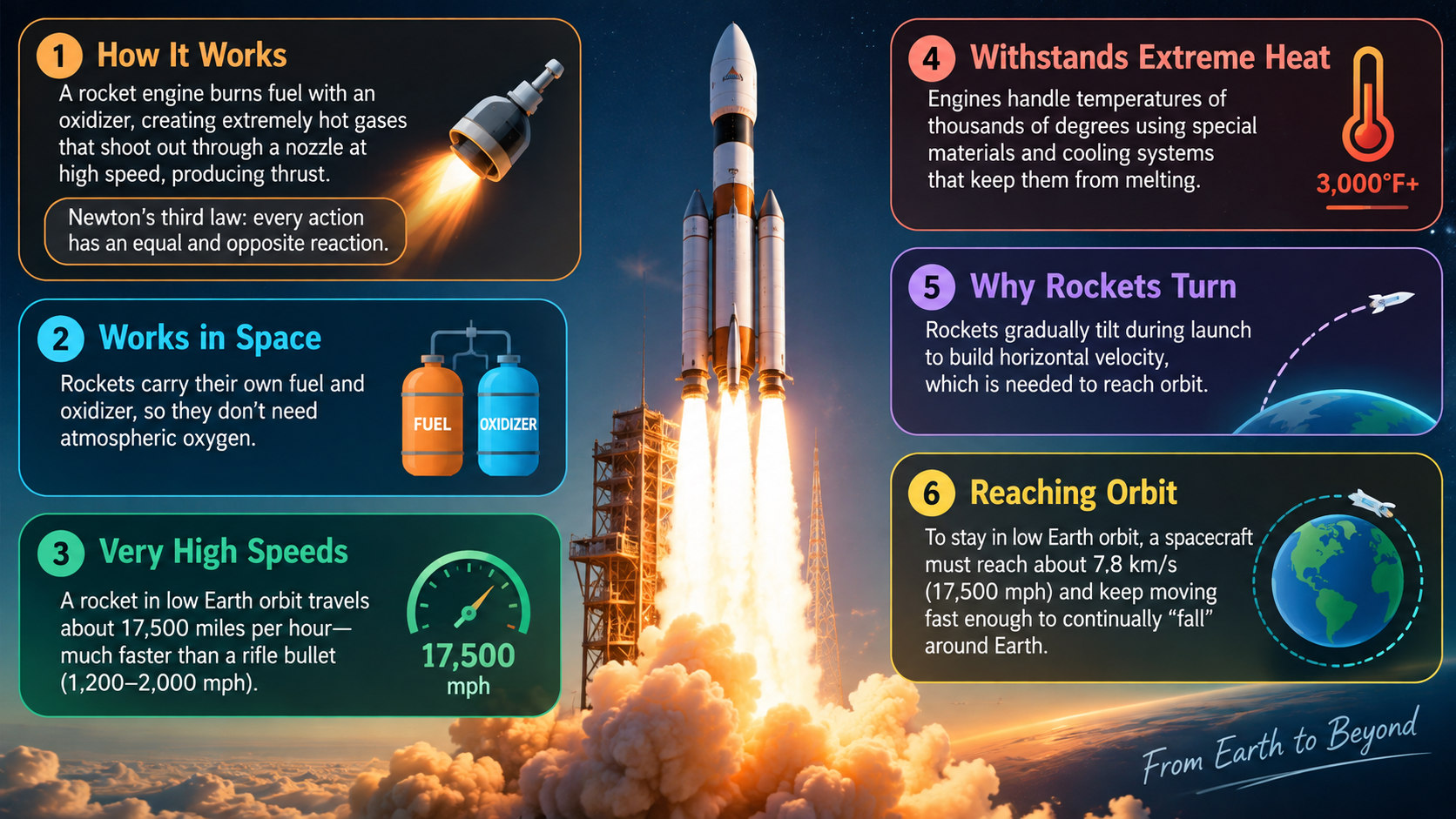
At its core, rocket propulsion follows Newton’s third law of motion: every action produces an equal and opposite reaction. A rocket engine burns fuel with an oxidizer and produces extremely hot, high-pressure gases. These gases expand through a narrow nozzle and leave the engine at very high speeds. NASA explains that rocket thrust comes from accelerating exhaust gases through the engine nozzle.
To understand how rocket engines work, we need to look beyond combustion. Rocket engines must manage extreme heat, pressure, fuel flow, and changing flight conditions.
This guide explains how rockets operate without atmospheric oxygen, why engines do not melt, why rockets turn during launch, and how rocket speeds compare with bullets and other spacecraft.
How do rocket engines work in space without oxygen?
Rocket engines work in space because they carry both fuel and oxidizer onboard. Unlike jet engines, rockets do not need to collect oxygen from the atmosphere. Jet engines use atmospheric air for combustion, while rocket engines carry the oxidizer required for their own chemical reaction. This self-contained approach is also important when considering reusable spacecraft technology.
Many liquid rocket engines use fuels such as liquid hydrogen, methane, or kerosene-based propellants. They pair these fuels with an oxidizer, commonly liquid oxygen. Pumps or pressurization systems move the propellants into the combustion chamber.
Inside the chamber, the fuel and oxidizer mix and ignite. Their chemical reaction produces extremely hot, high-pressure gas. That gas expands through a convergent-divergent nozzle and accelerates to very high speeds.
The escaping exhaust creates thrust through Newton’s third law. Because the rocket carries everything needed for combustion, it can continue producing thrust in the vacuum of space. This is a fundamental part of how do rocket engines work without atmospheric oxygen.
The Critical Role of Chemical Oxidizers
An oxidizer is essential because space does not provide enough atmospheric oxygen for conventional combustion. Rocket engines therefore carry their own supply, making them self-contained propulsion systems.
Liquid oxygen, or LOX, is one of the most common oxidizers used in modern chemical rockets. It must remain extremely cold to stay liquid. Its boiling point is about −297°F (−183°C) at standard atmospheric pressure.
Keeping oxygen in liquid form allows engineers to store a large amount of oxidizer in a relatively compact tank. During flight, pumps or pressurization systems send the oxidizer toward the combustion chamber.
The oxidizer then reacts with the fuel to release chemical energy. That energy produces high-pressure exhaust, which the nozzle converts into a fast-moving jet.
This explains another important part of how do rocket engines work in space. They do not create combustion using outside air. Instead, they bring their own oxidizer and fuel wherever they travel.
Is a rocket faster than a bullet?
Yes, an orbital rocket can travel much faster than a conventional rifle bullet. A typical high-velocity rifle bullet may leave the barrel at roughly 1,800 to 3,000 feet per second. That equals approximately 1,200 to 2,000 miles per hour, depending on the ammunition and firearm.
A rocket needs far greater speed to reach and maintain orbit around Earth. A spacecraft in low Earth orbit typically travels about 17,500 miles per hour, or roughly 7.8 kilometers per second.
That means orbital spacecraft can travel many times faster than common rifle bullets. However, rockets do not reach orbital velocity instantly. They accelerate gradually while overcoming gravity and atmospheric drag.
It is also important to distinguish orbital speed from escape velocity. Reaching low Earth orbit requires around 17,500 miles per hour. Escaping Earth’s gravitational influence requires an initial velocity of roughly 25,000 miles per hour if no further propulsion is used.
Velocity Demands for Orbital Mechanics
Reaching space and reaching orbit are two different challenges. A vehicle can climb above most of the atmosphere without achieving the speed required to remain in orbit.
Low Earth orbit requires a spacecraft to travel at roughly 7.8 kilometers per second, or 17,500 miles per hour. At that speed, the spacecraft continuously falls toward Earth while moving forward fast enough to keep missing the surface.
This is why rockets gradually build horizontal velocity during ascent. Simply flying upward would require enormous energy without creating a stable orbit.
A useful way to picture orbital flight is to imagine throwing an object forward. Throw it slowly, and it falls to the ground. Throw it faster, and it travels farther before landing. At orbital velocity, Earth curves away beneath the moving spacecraft.
Rockets therefore spend much of their energy developing sideways velocity, not simply gaining altitude. This orbital speed is one of the most important reasons how do rocket engines work involves more than simply producing upward thrust.
Why do rocket engines not melt?
Rocket engines operate under temperatures that can exceed the melting points of many metals. So why do they survive? The answer involves several thermal management techniques that keep engine walls within safe operating limits.
One of the most important methods is regenerative cooling. Engineers build cooling channels into the walls of the combustion chamber and nozzle. Before reaching the injector, cold propellant flows through these channels.
The propellant absorbs heat from the engine walls. This process prevents the metal from reaching its melting point while also warming the fuel before combustion. Preheating the propellant can improve the overall efficiency of the engine.
Rocket engines may also use film cooling, where a thin layer of propellant flows along the chamber wall. This creates additional protection from the hottest combustion gases.
Some engines also use specialized materials and thermal barrier coatings. Together, these techniques allow an engine to withstand intense temperatures and pressures for the required duration. Understanding how do rocket engines work also means understanding how they control this extreme heat.
Film Cooling and Thermal Barrier Coatings
Film cooling provides another layer of protection inside some rocket combustion chambers and nozzles. Engineers inject a small amount of fuel or another coolant along the interior surface of the chamber.
This fluid forms a relatively cooler layer between the extremely hot combustion gases and the engine wall. The protective layer reduces direct heat transfer and helps prevent the metal from overheating.
Some rocket engines also use thermal barrier coatings or heat-resistant materials in areas exposed to severe temperatures. These materials can reduce the amount of heat reaching the underlying structure.
However, rocket engines do not depend on one technique alone. Their thermal protection systems combine cooling, material selection, chamber design, and carefully controlled propellant flow.
Regenerative cooling remains particularly important because it performs two jobs simultaneously. It removes heat from the engine and transfers that heat into the propellant.
The result is a carefully controlled thermal system. Without effective cooling, the combustion chamber and nozzle could suffer rapid erosion, deformation, or structural failure during operation.
Why don’t rockets go straight up into space?
Rockets do not fly straight upward because reaching orbit requires enormous horizontal velocity. Getting above the atmosphere is only one part of the challenge. A spacecraft must also move sideways fast enough to continuously fall around Earth rather than falling back to the surface. These principles become especially important for heavy-lift rockets designed for demanding lunar missions.
A launch vehicle usually begins nearly vertically to clear the launch area safely. Shortly afterward, it gradually tilts away from the vertical path. This maneuver is commonly associated with a gravity turn. Understanding these flight-path decisions is also useful when exploring heavy-lift rockets and their role in future lunar outposts.
As the rocket gains altitude, an increasing portion of its velocity becomes horizontal. This allows the vehicle to build the speed needed for orbital flight.
Flying straight upward would waste much of the rocket’s propellant fighting gravity without creating enough sideways motion. The rocket would eventually reach its highest point and fall back toward Earth.
The curved flight path is therefore intentional. It is a key part of how do rocket engines work during launch, because the engine must provide thrust while the vehicle gradually redirects its velocity toward the desired orbit.
The Physics of Continuous Freefall
Orbit can be understood as a form of continuous freefall. A spacecraft in orbit is constantly being pulled toward Earth by gravity. However, its sideways velocity is high enough that Earth curves away beneath it.
Imagine throwing a ball horizontally. The faster it moves, the farther it travels before reaching the ground. At orbital speeds, the surface curves away quickly enough to prevent the spacecraft from hitting Earth.
This does not mean gravity disappears in orbit. Earth’s gravity remains a major force acting on the spacecraft. Instead, the spacecraft is moving forward so rapidly that it continually falls around the planet.
That is why rockets need to develop substantial horizontal speed. Altitude alone cannot create a stable orbit.
The gravity turn helps launch vehicles achieve this efficiently. By gradually changing direction during ascent, the rocket reduces unnecessary vertical velocity and builds the horizontal speed needed for orbital mechanics.
This distinction is essential when explaining how do rocket engines work and why thrust direction matters as much as thrust itself.
Is anything faster than a rocket?
Yes. Several human-made spacecraft have achieved speeds far beyond those of typical launch vehicles. However, it is important to define what “rocket speed” means because launch vehicles accelerate throughout their missions.
A rocket leaving Earth can reach extremely high speeds. A spacecraft needs about 25,000 miles per hour of escape velocity from Earth’s surface if it must escape Earth’s gravity without additional propulsion.
Some spacecraft become much faster later in their missions through planetary gravity assists and changes in solar orbit. NASA’s Parker Solar Probe is a notable example. During close approaches to the Sun, it reaches speeds of more than 400,000 miles per hour relative to the Sun.
Natural objects can also move much faster. Cosmic rays can approach the speed of light, while light itself travels at about 186,282 miles per second in a vacuum.
These examples show that chemical rockets are powerful but not the fastest things in the universe. They provide the controlled thrust needed to change a spacecraft’s trajectory and velocity.
The Unmatched Velocity of Solar Probes
The Parker Solar Probe holds the record for the fastest human-made object. Its extreme speed comes primarily from its orbit around the Sun rather than simply from continuous rocket thrust.
As Parker Solar Probe travels closer to the Sun, it moves deeper into the Sun’s gravitational field. Its trajectory allows it to gain enormous orbital speed during close solar approaches.
The spacecraft uses carefully planned orbital maneuvers and planetary gravity assists to reshape its path. Its mission demonstrates an important principle of spaceflight: spacecraft can gain or change speed through gravity without relying entirely on engine burns.
At its fastest, Parker Solar Probe reaches speeds exceeding 400,000 miles per hour relative to the Sun. That is dramatically faster than the speed of an orbital rocket shortly after launching from Earth.
This distinction matters when comparing spacecraft speeds. Rocket engines provide controlled thrust, while gravity and orbital mechanics can also produce enormous changes in speed.
Why can’t NASA go to the Moon anymore?
NASA can go to the Moon, and it is currently working on returning astronauts through the Artemis program. The idea that NASA cannot return is therefore misleading.
The real challenge is that the Apollo-era system no longer exists. After the Apollo program ended in 1972, the Saturn V production system was discontinued. Specialized factories, tooling, suppliers, facilities, and experienced teams were no longer maintained for routine lunar missions.
Returning to the Moon therefore required developing new hardware rather than simply rebuilding the old system. Modern lunar missions also involve updated navigation, communications, life-support, crew systems, and safety requirements.
NASA’s Artemis program uses the Space Launch System (SLS), Orion spacecraft, and other supporting technologies to enable lunar missions. The program also aims to establish a more sustainable presence around and on the Moon, creating a growing need for heavy-lift rockets for future lunar outposts.
Understanding how do rocket engines work helps explain why lunar missions require more than a powerful engine. A complete mission needs launch systems, spacecraft, navigation, communications, life support, and extensive ground infrastructure.
Frequently Asked Questions
What kind of fuel do modern rockets use?
Modern launch vehicles primarily rely on refined kerosene (RP-1), liquid hydrogen, or liquid methane, each paired with liquid oxygen as an oxidizer. Solid propellants, utilizing ammonium perchlorate mixed with aluminum powder, are also commonly used in strap-on boosters to provide immediate liftoff thrust. The choice depends entirely on mission payload, storage constraints, cost factors, and specific engine efficiency requirements.
How loud is a rocket launch?
A full-scale orbital rocket launch generates acoustic sound levels exceeding 200 decibels close to the launch mount. This acoustic energy is so violent that it can structurally damage the launch vehicle itself. To counteract this danger, launch facilities utilize massive sound suppression water systems that dump hundreds of thousands of gallons of water under the engines to dampen acoustic shockwaves.
How long does it take a rocket to reach space?
A standard orbital rocket typically crosses the Karman line—the internationally recognized boundary of space at 62 miles (100 kilometers) altitude—in roughly two and a half to three minutes after liftoff. However, the vehicle must continue burning its engines for an additional five to six minutes downrange to achieve the horizontal orbital speed necessary to stay in space.
Can rocket engines be restarted in space?
Yes, many modern upper-stage engines are specifically engineered for multiple restarts in a vacuum. Restarting in microgravity requires specialized spark or hypergolic igniters, as well as small settling thrusters called ullage motors. These small thrusters fire briefly to push propellants to the bottom of the tanks, ensuring bubbles do not enter the turbopumps before main engine ignition.
Conclusion
Rocket propulsion stands as one of humanity’s most remarkable engineering achievements. Rather than relying on mystical science, every launch is governed by proven Newtonian physics and rigorous thermodynamic engineering. From internalizing dedicated oxidizers for vacuum operations to using freezing propellants to cool combustion chambers, aerospace engineers have systematically solved the extreme hazards of spaceflight.
Understanding the real mechanics of spaceflight clarifies why vehicles curve during flight, why speeds must exceed the pace of a rifle bullet, and why deep-space missions require careful trajectory calculations. As private industry and international space agencies refine reusable hardware and advance new fuels, space access will become progressively more reliable.
Whenever you observe a fiery liftoff, you can appreciate the intricate balance of heat management, velocity control, and chemical power propelling that payload upward. Keep exploring aerospace science, study the mechanical design choices behind next-generation vehicles, and stay informed as human exploration pushes deeper into our solar system than ever before.