
Implementing Experiential Writing to Increase Engagement
Traditional writing instruction can leave learners disconnected from their own words. When students only summarize textbooks or answer abstract prompts, motivation can quickly decline. Experiential writing to increase engagement bridges the gap between abstract ideas and personal experience. This approach asks learners to explore real-world situations, sensory observations, and hands-on activities before they begin writing. These experiences give students concrete details and meaningful questions to explore. Research and guidance from the National Council of Teachers of English emphasize the value of authentic writing experiences for developing comprehension, critical thinking, and student voice.
This shift matters because modern learners encounter large amounts of passive digital content. Experiential learning creates a more active alternative by requiring attention, participation, reflection, and decision-making. Students become participants rather than passive recipients of information.
This guide examines the core principles behind experiential learning and student engagement. It also explores engagement techniques, immersive learning experiences, and practical classroom strategies that educators can apply to writing instruction.
What are the 5 principles of experiential learning?
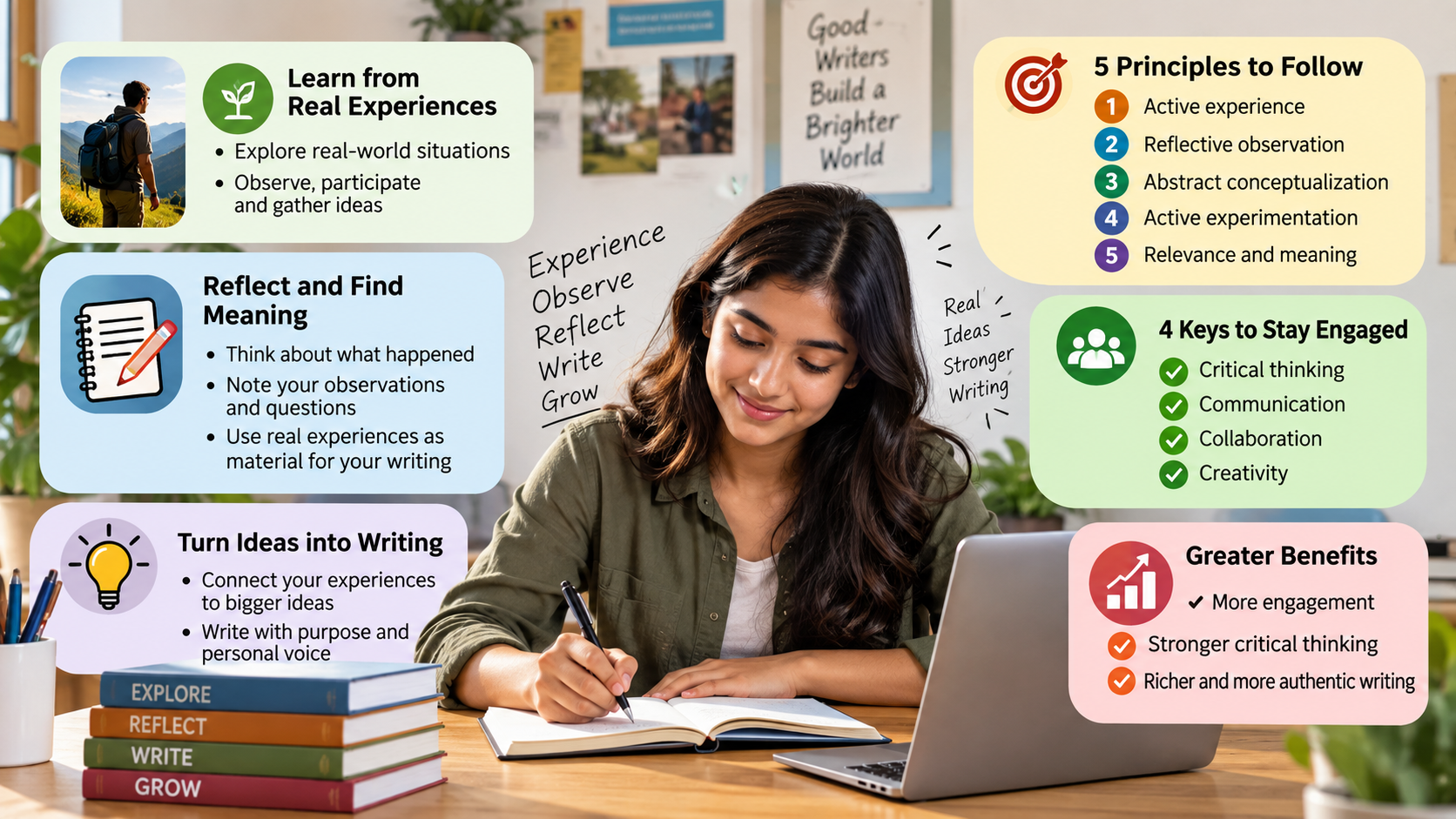
The five core principles of experiential learning create a pathway from direct experience to deeper understanding. First, learners need an active experience that allows them to interact with a situation rather than simply read about it. Second, reflective observation encourages students to examine what happened and consider why it happened. Third, abstract conceptualization helps learners turn those observations into broader ideas, explanations, or frameworks. Fourth, active experimentation gives students opportunities to test those new ideas in another situation. Finally, meaningful learning depends on relevance. Students should understand why the experience matters to their lives, communities, or learning goals. Teachers can also consider different types of learners when designing these experiences to support varied ways of absorbing information.
In writing instruction, these principles create a natural connection between experience and composition. Students observe, question, reflect, develop ideas, and then communicate what they discovered. This process makes writing feel purposeful instead of mechanical.
When educators use experiential writing to increase engagement, assignments can become opportunities for investigation, reflection, and discovery rather than simple compliance tasks.
Connecting Reflection Directly to the Page
Reflection turns an activity into meaningful knowledge that students can use in their writing. After completing an experience, learners can record their immediate observations, emotions, questions, and unexpected discoveries. These notes provide concrete material for later drafts. Instead of inventing examples, students can draw from events they actually experienced.
Teachers can guide reflection with focused questions. What did you notice first? What surprised you? Did the experience challenge an assumption? What evidence supports your interpretation? Such questions encourage students to move beyond simple descriptions.
Reflection also strengthens critical thinking and writing development. Students learn to distinguish between observation and interpretation. They can identify patterns, reconsider their first reactions, and develop stronger arguments.
A short reflection activity can therefore become the bridge between action and composition. Students enter the writing process with clearer ideas and richer details. This makes drafting easier while helping them create more authentic and thoughtful work.
What are the four C’s of student engagement?
The four C’s of student engagement are Critical thinking, Communication, Collaboration, and Creativity. Together, they support active participation and help students take greater ownership of their learning. Critical thinking encourages learners to question information, examine evidence, identify assumptions, and develop logical conclusions. Communication helps them express those conclusions clearly for specific audiences and purposes. Collaboration allows students to exchange perspectives, discuss ideas, and improve their work through feedback. Creativity gives learners freedom to experiment with language, structure, examples, and presentation. These skills are especially relevant when comparing traditional and modern classrooms and the teaching styles they use.
These four areas work best when they appear together rather than as isolated classroom activities. A writing project might ask students to investigate a real problem, discuss their findings with classmates, develop an original solution, and present their argument to an authentic audience.
This approach makes writing more interactive and purposeful. Students are not simply completing an assignment for a grade. They are thinking, communicating, working with others, and making creative decisions throughout the writing process.
Driving Meaningful Collaboration Through Shared Inquiries
Collaboration can turn writing from an isolated task into a shared process of discovery. Students who investigate the same question may notice different details or reach different conclusions. Discussing those differences helps writers recognize perspectives they might otherwise overlook.
Teachers can organize small groups around a common inquiry. Each student can gather evidence, record observations, and explain their interpretation to the group. Classmates can then question assumptions, suggest additional evidence, or challenge weak reasoning.
This process improves more than teamwork. It also strengthens audience awareness, because students learn to explain ideas to people who may not initially agree with them. Peer discussions can reveal unclear arguments before students begin revising their drafts.
Collaboration should still include individual responsibility. Each learner needs ownership of their final writing and decisions. Structured roles, clear discussion questions, and focused peer feedback can prevent one student from dominating the activity.
When collaboration is connected to a meaningful experience, students gain multiple viewpoints that can make their final writing more balanced, specific, and reader-focused.
When engaged in experiential learning?
Experiential learning encourages students to actively test assumptions and discover solutions through direct involvement. Instead of memorizing predetermined answers, they investigate situations, observe consequences, make decisions, and respond to unexpected results. This process moves learners from passive instruction toward active inquiry and problem solving.
They do not simply memorize predetermined answers. Instead, they investigate situations, observe consequences, make decisions, and respond to unexpected results. This process moves learners from passive instruction toward active inquiry and problem solving.
In a writing classroom, these experiences can provide the raw material students often struggle to find. A learner who observes a local environment, conducts an interview, or participates in a simulation has specific details to describe and analyze. Writing then becomes a way to document discoveries and communicate conclusions.
Experiential learning can also create productive uncertainty. Students may discover that their original assumptions were incomplete or incorrect. They must then reconsider their evidence and adjust their thinking. That process can strengthen analytical reasoning and intellectual flexibility.
For educators using experiential writing to increase engagement, the goal is not simply to make activities more entertaining. The experience should create meaningful questions that require students to observe, reflect, analyze, and communicate through writing.
Navigating Constructive Discomfort and Problem Solving
Experiential activities do not always produce predictable results. Students may encounter conflicting evidence, unexpected reactions, or outcomes that challenge their original assumptions. This uncertainty can feel uncomfortable, but it can also create valuable opportunities for learning.
For example, an experiment might produce results that contradict a student’s initial hypothesis. Rather than treating the unexpected result as failure, the teacher can ask the student to investigate why it occurred. The learner can review observations, reconsider the original claim, and develop a revised explanation.
This process strengthens problem-solving and analytical writing. Students learn that strong writing does not require pretending to have perfect answers. It requires examining evidence honestly and explaining how conclusions were reached.
Teachers should provide enough structure to keep constructive discomfort productive. Clear expectations, reflection questions, and supportive feedback can help students work through uncertainty without becoming overwhelmed.
When students learn to respond thoughtfully to unexpected outcomes, they become more flexible writers. They can revise arguments, acknowledge limitations, and communicate complicated ideas with greater confidence and accuracy.
What are the three main types of engagement techniques?
The three main types of engagement techniques are behavioral, emotional, and cognitive engagement. Behavioral engagement focuses on visible participation. Students complete tasks, contribute to discussions, conduct activities, and consistently participate in the writing process. Emotional engagement focuses on interest, curiosity, confidence, and personal connection. Students are more likely to invest effort when they believe the activity matters to them or their community. Time constraints and productivity can also influence how students manage effort and attention during these activities.
Cognitive engagement goes deeper. It requires learners to analyze ideas, monitor their thinking, solve problems, and make deliberate decisions about their writing. Techniques such as reflection journals, revision activities, self-assessment, and metacognitive prompts can encourage this deeper involvement.
Effective experiential writing combines all three dimensions. A field observation, for example, can require students to participate actively, connect personally with what they observe, and analyze those observations in a written response.
Using these approaches together can make writing more purposeful. Students are physically involved, emotionally invested, and intellectually challenged. This combination supports experiential writing to increase engagement without relying on entertainment or constant external rewards.
Implementing Cognitive Techniques for Deeper Thought
Cognitive engagement asks students to think carefully about both their ideas and their writing processes. Instead of focusing only on the finished draft, teachers can ask learners to examine how they developed their arguments, selected evidence, and organized information.
Process logs are one practical technique. Students can briefly explain what changed between drafts and why they made specific decisions. Dialectical notebooks can also help learners compare observations with interpretations, questions, or opposing viewpoints.
Peer challenge activities provide another useful approach. Students can ask classmates to identify unsupported claims, unclear reasoning, or missing perspectives. The writer then decides whether revisions are necessary and explains the reasoning behind those changes.
Self-assessment should also form part of the process. Students can review their work against clear criteria for evidence, organization, audience, and clarity.
These strategies make thinking visible. Learners begin to recognize patterns in their own composing habits and become more independent writers. Over time, this metacognitive awareness can improve both writing quality and confidence.
What are some examples of engagement strategies?
Practical engagement strategies connect curriculum goals with experiences that students can understand and investigate. Sensory field observation is one useful method. Students can explore an environment and record sights, sounds, textures, smells, and other details before writing a descriptive piece. This gives them specific material instead of requiring them to invent descriptions. Teachers can also use AI writing tools selectively to support parts of the writing process without replacing students’ own observations and thinking.
Community-based investigative journalism provides another option. Students can interview people, investigate local concerns, and produce articles based on their findings. This approach connects writing with research, communication, and real-world audiences.
Role-playing simulations can also support engagement. Students might enter a historical, ethical, or civic situation and write from a specific stakeholder’s perspective. The experience gives them a clear purpose and audience.
Interactive digital publishing can add another layer of relevance. Students can publish suitable work for classmates, community groups, or other authentic audiences.
The strongest strategies share one feature: students have something meaningful to observe, question, or solve before they write. This connection makes experiential writing to increase engagement more purposeful and can encourage stronger participation throughout the composition process.
Utilizing Simulation Scenarios for Persuasive Compositions
Immersive simulations give students realistic roles and problems that require persuasive communication. Instead of simply studying how arguments work, learners must use evidence and reasoning to address a situation. This creates an immediate reason to write.
For example, students could act as city council members responding to a fictional zoning dispute. Each learner might represent a different stakeholder, such as a resident, business owner, environmental group, or planning official. Students would research the issue, identify relevant concerns, and prepare a persuasive policy memo.
The simulation encourages writers to anticipate counterarguments and competing priorities. They must explain their position while considering what other stakeholders might value. This naturally strengthens audience awareness and rhetorical decision-making.
Teachers can follow the simulation with a reflection activity. Students can identify which arguments influenced them, which evidence proved most useful, and where their position changed.
This structure turns persuasive writing into an applied problem-solving exercise. Students are not merely practicing argumentative techniques. They are using those techniques to communicate within a realistic situation with competing interests and consequences.
Frequently Asked Questions
How does experiential writing differ from traditional essay writing?
Traditional essay writing often relies on secondary sources, abstract prompts, and formulaic templates. In contrast, experiential writing requires students to participate in an active event, simulation, or sensory exercise before writing. The resulting draft synthesizes personal observation, critical reflection, and academic analysis, producing a more authentic authorial voice and deeper engagement with the subject matter.
Can experiential writing methods work in virtual or online classrooms?
Yes, experiential writing works effectively in virtual environments through digital field studies, at-home experiments, and remote community interviews. Students can observe local environments, conduct digital ethnographies, or analyze virtual simulations. They then share reflections via digital forums, collaborating asynchronously to develop well-crafted, evidence-based essays.
How do educators assess experiential writing fairly and objectively?
Educators assess experiential writing by evaluating reflective depth, analytical rigor, and rhetorical craft rather than personal opinions. Using clear analytic rubrics helps instructors measure how effectively students connect concrete evidence to conceptual frameworks. This approach ensures objective grading while honoring individual student insights and authentic voice.
Which grade levels benefit most from experiential writing approaches?
Students across all educational tiers benefit from experiential writing, from primary school learners to post-graduate researchers. Younger pupils build strong observational and descriptive vocabularies through hands-on discovery, while secondary and university students develop sophisticated argumentative, ethnographical, and analytical capabilities by evaluating complex, authentic situations directly.
Conclusion
Implementing experiential writing to increase engagement shifts writing instruction from a passive classroom exercise into an active, transformative journey. By resting curriculum design on the five principles of experiential learning, instructors establish clear bridges between hands-on action and academic composition. Furthermore, embedding the four C’s ensures students develop the collaborative and critical capabilities required for modern communication.
When writers become actively involved in hands-on exploration, they no longer struggle to invent details or mimic artificial voices. Instead, they write with conviction, clarity, and authority derived directly from lived experience. Employing balanced behavioral, emotional, and cognitive engagement techniques ensures every student finds meaningful access points into complex writing projects.
As education moves toward deeper, more authentic learning assessments, experiential writing stands out as an indispensable approach. We encourage you to replace generic writing prompts with purposeful, hands-on tasks this week. Watch your classroom transform into an active workshop where students communicate with authentic purpose, intellectual curiosity, and enduring pride.