
5 Apps to Enhance Your Vocabulary Fast (2026 Guide)
A rich vocabulary helps you express complex ideas with precision. It can also improve your confidence in professional and academic settings. Finding the right tools makes this process easier and more consistent. The 5 apps to enhance your vocabulary in this guide offer different approaches to learning and remembering new words.
Modern vocabulary apps make learning more engaging than traditional word lists. Many use adaptive practice, contextual examples, repetition, audio, and interactive exercises. These features can help learners understand words instead of simply memorizing definitions.
However, an app works best when you use it consistently. Reading, writing, listening, and speaking should support your digital practice. Together, these habits help move words from passive recognition into active vocabulary.
This guide answers common questions about vocabulary improvement. You will learn which app may suit your goals, how many words to study daily, and how apps compare with broader language-learning platforms. You will also find practical ways to build a stronger vocabulary without relying on cramming.
Vocabulary
The Vocabulary app is designed for learners who want to build a stronger English vocabulary through focused practice. It can help you discover new words, understand their meanings, and review them regularly. Its dedicated vocabulary approach makes it useful for students, professionals, and anyone looking to improve everyday communication.
A vocabulary-focused app can be especially helpful when general language platforms do not provide enough depth. Instead of learning words only as part of broader lessons, you can concentrate on expanding your word knowledge.
Use the app as part of a consistent combine app-based learning with reading and listening. Seeing routine. Spend a few minutes learning new words, then review them later. Try using unfamiliar words in your own sentences to strengthen recall.
For better results, combine app-based learning with reading and listening. Seeing a word in different contexts helps you understand its meaning and usage more naturally.
Duolingo
Duolingo is a popular language-learning app that uses short lessons and interactive exercises to make daily practice easier. It covers vocabulary alongside skills such as reading, listening, speaking, and translation.
Its biggest advantage is its habit-focused learning experience. Short lessons can fit into busy schedules, while progress features encourage learners to practice regularly. This makes Duolingo particularly useful for beginners and intermediate learners who need a simple way to maintain consistency.
Although Duolingo is not exclusively a vocabulary app, it can help learners build vocabulary through repeated exposure. Words are introduced within lessons instead of being presented only as isolated definitions.
For stronger vocabulary growth, combine Duolingo with reading and dedicated vocabulary review. This gives you broader language practice while creating more opportunities to encounter and use new words.
Anki
Anki is a powerful flashcard app built around spaced repetition. It helps learners review information at intervals designed to improve long-term retention. This makes it particularly useful for vocabulary learners who want greater control over what they study.
You can create your own vocabulary cards or use existing decks. Cards can include definitions, example sentences, pronunciation, images, and other useful information. This flexibility allows you to create study materials around your personal goals.
Anki works especially well when you regularly add useful words from books, articles, courses, or conversations. Instead of trying to memorize a large list at once, you review smaller groups over time.
The app may feel more demanding than highly gamified alternatives. However, its customization makes it valuable for serious learners.
For the best results, avoid creating overly complicated cards. Include the word, a clear meaning, and a natural example sentence. Then review consistently.
Elevate
Elevate is a brain-training app that includes exercises designed to develop skills such as vocabulary, reading, writing, and communication. Its short, interactive activities make learning feel more like a daily mental workout.
For vocabulary learners, Elevate can provide useful practice with word meanings, language comprehension, and verbal skills. Its structured exercises are helpful for people who prefer variety rather than traditional flashcards.
One advantage is its focus on short sessions. You can practice for a few minutes without committing to a lengthy study block. This makes it easier to build a consistent routine.
However, Elevate should complement rather than replace direct vocabulary study. To expand your word knowledge effectively, combine its exercises with reading and contextual learning.
After encountering a new word, try using it in your own sentence. You can also keep a personal vocabulary list for words that you want to remember.
This combination turns short practice sessions into a broader vocabulary-building strategy.
WordUp
WordUp is a vocabulary-learning app focused on helping users learn useful English words through context. It uses examples and different forms of media to help learners understand how words appear in real communication.
The app can be useful for learners who want to move beyond simple dictionary definitions. Understanding a word involves more than knowing its meaning. You also need to recognize how it sounds, where it appears, and how native speakers use it.
WordUp can support this process by presenting vocabulary in contextual examples. This approach can make unfamiliar words easier to understand and remember.
For better results, do not simply complete lessons and move on. Review difficult words and use them in your own writing or conversations. Try creating short sentences that relate to your everyday life.
WordUp can work especially well alongside reading, listening, and speaking practice. Combining contextual exposure with regular recall gives you more opportunities to move words from passive recognition into your active vocabulary.
What is the best app to increase vocabulary?
If your goal is to find the best app to increase vocabulary, Vocabulary is a strong option for focused English word practice. It is designed around vocabulary development rather than treating vocabulary as a small part of a broader language course.
A dedicated vocabulary app can help you discover new words, review familiar ones, and improve your understanding through repeated exposure. This focused approach is useful for students, professionals, advanced learners, and anyone preparing for vocabulary-heavy exams.
However, there is no single app that works best for every learner. Your ideal choice depends on your current level, study goals, preferred learning style, and available time.
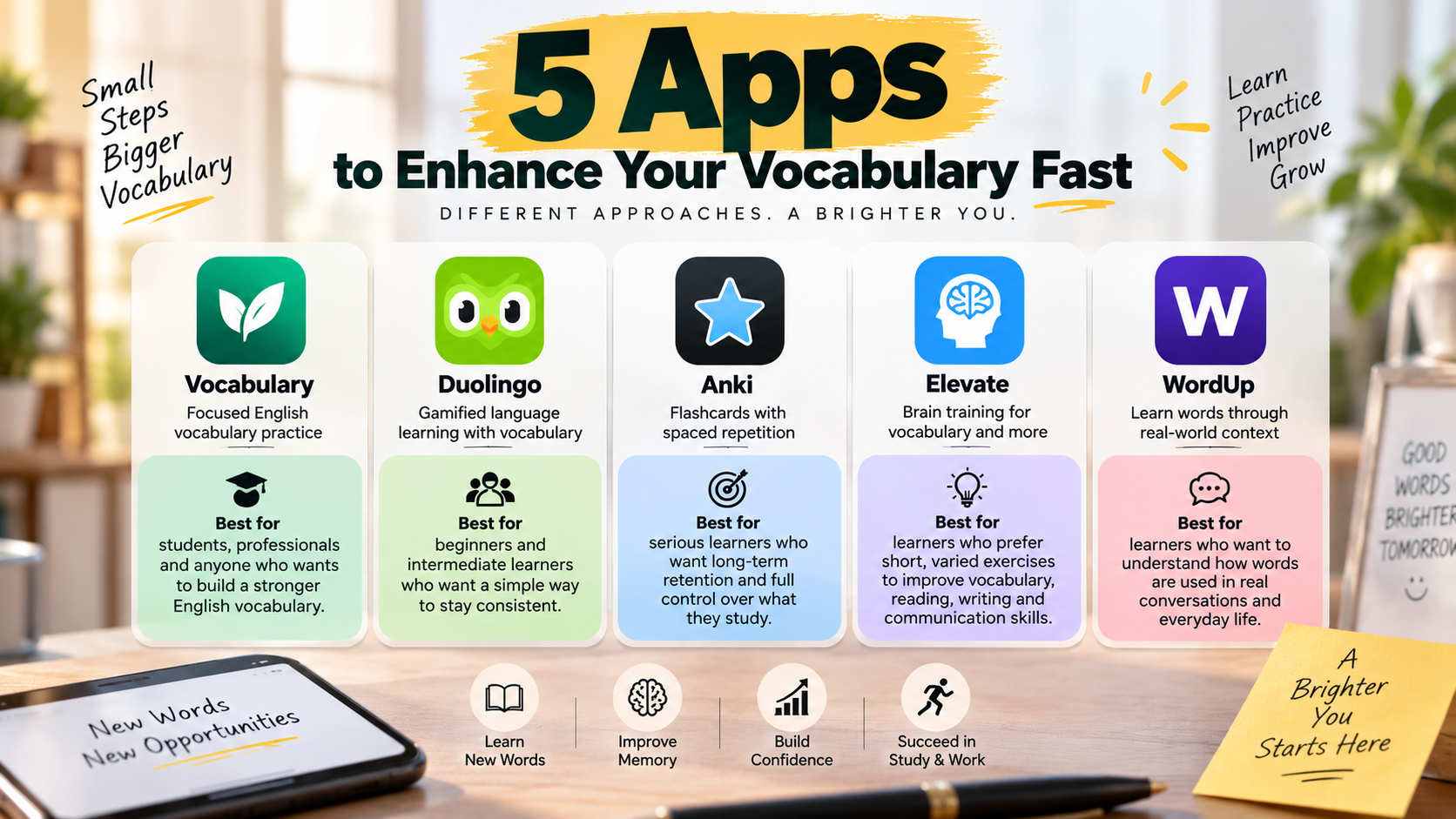
The apps to enhance your vocabulary in this guide offer different approaches. Vocabulary focuses directly on word learning. Duolingo supports broader language development. Anki is ideal for spaced repetition and personalized flashcards. Elevate provides varied mental exercises, while WordUp emphasizes contextual vocabulary learning.
Choose the app that fits your learning habits. The best vocabulary app is ultimately the one you can use consistently and effectively.
How can I enhance my vocabulary?
To enhance your vocabulary effectively, combine daily app practice with reading, listening, writing, and active usage. Start with a manageable routine of 10 to 20 minutes. Short sessions are easier to maintain and can become a consistent part of your day.
Digital practice introduces new words and gives you opportunities to recall them. Reading then shows how those words work in authentic contexts. Try novels, quality journalism, essays, nonfiction books, or subjects that genuinely interest you. You can also explore educational apps for students to discover additional tools for structured learning.
When you encounter an unfamiliar word, first examine its surrounding sentence. Guess its meaning before checking a dictionary. Then note the definition, pronunciation, and an example that makes sense to you.
Active use is equally important. Write a sentence using each new word. Try using it in an email, journal entry, discussion, or conversation.
A simple routine can include:
- 10 minutes of vocabulary app practice.
- 10 minutes of focused reading.
- 5 minutes reviewing new words.
- One deliberate attempt to use a new word.
For a more organized routine, iPhone and Android apps to simplify your routine can help you manage daily learning habits.
The apps to enhance your vocabulary can support this routine, but consistent practice and real-world usage remain essential.
Can I memorize 100 words in a day?
You can review 100 words in one day, but reviewing them does not guarantee lasting mastery. Large vocabulary lists can create a heavy cognitive load. Without later review and active use, many newly encountered words become difficult to recall.
A better strategy is to learn fewer words and revisit them regularly. Your daily target should match your current level, available time, and ability to use the words correctly. Building a manageable routine is easier when you use productivity apps for Windows 11 to organize study time and reminders.
For many learners, five to ten useful words per day provides a manageable starting point. Study each word through its definition, pronunciation, common combinations, synonyms, and example sentences.
Then revisit those words over several days. Use them while writing or speaking. This gives your brain repeated opportunities to retrieve the information.
Cramming may feel productive because you can recognize many words immediately. However, recognition is not the same as active mastery.
If your goal is long-term vocabulary growth, consistency matters more than an impressive daily number. A smaller collection of well-understood words can improve communication more than a large list you quickly forget.
The apps to enhance your vocabulary can make this process easier through structured practice and review. Choose a realistic daily target and focus on retaining useful words.
Which is the No. 1 English learning app?
Duolingo is one of the most widely used language-learning platforms and remains a popular choice for building a daily study habit. Its short lessons, interactive exercises, and progress features make regular practice approachable. Learners who use Android devices can also explore free apps for Android users for additional language-learning options.
For English learners, Duolingo supports vocabulary development alongside listening, reading, speaking, and translation activities. Its main strength is not specialized vocabulary depth. Instead, it encourages learners to return regularly and practice multiple language skills.
That distinction matters when choosing an app. Someone starting English may benefit from Duolingo’s broader course structure. An advanced learner seeking precise vocabulary and nuanced word usage may need a dedicated vocabulary platform.
Among the apps to enhance your vocabulary, Duolingo is best suited to learners who want broader language practice and an engaging daily routine. It can complement dedicated vocabulary tools by providing additional exposure to words in different lessons.
Ultimately, the best English learning app depends on your goal. Choose Duolingo for habit-building and broader language practice. Choose a specialized vocabulary app when expanding your word knowledge is the main priority.
What app is better than Duolingo?
There is no single app that is universally better than Duolingo. The right alternative depends on what you want to improve. Duolingo is useful for broad language practice, while dedicated vocabulary apps can provide more focused word learning.
If your main goal is vocabulary growth, Vocabulary can provide a more direct learning experience. Anki is another strong option when you want complete control over flashcards and spaced repetition.
WordUp is useful for learners who prefer contextual examples and practical English usage. Elevate offers varied exercises for people who enjoy short, interactive mental workouts.
These differences make the apps to enhance your vocabulary useful for different types of learners. You do not necessarily need to replace Duolingo. You can combine it with another app based on your specific learning needs.
For example, use Duolingo for broader English practice and Anki for targeted vocabulary review. Alternatively, use WordUp for contextual learning and Vocabulary for focused word development.
The best approach is to choose tools that complement each other. Your learning goals, consistency, and ability to use new words matter more than choosing a single perfect app.
Conclusion
Building a stronger vocabulary can improve communication, writing clarity, reading comprehension, and confidence. The right app can make that process more organized and engaging. However, no single tool can replace consistent exposure and active language use.
The apps to enhance your vocabulary covered in this guide each offer a different learning experience. Vocabulary is ideal for focused word practice and regular vocabulary development. Duolingo supports broader English learning and daily habit formation. Anki stands out for customizable flashcards and spaced repetition.
Elevate is a good choice for learners who enjoy short, varied exercises. WordUp focuses on contextual learning and useful English vocabulary, helping learners understand how words work in real communication.
Your learning strategy matters as much as your choice of app. Avoid trying to memorize huge word lists in one session. Instead, learn a manageable number of useful words and review them regularly.
Combine app practice with reading, writing, listening, and speaking. Pay attention to context, pronunciation, tone, and common word combinations. Most importantly, use new words as soon as possible.
Choose the apps to enhance your vocabulary that match your goals and learning style. Set a realistic daily target and stay consistent. Over time, regular exposure, active recall, and real-world usage can turn new words into confident, usable language.