Understanding the Diverse Types of Learners
Every person processes and understands information differently. That makes understanding the different types of learners useful for teachers, students, and educators. However, learners should not be treated as permanently fixed into one category. People often use different approaches depending on the subject, task, environment, and learning goal.
Several educational frameworks describe how people may prefer to receive, process, or demonstrate information. These include Gardner’s theory of multiple intelligences, sensory learning-style models, the VAK framework, and the VARK model. Each framework uses different categories and serves a different purpose.
This difference can create confusion. Some sources discuss four learning styles, while others mention seven or eight categories. These numbers do not necessarily contradict one another. They usually come from different educational models. Research has found little evidence that matching teaching methods to a student’s preferred learning style improves learning outcomes, so these models are better viewed as frameworks for exploring learning preferences rather than strict classifications. See the Education Endowment Foundation’s guidance on learning styles for a research-based overview.
This guide explains the major types of learners, including eight multiple-intelligence categories, seven commonly discussed learning styles, three classroom categories, four VARK categories, and ten practical learning methods. Understanding these frameworks can help students choose more effective study strategies without assuming that one method works for everyone.
What are the 8 types of learners?
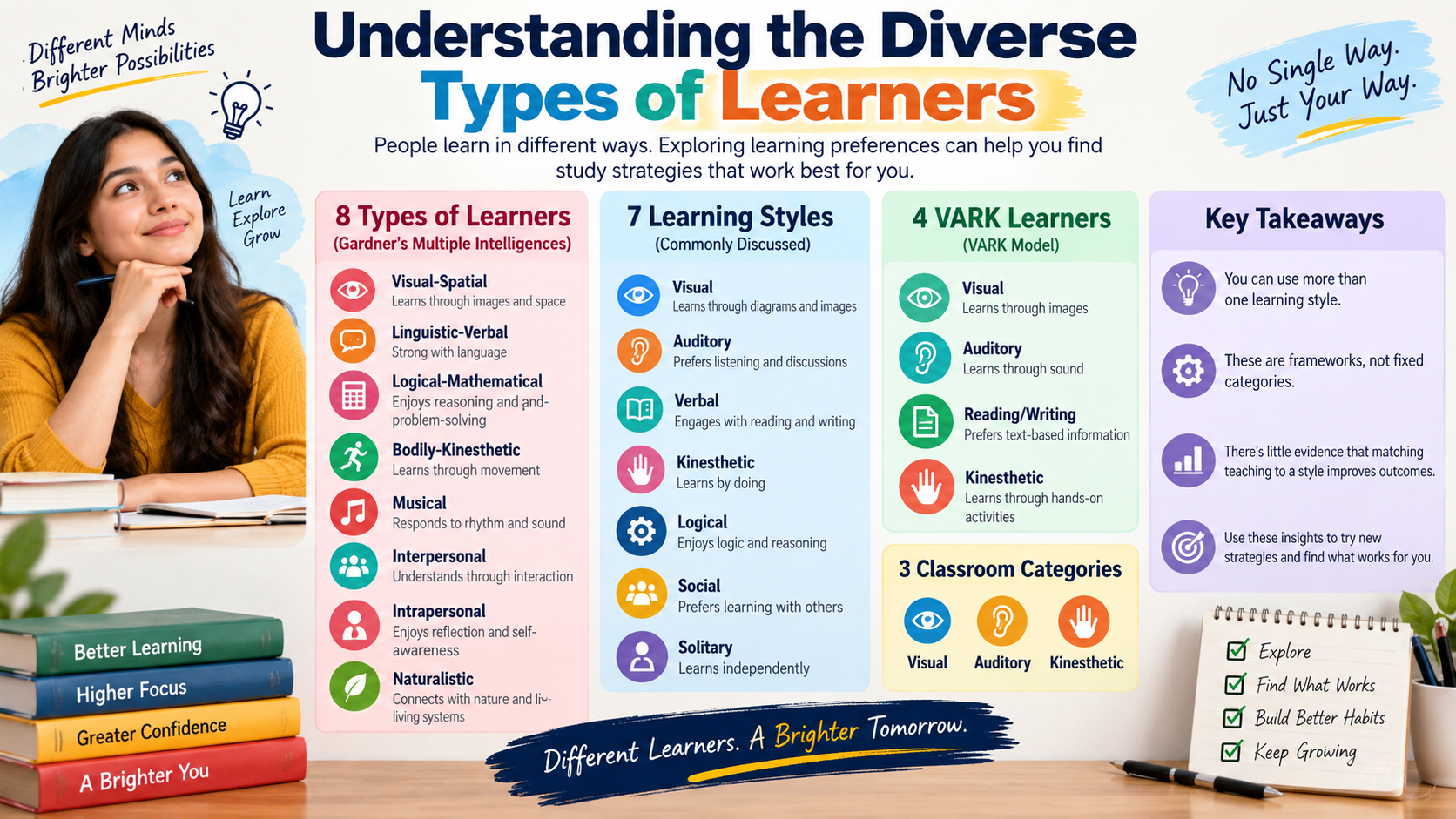
Howard Gardner’s theory of multiple intelligences describes eight areas in which people can demonstrate strengths. These are often discussed as different types of learners, although Gardner’s theory was designed to describe forms of intelligence rather than fixed learning styles.
The eight categories are:
- Visual-spatial: Understands information through images, maps, diagrams, and spatial relationships.
- Linguistic-verbal: Shows strength with reading, writing, speaking, and language.
- Logical-mathematical: Enjoys patterns, calculations, reasoning, and problem-solving.
- Bodily-kinesthetic: Learns or demonstrates understanding through movement and physical activity.
- Musical: Responds strongly to rhythm, sound, melody, and musical patterns.
- Interpersonal: Understands ideas through communication, cooperation, and interaction with others.
- Intrapersonal: Benefits from reflection, independent thinking, and self-awareness.
- Naturalistic: Connects information with nature, living systems, and the physical environment.
These categories can help educators recognize different strengths without labeling students permanently.
Tailoring Study Habits to Gardner’s Model
Students can use Gardner’s categories as a starting point for exploring different study habits and productivity systems for students. The goal should not be to identify one permanent learning type. Instead, students can test strategies that match their strengths and the demands of a particular subject.
For example, someone who enjoys music could use rhythm or verbal patterns to remember information. A student with strong visual-spatial abilities might organize concepts with diagrams, timelines, or mind maps. A learner who enjoys interpersonal activities could discuss difficult ideas with classmates.
The important point is flexibility. A student may prefer independent reflection for one task but benefit from collaboration during another. Similarly, visual materials can help with science while practice and discussion may work better for language learning.
Gardner’s framework can therefore encourage students to explore multiple ways of understanding information. It should complement evidence-based techniques such as active recall, practice testing, and spaced repetition, rather than replace them. Students can also strengthen their study habits by focusing on critical thinking rather than memorization when appropriate.
What are the 7 types of learning styles?
The seven commonly discussed learning styles describe different ways people may prefer to interact with information. They are usually identified as visual, auditory, verbal, kinesthetic, logical, social, and solitary styles.
Visual learners often prefer diagrams, images, charts, and demonstrations. Auditory learners may enjoy spoken explanations, discussions, and recorded material. Verbal learners tend to engage with reading, writing, and language-based activities. Kinesthetic learners may prefer practical activities and real-world examples.
Logical learners often look for patterns, systems, and clear relationships. Social learners may enjoy collaboration and discussion, while solitary learners often prefer quiet, independent study.
However, these categories should not be treated as strict scientific classifications. Learning preferences can change with the subject and situation. A student might prefer diagrams for mathematics but discussion for history.
Using several approaches can therefore be more useful than trying to identify one permanent style. Students should experiment with different methods and judge them by actual learning and retention.
Blending Multiple Sensory Pathways for Retention
Combining different ways of interacting with information can make studying more active and engaging. Instead of relying on a single preferred style, students can connect several useful activities around the same concept.
For example, a student studying biology could read a short explanation, examine a labeled diagram, explain the process aloud, and complete practice questions. These activities require different forms of attention and processing. More importantly, they encourage the learner to actively work with the information.
Handwritten notes can also be combined with diagrams, questions, examples, and short explanations. However, simply adding more sensory inputs does not automatically improve memory. The quality of the learning activity matters more than the number of senses involved.
For stronger information retention, students should combine multimodal resources with proven techniques. Active recall requires retrieving information from memory. Spaced repetition revisits material over increasing intervals. Practice testing checks whether knowledge can actually be retrieved.
The best approach is therefore not to force every lesson into a learning-style category. Instead, use different methods when they make the information clearer, easier to practice, or easier to retrieve.
What are the three main categories of learners in the classroom?
The classic VAK framework groups learners into three broad categories: visual, auditory, and kinesthetic. These categories are commonly used in classroom discussions about learning preferences.
Visual learners may respond well to diagrams, demonstrations, charts, written examples, and organized visual information. Auditory learners may prefer spoken explanations, discussions, questions, and verbal instructions. Kinesthetic learners may engage more readily with practical activities, demonstrations, experiments, and physical tasks.
These categories can provide teachers with simple ideas for varying classroom instruction. However, they should not be used to label students permanently or assume that a student can learn only through one format. Understanding educational psychology theories can provide teachers with broader perspectives on how students learn and develop.
A single lesson can include several forms of instruction. A teacher could introduce a science concept with a diagram, explain the process verbally, and then demonstrate it through an experiment. Students can also answer questions or solve problems afterward.
This approach creates variety while keeping the focus on understanding. Effective teaching should consider the learning objective, subject matter, student needs, and evidence-based instructional practices, rather than relying entirely on VAK labels.
Managing Classroom Diversity Through Varied Delivery
Teachers can support classroom diversity by presenting important concepts in more than one useful format. This does not require creating a separate lesson for every student. Instead, teachers can build reasonable variety into the same lesson, much as modern classrooms use varied teaching styles to support different learning needs.
For example, a science lesson could begin with a visual representation of a process. The teacher could then explain the process and invite students to discuss it. A short practical demonstration could follow. Students could finish by answering questions or completing an application task.
This structure gives students several opportunities to interact with the material. It also helps teachers determine whether students actually understand the concept.
However, variety alone does not guarantee better learning. A visually attractive presentation can still be ineffective if students remain passive. Likewise, a practical activity may create engagement without producing meaningful understanding, which is why teachers should use student engagement strategies alongside varied instruction.
Teachers should therefore connect each activity to a clear learning objective. Retrieval questions, worked examples, guided practice, feedback, and application tasks can make lessons more effective.
The purpose of varied delivery should be to improve access and engagement while maintaining instructional quality. It should not be to place every student into a fixed classroom category.
What are the four major types of learning?
The VARK model identifies four commonly discussed learning preferences: visual, auditory, reading/writing, and kinesthetic. Unlike the three-category VAK framework, VARK separates reading and writing from visual information.
Visual learners may prefer charts, diagrams, graphs, symbols, and other visual representations. Auditory learners may prefer lectures, conversations, explanations, and discussions. Reading/writing learners often engage with written instructions, articles, notes, lists, and definitions. Kinesthetic learners may prefer demonstrations, practical activities, examples, and real-world applications.
These categories are useful for describing preferences, but they should not be interpreted as proof that each person learns best only through one mode. Research has not established strong evidence for matching instruction to a person’s supposed learning style.
Instead, students can use the VARK categories to explore different ways of studying. The most effective method depends on the material and the task. For example, a graph may be appropriate for interpreting data, while practice questions may be better for testing mathematical knowledge.
The model is therefore best treated as a planning and reflection tool, not a rigid classification system.
Why Reading and Writing Deserves Separation
VARK separates reading and writing from visual learning because written language and visual representations communicate information differently. A paragraph presents information through words and sequential reading. A diagram can show relationships, structures, or spatial information at a glance.
This distinction can help teachers think more carefully about how information is presented. For example, a lesson about a complex process might include a written explanation alongside a labeled diagram. Students could then summarize the process using their own words.
However, separating these preferences does not mean that every student has one permanent reading/writing or visual learning style. People regularly use both written language and visual information when studying.
A student may read an explanation, examine a chart, write notes, and complete practice questions during the same study session. These activities can complement one another.
For effective learning, the important question is not simply which category a student belongs to. The better question is which representation or activity helps the student understand and retrieve the target information.
Reading, writing, diagrams, examples, and practice can all have value when they serve a clear instructional purpose.
What are the 10 methods of learning?
Students can use many evidence-informed learning methods to understand, practice, and retain information. Ten commonly discussed approaches include spaced repetition, active recall, dual coding, elaborative interrogation, interleaving, self-explanation, the Feynman technique, practice testing, project-based learning, and peer teaching.
Spaced repetition revisits information over time. Active recall requires students to retrieve information without simply rereading their notes. Dual coding combines words with useful visual representations. Elaborative interrogation encourages learners to ask why information is true.
Interleaving mixes related topics or problem types instead of practicing one type continuously. Self-explanation requires learners to explain their reasoning. The Feynman technique encourages simple explanations that expose knowledge gaps. Practice testing measures whether information can be retrieved.
Project-based learning applies knowledge to practical tasks. Peer teaching requires students to explain concepts to others. This approach can give learners opportunities to apply knowledge through meaningful projects rather than relying only on traditional study activities.
These methods are not equally useful for every task. Students should choose techniques based on the subject, learning objective, and stage of study.
Selecting the Right Method for Difficult Concepts
Choosing a learning method should begin with the type of knowledge being learned. Memorizing vocabulary, solving equations, understanding scientific concepts, and building practical skills require different forms of practice.
For factual information, active recall and spaced repetition can provide a structured way to review important details. Students can use flashcards, practice questions, or short self-tests. For problem-solving subjects, worked examples, deliberate practice, and interleaving can help learners recognize different problem types.
Self-explanation can be useful when students need to understand how or why something works. The Feynman technique can expose gaps by forcing learners to explain a difficult idea in simple language. Project-based tasks are useful when students need to apply knowledge to realistic problems.
Students should also measure results instead of relying on comfort. A method that feels easy may not produce strong retention. Practice questions can reveal whether information can actually be recalled and applied.
The best learning strategy is therefore the one that supports the specific goal and produces measurable improvement. Combining several methods can create a more flexible and effective study system.
Frequently Asked Questions
Can an individual possess more than one learning style?
Yes, individuals can demonstrate characteristics associated with multiple types of learners. A student may prefer diagrams for mathematics but discussions for history. Preferences can change with context, subject, and learning goals.
Does matching teaching styles to learning styles guarantee better test scores?
No, matching teaching styles with preferred types of learners does not guarantee higher test scores. Learning outcomes depend on content, practice, feedback, retrieval, and instructional quality, not preference alone.
How does the VARK framework differ from Gardner’s multiple intelligences?
VARK categorizes preferred ways of interacting with information, while Gardner’s model describes broader intellectual abilities. Therefore, these frameworks classify types of learners differently and should not be treated as identical systems.
How do I identify which learning method works best for me?
Experiment with different methods and measure your results. Compare recall after practice questions, diagrams, explanations, or summaries. This helps identify which approaches work best for your types of learners.
Conclusion
Understanding the diverse types of learners shifts education away from rigid instruction toward dynamic, personal growth. Whether you examine Gardner’s eight intelligences, explore the VARK model, or use the ten proven study techniques, these frameworks show that no single learning path fits everyone. This idea also connects closely with personalized learning in education, which emphasizes adapting learning experiences to individual needs and circumstances.
When educators respect these differences, classrooms become engaging spaces where every student can thrive. Similarly, independent learners gain an edge by identifying their cognitive habits and adopting compatible study methods. Instead of forcing yourself into frustrating study routines, embrace your natural tendencies. Experiment with active recall, combine visuals with text, and build a personalized system that turns complex information into lasting knowledge.