Traditional vs Modern Classrooms: Teaching Styles Around the World
Education has changed significantly over the past few decades. Understanding traditional vs modern classrooms helps educators and parents see how learning environments influence student development. Traditional methods often rely on structured lessons, teacher-led instruction, and memorization. Modern approaches place greater emphasis on collaboration, critical thinking, creativity, and digital literacy. Education systems around the world continue to combine elements of both approaches to prepare students for changing academic and workplace demands. The U.S. Department of Education, provides resources on educational initiatives and learning practices.
The differences matter because classroom environments can influence student engagement, knowledge retention, and skill development. However, neither approach is automatically better in every situation. The effectiveness of a teaching method depends on the subject, students, teacher, and learning goals.
Whether you are an educator improving your teaching approach or a parent comparing school environments, these differences provide useful context. This article examines traditional and modern teaching methods, classroom layouts, the 7 C’s of teaching, common teaching styles, and the similarities between traditional and modern education systems.
What Are the Differences Between Modern and Traditional Methods of Teaching?
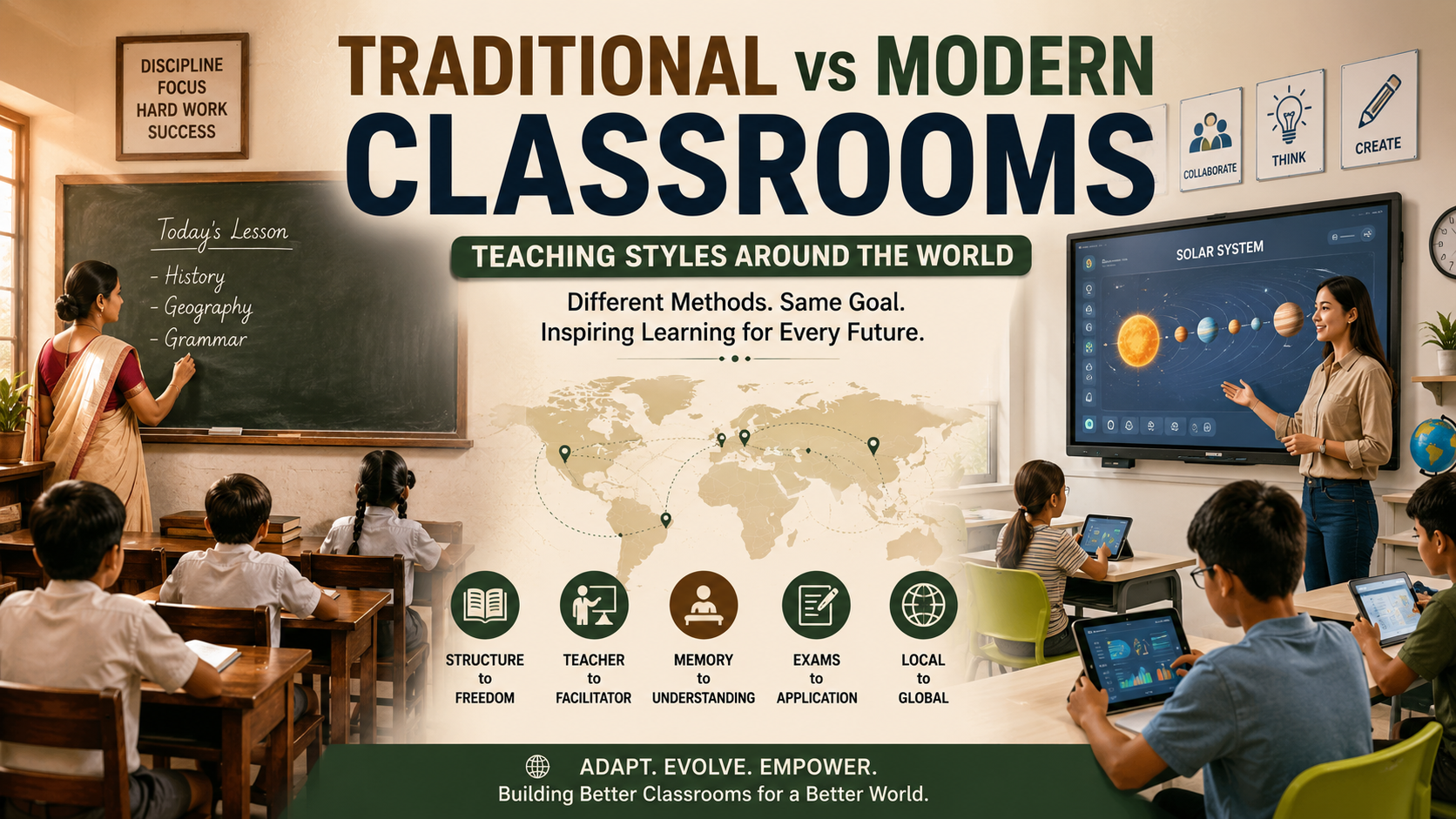
Traditional and modern teaching methods represent different approaches to classroom learning. Traditional teaching usually places the teacher at the center of instruction. The teacher explains concepts while students listen, take notes, study textbooks, and complete individual assignments. Lectures, repetition, and examinations are common parts of this approach.
Modern teaching makes students more active participants. Teachers may use collaborative projects, inquiry-based learning, discussions, practical activities, and digital tools. Instead of focusing mainly on memorizing information, students may apply concepts to problems and real-world situations. Teachers often act as facilitators who guide students through the learning process.
The biggest difference is not simply technology. It is the role students play during learning. Traditional classrooms often emphasize receiving and remembering information. Modern classrooms place greater emphasis on applying, questioning, creating, and communicating knowledge.
The Shift in Student Interaction and Assessment
Assessment also differs between the two approaches. Traditional education often depends on written examinations and standardized tests. These methods can provide clear measures of academic performance but may not capture every practical skill.
Modern education may combine tests with formative assessments, presentations, projects, digital portfolios, and peer feedback. These methods allow teachers to monitor progress throughout the learning process. A balanced classroom can use both approaches when each serves a clear purpose.
What Are the Key Differences Between a Traditional Classroom and a Modern Classroom?
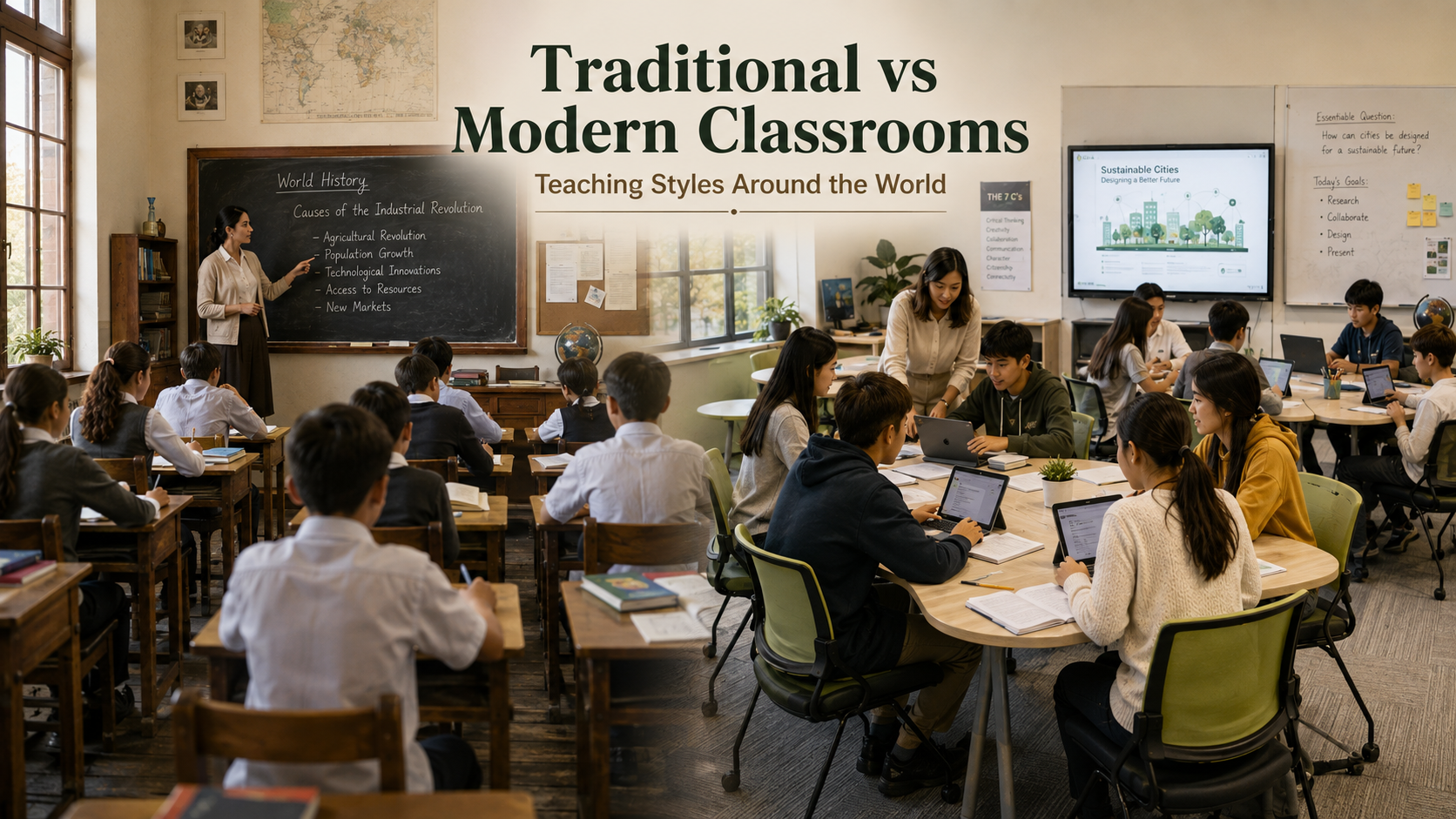
The physical environment and use of technology make some differences between traditional and modern classrooms immediately visible. A traditional classroom commonly uses fixed desks arranged toward a teacher and board. This arrangement supports lectures and individual work. Technology may play a limited supporting role. Classroom styles can also differ significantly across countries, reflecting different educational traditions and approaches.
A modern classroom can use flexible seating, shared workspaces, interactive displays, tablets, and online collaboration platforms. These features make it easier for students to work in groups and access digital resources. However, technology alone does not make a classroom modern or effective.
The curriculum can also differ. Traditional classrooms may follow a more standardized sequence of lessons. Modern classrooms can offer greater opportunities for personalized learning, allowing students to explore different resources or activities based on their abilities and interests.
Flexible Spaces and Technology Integration
Flexible layouts can encourage communication and teamwork. Students can move between individual work, group activities, and classroom discussions more easily. Digital tools can also provide access to online libraries, educational platforms, virtual experiences, and international perspectives. Effective lesson planning can help teachers organize these activities efficiently while maintaining clear learning objectives.
Still, technology must support a specific learning objective. Simply adding tablets or interactive screens does not guarantee better learning outcomes. Effective modern classrooms combine appropriate technology with clear instruction, meaningful activities, and strong teacher guidance.
What Are the 7 C’s in Teaching?
The 7 C’s of teaching provide a useful framework for developing skills that extend beyond memorizing academic information. The commonly referenced competencies include critical thinking, creativity, collaboration, communication, character, citizenship, and connectivity.
Critical thinking helps students evaluate information, recognize problems, and develop reasoned solutions. Creativity encourages original ideas and different approaches to challenges. Collaboration teaches students how to contribute to teams, share responsibilities, and respect different viewpoints.
Communication helps learners express ideas clearly through speaking, writing, and digital formats. Character focuses on qualities such as responsibility, integrity, and resilience. Citizenship encourages awareness of responsibilities within communities and society. Connectivity highlights the ability to build relationships and use connected resources effectively.
These competencies can complement traditional academic knowledge. Students still need strong foundations in subjects such as mathematics, science, languages, and history. The 7 C’s add practical skills that can help learners apply that knowledge beyond the classroom.
Cultivating Modern Skills for Global Learners
Teachers can develop these skills through group projects, discussions, research activities, presentations, and problem-solving exercises. A single activity can address several competencies at once. Proven student engagement strategies can also help teachers make these activities more interactive and purposeful.
For example, a team research project can develop collaboration, communication, critical thinking, creativity, and digital connectivity. Teachers can also use reflection activities to help students understand how they developed these skills.
The goal is not to replace academic learning. Instead, the 7 C’s can strengthen how students use what they learn. This makes them relevant to modern education while remaining compatible with effective traditional teaching practices.
What Are Some Common Teaching Styles Used in Classrooms?
Teachers use different instructional styles depending on the subject, age group, classroom environment, and learning objectives. The authoritative or direct-instruction style places the teacher in a central role. It can work well when students need clear explanations, demonstrations, or structured guidance. Other educational approaches, including alternative education models, may use different structures to meet specific student needs.
The facilitator style encourages students to explore ideas through activities, discussions, and practical tasks. The teacher provides guidance rather than controlling every stage of learning. The demonstrator style emphasizes showing concepts through examples, experiments, or practical demonstrations. It can be useful in subjects such as science, technology, and art.
The delegator style gives students greater responsibility for completing projects or solving problems. Teachers remain available for support and feedback. Finally, blended teaching combines multiple approaches based on the needs of the lesson.
No single teaching style works best for every classroom. Effective teaching depends on choosing an approach that matches the learning goal.
Choosing the Right Pedagogical Approach
Teachers often need to balance direct instruction with student-centered activities. Complex concepts may require a clear explanation before students can explore them independently.
A blended approach can therefore combine short lectures, demonstrations, discussions, projects, and assessments. This provides structure without making students passive throughout the lesson.
The best approach also considers student age, subject difficulty, available resources, and classroom size. Teachers should evaluate whether a method is helping students understand and apply the material. Teaching style should serve learning objectives, rather than following a trend simply because it appears modern.
Similarities of Traditional and Modern Education
Despite their differences, traditional and modern education systems share several important foundations. Both aim to develop knowledge, support intellectual growth, and prepare students for future responsibilities. Schools using either approach still teach core subjects such as mathematics, science, languages, literature, and social studies.
Both systems also depend on qualified teachers. Teachers explain concepts, provide guidance, establish classroom expectations, and evaluate student progress. Even modern classrooms require structure and clear learning objectives. Strong parent-teacher communication can also support student progress by helping families and educators work together. Technology does not eliminate the need for effective instruction.
Assessment remains another common feature. Traditional schools may rely more heavily on examinations, while modern schools may combine tests with projects and ongoing assessments. However, both approaches need reliable ways to determine whether students are meeting learning goals.
Schedules, curricula, classroom rules, and institutional policies also remain important. These structures create consistency and accountability for students and educators.
Shared Foundations in Student Success
The similarities show that traditional vs modern classrooms are not completely separate systems. Many schools combine elements of both approaches.
A teacher may deliver a structured explanation before assigning a collaborative project. Students may study from textbooks while also using digital resources. A classroom may use examinations alongside presentations, portfolios, and practical assignments.
Both approaches ultimately seek to help students become knowledgeable, capable, and responsible individuals. The strongest learning environment may therefore depend less on choosing one model and more on using the right method for each educational goal.
Rather than treating traditional and modern education as opposites, educators can consider what each approach does well. Structure, subject knowledge, technology, collaboration, and critical thinking can all contribute to effective learning when used appropriately.
FAQ SECTION
How Has Technology Changed Modern Classrooms?
Technology has significantly changed traditional vs modern classrooms by making learning more interactive, flexible, and accessible. Traditional chalkboards and printed textbooks now often work alongside interactive displays, laptops, tablets, and digital learning platforms. Students can access educational resources instantly and collaborate through cloud-based documents. Teachers can also use learning software to track progress and provide personalized activities. However, technology works best when it supports clear learning objectives rather than replacing effective teaching.
Is Traditional Teaching Completely Obsolete Today?
Traditional teaching is far from obsolete and continues to play an important role in education. Direct instruction, lectures, textbooks, and structured practice can work especially well when students need foundational knowledge or clear explanations of complex concepts. Traditional methods can also provide useful structure in large classrooms. The key issue is not whether traditional teaching should disappear. Instead, educators should consider when direct instruction is most effective and combine it with other methods when students need greater interaction or practical application.
Why Is Collaboration Emphasized in Modern Teaching?
Collaboration is emphasized because students often need teamwork and communication skills beyond the classroom. Modern learning activities can place students in groups where they share ideas, divide responsibilities, solve problems, and evaluate different viewpoints. These activities can improve communication while teaching students how to handle disagreements constructively. Collaboration also encourages students to explain their reasoning to others. However, group work should have clear objectives and individual accountability. Simply placing students into groups does not automatically create meaningful learning.
Can Teachers Combine Traditional and Modern Methods?
Yes. Teachers can combine traditional and modern approaches through a blended teaching strategy. For example, an educator might begin with a short lecture to explain a difficult concept. Students can then complete a group activity, conduct digital research, or solve a practical problem using what they learned. This approach combines the structure of traditional instruction with the active participation associated with modern classrooms. The most effective combination depends on the subject, student needs, available resources, and specific learning objectives.
Conclusion
Exploring traditional vs modern classrooms reveals how teaching styles continue to evolve to meet the changing needs of society. While traditional methods offer structure and direct knowledge transfer, modern approaches foster critical thinking, collaboration, and technological fluency. Both educational frameworks share a common goal: equipping students with the knowledge and skills necessary for lifelong success. Recognizing the strengths of each model allows educators, schools, and parents to create balanced learning environments. By embracing the best elements of both worlds, we can better support students as they navigate their educational journeys and prepare to lead in an interconnected global community.