
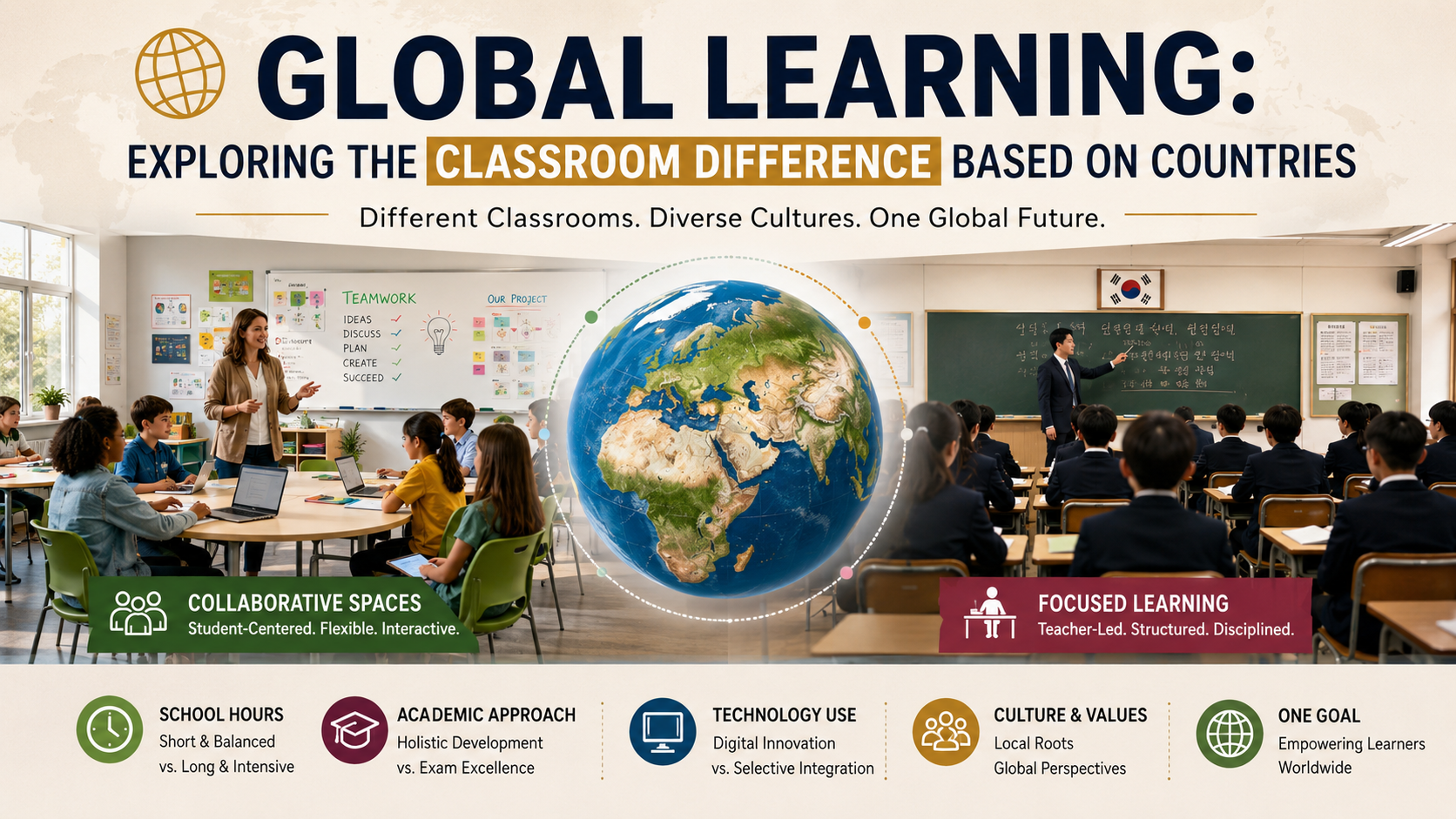
Global Learning: Exploring the Classroom Difference Based on Countries
When you step into a school, you expect to see desks, a chalkboard, and a teacher leading a room full of students. However, the way education actually functions changes dramatically depending on where you live. The unique classroom difference based on countries reveals that teaching is never a one-size-fits-all model. Instead, local culture, societal values, and government funding deeply shape how students learn every single day.
Understanding these educational variations is essential for modern educators, expatriate families, and policymakers alike. By examining international schooling models, we gain fresh perspectives on how to improve student engagement and academic outcomes. According to international education studies published by the UNESCO Institute for Statistics, national cultural values directly dictate classroom dynamics and academic expectations worldwide. This article will explore how global school environments differ, from layout to testing methods.
Defining the Classroom Difference Based on Countries
The core variation in international schooling stems from how societies view the roles of teachers and students. In some nations, education is strictly teacher-centered, emphasizing lectures and memorization. Conversely, other cultures champion student-led discovery and collaborative group work. These philosophical disagreements alter the physical layout of the room, the length of the school day, and even the emotional atmosphere.
For instance, some cultures prioritize competitive testing, while others focus entirely on holistic well-being. Recognizing these contrasts helps us appreciate the diverse paths toward academic success. Every country shapes its curriculum around the type of citizen it wants to produce. Therefore, a classroom in one part of the world might look like a highly disciplined workplace, while in another, it resembles an open, creative studio. Understanding this dynamic helps educators adapt to an increasingly globalized student population.
Collaborative Spaces vs. Lecture Halls: Global Physical Layouts
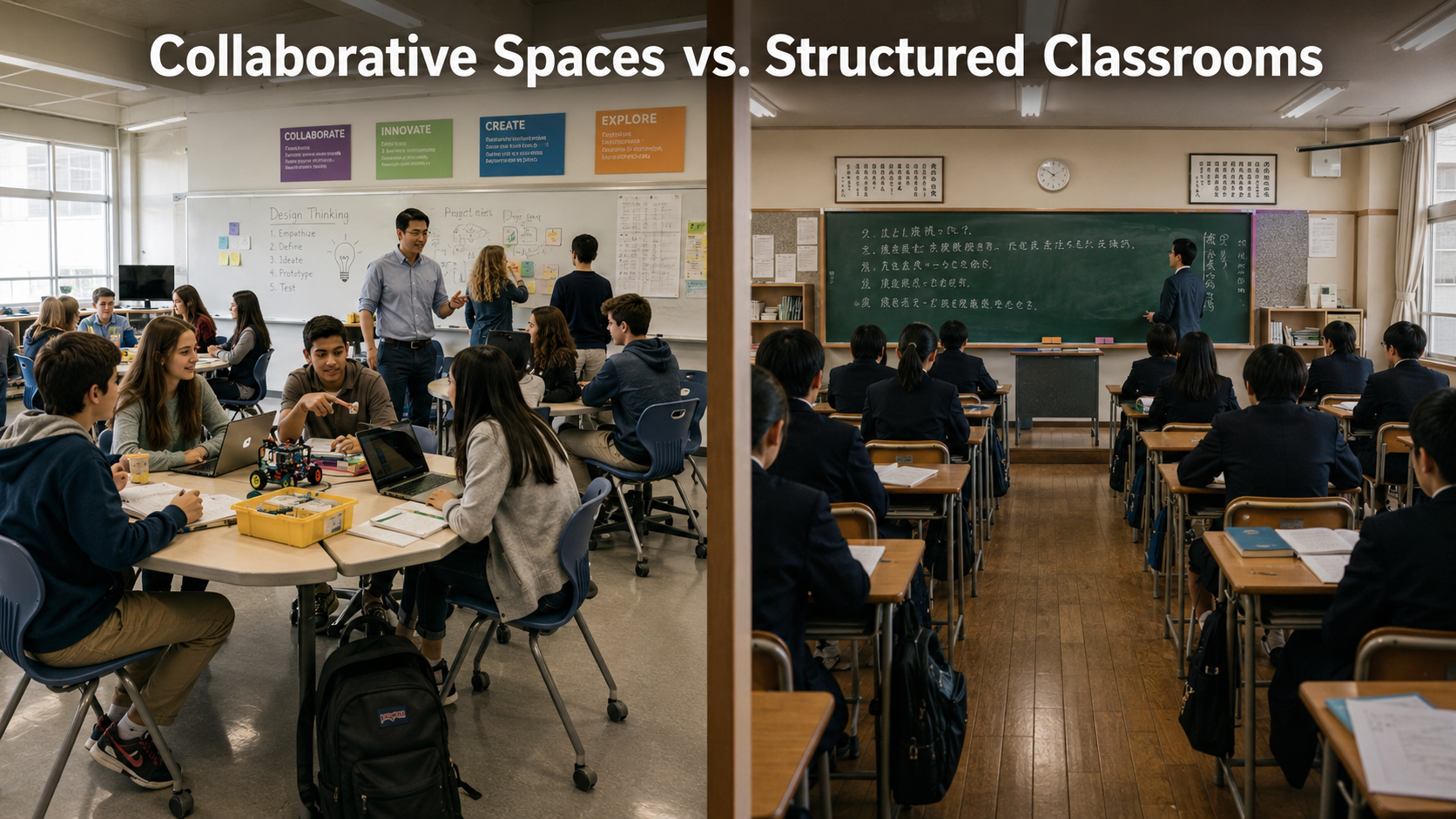
The physical layout of a room tells you everything about its teaching philosophy and highlights a clear classroom difference based on countries. In many Western nations, like the United States or Canada, furniture is highly flexible. Desks are regularly grouped together into clusters to promote conversation and team projects. This intentional setup encourages students to talk to one another, share ideas, and work through problems as a collective unit.
In contrast, schools in East Asian countries, such as South Korea and Japan, often utilize a traditional grid layout. Desks face forward in straight, unmoving rows toward the teacher. This structure maximizes focus, reinforces authority, and keeps the attention strictly on the lesson plan. Teachers can deliver information seamlessly without the distractions that come from collaborative seating arrangements. Both layouts serve their intended societal goals perfectly, showing how physical environments dictate behavior.
Flexible Seating and International Schooling Differences
Western schools frequently use beanbag chairs, standing desks, and whiteboards lining every wall. This design choice signals that learning is an active, social process. Students are expected to move around, choose their own comfortable working spaces, and collaborate constantly. The open space naturally minimizes the traditional hierarchy between the teacher and the child, fostering a sense of independence and personal responsibility early in life.
Fixed Rows and Regional School Environment Variations
The traditional forward-facing setup in Asian classrooms emphasizes respect for the educator and unity among peers. Because students stay in fixed rows, they learn to value quiet focus, active listening, and self-discipline. This design supports large class sizes efficiently, ensuring every student has a clear, unobstructed view of the board. The lack of physical clutter mirrors the focused, distraction-free environment that these academic cultures highly prize.
Academic Rigor and School Hours Across Borders
The time students spend studying varies wildly across the globe. This represents a massive element of the global school differences seen internationally. The length of the school day directly impacts how deeply a curriculum can be explored and how much stress students experience.
-
The Finnish Model: Finland famously provides a relaxed schedule. Children start formal schooling later, enjoy 15-minute outdoor breaks every hour, and rarely receive homework. They consistently rank among the top global performers.
-
The East Asian Model: Countries like Singapore and China operate on the opposite end of the spectrum. The school day often extends into the evening through mandatory cram schools, known as hagwons in South Korea. Students face intense pressure to master complex curricula at a very young age.
This massive divergence highlights two entirely different paths to educational excellence. While one system relies on intense, high-octane study hours, the other relies on rest and high-quality instruction during brief periods. Consequently, global families often experience culture shock when transitioning between these highly contrasting academic environments.
The Role of Technology and the Classroom Difference Based on Countries
Technological integration highlights another fascinating contrast in international schooling styles. The classroom difference based on countries becomes incredibly obvious when analyzing how different nations integrate digital tools. High-income nations have rapidly shifted toward digitized learning environments, drastically changing how assignments are completed and assessed. However, the adoption rate and philosophy behind this technology vary heavily based on regional wealth and cultural educational goals.
Some nations believe that digital literacy should be taught as early as possible, integrating screens into daily preschool activities. Other societies view early screen time as a hindrance to natural cognitive development and deliberately delay its introduction. This ongoing global debate shapes the tools found inside modern schools, creating a digital divide that is pedagogical rather than purely economic.
1:1 Device Initiatives and Global Digital Learning
In Scandinavian schools and wealthy districts across the United States, laptops or tablets are standard issue for every single child. Textbooks are frequently entirely digital, and assignments are submitted through cloud platforms. This setup allows for personalized learning speeds, where software adapts to a child’s unique academic level. Teachers act more as facilitators, guiding students as they navigate vast online resources and learn research skills independently.
Tech-Free Philosophies and Traditional Teaching Styles
Surprisingly, some highly advanced countries intentionally limit technology in early education. Certain European schools protect traditional tactile skills, preferring physical books, paper notebooks, and cursive handwriting practice. They believe this approach builds stronger cognitive focus, patience, and fine motor skills before introducing digital screens. By keeping the early years tech-free, these schools ensure that children develop deep interpersonal communication habits without digital distractions.
Grading Systems and Global Assessment Methods
How we measure intelligence is a fundamental component of the classroom difference based on countries. Some systems treat assessment as a constant ranking system, while others view it as a private tool for personal growth. These choices heavily dictate the psychological well-being of the student population.
In the United Kingdom and its historical territories, high-stakes standardized testing often determines a student’s entire academic future. Similarly, the Chinese Gaokao exam dictates university placement based on a single score achieved over a few intense days. Meanwhile, countries like New Zealand focus heavily on qualitative portfolios, assessing how a child applies knowledge to real-world scenarios rather than grading them through multiple-choice questions. This shift reduces exam anxiety and values diverse learning styles over standardized memorization.
FAQ SECTION
What is the main classroom difference based on countries?
The primary difference lies in the underlying educational philosophy, which balances teacher-led instruction with student-led discovery. Western nations tend to favor collaborative group work, flexible seating, and open discussions where student opinions are actively encouraged. Conversely, many Eastern nations prioritize lecture-based teaching, structured rows, and deep academic discipline. Cultural values dictate whether a school focuses on individual creative expression or collective academic achievement. These priorities dictate everything from the daily schedule to the physical furniture in the room. For instance, an American classroom encourages debate and personal projects, while a Japanese classroom emphasizes listening, respect for authority, and shared community responsibilities. Neither system is inherently better, but each is specifically tailored to prepare children for the exact social and professional expectations of their respective adult societies.
How do school hours differ between countries?
School hours vary significantly based on national traditions, cultural expectations, and systemic educational goals. For example, Finnish students spend roughly four to five hours per day at school, which includes frequent fifteen-minute outdoor play breaks designed to refresh their minds. On the other hand, students in East Asian countries like South Korea, China, and Japan often experience a grueling schedule. Their regular school day runs until the late afternoon, but it is immediately followed by several hours of mandatory private evening tutoring at specialized academies. This means an Asian student might study for twelve hours a day, while a European peer finishes in less than half that time. These differences impact a child’s lifestyle, sleep schedule, and family dynamics, showing how differently societies define the time required to achieve true academic mastery.
Why do some countries avoid giving homework?
Nations like Finland intentionally minimize or completely eliminate homework because their educational philosophy prioritizes rest, family integration, and physical play. They believe that children learn more efficiently when they are well-rested and allowed to explore the world outside of a school building. Independent global research shows that heavy homework loads in primary school do not necessarily correlate with higher academic achievement or better standardized test scores. Instead, excessive assignments often lead to childhood burnout, chronic stress, and a lack of interest in learning. By keeping the schoolwork strictly within the classroom hours, these countries ensure that children maintain a healthy work-life balance from a very young age. This approach fosters a natural, lifelong curiosity rather than turning education into an exhausting chore that children actively dread every single evening.
How does classroom discipline vary globally?
Discipline styles reflect societal expectations of authority and community duty. In Japan and Taiwan, discipline is deeply tied to collective responsibility; students are routinely responsible for cleaning their own classrooms, sweeping hallways, and serving lunch to their peers. This builds a strong sense of community, mutual respect, and shared ownership of the physical environment. In contrast, Western classrooms approach discipline through an individualistic lens. Teachers focus on emotional self-regulation, private conversations, and tailored behavioral plans. Instead of relying on collective social pressure, Western educators encourage students to understand the personal consequences of their actions. This fundamental split shows how school systems utilize daily discipline to either reinforce group harmony or champion individual autonomy, preparing children for the distinct social frameworks they will navigate as adults.
Do all countries use standardized testing?
No, standardized testing usage varies globally depending on national educational values. Countries like Singapore, China, and the United States rely heavily on rigid exams to measure progress, rank schools, and secure highly competitive university placements. In these systems, test preparation becomes a central focus of the daily curriculum. However, other highly advanced nations, such as Finland, completely avoid standardized tests until the very end of high school. They rely instead on customized, teacher-created classroom assessments that track individual growth over time without the pressure of a numerical ranking system. This alternative approach values deep conceptual understanding and critical thinking over memorization, proving to the global community that high-stakes testing is not the only pathway to creating a highly literate and economically successful population.
CONCLUSION
Exploring the classroom difference based on countries proves that there is no singular blueprint for educational excellence. Every nation constructs its school system to mirror its deepest cultural values, whether that means fostering individual creativity, encouraging corporate teamwork, or instilling rigorous academic discipline. While Western models often champion freedom and collaboration, Eastern systems demonstrate the undeniable power of structure, focus, and high standards. Neither approach is objectively superior, as both successfully prepare students for their respective cultures.
The most successful educational frameworks of the future will likely combine the best elements of both worlds—merging the joyful flexibility of play-based learning with the focused depth of structured instruction. Families navigating these global models should understand these cultural priorities when learning how to choose the right school for their child’s specific development. By studying these global variations, educators can discover innovative strategies to inspire the next generation of lifelong learners. Ultimately, understanding the classroom difference based on countries allows us to build inclusive, adaptive classrooms that can serve children from any background, ensuring that global education continues to evolve and thrive in a connected world.