
How to Write a Cover Letter That Gets You Noticed
Learning how to write a cover letter is essential for capturing a hiring manager’s attention before they even look at your resume. In today’s competitive job market, a strong application letter bridges the gap between your professional background and the specific role you want. According to guidelines from CareerOneStop, a sponsored website of the U.S. Department of Labor, tailoring your message to the employer is critical for success. This article answers top reader questions, including how to structure your opening, what a cover letter is, simple examples, internship writing tips, and comprehensive examples to guide your writing process.
How Do I Write My Cover Letter?
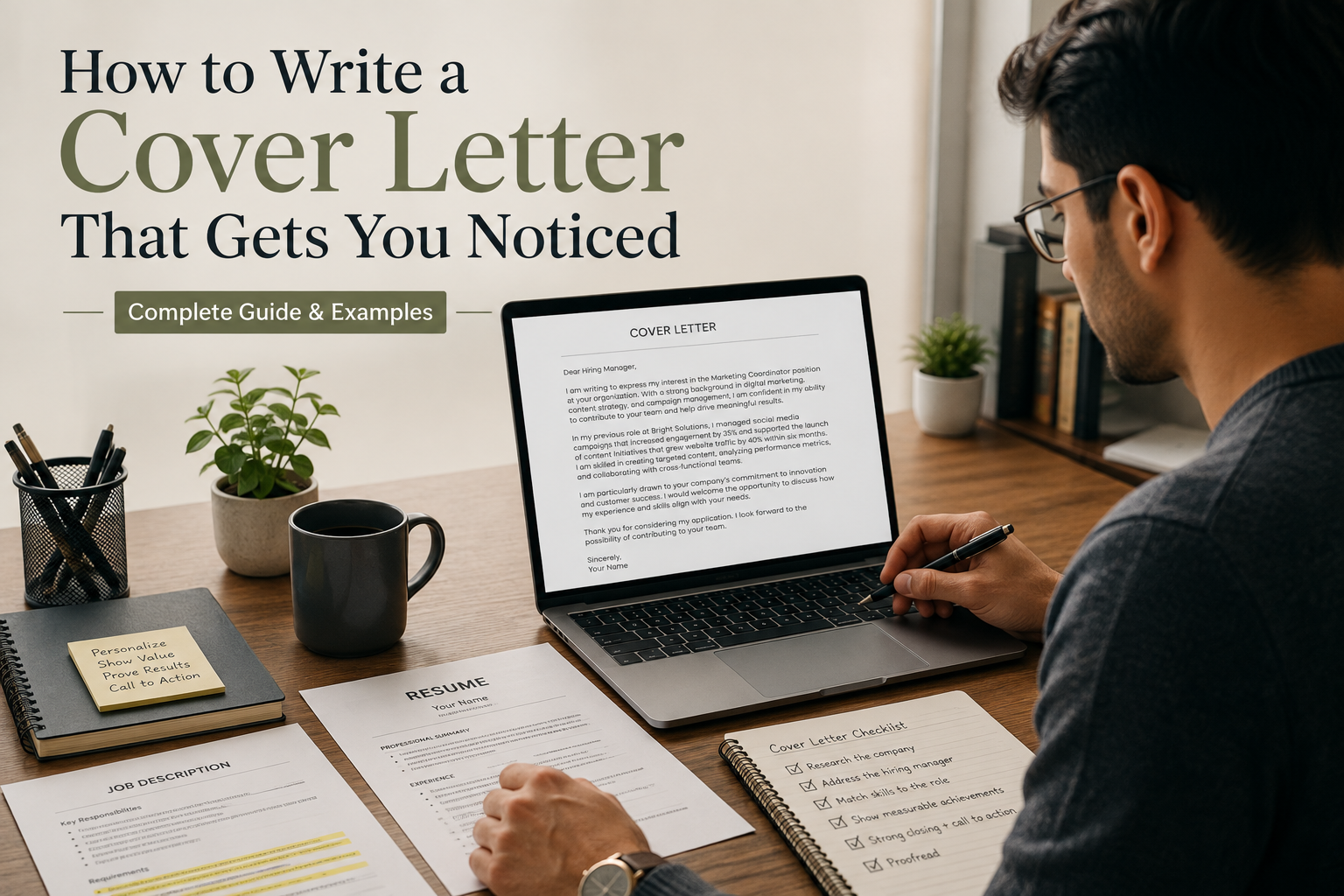
To learn how to write a cover letter, start by studying the job description carefully. Identify the skills, qualifications, and company values that match your background. Then, address the hiring manager by name whenever possible. A personalized greeting creates a stronger first impression than a generic opening.
Begin with a clear introduction that names the position you want. Briefly explain why your experience makes you suitable for the role. Avoid repeating your entire CV. Instead, select the most relevant achievements and connect them directly to the employer’s needs.
Use the body paragraphs to show evidence of your abilities. Mention specific projects, responsibilities, or results that demonstrate your value. End with a confident closing that shows interest in an interview. Thank the hiring manager for considering your application.
Keep the tone professional and natural. Aim for one clear page with short paragraphs and easy-to-read formatting. Every sentence should help explain why you are a strong candidate.
Focus on Measurable Achievements
Specific achievements make a cover letter more convincing than a list of general responsibilities. Employers want evidence that you can create useful results. Whenever possible, support your claims with numbers, percentages, time savings, or other measurable outcomes that demonstrate the skills employers look for in graduates.
For example, avoid saying that you “improved customer service.” Instead, explain how you reduced response times by 20% or increased customer satisfaction through a new process. These details give employers a clearer picture of your capabilities.
Use achievements that directly relate to the position. A sales role may benefit from revenue or conversion figures. A technical role could highlight performance improvements, successful projects, or reduced errors. An administrative position might emphasize efficiency or time savings.
You can also organize important achievements into brief bullet points when appropriate. However, do not turn the entire cover letter into a list. Use bullets selectively to make important results easier to scan.
How Do I Start a Good Cover Letter?
A strong cover letter opening should create relevance immediately. Avoid predictable phrases such as “To whom it may concern” when you can identify the hiring manager. A personalized greeting feels more professional and shows that you made an effort to research the company.
The first paragraph should quickly explain the position you want and why you are interested. Mention a relevant achievement, skill, or experience that connects with the employer’s current needs. Avoid making the opening entirely about what you want from the company.
Research the organization before writing this section. Look at its products, services, mission, recent developments, or business priorities. Then connect one relevant part of your experience to the organization’s work.
Your opening does not need dramatic language. It needs to be specific and credible. A concise introduction can be more effective than a long explanation.
Most importantly, avoid generic statements that could appear in any application. The reader should understand why you want this role and why your background fits it within the first few sentences.
Crafting a Compelling Hook
Your opening hook should introduce a strong reason for the employer to continue reading. One effective approach is to lead with a relevant professional achievement. Another option is to connect your experience directly with the company’s mission or current needs.
For example, you could mention a project where you solved a problem similar to one faced by the prospective employer. This creates an immediate connection between your previous work and the position you want.
Keep the hook short. One or two focused sentences are usually enough. Avoid exaggerated claims, dramatic language, or statements that cannot be supported by your experience.
A strong hook might mention a measurable result, specialized skill, or relevant career milestone. It should provide evidence rather than simply describing yourself as hardworking, passionate, or motivated.
Remember that the purpose of the opening is not to tell your complete career story. It is to establish relevance and encourage the hiring manager to read further. Once the hook has created that connection, use the following paragraphs to provide supporting evidence.
What Is a Cover Letter for a CV?
A cover letter for a CV is a personalized document that accompanies your curriculum vitae during a job application. Your CV presents your education, experience, skills, and achievements in a structured format. The cover letter adds context and explains why those qualifications are relevant to the specific position.
Think of the cover letter as a focused professional introduction. It should not repeat every detail from your CV. Instead, it should select the most important information and connect it to the employer’s requirements.
A cover letter can also explain circumstances that may not be obvious from your CV. For example, you may want to explain a career change, employment gap, relocation, or move into a different industry.
The document also gives employers an opportunity to evaluate your communication skills. Clear structure, concise writing, and professional language can strengthen your application.
However, a cover letter is not always required for every application. If an employer specifically asks for one, tailor it carefully. When optional, consider whether the letter adds useful context that your CV cannot provide.
Providing Context for Your Career
A cover letter can provide useful context when your career history does not follow a straightforward path. Your CV may show an employment gap or industry change, but it usually cannot explain the reasons behind it.
Use the cover letter to provide a brief and professional explanation when necessary. Avoid making the explanation defensive or overly personal. Focus on what you learned and how the experience prepared you for the position you are seeking, especially when addressing an employment gap on your resume.
For example, someone moving from one industry to another can highlight transferable skills. Project management, communication, research, problem-solving, and leadership often apply across different fields.
You do not need to explain every career decision. Include context only when it helps the employer understand your qualifications or address a potential question.
Keep the focus on your readiness for the new opportunity. Explain how your previous experience developed useful skills and how those skills can support the employer’s goals.
This approach turns a potentially confusing career history into a clearer professional narrative without adding unnecessary detail.
What Is a Simple Example of a Cover Letter?
A simple cover letter example should provide a clear structure that you can customize for each application. Start with your contact information and the employer’s details. Follow this information with a professional greeting, preferably using the hiring manager’s name.
The opening paragraph should identify the position and briefly explain your strongest qualification. The middle paragraphs should focus on relevant achievements, skills, and experience. Choose examples that directly match the requirements in the job description.
The closing paragraph should reinforce your interest in the position. You can also invite the employer to discuss your qualifications further during an interview. Finish with a professional sign-off and your name.
Keep the layout simple and consistent. Use readable fonts, standard margins, and enough spacing between sections. Avoid excessive graphics, unusual fonts, or complicated formatting unless the industry specifically encourages creative applications.
A cover letter should normally fit on one page. Recruiters often review many applications, so clear organization makes your information easier to understand quickly.
Breaking Down Basic Formatting
Professional formatting helps your cover letter look organized and makes the content easier to scan. Start with your name and contact information. Include relevant details such as your phone number, email address, and location when appropriate.
Next, add the date and employer information. If you know the hiring manager’s name, use a personalized greeting. Then divide the letter into a clear introduction, body, and closing.
Choose a professional and readable font. Keep the text size comfortable and maintain consistent spacing throughout the document. Standard margins also help prevent the page from looking crowded.
Avoid using too many design elements. Colors, graphics, icons, and decorative fonts can distract from your qualifications. A simple layout usually works well for most professional applications.
Before submitting the letter, check the company name, job title, hiring manager’s name, and contact details carefully. A small formatting or personalization error can make the application appear careless, so review your letter for resume and application mistakes recruiters notice immediately.
Finally, save the document in the requested file format. If the employer does not specify a format, PDF is often a practical choice because it preserves your layout.
How to Write a Cover Letter for an Internship
Learning how to write a cover letter for an internship requires a different approach from writing one for an experienced professional. Students and recent graduates may have limited employment history. However, they can still demonstrate relevant skills through education, projects, volunteering, extracurricular activities, and leadership roles.
Start by explaining why you want the internship and why the specific organization interests you. Avoid generic statements about wanting to “gain experience.” Instead, identify something relevant about the company, industry, or role.
Next, connect your academic experience to the internship requirements. Mention relevant coursework, assignments, research, presentations, or technical projects. Focus on what you actually did and what skills you developed.
You should also demonstrate your willingness to learn and contribute. Employers understand that interns are still developing professionally. They want candidates who can take direction, communicate clearly, solve problems, and work effectively with others.
Keep the letter concise and confident. Do not apologize for having limited professional experience. Instead, show how your existing skills and experiences have prepared you to contribute to the internship.
Showcasing Academic Projects
Academic projects can provide valuable evidence when you do not have extensive professional experience. Instead of simply naming a project, explain the problem you addressed and the role you played.
Mention the tools, software, research methods, or technical skills you used. For example, a computer science student could discuss a website, application, database, or programming project. A marketing student might describe a research assignment or campaign analysis.
Focus on outcomes whenever possible. Explain what you built, improved, analyzed, presented, or learned. If the project involved teamwork, describe your specific contribution rather than claiming responsibility for the entire project.
You can also mention capstone projects, competitions, student organizations, volunteer activities, or leadership positions. These experiences can demonstrate communication, organization, collaboration, and problem-solving skills that employers value in graduates.
The goal is to connect academic experience with the employer’s expectations. Do not include every assignment you have completed. Choose two or three examples that demonstrate skills relevant to the internship.
This approach helps employers see practical potential rather than focusing only on your limited work history.
How to Write a Cover Letter: Examples and Templates
Studying cover letter examples can help you understand professional structure, tone, and organization. Examples are particularly useful when you are unsure how to introduce yourself, present achievements, or close the letter, especially before preparing for an interview.
Look for examples related to your industry or career stage. A cover letter for an entry-level technology position may look different from one for a teaching, finance, marketing, or healthcare role.
Pay attention to how strong examples connect candidate experience with employer requirements. Notice how they use specific achievements instead of relying on broad claims. Also examine how the writer keeps the letter focused rather than repeating the CV.
Do not copy an example word for word. Recruiters can recognize generic templates, especially when several applications use similar language. Use examples only as structural references.
Your final letter should reflect your own experience, achievements, and communication style. Replace generic statements with specific details about the employer and position.
A useful template can save time, but customization is what makes the application relevant. Review every sentence before submitting it.
Adapting Templates for Success
A template becomes useful when it provides structure without replacing personalization. Start with a reliable format, then customize the content for the specific position.
Replace generic placeholders with the correct company name, job title, hiring manager, and relevant skills. Next, review the job description and identify the qualifications that matter most.
Choose achievements that demonstrate those qualifications. Include measurable results when possible, but do not invent numbers simply to make the letter appear stronger. Accuracy matters more than impressive-sounding claims.
Remove sentences that could apply to almost any employer. For example, broad statements about being passionate or hardworking usually add little value without supporting evidence. Instead, focus on building a personal brand for career growth through specific experiences, achievements, and skills.
Read the final version aloud before submitting it. This can help you identify awkward wording, repeated ideas, and sentences that are too long. Also check spelling, grammar, names, and job titles.
Most importantly, treat each cover letter as a targeted application rather than a document you send unchanged to every employer. A focused, relevant letter has a better chance of showing why your background fits the specific opportunity.
FAQ SECTION
What is the ideal length for this document?
Your application document should never exceed one single page. Keeping it concise ensures that hiring managers can review your core qualifications quickly. Aim for three to four short paragraphs that deliver maximum impact without overwhelming the reader.
Should I send the same document to every employer?
You should always tailor your message for each specific job application. Generic documents are easy for recruiters to spot and often end up rejected. Customizing your text shows genuine interest and proves you understand the employer’s unique requirements.
Do I need to include my home address at the top?
Modern professional standards have evolved, meaning your full home address is no longer strictly necessary. Including your city, state, phone number, and professional email address is entirely sufficient for contact purposes. This approach also saves valuable space on your single-page layout.
What font style and size work best?
Clean, professional fonts like Arial, Calibri, or Helvetica in 10 to 12-point size are ideal. Avoid overly stylized or decorative fonts that reduce readability on digital screens or printed paper. Consistent formatting ensures your application looks polished and professional.
Conclusion
Mastering how to write a cover letter is a game-changer for your professional job search. By addressing each core question thoughtfully, you can craft compelling narratives that highlight your unique value. Remember to tailor every section, focus on measurable achievements, and keep your formatting clean and concise. Implementing these proven strategies will help you stand out from the competition and secure more interviews. Take what you have learned today and start applying these techniques to land your dream role.